

ISEE test prep works best when you know what to expect before you ever open a practice book.
Every section of the exam has its own timing, its own question style, and its own pace.
So a plan built around real practice questions beats random studying every time.
This blog breaks down the ISEE format section by section, then rounds up the free and low-cost practice tests actually worth your time, plus a five-week schedule to pull it all together.
Track your mistakes as you go so you know what needs another look.
Set aside weekly study time rather than cramming. Steady prep beats a single late-night review.
Breaking Down the ISEE Exam Format
ISEE stands for Independent School Entrance Exam and is managed by the Educational Records Bureau.
Before you can build a study plan, you need to know exactly what you’re up against:
| Feature | Details |
|---|---|
| Levels | Primary, Lower, Middle, Upper |
| Administered By | ERB (Educational Records Bureau) |
| Test Format | Computer-Based & Paper-Based (availability varies) |
| Sections | Verbal and Quantitative Reasoning, Reading Comprehension, Mathematics Achievement, Essay |
| MCQ’s | Varies by level |
| Essay | Yes (Unscored but sent to schools) |
| Score Scale | Stanines and Scaled Scores |
Knowing this exam structure helps you build a smarter, more focused study plan.
Complete ISEE Subject Breakdown
You don’t need to master every section equally, so knowing what each one actually tests helps you decide where to spend your study hours.
- Verbal Reasoning: Synonyms test exact word meaning, while sentence completion asks you to fill in missing words. Reading habits matter most here.
- Quantitative Reasoning: Word problems and comparisons cover numbers, operations, algebra, geometry, measurement, and data analysis, with probability concepts mixed in.
- Reading Comprehension: Passages come with questions on main ideas, details, inference, vocabulary, organization, logic, tone, and figurative language use.
- Mathematics Achievement: Applied math covers the same core strands as Quantitative Reasoning, including decimals, fractions, percents, and multi-step problem solving.
- Essay: An unscored writing sample follows a grade-level prompt. Schools read it directly, so structure and legible handwriting still matter.
Verify your child’s precise level, focus on the weakest part first, and expand from there.
Free ISEE Practice Test Sources Worth Your Time
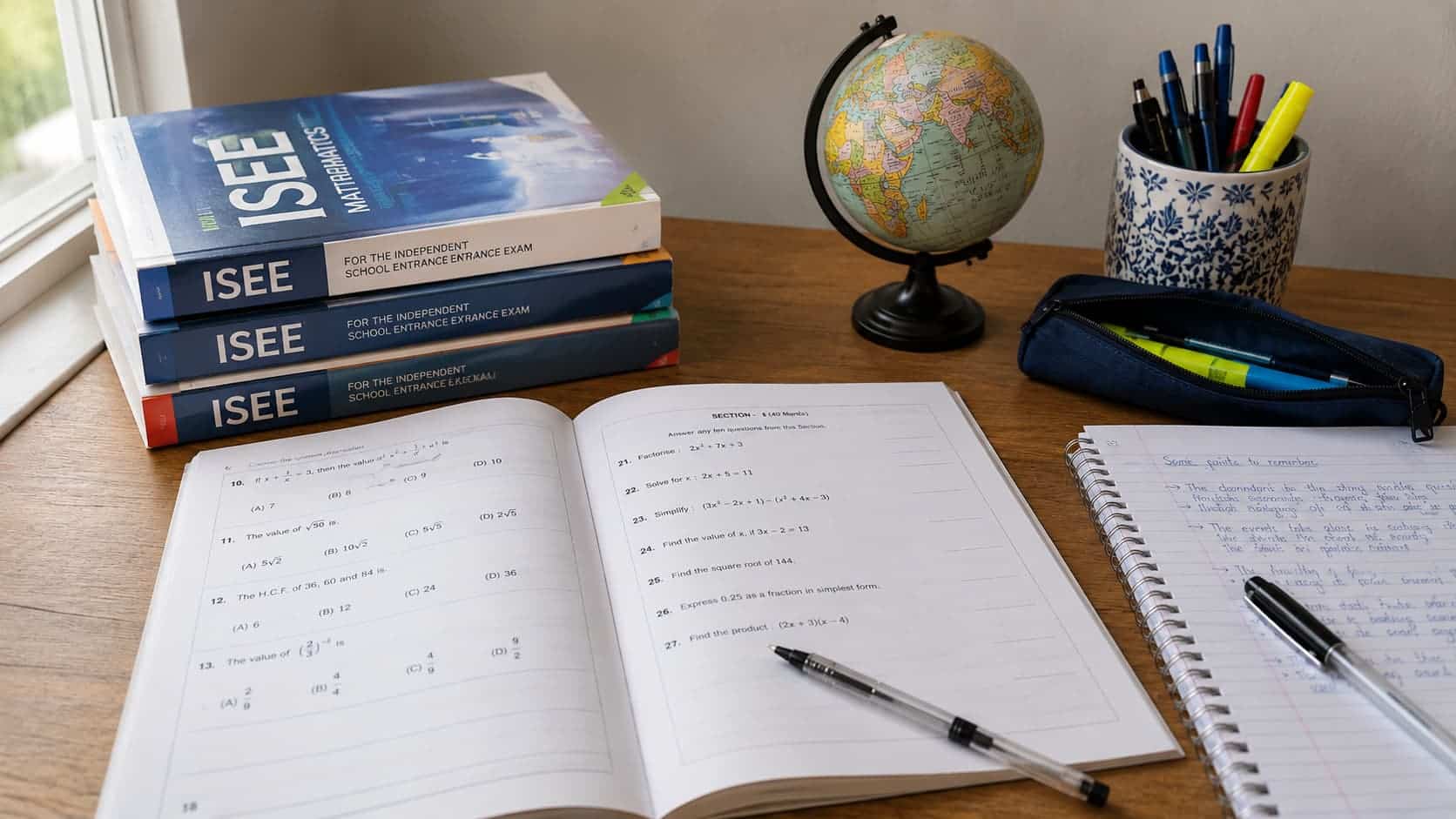
Here are useful places to find free ISEE practice material, ranked by how close they get you to the real exam.
1. ERB’s Official “What to Expect” Guide
Free to access, but registration is required. Each guide focuses on one level: Lower, Middle, or Upper.
It includes sample questions followed by a near-full-length practice test with an answer key.
It skips explanations, so pair it with a separate resource for reviewing wrong answers.
Download the What to Expect PDF for your child’s level, print it, and time the sections exactly as listed to simulate real conditions.
2. Scalar Learning’s ISEE Math Practice Tests Playlist
Completely free YouTube playlist, no sign-up. Each video walks through a real ISEE Middle Level math section in real time, narrating the reasoning behind every answer choice.
Watch one video per sitting while you attempt at the same questions.
Pause before the explanation to try solving it yourself first, then compare your approach to the walkthrough.
3. Piqosity’s Retired ISEE Questions
Free PDF downloads, no account needed.
These are retired official ERB guides across all three levels, each containing a near-full-length test plus roughly 30 additional sample questions with full answer explanations.
Download the PDF matching your level, complete it under timed conditions, then work through every explanation, right or wrong, to understand the reasoning behind each answer.
4. Ivy Global’s Sample ISEE Exams
Free, printable sample exams are available for the Lower, Middle, and Upper Levels, and they mimic the real test’s section order and timing closely enough for a useful paper-based dry run.
No login or personal information required.
Print the exam, find a quiet room, set a timer matching each section’s official length, and score it yourself afterward with the included answer key.
5. UnionTestPrep’s ISEE Practice Questions
Free online question sets organized by subject rather than as one long simulation.
Some premium study guides are sold separately, but the core practice questions stay free.
Use this after a full-length test to drill whichever section scored lowest.
Work through questions by topic, check answers immediately, and repeat weak areas until accuracy improves.
6. Test Innovators’ Free Practice Test
Free tier, no card required. You get one full-length practice test online plus an automatic score report showing scaled scores, percentiles, and section-by-section diagnostics.
Paid tiers unlock more tests and tutoring.
Create a free account, select your child’s grade level, and take the test under timed conditions.
Review the diagnostic report afterward to spot which section needs the most attention.
7. Larchmont Academics’ Free ISEE Strategy Videos
Completely free video library from a former independent school teacher, covering verbal reasoning, sentence completion, and reading comprehension strategies rather than math.
No sign-up or purchase required to watch.
Use this after your child’s practice test flags a weak verbal or reading section: watch the matching video, then immediately apply the strategy to a fresh set of practice questions.
8. Mometrix’s Free Online ISEE Practice Tests
Free, level-specific practice tests for Primary, Lower, Middle, and Upper Level, taken directly online with no sign-up.
Each test scores itself instantly and breaks down which question types gave you the most trouble.
This works well as a quick check between full-length practice tests, since you don’t need to schedule a longer session to use it.
Download Our Free PDFs to Increase Your Score
We have created our own printable ISEE practice books, with one designated for each level.
Each is built entirely from original questions, not copied from ERB or any other prep company.
Every book includes five full-length practice tests covering Verbal Reasoning, Quantitative Reasoning, Reading Comprehension, and Mathematics Achievement, plus an unscored Essay for Lower, Middle, and Upper Levels.
Each test provides answer explanations for all scored questions, clarifying why answers are right or wrong.
Grab the version that matches your child’s grade below:
- ISEE Practice PDF for Primary Level (Grades 2-4)
- ISEE Practice PDF for Lower Level (Grades 5-6)
- ISEE Practice PDF for Middle Level (Grades 7-8)
- ISEE Practice PDF for Upper Level (Grades 9-12)
Week-by-Week Study Schedule For Your Success
Five focused weeks, each built around a specific goal, can take a student from unsure to ready without burning out.
The trick is finding a study rhythm that actually sticks instead of switching methods every few days.
| Week | Focus | Practice Task | What To Prioritize |
| Week 1 | Diagnose baseline | Take one full-length practice test cold | Note timing struggles and guessing patterns, not just wrong answers |
| Week 2 | Verbal reasoning | Drill synonyms and sentence completion daily | Learn ten new words a day and focus on retaining vocabulary for the long term, not just for tomorrow’s quiz |
| Week 3 | Quantitative reasoning | Work word problems and number concepts | Focus on multi-step problems and quantitative comparisons specifically |
| Week 4 | Reading and math achievement | Timed passage sets and applied math drills | Practice inference questions and applied math under a strict clock |
| Week 5 | Full simulation | Retake full-length test under timed conditions | Compare scaled scores against Week 1 to confirm real improvement |
Tips to Make Test Day Easier
Even the best-prepared students can lose points to nerves or poor pacing on the actual day.
- Skip late-night cramming. A rested brain outperforms a tired one, regardless of extra practice questions.
- Don’t let tough questions eat time; move on and return if you have minutes.
- Wrong answers cost you nothing on the ISEE. Always guess rather than skip a question entirely.
- Pack your admission ticket, ID, and approved pencils. Leave calculators, scrap paper, and phones at home.
- If a section ends early, revisit any unsure questions; a second look can catch careless mistakes.
Test day goes smoother when these habits feel automatic rather than rushed, and working through pre-test nerves ahead of time makes the pacing part much easier to stick to.
Walk in with a plan for pacing and guessing already set, and the rest of the test becomes far less intimidating.
Frequently Asked Questions (FAQ’s)
1. How Much Does the ISEE Cost?
ISEE registration fees typically range from $165 to $255, depending on your testing format, phone registration option, and specific testing location.
2. When Should You Start ISEE Test Prep?
Most families begin serious ISEE test prep three to four months before test day, giving enough time to build skills without burnout.
3. Are Calculators Allowed on the ISEE?
No calculators are permitted on any ISEE section. You must solve every math problem using mental math, estimation, or handwritten calculations only.
4. How Long Are ISEE Scores Valid?
Schools typically compare ISEE scores against other applicants from the same testing level within the past three years, not indefinitely.
5. Is the ISEE Harder Than The SSAT?
Neither test is universally harder. The ISEE emphasizes quantitative comparisons and vocabulary, while difficulty ultimately depends on your child’s specific academic strengths.
Bottom Line
Practicing matters more than researching at this point in ISEE prep. The structure, the scoring, and the free resources are the easy part. What actually moves scores is working through real questions on a regular schedule.
Grab the printable practice test for your child’s level above and go section by section at a comfortable pace.
Steady weekly practice builds test-day readiness far more than a single late review session.
Drop a comment with the section you’re starting with first; we’d love to hear where you’re beginning.