

Some math problems make you stop and think twice. You read the question, and nothing clicks right away.
These hard math problems are not about big numbers or fancy symbols.
They test how well you spot small clues and connect them. Some hard math problems come from known competitions. Others show up in daily logic puzzles or classroom lessons. Each one asks you to slow down and look closer.
You don’t need a special gift to work through them. You just need patience and steady practice.
Hard math problems are simply puzzles waiting for the right approach.
What Makes a Math Problem Genuinely Hard?
A math problem is not hard just because it uses long formulas or advanced terms.
It becomes hard when what you see does not clearly show what you need to do next.
For a student, that gap can feel like a wall. They may know the rules, but the problem hides the path.
Real difficulty often comes from hidden structure, unclear starting points, and steps that depend on earlier insight.
A problem can feel strange when the right answer seems wrong until you fully prove it. That’s why some problems don’t need advanced math. Olympiad-style problems often rely on deep thinking, clean logic, and patient testing.
For practice, the goal isn’t to race toward an answer. The goal is to train your mind to notice patterns others miss.
How These Problems Make You Better at SAT, ACT, and Beyond
When you spend time with challenging problems, your brain learns to look beyond the obvious.
Here’s how these problems train for your exam:
Hard problems train you to recognize patterns quickly and obscure simple ideas with complex wording.
Some difficult problems benefit from starting with the answer, which can also help solve tricky test questions faster.
Strong problem solvers quickly dismiss incorrect structures, saving time during exams.
Olympiad-style algebra improves equation building and logic, directly benefiting systems-of-equations questions.
Combinatorics problems improve counting and analysis, often used in ACT probability questions.
Hard geometry builds spatial thinking and proof skills, aiding with advanced geometry questions on exams.
The biggest benefit is not memorizing more math. It teaches you how to think when the solution isn’t obvious.
Hard Math Problems Ranked from Most to Least Challenging

These problems originate from school entrance puzzles, internet challenges, national competitions, and olympiads.
1. The Missing Dollar
Domain: Logic, Arithmetic
Question: Three friends check into a hotel room that costs $30.
Each pays $10. Later, the manager realizes the room only costs $25 and sends the bellboy back with $5. The bellboy can’t split $5 three ways, so he pockets $2 and gives each friend $1 back.
Each friend paid $9, so together they paid $27. The bellboy kept $2. That’s $27 + $2 = $29.
Where did the missing dollar go?
Answer and Explanation:
No dollar is missing; the problem tricks you into adding numbers that should be subtracted. The friends paid $27 in total: $25 to the hotel and $2 to the bellboy. Adding the bellboy’s $2 to the $27 is double-counting it.
The correct accounting is $25 + $2 + $3 = $30.
The “missing dollar” is a misdirection built into the question’s framing of the arithmetic.
2. Cheryl’s Birthday
Domain: Logic
Question: Albert and Bernard just became friends with Cheryl, who gives them a list of ten possible birthdays: May 15, May 16, May 19, June 17, June 18, July 14, July 16, August 14, August 15, August 17.
Cheryl tells Albert the month and Bernard the day. Albert says: “I don’t know Cheryl’s birthday, but I know Bernard doesn’t either.” Bernard says: “I didn’t know at first, but now I do.” Albert says, “Now I know too.”
When is Cheryl’s birthday?
Answer and Explanation:
July 16. Albert’s first statement tells you the month can’t be May or June; those months contain days (18 and 19) that appear only once, which would let Bernard know immediately.
That leaves July and August. Bernard’s statement means that after eliminating May and June, he can now pinpoint the day, which rules out July 14 and August 14 (both appear in the remaining list, so they’d still leave ambiguity).
That leaves July 16, August 15, and August 17.
Since Albert now knows too, the month can’t be August (two options remain). The birthday is July 16.
3. The Hardest Easy Geometry Problem
Domain: Geometry
Question: In triangle ABC, angle A is 20°, angle B is 60°, and angle C is 100°.
Point D is on BC, and point E is on AB such that angle ABD = 20° and angle ACE = 10°. Find angle EDB.
Answer and Explanation:
The answer is 30°. What makes this notorious is that the standard approach to setting up angle equations leads to a dead end. The elegant solution requires drawing a carefully chosen auxiliary line that reveals a hidden isosceles triangle.
The problem reminds us that in geometry, what you add to a figure matters as much as what the figure already contains.
Every angle is recoverable from the constraints once you see the right construction.
4. The Infinite Chessboard
Domain: Combinatorics
Question: You have an infinite chessboard. You place a knight on any square.
The knight moves in standard L-shapes. Can a knight visit every square on an infinite chessboard exactly once?
Answer and Explanation:
No. Color the board in the standard alternating black-and-white pattern.
A knight always moves from a black square to a white square and back.
On an infinite board, there are an equal number of black and white squares, but the knight alternates colors with every move.
For a path visiting every square exactly once (a Hamiltonian path), the moves between squares of each color must be balanced. The coloring argument shows this balance cannot hold across an infinite board.
This invariant argument, which finds a property preserved by all moves, is a powerful tool in competition math.
5. The Two Trains
Domain: Algebra
Question: Two trains start from opposite ends of a 300-mile track at the same time.
Train A travels at 70 mph. Train B travels at 80 mph.
A fly starts at the front of Train A, flies to Train B, bounces back to Train A, and keeps going back and forth until the trains collide. The fly travels at 150 mph. How far does the fly travel in total?
Answer and Explanation:
300 miles. Most people try to sum an infinite series of back-and-forth trips; that’s the hard way.
The trick is to ignore the fly’s path entirely and focus on time.
The trains cover a combined distance of 300 miles at a combined speed of 150 mph, so they meet in exactly two hours.
The fly travels at 150 mph for two hours. Distance = 150 × 2 = 300 miles.
This problem is famous because John von Neumann, one of the greatest mathematicians of the twentieth century, solved it instantly and, when told there was a shortcut, said, “Of course, but I summed the series.”
6. The Pigeon and the Holes
Domain: Combinatorics / Number Theory
Question: You have thirteen people in a room. Prove that at least two of them share a birth month.
Answer and Explanation:
There are twelve months and thirteen people. By the Pigeonhole Principle, if you distribute thirteen people across twelve months, at least one month must contain at least two people.
It’s mathematically impossible for every month to have at most one person. The Pigeonhole Principle looks obvious when stated simply like this, but it underlies some of the hardest proofs in number theory and combinatorics.
In competition problems, “pigeons” and “holes” are often abstract objects, not real people or months.
7. The Burning Ropes
Domain: Logic
Question: You have two ropes. Each rope takes exactly sixty minutes to burn from one end to the other, but neither burns at a uniform rate. Using only these two ropes and a lighter, measure exactly forty-five minutes.
Answer and Explanation:
Light Rope 1 at both ends simultaneously and light Rope 2 at one end at the same time. Rope 1, burning from both ends, finishes in thirty minutes. The moment Rope 1 goes out, light the other end of Rope 2.
Rope 2 had thirty minutes of burning time left, lit from both ends; it now takes fifteen more minutes.
Thirty plus fifteen equals forty-five minutes.
The key insight is that burning from both ends doesn’t halve the distance covered; it halves the time remaining.
8. The Broken Calculator
Domain: Arithmetic / Problem Solving
Question: Your calculator has a broken multiplication key. You can only use addition, subtraction, and squaring.
How do you calculate 13 × 17?
Answer and Explanation:
Use the identity: a × b = ((a + b)² − a² − b²) / 2. Plug in 13 and 17: (13 + 17)² = 900, 13² = 169, 17² = 289.
So (900 − 169 − 289) / 2 = 442 / 2 = 221.
This problem rewards knowledge of algebraic identities over raw calculation. The same identity appears in disguise on standardized tests whenever a question asks you to find a product using only sum and square information.
9. The Census Taker
Domain: Logic / Number Theory
Question: A census taker asks a woman how many children she has and what their ages are. She says she has three children. The product of their ages is 36, and the sum of their ages equals the house number across the street.
The census taker looks at the house number, thinks for a moment, and says he still can’t determine the ages.
The woman adds: “My eldest child loves chocolate.” The census taker immediately figures it out. What are the ages?
Answer and Explanation:
The ages are 1, 6, and 6. First, list every way three positive integers multiply to 36, then compute each sum: (1,1,36) = 38, (1,2,18) = 21, (1,3,12) = 16, (1,4,9) = 14, (1,6,6) = 13, (2,2,9) = 13, (2,3,6) = 11, (3,3,4) = 10.
The census taker can see the house number but still can’t decide, which means two combinations share the same sum.
Only 13 appears twice: (1,6,6) and (2,2,9). The mention of an “eldest” child rules out (2,2,9) since twins have no eldest.
The ages are 1, 6, and 6.
10. The Moving Sofa Problem
Domain: Geometry / Calculus
Question: What is the largest shape that can be moved around a right-angle corner in a hallway of width one unit without getting stuck?
Answer and Explanation:
The maximum area is approximately 2.2195 square units, achieved by the “Gerver sofa,” a curved telephone-receiver-like shape proven optimal in 2024 by mathematician Jineon Baek.
The problem sounds like a furniture-moving annoyance, but the mathematics involves optimizing over all possible curved shapes under a continuous geometric constraint.
It sat unsolved for nearly sixty years after being formally posed in 1966, and its solution required tools from the calculus of variations and ideas from convex geometry. It’s a reminder that the hardest math problems don’t always look hard.
11. The Three Switches
Domain: Logic / Problem Solving
Question: You are outside a room containing three light switches. Inside the room are three light bulbs, each controlled by exactly one switch. You may manipulate the switches as much as you want, but you can enter the room only once.
How can you determine which switch controls which bulb?
Answer and Explanation:
Turn the first switch on for several minutes, then turn it off. Turn the second switch on and immediately enter the room.
The bulb that is on belongs to the second switch. The bulb that is off but warm belongs to the first switch.
The remaining cold, unlit bulb belongs to the third switch.
The key is realizing that you can use heat as additional information, not just whether a bulb is on or off.
The problem looks like a simple switching puzzle, but it rewards thinking beyond the obvious two states.
12. The 100 Prisoners Problem
Domain: Probability / Strategy
Question: One hundred prisoners are numbered 1 through 100.
In another room are 100 drawers, each containing one prisoner’s number in a random arrangement. Each prisoner may open up to 50 drawers and must find their own number. They cannot communicate after the process begins.
What strategy gives the prisoners a surprisingly high chance that everyone survives?
Answer and Explanation:
The optimal strategy is to follow cycles in the permutation. For example, Prisoner 37 first opens drawer 37.
If it contains 82, they next open drawer 82, continuing until they either find 37 or have opened 50 drawers.
This strategy succeeds for the entire group whenever the random permutation contains no cycle longer than 50.
The probability of group success is about 31%, enormously better than the tiny probability produced by having every prisoner choose 50 drawers randomly.
The lesson is that understanding the structure of randomness can be much more powerful than treating every choice as independent.
13. The Infinite Hotel
Domain: Logic / Set Theory
Question: A hotel has infinitely many rooms, numbered 1, 2, 3, and so on, and every room is occupied.
A new guest arrives. Can the hotel accommodate the guest without asking anyone to leave?
Answer and Explanation:
Yes. Move the guest currently in Room 1 to Room 2, the guest in Room 2 to Room 3, and so on.
The new guest takes Room 1.
Every existing guest still has a room, even though the hotel was supposedly full. The same idea can accommodate infinitely many new guests by moving the guest in Room n to Room 2n, leaving all odd-numbered rooms available.
This illustrates the strange behavior of infinite sets: a fully occupied infinite collection can still have room for more elements.
14. The Sum of Consecutive Integers
Domain: Number Theory
Question: Which positive integers cannot be written as the sum of two or more consecutive positive integers?
Answer and Explanation:
The answer is exactly the powers of 2.
Every positive integer that is not a power of 2 can be expressed as a sum of two or more consecutive positive integers.
For example, 15 = 7 + 8, while 16 cannot be represented this way. The underlying reason comes from the factorization of the number: an odd factor greater than 1 allows the number to be arranged into a suitable sequence of consecutive integers.
This problem connects a simple-looking addition puzzle with the deeper structure of odd and even factors.
15. The 12-Coin Problem
Domain: Logic / Combinatorics
Question: You have 12 visually identical coins.
Exactly one is counterfeit, and it may be either heavier or lighter than the others. Using a balance scale only three times, can you identify the counterfeit coin and determine whether it is heavier or lighter?
Answer and Explanation:
Yes. The strategy begins by dividing the coins into carefully chosen groups and comparing four coins against four coins.
Depending on whether the scale balances, tips left, or tips right, you can systematically reduce the possibilities.
Each weighing has three possible outcomes, so three weighings provide up to 33=273^3 = 27 outcome patterns.
There are 24 possibilities to distinguish: each of the 12 coins could be either heavier or lighter.
The difficulty is not the amount of arithmetic. It is designing each weighing so that every possible outcome leaves enough information for the next step.
16. The Monty Hall Problem
Domain: Probability / Logic
Question: You are shown three doors. Behind one is a car, and behind the other two are goats. You choose a door.
The host, who knows what is behind the doors, opens one of the other doors to reveal a goat. You may stay with your original choice or switch to the remaining unopened door. Should you switch?
Answer and Explanation:
Yes. You should switch. Staying gives you a 1/3 chance of winning, while switching gives you a 2/3 chance.
Your original choice has only a one-in-three chance of being correct.
The other two doors collectively have a two-in-three chance. When the host deliberately removes one losing door, that entire two-thirds probability effectively transfers to the one remaining unopened door.
The problem is difficult because the situation looks like a 50–50 choice after one door is opened, but the host’s knowledge changes the probabilities.
17. The 100 Prisoners and Boxes Variant
Domain: Probability / Combinatorics
Question: Suppose the 100 prisoners from the earlier problem are allowed to agree on a strategy beforehand.
Each prisoner may inspect only 50 of the 100 numbered boxes. Is there a strategy that gives the group a reasonable chance of success, rather than an almost impossible one?
Answer and Explanation:
Yes. The prisoners should use the cycle-following strategy again.
Each prisoner begins with the box carrying their own number and follows the chain of numbers found inside the boxes.
The group succeeds if the hidden permutation has no cycle longer than 50. This produces a group survival probability of roughly 31%, compared with an astronomically small probability if everyone simply chose 50 boxes independently.
The surprising part is that cooperation before the experiment can transform a seemingly hopeless probability problem into one with a substantial chance of success.
18. The Birthday Paradox
Domain: Probability
Question: How many people must be in a room before there is a greater than 50% chance that at least two share the same birthday? Ignore leap years and assume birthdays are equally likely.
Answer and Explanation:
Only 23 people are needed. The probability that all 23 people have different birthdays is approximately 49.3%, so the probability of at least one shared birthday is approximately 50.7%.
The easiest way to calculate it is to find the probability of no matches and subtract that result from 1.
The puzzle feels counterintuitive because people often compare the number of people with 365 possible birthdays.
The real issue is the number of pairs, which grows rapidly as the group gets larger.
19. The Four-Color Theorem
Domain: Combinatorics / Graph Theory
Question: What is the smallest number of colors needed to color any flat map so that neighboring regions never share the same color?
Answer and Explanation:
Four colors are always sufficient, and some maps require all four. This is the Four-Color Theorem.
The statement is easy to understand, but proving it was extraordinarily difficult. The first accepted proof, completed in 1976, relied heavily on computer-assisted checking of many possible configurations.
The theorem shows how a simple question about coloring maps can lead into graph theory, where regions become vertices and shared boundaries become edges.
20. The 1000 Bottles Problem
Domain: Logic / Binary Representation
Question: You have 1,000 bottles of wine, exactly one of which is poisoned. You have 10 test strips, and a positive result appears the next day. Each strip can test samples from many bottles.
How can you identify the poisoned bottle using only one round of testing?
Answer and Explanation:
Number the bottles from 0 to 999 and write each number in 10-bit binary. Assign each test strip to one binary position.
Put a sample from a bottle onto every strip corresponding to a binary 1 in its number.
The next day, the pattern of positive and negative strips gives the binary number of the poisoned bottle. Ten binary digits can represent 210=1,0242^{10} = 1,024 possibilities, which is enough to identify one bottle among 1,000.
The trick is converting the testing problem into an information problem using binary encoding.
21. The Bridge and Torch Problem
Domain: Optimization / Logic
Question: Four people need to cross a bridge at night. They have one flashlight, and at most two people can cross at once.
Their crossing times are 1, 2, 7, and 10 minutes. What is the minimum total time needed for everyone to cross?
Answer and Explanation:
The minimum is 17 minutes. Send the 1- and 2-minute people across first, taking 2 minutes.
The 1-minute person returns with the flashlight, taking 1 minute.
The 7- and 10-minute people then cross together, taking 10 minutes. Finally, the 2-minute person returns with the flashlight (2 minutes), and the 1- and 2-minute people cross again (2 minutes).
Total: 2+1+10+2+2=172 + 1 + 10 + 2 + 2 = 17 minutes.
The challenge is recognizing that the fastest people must sometimes make extra trips so the slowest people can cross efficiently.
22. The Infinite Monkey Problem
Domain: Probability / Infinite Processes
Question: Imagine a monkey randomly pressing keys on a typewriter forever. What is the probability that it will eventually type a particular finite sentence, such as a famous Shakespearean line?
Answer and Explanation:
Assuming every key is chosen independently and each character has a positive probability of being selected, the probability is 1, meaning it will almost surely eventually appear.
The probability of producing the sentence in any particular position may be extremely tiny, but there are infinitely many opportunities to produce it. The probability of missing the sentence forever approaches zero.
This does not mean the monkey is likely to type Shakespeare quickly.
It means that an event with probability 1 can occur almost surely over an infinite sequence of trials.
23. The Poisoned Chocolate Bar
Domain: Combinatorics / Strategy
Question: You have a chocolate bar divided into a rectangular grid of equal squares.
Two players take turns breaking off a rectangular piece along the existing grid lines. The player who takes the final single square wins. Can the first player always force a win?
Answer and Explanation:
Yes, when the game is interpreted as repeatedly splitting the remaining rectangular pieces along grid lines, the strategy can be understood through invariants and parity.
Each legal break increases the total number of pieces by exactly one. Starting from one piece and ending with every individual square separated requires exactly one fewer break than the total number of squares.
This fixed count determines the parity of the number of moves and therefore which player makes the final move.
The key idea is that you don’t need to analyze every possible sequence. A quantity that changes predictably can settle the entire game.
24. The 100 Doors Problem
Domain: Number Theory / Logic
Question: There are 100 closed doors. On the first pass, you toggle every door. On the second pass, every second door.
On the third pass, every third door, and so on until the 100th pass. Which doors remain open?
Answer and Explanation:
Only the doors numbered 1, 4, 9, 16, …, 100 remain open—the perfect squares.
A door is toggled once for every divisor of its number.
Most numbers have divisors in pairs, giving an even number of toggles and leaving the door closed. Perfect squares have one unpaired divisor, their square root, so they are toggled an odd number of times.
The puzzle turns a repetitive process into a clean number-theory observation.
25. The Self-Referential Number
Domain: Algebra / Number Theory
Question: Find a two-digit number whose digits add to 9, and whose value is four times the difference between the number and the number formed by reversing its digits.
Answer and Explanation:
Let the number be 10a+b10a+b. The digit condition gives a+b=9a+b=9.
The reversed number is 10b+a10b+a, so their difference is 9(a−b)9(a-b).
The second condition becomes
10a+b=4[9(a−b)].10a+b=4[9(a-b)].
Solving it together with a+b=9 gives a=8 and b=1, so the number is 81. The value of this problem comes from translating a verbal digit puzzle into equations rather than trying numbers randomly.
26. The Chessboard Domino Problem
Domain: Combinatorics / Invariants
Question: An ordinary 8×8 chessboard has two opposite corner squares removed. Can the remaining 62 squares be completely covered by 31 dominoes, with each domino covering exactly two adjacent squares?
Answer and Explanation:
No. The two removed opposite corners have the same color.
Therefore, the remaining board contains 30 squares of one color and 32 of the other.
Every domino placed on the board must cover exactly one black square and one white square. So 31 dominoes would require equal numbers of black and white squares.
Because the remaining board has unequal numbers of the two colors, complete coverage is impossible.
This is a classic example of an invariant solving a problem without requiring a complicated search.
27. The Three-Number Puzzle
Domain: Algebra / Logic
Question: Find three positive integers whose sum is 13 and whose product is 36. The largest number is unique.
What are the numbers?
Answer and Explanation:
The numbers are 2, 3, and 8. Their sum is 2+3+8=132+3+8=13, and their product is 2×3×8=482\times3\times8=48, so that does not work.
Instead, checking the factor combinations of 36 gives 1,6,61,6,6, 2,3,62,3,6, and other possibilities. The combination 2,3,62,3,6 sums to 11, while 1,6,61,6,6 sums to 13 but does not have a unique largest number.
Therefore, no such three positive integers exist.
The point is that you can solve a problem by proving impossibility rather than forcing a numerical answer. Systematically checking factor combinations is more reliable than guessing.
28. The Collatz Problem
Domain: Number Theory
Question: Start with any positive integer n. If it is even, divide it by 2. If it is odd, multiply it by 3 and add 1.
Repeat the process. Does every positive integer eventually reach 1?
Answer and Explanation:
This is the famous Collatz conjecture, and nobody has proved whether the answer is yes for every positive integer.
For example, starting with 6 gives: 6→3→10→5→16→8→4→2→1.6 \rightarrow 3 \rightarrow 10 \rightarrow 5 \rightarrow 16 \rightarrow 8 \rightarrow 4 \rightarrow 2 \rightarrow 1.
The process is extremely easy to state but extraordinarily difficult to analyze globally. Massive computations have verified the conjecture for enormous ranges of starting values, but computational evidence is not a proof for all positive integers.
It is a perfect example of how a simple rule can produce a genuinely deep unsolved problem.
29. The Sum of the First Integers
Domain: Algebra / Pattern Recognition
Question: Without adding every number individually, find the sum 1+2+3+⋯+1001+2+3+\cdots+100.
Answer and Explanation:
The answer is 5,050. Pair the numbers from opposite ends:
1+100=101,2+99=101,3+98=101.1+100=101,\quad 2+99=101,\quad 3+98=101.
There are 50 such pairs, so the total is 50×101=5,05050\times101=5,050.
The general formula is, 1+2+⋯+n=n(n+1)2.1+2+\cdots+n=\frac{n(n+1)}{2}.
The calculation is easy once you recognize the pattern. The deeper lesson is to look for structure before performing a long sequence of operations.
30. The Four Numbers That Make 24
Domain: Arithmetic / Problem Solving
Question: Using the numbers 3, 3, 8, and 8 exactly once, and using only addition, subtraction, multiplication, division, and parentheses, make 24.
Answer and Explanation:
One solution is: 8÷(3−83)=24.8\div(3-\frac{8}{3})=24.
The expression uses both 8s and both 3s exactly once. Since
3−83=13,3-\frac83=\frac13,
dividing 8 by 13\frac13 gives 24.
The challenge is that straightforward combinations such as 8+8+3+38+8+3+3 do not work. The solution requires creating a small fractional value and then using division to produce the target number.
This type of puzzle rewards working backward from the desired result rather than trying random combinations
Popular Hard Problems From Recent Olympiads
These problems come from competitions; you do not need a math degree to understand what is being asked.
You just need patience, a pencil, and a willingness to sit with something uncomfortable for a while.
31. IMO 2024 Problem 1
Domain: Number Theory
Question: Determine all real numbers α such that, for every positive integer n, the integer ⌊α⌋ + ⌊2α⌋ + … + ⌊nα⌋ is a multiple of n.
Answer and Explanation:
The answer is all even integers. If α = 2m for some integer m, the sum equals m·n(n+1), which is always divisible by n. For non-integer or odd-integer values, a parity or fractional-part argument produces a contradiction.
The proof has two cases: α even and α odd, using induction to show only even integers survive.
32. IMO 2023 Problem 1
Domain: Number Theory
Question: Determine all composite integers n > 1 with the following property: if d₁, d₂, …, dₖ are all the positive divisors of n with 1 = d₁ < d₂ < … < dₖ = n, then dᵢ divides dᵢ₊₁ + dᵢ₊₂ for every 1 ≤ i ≤ k − 2.
Answer and Explanation:
The answer is n = p² and n = 2p for prime p. The key insight is examining the structure of divisors for numbers with exactly two or three prime factors. Numbers with more prime factors fail the divisibility condition at some consecutive triple.
Working through small cases first reveals the pattern quickly, and the general proof follows by showing any additional prime factor creates a pair where the condition breaks.
33. IMO 2021 Problem 1
Domain: Combinatorics
Question: Let n ≥ 100 be an integer. Ivan writes the numbers n, n+1, …, 2n, each on a different card.
He then shuffles these cards and divides them into two piles.
Prove that at least one of the piles contains two cards such that the sum of their numbers is a perfect square.
Answer and Explanation:
The proof identifies specific pairs within the range {n, n+1, …, 2n} whose sums are perfect squares, then uses the Pigeonhole Principle.
For large enough n, you can find three numbers a, b, c in the range where a+b, a+c, and b+c are all perfect squares.
Since these three numbers occupy only two piles, at least two of them share a pile, and any two of them produce a perfect square sum. Finding those three numbers is the creative step; the rest is clean logic.
34. IMO 2022 Problem 1
Domain: Combinatorics
Question: The Bank of Oslo issues two types of coins: aluminum coins worth 1 krone and bronze coins worth n kroner.
Determine all values of n such that for any assignment of coins to positions 1, 2, …, 3n, it is possible to find a contiguous sequence of coins whose values sum to 2n.
Answer and Explanation:
All positive integers n work. The proof uses a sliding-window argument that tracks prefix sums modulo 2n and shows that a consecutive segment must hit the target value.
The key is that among 3n+1 prefix sums, only 2n distinct residues exist modulo 2n, so by the pigeonhole principle, a repeat occurs within a window that forces the correct sum.
35. IMO 2023 Problem 2
Domain: Geometry
Question: Let ABC be an acute-angled triangle with AB < AC. Let Ω be the circumcircle of ABC.
Let S be the midpoint of the arc BC of Ω containing A. The perpendicular from A to BC meets Ω again at D.
The line through D parallel to BC meets Ω again at E. Prove that the line tangent to Ω at E meets line SD on the internal angle bisector of angle BAC.
Answer and Explanation:
This is a circle geometry problem where the solution lies in angle relationships between arcs and chords. Setting S as the midpoint of arc BC means it lies on the angle bisector of angle BAC; that connection is the anchor of the proof.
From there, proving the tangent at E and line SD meet on that bisector requires careful tracking of arc measures and using the inscribed angle theorem at multiple steps.
It is harder than it looks, but every tool you need is standard circle geometry, nothing beyond high school level.
36. IMO 2021 Problem 3
Domain: Geometry
Question: Let D be an interior point of acute triangle ABC such that angle ADB = angle ACB + 90° and AC · BD = AD · BC.
Prove that the tangents to the circumcircle of triangle BCD at B and D meet on line AC.
Answer and Explanation:
The two given conditions together force D into a very specific geometric position relative to the triangle.
The angle condition connects D to the circumcircle of BCD, and the ratio condition links lengths across the triangle in a way that resembles the sine rule.
The proof strategy is to show the intersection of the two tangents satisfies the collinearity condition by computing the power of a point and using the angle constraints.
This problem rewards methodical setup: label everything, write out what each condition means algebraically, and then connect the two threads.
37. IMO 2022 Problem 2
Domain: Algebra
Question: Let ℝ⁺ denote the set of positive real numbers.
Find all functions f: ℝ⁺ → ℝ⁺ such that for each x ∈ ℝ⁺, there is exactly one y ∈ ℝ⁺ satisfying xf(y) + yf(x) ≤ 2.
Answer and Explanation:
The only solution is f(x) = 1/x.
The uniqueness condition in the problem is the key: for a given x, exactly one y satisfies the inequality, which forces the inequality to actually be an equality at that point. From xf(y) + yf(x) = 2, substituting x = y gives 2xf(x) = 2, so f(x) = 1/x.
The harder direction is proving no other function works: assuming f(x) ≤ 1/x and f(x) ≥ 1/x, and using limit arguments, closes the proof.
What makes this problem memorable is how a uniqueness condition quietly encodes the entire behavior of the function.
What Mathematicians Call Truly Hard: Community Discussion
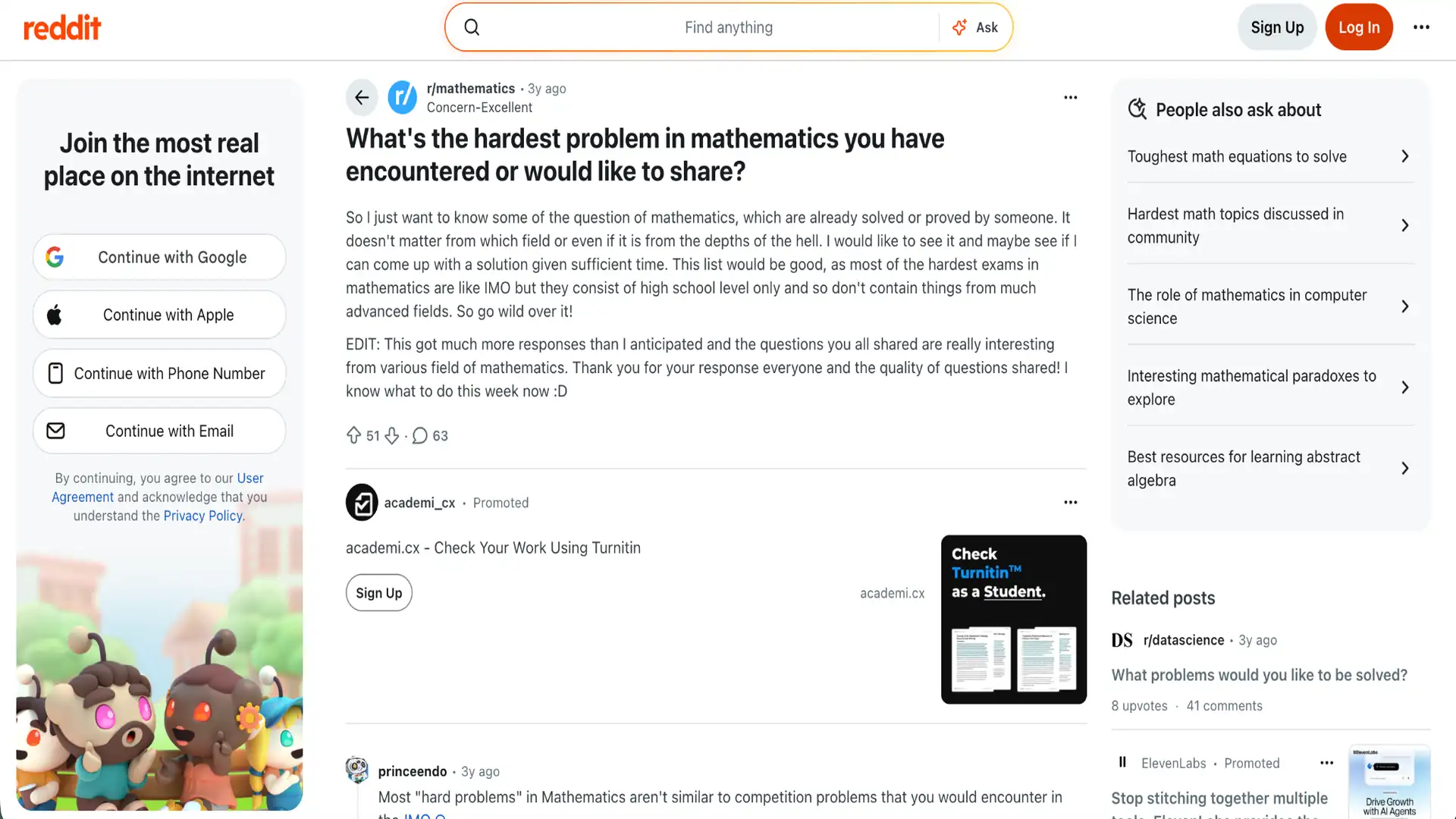
A Reddit thread asked mathematicians and students to share the problems that genuinely stopped them.
The answers had little to do with competition math. Princeendo opened with a simple point.
Real difficulty means understanding the deep structure of an object and recognizing patterns that take years to notice.
Asphias mentioned two problems from university coursework: proving Zorn’s Lemma implies the Well-Ordering Theorem, and working through a differential involving geometric Brownian motion in stochastic calculus.
AlchemistAnalyst brought up a topology problem. Using only closure and complement operations, there is a fixed limit on how many unique subspaces you can generate, regardless of the starting space.
Hard math looks different once you leave the classroom.
Tips for Tackling Math Problems Without Giving Up
Grinding through hard math problems gets easier once you stop approaching them randomly.
Read the problem until you can rephrase it without looking.
Use smaller numbers instead of large ones.
Replace broad statements with specific examples. Simpler versions often expose the needed structure.
Hard problems often hinge on overlooked assumptions. Write down everything: constraints, givens, and obvious points.
Give a stuck approach ten minutes, then walk away completely and try a different entry point.
Knowing whether you’re seeking an integer, a ratio, or a proof helps you choose the right tools before you start.
Habits like these aid in Olympiad problems and transfer to any timed test with unfamiliar challenges.
Frequently Asked Questions (FAQ’s)
How Much Time Does It Take to Solve an IMO-Level Problem on Average?
Top contestants spend one to three hours per problem under exam conditions. Outside competitions, one thorough problem daily builds real skill over months.
Is It Too Late to Start Practicing Hard Math Problems in High School?
Not at all. Many Olympiad competitors began serious practice in ninth or tenth grade and still qualified nationally within two focused years.
Do Hard Math Problems from Olympiads Ever Appear in Real-World Applications?
Yes. Combinatorics mirrors algorithm design, number theory underpins cryptography, and geometric reasoning shows up constantly in engineering and physics.
Your Turn to Try
Hard math problems exist to sharpen how you think and how you spot patterns.
Every problem here shows a different way to get stuck and a different way to break free.
Some rely on logic. Some rely on geometry. Some just need a fresh way of looking at the question.
Pick one problem from this list and give it a real shot today. Which one gave you the hardest time?
Drop your answer in the comments below.