
The CCAT packs several question types into one short timed test. That mix is exactly why a CCAT practice test helps so much.
It shows you the pace, the question styles, and the pressure you will face.
You get to make mistakes now instead of during your actual test. Verbal, math, logic, and spatial questions all show up together in it.
Working through a CCAT practice test builds speed and steadier accuracy.
You start noticing your weak spots instead of guessing where they are. Preparation helps more than last-minute guessing ever does.
CCAT Test Format at a Glance
The CCAT, or Criteria Cognitive Aptitude Test, is a pre-employment assessment to measure general cognitive ability across three areas.
Here is a quick overview of everything you need to know about the test format:
| Feature | Details |
|---|---|
| Full Name | Criteria Cognitive Aptitude Test |
| Developed By | Criteria Corp |
| Purpose | Measure general cognitive ability and aptitude |
| Question Categories | Verbal, Math & Logic, Spatial Reasoning |
| Total Questions | 50 |
| Time Limit | 15 minutes |
| Average Score | 24 out of 50 |
| Who Takes It | Job applicants in tech, sales, finance, operations, and more |
Now that you know what the CCAT is, here is a closer look at what the test actually covers and how each section is structured.
What Types of Questions Appear on the CCAT?
The CCAT does not focus on just one subject area. It mixes several reasoning skills into a single fast-paced test. Here are the main question types you can expect on test day:
- Numerical Reasoning: It tests how well you work with numbers, ratios, and basic math logic.
- Verbal Reasoning: It checks how well you understand words, sentences, and written arguments.
- Logical Reasoning: It measures how well you spot patterns in statements and draw fair conclusions.
- Spatial Reasoning: It looks at how you picture and imagine shapes and predict how they move or fit together.
- Pattern Recognition: It tests how quickly you notice sequences and figure out what comes next.
Knowing these categories ahead of time helps you prepare smarter. You can focus your practice on the areas that matter most.
CCAT Sample Questions

This is the section users are searching for most. Here are real-style sample questions across all three categories, with all answers and explanations consolidated in a table at the end.
Verbal Sample Questions
Q1. Analogy
A bird is to a flock as a fish is to:
a) Ocean
b) School
c) Pond
d) Scale
Q2. Antonym
Which word is most opposite in meaning to ABUNDANT?
a) Scarce
b) Wealthy
c) Generous
d) Quiet
Q3. Sentence Completion
Despite the _______ weather, the outdoor event went ahead as planned.
a) Pleasant
b) Favorable
c) Inclement
d) Mild
Math & Logic Sample Questions
Q4. Number Series
2, 6, 18, 54, ___
a) 108
b) 162
c) 72
d) 216
Q5. Word Problem
A store sells a jacket for $120 after applying a 20% discount. What was the original price?
a) $140
b) $144
c) $150
d) $160
Q6. Arithmetic/Ratio
A car travels 180 miles in 3 hours. How many miles will it travel in 5 hours at the same speed?
a) 270
b) 300
c) 320
d) 360
Spatial Reasoning Sample Questions
Q7. Pattern Recognition
Look at the following sequence: circle, square, triangle, circle, square, ___
a) Circle
b) Triangle
c) Square
d) Rectangle
Q8. Odd One Out
Four figures each show a shape with an internal dot. In three of them, the dot is inside the shape. In one, the dot sits outside the boundary. Which figure is the odd one out?
a) Figure A
b) Figure B
c) Figure C
d) Figure D
Answer Key
Check your answers against the table below. Each answer includes a brief explanation so you understand the reasoning behind it, not just the correct choice.
| Q | Answer | Explanation |
|---|---|---|
| Q1 | b) School | A group of birds is a flock. A group of fish is a school. The relationship is that of an animal to a collective noun. |
| Q2 | a) Scarce | Abundant means present in large quantities. Scarce means in short supply, making it the direct opposite. |
| Q3 | c) Inclement | The word “despite” signals a contrast. The weather must have been unfavorable for the event to go ahead and be noteworthy. |
| Q4 | b) 162 | Each number is multiplied by 3. So 54 x 3 = 162. |
| Q5 | c) $150 | $120 represents 80% of the original price. Divide $120 by 0.80 to get $150. |
| Q6 | b) 300 | The car travels 60 miles per hour. At that rate, 60 x 5 = 300 miles. |
| Q7 | b) Triangle | The sequence repeats in a fixed three-shape cycle. After the circle and square, the next shape is always a triangle. |
| Q8 | d) Figure D | Look for the figure where the dot falls outside the shape’s boundary. That breaks the rule shared by all other figures. |
If you got most of these right without much trouble, you are already in a solid position.
If a few tripped you up, the prep strategies and free practice resources later in this post will help you close those gaps before test day.
How Long Does the CCAT Take?
The CCAT has a 15-minute time limit, but the full process usually takes between 20 and 30 minutes.
After receiving a test link from your employer, you will go through a brief instructions page and a short demographics section before the timer starts.
Once it begins, the clock runs continuously with no option to pause. After you submit, results go directly to the employer, not to you.
Most hiring teams review scores within a few days. After that, you can expect to hear about next steps in the hiring process.
Raw scores tend to climb gradually as familiarity with the format grows, which is one reason building stronger scores over time works better than cramming the night before.
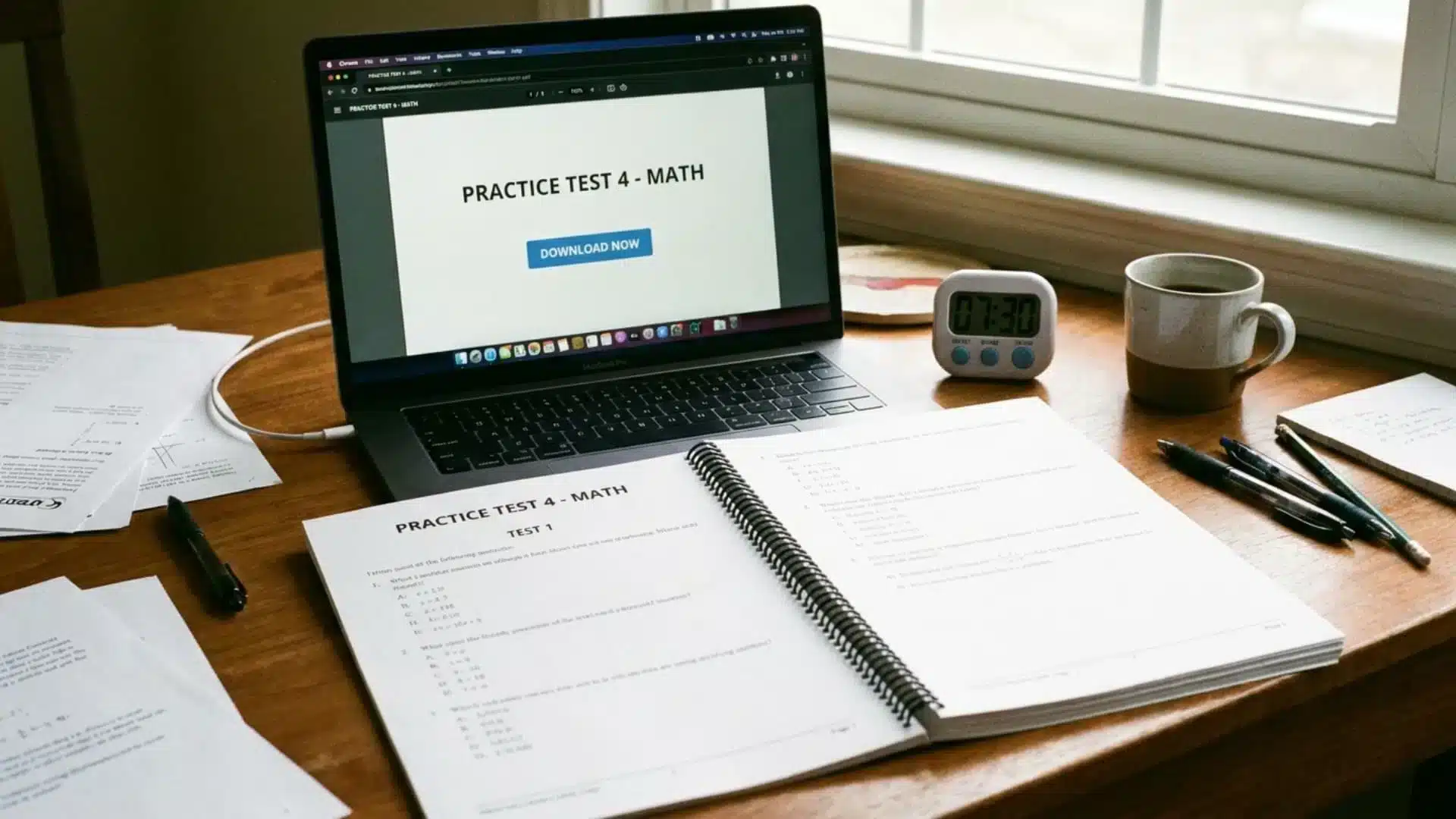
Free CCAT Practice Test PDF Download
The free CCAT practice test PDFs below each include 25 practice questions across verbal, math, logic, and spatial reasoning, a full answer key with explanations, a score-tracking sheet, and a test-day tip sheet.
| Focus Area | Download | |
|---|---|---|
| Practice Test 1 | Mixed: All Categories | Download PDF |
| Practice Test 2 | Verbal Heavy | Download PDF |
| Practice Test 3 | Math & Logic Heavy | Download PDF |
| Practice Test 4 | Spatial Reasoning Heavy | Download PDF |
| Practice Test 5 | Full Mixed Simulation | Download PDF |
Download all five, work through them in order, and use the score tracker in each PDF to measure your progress over time.
Where to Find More CCAT Practice Tests?

Beyond the free PDFs above, there are several reliable resources worth bookmarking as you prepare.
- Criteria Corp Official Site (Free): The official source for the CCAT, offering limited sample questions directly from the test maker.
- JobTestPrep (Paid): Offers full-length simulations with detailed score reports, making it a solid option if you want the most comprehensive paid prep available.
- Practice Aptitude Tests (Free): Provides timed CCAT-style tests with answer explanations, a good option for additional free practice beyond the PDFs above.
- Assessment Training (Free and Paid): Covers a mix of free and premium practice options, with flexibility depending on how much prep time and budget you have.
- iPrep (Free and Paid): Provides realistic CCAT-style questions with step-by-step video explanations, useful if you prefer a more guided prep approach.
- CCAT Practice Test (Free): Offers a downloadable 30-question PDF and an online demo through TestsCareers, covering all question categories with answers and explanations.
When evaluating any practice resource, look for tests that match the real format as closely as possible: 50 questions, a 15-minute time limit, and all three question categories included.
CCAT Prep Tips and Strategies
Knowing the format is a good start, but targeted preparation is what actually improves your score. Here are the most effective strategies to use in the weeks leading up to your test.
- Practice under timed conditions: The 15-minute limit is the hardest part of the CCAT. Always practice with a clock running to build real pacing instincts.
- Do not get stuck on hard questions: If a question is taking too long, skip it and move on. Return to it only if time allows.
- Always guess before time runs out: There is no penalty for wrong answers. Use the last 60 seconds to fill in every unanswered question with your best guess.
- Focus extra time on math and logic: Brushing up on fractions, ratios, and number sequences will have the greatest impact on your score.
- Use the process of elimination on verbal questions: Rule out the two most obviously wrong answers first. This significantly improves your odds when you are unsure about two choices.
If the ticking clock rattles you more than the questions do, working on calming pre-test nerves ahead of time can steady your pacing on every section.
Final Thoughts
A CCAT practice test works best when you treat it like the real thing. Timed practice builds habits that reading alone cannot teach you.
Track your wrong answers afterward and figure out why you missed each one.
Spend extra effort on math and logic since it carries real weight. Verbal and spatial questions improve the same way, through steady repetition.
Every CCAT practice test you complete sharpens your pacing and accuracy.
Stick with your prep and walk into test day ready. Drop a comment below and share how your practice is going.
Frequently Asked Questions
Can I Retake The CCAT?
It depends on the employer. Criteria Corp recommends a minimum gap of six months between attempts. The decision to allow a retake is ultimately up to the hiring company.
Does The CCAT Have a Passing Score?
There is no universal passing score. Each employer sets its own benchmark based on the role. A score that is competitive for one position may not meet the threshold for another.
Is There a Cheat Sheet for the CCAT?
Yes. CCAT cheat sheets summarize common question types, formulas, strategies, and time-saving tips, but practicing realistic questions is more effective for preparation.