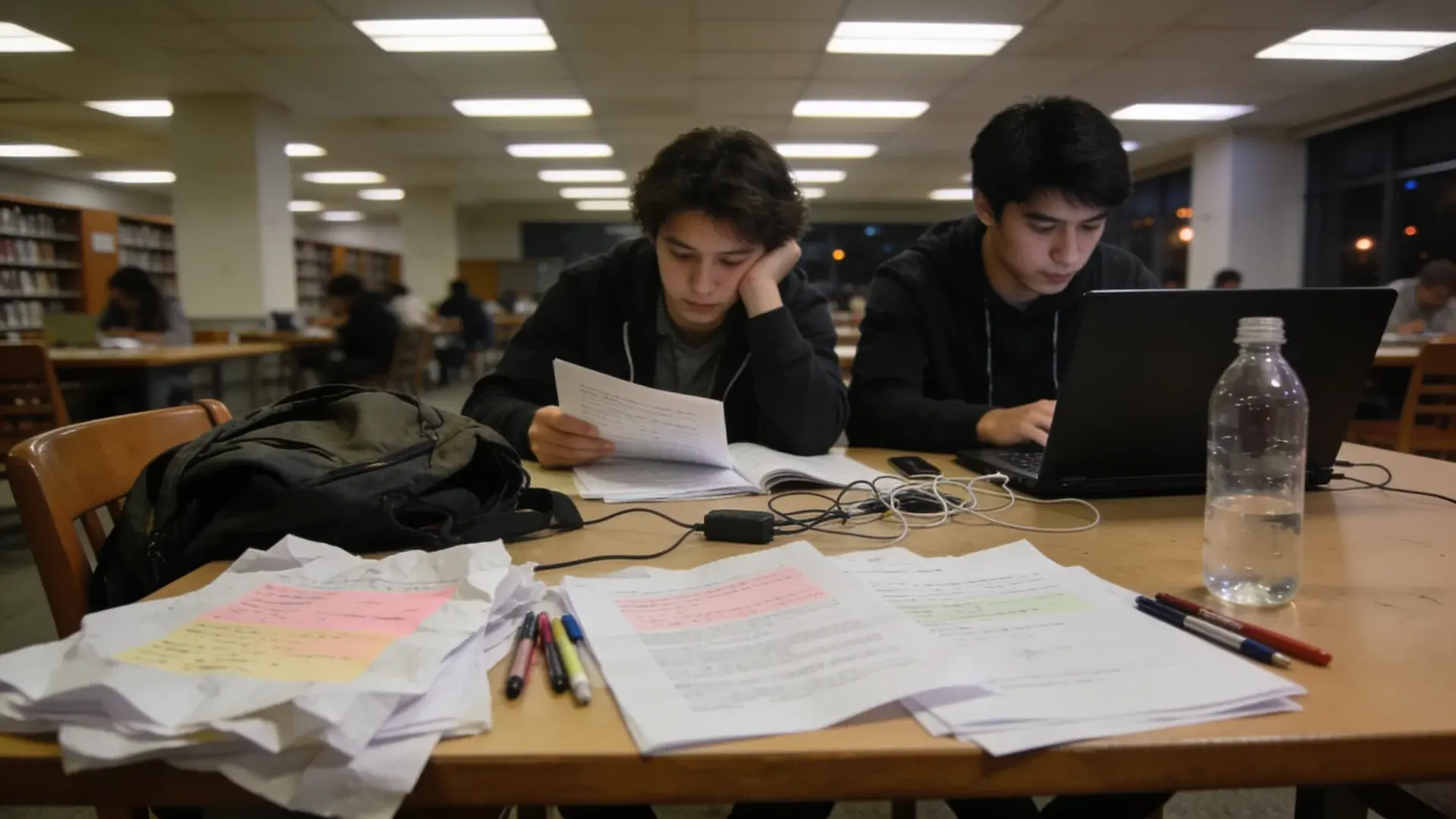


The night before a skills test, cramming feels like the responsible thing to do. You’ve got notes spread out, coffee, and hours ahead of you.
It feels productive, but the problem is that your brain does not work the way cramming assumes it does.
So why shouldn’t you cram for a skills test? Because skills tests do not ask you to recognize information. They ask you to use it, under pressure, in real time.
In this blog, I have covered why cramming fails skills tests specifically, what it does to your memory and performance on test day, and practical strategies you can start using right now.
Why Do Students Often Cram for Skills Tests?
Many students cram for skills tests because they underestimate how much time and practice are needed to perform well.
Some may delay studying because they feel confident they can learn everything quickly, while others may struggle with managing their time alongside school, work, or personal responsibilities.
Fear of failure can also push students into last-minute preparation as the test date approaches.
In some cases, students may not realize that skills tests require repeated practice and hands-on experience rather than simple memorization.
Cramming can feel like a quick solution, but it often creates pressure and leaves little time to build confidence, correct mistakes, and improve performance before the actual assessment.
Why Shouldn’t You Cram for a Skills Test?

Cramming isn’t just ineffective for skills tests. It actively works against the type of performance these assessments demand. Here’s what’s happening inside your brain when you study at the last minute:
1. Creates Temporary Memory Instead of Lasting Skills
Information absorbed through cramming gets stored in short-term memory, not the long-term systems that skills tests actually draw from.
It does not build lasting neural connections or develop real comprehension.
You might recall enough to get through the test, but that knowledge fades within days, sometimes hours, leaving no foundation to build on.
2. It Overloads Working Memory
Your working memory can only hold a limited amount of information at one time. When you push large volumes of material through it in a single session, it hits capacity.
The result on test day is that your brain struggles to retrieve what you studied, even when you covered it the night before.
For multi-step skills tasks, that retrieval gap shows up fast.
3. You Feel Ready But Blank Out Anyway
Repeated review makes material feel familiar, and that familiarity gets mistaken for mastery. This is called the fluency illusion.
You recognize the information easily during your study session, so you feel prepared. But recognition and recall are not the same thing.
Under test conditions, that sense of knowing often disappears the moment you need to apply it.
4. Cramming Can Increase Test Anxiety
Last-minute studying triggers a stress response in the body, releasing cortisol, a hormone that directly impairs concentration, decision-making, and memory recall.
On a skills test, where you’re already being observed or timed, that anxiety compounds.
The pressure of performance and the physical effects of stress combine to undercut exactly the skills you’ve been trying to prepare.
Working through specific test anxiety strategies in the weeks before the exam, rather than the night before, gives your body time to lower that stress response instead of fighting it on test day.
5. Recognition Gets You Nowhere on a Skills Test
Cramming covers recognition. Skills tests require application. Memorizing a process the night before doesn’t mean you can execute it under real conditions.
Procedural fluency, the ability to perform a skill accurately and automatically, only develops through repeated, spaced practice.
One late-night session doesn’t come close to replicating that.
Signs You Have Been Relying on Cramming Too Much
Cramming often feels productive at first, but it can leave gaps in understanding and confidence. Recognizing these warning signs can help you adjust your study habits before test day.
-
You blank out on test day despite studying hard: You covered the material, and then the moment the test started, it was gone. Familiarity built through cramming doesn’t hold up under retrieval pressure.
-
You forget material within 48 hours: If what you studied on Monday feels completely unfamiliar by Wednesday, it never made it into long-term memory.
-
You feel more anxious the more you study: Last-minute sessions don’t build confidence; they highlight how much ground you still feel you need to cover.
-
You have to relearn the same material every time: If nothing is sticking between study sessions, then cramming gives you familiarity without retention.
-
You can explain a concept but can’t execute it: Knowing how something works and being able to perform it are two different things.
Better Alternatives to Cramming for Skills Tests

Replacing cramming with consistent preparation helps build stronger skills, improve memory, and increase confidence. These strategies make learning more effective and easier to manage.
1. Use Spaced Repetition
Spaced repetition means reviewing material at increasing intervals rather than covering everything in a single long session.
The idea is simple: study a concept, revisit it a day later, then again a few days later, then a week later.
Short, regular sessions outperform last-minute marathons because they build long-term memory rather than short-term familiarity.
2. Practice Active Recall
Passive review, rereading notes, highlighting, and skimming flashcards create the illusion of learning without actually building retrieval strength.
Research found that students who practiced active recall retained 80% of the material after a week, compared to just 34% for those who reread.
For skills tests, where you’ll need to retrieve and apply knowledge without prompts, this method directly trains the mental process the test demands.
That gap comes down to how memory actually forms: pulling information out of your brain strengthens the pathway to it more than putting information back in front of your eyes.
3. Break the Skill into Smaller Chunks
Trying to master an entire skill set in one sitting leads to cognitive overload, which is where retention breaks down.
A more effective approach is to break the full skill into smaller, distinct components and focus on one at a time. Nail one piece before moving to the next.
This is especially useful for hands-on or multi-step skills where each stage depends on the one before it.
4. Simulate Test Conditions
Studying in a comfortable, low-pressure environment is useful early in your prep, but it doesn’t fully prepare you for what test day actually feels like.
At least a few sessions before the exam, practice under the same constraints you’ll face: timed, no notes, scenario-based prompts that mirror real test questions.
This does two things. It trains your brain to retrieve under pressure. It also reduces test-day anxiety because the conditions no longer feel unfamiliar.
5. Prioritize Sleep
One of the most common side effects of cramming is lost sleep, and that trade-off is never worth it.
Memory consolidation, the process by which your brain moves information from short-term to long-term storage, happens during sleep.
Going into a skills test rested gives your brain the best possible conditions for retrieving and applying what you’ve learned.
Building a Study Schedule That Works for Skills-Based Exams
A good study schedule isn’t about logging hours. It’s about structuring time so that what you learn actually sticks.
|
Day |
Focus |
|---|---|
|
Monday |
Introduce 1 to 2 new concepts or skill components |
|
Tuesday |
Active recall on Monday’s material + one new concept |
|
Wednesday |
Apply this week’s skills under timed conditions |
|
Thursday |
Review the current week + revisit last week’s content |
|
Friday |
Full practice session simulating test conditions |
|
Saturday |
Light review of weak areas only |
|
Sunday |
Rest |
Four or more weeks out, split sessions between new material and review. In the final week, stop introducing anything new and focus entirely on reinforcing what you already know.
Adjust this example to the test format, your current skill level, and the amount of preparation time available.
How Much Time Do You Actually Need to Prepare for a Skills Test?
Different skills tests carry different preparation demands, but the principle is the same across all of them: start earlier than feels necessary and spread it out consistently.
|
Test Type |
Recommended Prep |
Primary Focus |
|---|---|---|
|
Certification exams (medical, technical) |
4 to 8 weeks |
Knowledge + applied skill practice daily |
|
Vocational and hands-on assessments |
3 to 6 weeks |
Physical repetition and task simulation |
|
Academic skills tests |
2 to 4 weeks |
Consistent review and regular self-testing |
|
Short-format or single-skill assessments |
1 to 2 weeks |
Targeted practice under timed conditions |
If your test is within 48 hours and preparation hasn’t started, focus only on the highest-weighted skills, skip anything unfamiliar, and prioritize sleep over extra study hours.
A schedule like this works best alongside other practical ways to raise your score, since steady, spaced practice yields better results than any single study session.
Study Habits That Hurt Your Skills Test Score
Some study habits feel productive but consistently work against performance on skills tests. These are the ones that show up most often:
-
Passive re-reading instead of active recall: Reviewing notes builds recognition, not retrieval. You’re training your brain to identify information, not pull it up under pressure.
-
Skipping practice under test conditions: If the first time you perform under pressure is the actual test, your brain has no frame of reference for it.
-
Focusing on what you know rather than what you don’t: Reviewing familiar material feels productive but does little to improve your score. Weak areas are exactly where test points are lost.
-
Studying in long single sessions: One four-hour session feels thorough but overloads working memory. Shorter, spaced sessions build far stronger retention over time.
-
Leaving application practice until last: Understanding a concept and executing it are different skills. Waiting until the final days to practice application leaves no room to close that gap.
Conclusion
Cramming may seem like a way to quickly prepare for a skills test, but it rarely helps you build the confidence, memory, and practical ability needed for success.
Skills improve through regular practice, repetition, and learning from mistakes over time.
Remember, progress does not come from one long study session but from small efforts repeated consistently.
The goal is not just to pass the test but to develop skills you can rely on in real situations.
Have you ever tried cramming for a skills test? Share your thoughts or experience in the comments below.
Frequently Asked Questions
Why Do Skills Tests Require More Preparation than Written Exams?
Skills tests measure your ability to apply knowledge in real situations, so they require hands-on practice, coordination, and confidence, not just memorization.
How Can I Stay Motivated While Preparing for a Skills Test?
Set small goals, track your progress, practice consistently, and remind yourself that each session helps improve your overall performance.
Should I Take Practice Tests Before the Actual Skills Test?
Yes, practice tests help you become familiar with the process, identify weak areas, and reduce nervousness before the real assessment.
How Can I Avoid Feeling Overwhelmed While Studying for a Skills Test?
Break preparation into smaller tasks, focus on one skill at a time, and create a schedule that allows enough time for practice and review.