
Nursing school gives you facts, but the NCLEX makes you apply them fast under pressure.
Is the NCLEX hard? This question sits in the mind of every nursing student before test day.
Nothing about it feels fixed or easy to predict. The questions change based on how you answer each one.
This shifting pattern throws off even students who studied hard. Stress builds fast when you cannot tell how you are doing.
Once you understand why it feels this way, some of that worry fades. The exam is tough, but it is not out of reach.
Is the NCLEX Hard?
Yes, the NCLEX is hard, and it is built that way on purpose.
The exam does not test how much you memorized in nursing school.
It tests if you can think like a nurse under real pressure, which is much harder to measure and study for. Unlike a typical final exam, there is no fixed number of questions, no way to fix answers, and no way to predict how you are doing mid-test.
This is exactly why so many test-takers walk away saying it was harder than expected.
NCLEX Exam Structure at a Glance
The exam has a few defining features that set it apart from anything you encountered in nursing school.
Understanding them ahead of time reduces some of the surprise on test day.
Exam Feature | Details |
|---|---|
Test Format | Computerized Adaptive Testing (CAT) adjusts the difficulty based on your last answer |
Number of Questions | 85 to 150 for the NCLEX-RN |
Time Limit | Up to 5 hours, including two optional breaks |
Navigation | No skipping questions, no going back to change answers |
Scoring Method | Measured in logits, not a simple percentage correct |
Newer Question Types | Case studies, bow-tie items, and matrix questions under the Next Generation NCLEX (NGN) |
Why the NCLEX Feels Harder Than Expected?

The NCLEX doesn’t feel like other exams, and once you understand what is happening, it becomes clear why.
1. Computerized Adaptive Testing (CAT) Format
Every answer you give shapes the next question you see.
Get one right, and the system pushes you toward something more difficult.
Get one wrong, and it pulls back toward easier ground. This means you can never gauge how you are doing by how a question feels, and there is no way to skip a hard question and return to it later.
2. Broad Content Scope Across All Nursing Specialties
The NCLEX does not stay in one lane. A single session can move from pediatrics to mental health to pharmacology to maternity care within a handful of questions.
There is no way to specialize your way out of any one area, since the exam expects baseline competence across the full scope of nursing practice from day one.
3. Critical Thinking Over Memorization
Most questions do not ask you to recall a fact.
They are asking you to apply it under pressure. A question might describe a patient scenario and ask what you should do first, not what you simply know about the condition in general.
This shift from recall to application is often the biggest adjustment for test-takers coming out of nursing school.
4. Variable Test Length and Unpredictability
Since the number of questions depends entirely on performance, two people can sit for the same exam, and one finishes in as few as 85 questions while the other answers closer to 150.
There is no fixed number to count down toward, which makes pacing and mental stamina a real part of the challenge, not just content knowledge, and adds a layer of uncertainty most other exams do not have.
5. High Stakes and No Room for a Second Attempt That Day
You can’t retake a section or redo a rough stretch of questions once you’ve submitted it.
One sitting determines if you get licensed to practice, and a required waiting period follows any failed attempt before you can try again.
That pressure alone changes how the exam feels compared to a school final, where one bad day can usually be offset by other coursework later on.
NCLEX-RN vs NCLEX-PN: What Is the Difference
The NCLEX-RN and NCLEX-PN are two separate licensure exams that lead to different nursing roles.
Aspect | NCLEX-RN | NCLEX-PN |
|---|---|---|
Leads to | Registered Nurse (RN) license | Licensed Practical/Vocational Nurse license |
Education required | ADN or BSN program | LPN/LVN diploma or certificate program |
Scope of practice | Broader clinical judgment and coordination | Task-focused care under RN supervision |
Question range | 85 to 150 | 85 to 205 |
In short, the RN exam tests a wider scope of independent clinical decision-making, while the PN exam focuses more on delivering care under supervision and executing tasks accurately.
Types of Questions that Trip People Up

Some question formats cause more trouble than others, and knowing what to expect in advance reduces the shock factor.
Select-All-that-Apply (SATA) Questions: Anywhere from two to all choices can be correct, with partial credit, so careful reading matters more than guessing
Prioritization and Delegation Questions: Ask who to see first or what task goes to RNs, LPNs, or unlicensed staff, based on urgency and scope
Case Study and Unfolding Case Questions: A single patient scenario unfolds across linked questions, so an early misread can affect later answers
Bow-Tie and Matrix Questions: Connect causes, actions, and outcomes in a structured grid rather than picking one simple answer choice
NCLEX Study Plan Before Exam
Real NCLEX preparation does not happen in a few weeks. Here is a focused review plan for your final weeks before the test:
Week | Focus | What to Do | Goal |
|---|---|---|---|
Week 1 to 2 | Diagnostic assessment | Review your weakest categories first | Identify gaps early |
Week 3 to 4 | Pharmacology and physiological adaptation | Answer daily practice questions | Build content confidence |
Week 5 to 6 | NGN question types | Practice SATA, case studies, bow-tie, and matrix | Strengthen clinical judgment |
Week 7 | Timed practice exams | Simulate real exam conditions | Build stamina and pacing |
Week 8 (final days) | Light review and rest | Confirm exam-day logistics | Walk in calm and ready |
This is a focused study period to sharpen existing knowledge. Retaking candidates often need ten to twelve weeks of revision.
Study Resources to Help You Prepare
A mix of free and paid resources can enhance your prep, especially in areas needing most attention.
UWorld: A paid QBank offering detailed, visual rationales and CAT-style practice tests, with a free trial.
Nurseslabs: A free bank of over 1,000 practice questions organized by nursing topic, along with an NGN tutorial.
GoodNurse: Free topic-based quizzes with rationales, plus an AI tutor for on-demand explanations.
Nursing Education: Lets you build a custom free practice test from thousands of application-level questions.
Mometrix: Free practice tests for NCLEX-RN and NCLEX-PN, plus paid study guides and flashcards.
Working through sorted practice questions by content area, rather than random mixed sets, also helps you spot which specialties still need review before you move to full-time exams.
Tips for Studying for the NCLEX
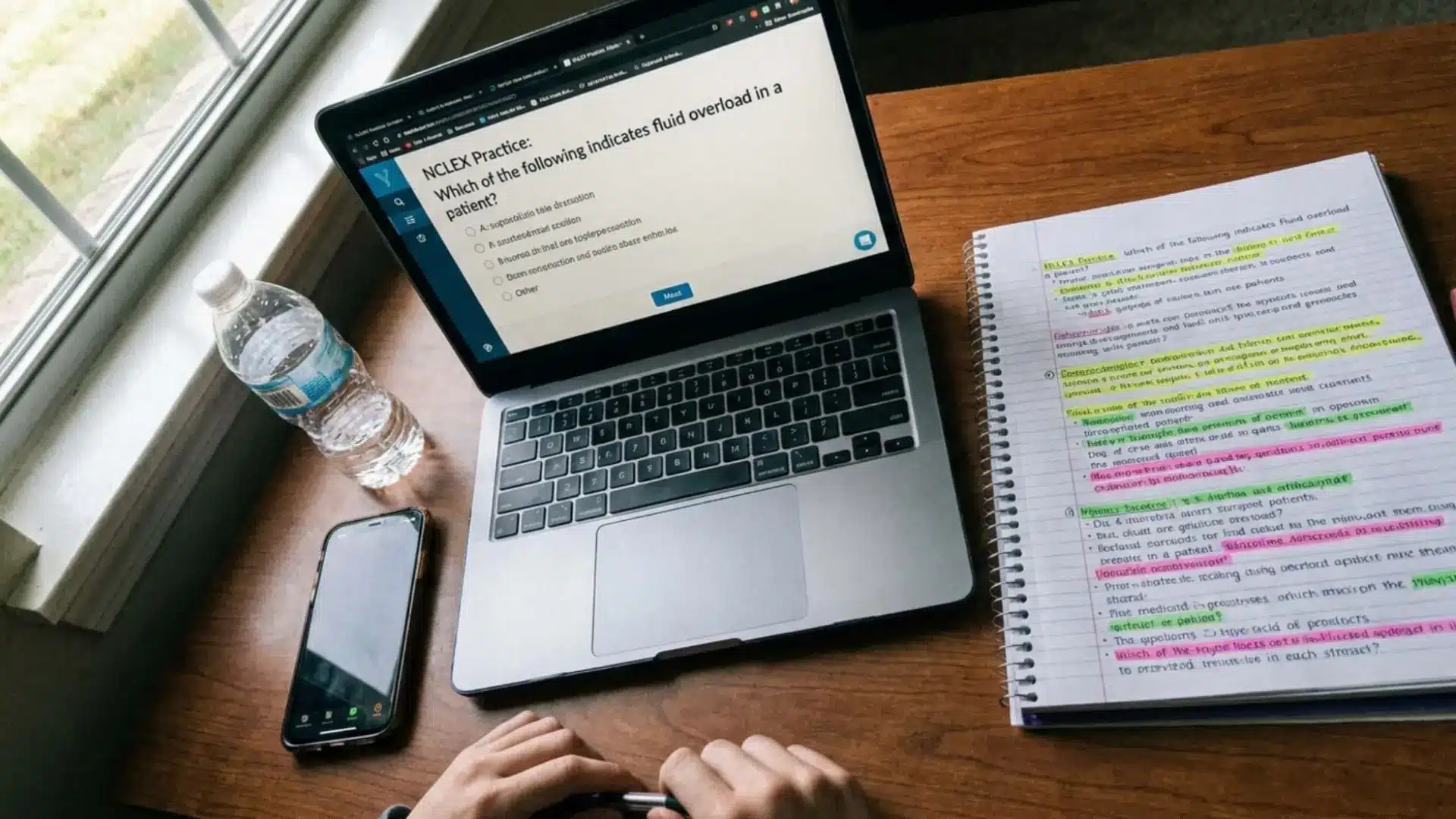
A few consistent habits tend to separate first-time passes from repeat attempts.
Practice NGN-Style and SATA Questions Daily: These formats make up a growing share of the exam and take real repetition to get comfortable with, more than standard multiple-choice ever will.
Focus on Rationale over Correct Answers: Reviewing why wrong choices are wrong helps the underlying reasoning transfer to new scenarios you have not seen before.
Simulate Real Testing Conditions: Timed practice exams build stamina and help you get used to the pacing and pressure of a multi-hour session.
Identify Weak Content Areas Early: Diagnostic or readiness assessments let you allocate study time to those areas rather than reviewing everything equally.
Prioritize Application over Memorization: Practicing reasoning through a patient scenario matters more than memorizing isolated facts.
Review Daily in Shorter Sessions: Spaced repetition tends to hold up better under exam pressure than long, infrequent study blocks.
Exam-day nerves are a separate problem from content gaps, and practicing test-anxiety strategies alongside your content review is worth starting early, not just at the end of your prep.
How the NCLEX Compares to Nursing School Exams
Nursing school exams and the NCLEX test are two different things, even when the content overlaps.
the table below breaks down exactly where they part ways.
Nursing School Exams | NCLEX |
|---|---|
Recall or listing facts from lectures | Deciding what a nurse should do for a specific patient right now |
Stays within one subject at a time | Blends every subject together without warning |
Flat percentage of correct answers | Pass or fail tied to a single ability estimate |
Missed questions rarely change the outcome | Consistency across every question matters far more |
These differences show why excelling in nursing school doesn’t secure an easy pass, as the NCLEX tests a different skill.
Frequently Asked Questions (FAQ’s)
1. Is the NCLEX Harder Than the SAT?
Most test-takers find the NCLEX harder because of its adaptive format and strong focus on applied clinical judgment.
2. What Percentage of People Fail the NCLEX?
About 11% to 13% of first-time US-educated NCLEX-RN candidates fail on the first try.
3. How Many Questions Do You Need to Pass the NCLEX?
There is no fixed number, since the exam ends once the computer reaches a clear pass-or-fail result.
4. Can You Retake the NCLEX if You Fail?
Yes, candidates can retake it after a required waiting period, though pass rates tend to drop for repeat attempts.
Final Thoughts
Is the NCLEX hard? Yes, but that does not mean you cannot pass it.
Steady practice and smart pacing help more than raw memory alone.
Many nurses who passed still felt nervous walking into the testing room.
Trust the work you already put in during nursing school. Stay calm when a question feels strange or unclear. Read slowly and apply what you know. Nursing school gave you the basics, and the exam checks how you use them.
Drop a comment below and share your own NCLEX experience.