

Every parent wants a place where they feel safe, supported, challenged, and excited to learn.
Yet when charter schools and public schools appear to offer similar benefits, the decision can quickly become confusing.
The difference between charter and public school options is not always obvious at first glance, especially when both are publicly funded and open to students.
One may promise flexibility and specialized programs, while the other may offer familiar routines, neighborhood connections, and broader resources.
Understanding How Public School Choices Work
Public school choices can look different depending on where a family lives.
In many areas, students attend a traditional public school based on their home address, while some districts also offer magnet schools, charter schools, or other specialized programs.
These options may differ in how students apply, what subjects they focus on, and how the school is managed.
Some schools follow district rules closely, while others may have more freedom to design their programs or teaching methods.
Understanding how these choices work makes it easier to compare schools fairly and find an option that fits a child’s learning needs and family priorities.
Difference Between Charter and Public School

Both charter schools and public schools provide tuition-free education, but they differ in how they are managed, how students enroll, and the educational experiences they offer.
1. Enrollment and Admissions Process
While public schools prioritize universal access within a district, charter schools provide additional school-choice options that may attract students from multiple communities.
Public schools typically enroll students based on where they live, guaranteeing access to schools within designated district boundaries.
Charter schools are open to students regardless of neighborhood, but families usually must submit an application.
2. Governance and School Management
Charter schools must demonstrate performance results to maintain their authorization, while public schools remain accountable through district and state oversight systems.
Public schools are governed by local school districts and elected school boards that oversee budgets, staffing, policies, and educational standards.
Charter schools operate under independent governing boards and are granted greater autonomy through charter agreements.
3. Curriculum and Educational Approach
While both school types must meet state academic requirements, charter schools may use innovative teaching methods and instructional structures that differ from traditional district-based educational approaches.
Public schools generally follow district-approved curricula designed to align with state learning standards and ensure consistency across schools.
Charter schools often have greater flexibility to implement specialized educational models, such as STEM-focused, arts-centered, language immersion, or college-preparatory programs.
4. Teacher Qualifications and Staffing
While both school types employ qualified educators, public schools often follow more standardized staffing requirements, whereas charter schools may prioritize subject-matter experience or mission-specific teaching skills.
Public schools typically require teachers to hold state certification and meet district hiring standards before entering the classroom.
Charter schools may have more flexibility in recruitment, depending on state regulations, allowing them to hire professionals with specialized expertise or alternative credentials.
5. Student Services and Accountability
Accountability systems also differ: public schools are evaluated by district and state performance measures, while charter schools must meet specific goals outlined in their charter agreements.
Public schools commonly provide a broad range of services, including transportation, special education programs, counseling, meal assistance, and extracurricular activities supported by district resources.
Charter schools may offer many of these services, but availability can vary by school and funding levels.
Since both school types still give state assessments, brushing up on practical middle school test-taking strategies can help a student adjust to a new testing rhythm after switching schools.
Similarities Between Public Schools and Charter Schools
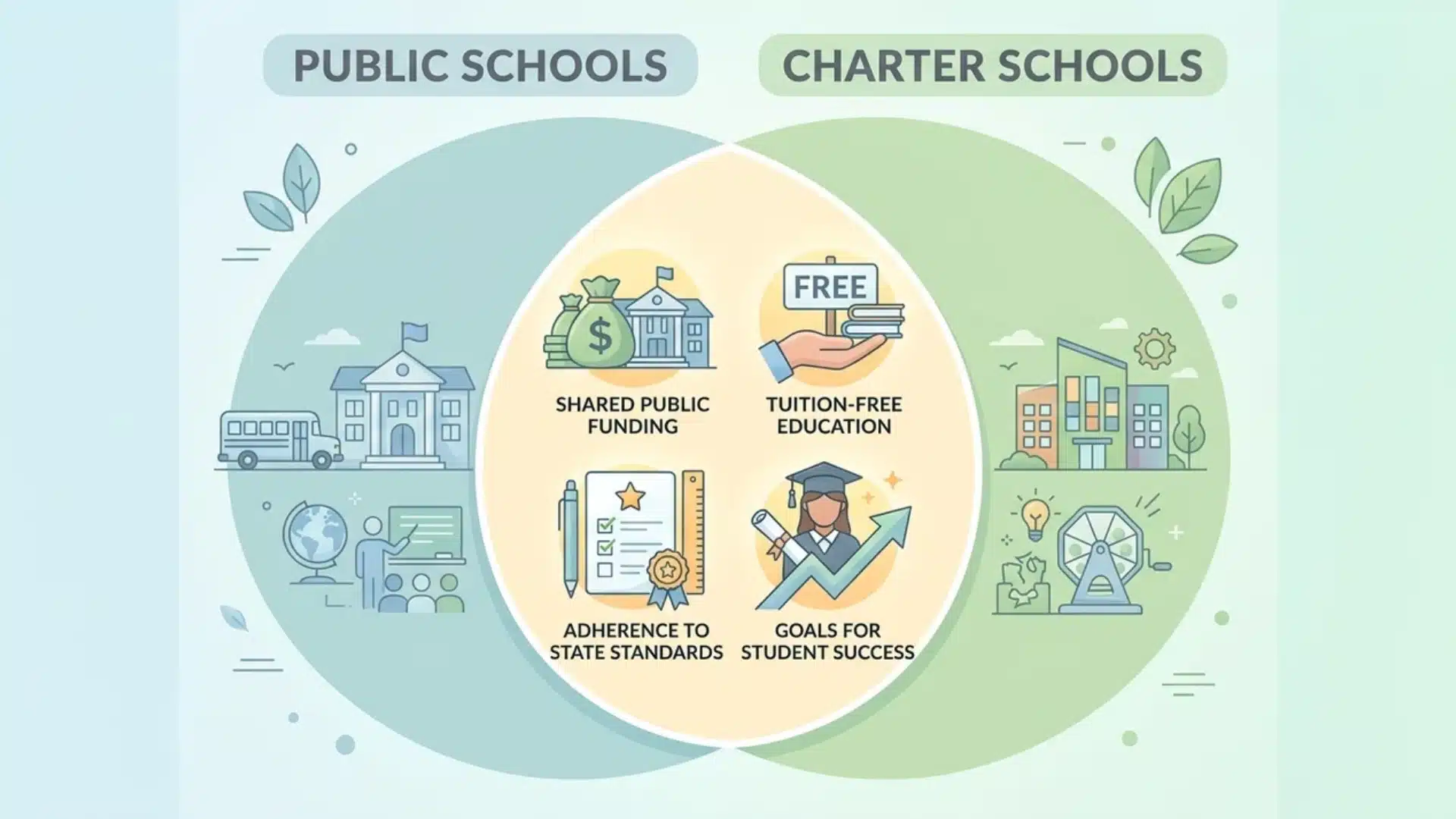
Both charter schools and public schools are part of the public education system and share several core characteristics despite their operational differences.
Understanding these common elements helps parents recognize that both options are designed to support student learning and achievement.
Key similarities include:
Tuition-free education: Students can attend both charter schools and public schools without paying tuition.
Public funding: Both receive government funding and are accountable for how public resources are used.
State academic standards: Students in both school types are required to meet state learning expectations and participate in assessments.
Focus on student success: Both aim to prepare students for higher education, careers, and long-term academic achievement.
Is Charter School Better than Public School?
A charter school is not automatically better than a public school. The better choice depends on the quality of the individual school and your child’s learning needs.
Charter schools may offer specialized programs, smaller learning environments, or flexible teaching methods.
However, some may have limited transportation, fewer extracurricular activities, or less stable funding.
Public schools often provide broader student services, established facilities, sports, clubs, and neighborhood connections.
Visiting both schools and speaking with teachers and parents can provide useful insight. The best school is the one where your child feels supported, engaged, and able to grow academically and socially.
When to Consider Each School Type?
Compare your child’s needs, interests, and required support before choosing between a charter and public school.
Consider a Charter School When | Consider a Public School When |
|---|---|
You want specialized programs. | You want more sports and activities. |
You prefer smaller classes. | You need broader support services. |
You value flexible teaching methods. | You prefer an established school system. |
You want a mission-focused education. | Transportation and facilities matter. |
Questions Parents Should Ask Before Choosing
Regardless of which direction you lean, the decision should be driven by specific, verifiable answers, not marketing materials.
Before enrolling your child in any school, public or charter, work through this checklist:
Charter renewal history: Check how long the school has operated and whether its charter has been consistently renewed.
Teacher turnover rate: High teacher turnover can indicate challenges with school culture and student continuity.
Specialized programs: Review the school’s educational model and whether it aligns with your child’s needs.
Lottery odds & waitlist: Ask about enrollment demand, waitlist size, and your chances of receiving a seat.
Transportation: Confirm whether transportation is provided or if families are responsible for getting students to school.
Special education support: Evaluate the availability of IEP services, specialists, and student support resources.
Financial stability: Look into the school’s financial health, governance history, and long-term sustainability.
Using this checklist can help you look beyond school labels and focus on the factors that have the greatest impact
Conclusion
Understanding the difference between charter and public schools is less about determining which option is universally better and more about recognizing how each school model operates.
Both can provide strong educational opportunities, but their approaches, structures, and areas of focus may differ.
Rather than relying on assumptions, it is important to evaluate individual schools based on their academic performance, programs, resources, and overall learning environment.
Which school model do you think better supports students’ needs? Share your experience or opinion in the comments below.
Frequently Asked Questions
Can Charter Schools Choose Which Students They Admit?
No. Charter schools must accept eligible applicants without considering factors such as academic performance or income.
Why Do Charter Schools Have Enrollment Lotteries?
Lotteries help ensure a fair admissions process when more students apply than the school can accommodate. They give all eligible applicants an equal chance of receiving a seat.
Can a Charter School Be Closed?
Yes. A charter school can lose its charter and be required to close if it consistently fails to meet academic, financial, or operational standards.