
Most students spend weeks reviewing limits and derivatives but walk into exam day not knowing how many questions they’ll face or how much time they have for each section.
That gap can cost valuable points.
The AP Calculus AB Exam lasts 3 hours and 10 minutes and is divided into two main sections: multiple-choice and free-response. Each section has its own timing rules, calculator policies, and scoring weight.
Knowing the exam structure is a valuable first step, especially as you build your study plan or prepare for final review. It can help you manage your time, understand what to expect, and approach each question with greater confidence.
What does the AP Calc AB Exam cover?
The AP Calculus AB exam covers four core areas: limits, derivatives, integrals, and the Fundamental Theorem of Calculus.
It also evaluates students’ ability to apply calculus concepts through mathematical reasoning, graphical analysis, and real-world problem-solving situations.
It is developed and administered by the College Board every May, typically during the AP exam window.
High school students take it to earn college credit or advanced placement at thousands of US universities, many of which accept a score of 3 or higher.
The format shapes everything, including how much time you spend on each topic, the strategies you use, and how effectively you prepare for different question types.
AP Calc AB Exam Format at a Glance
TheAP Calculus AB exam is split into two sections: Section I covers multiple-choice questions, and Section II covers free-response questions.
Each section then breaks into two parts, one with a calculator and one without.
Knowing this structure upfront lets you pace your AP Calc AB review around the actual test experience rather than guessing.
Section | Part | Questions | Calculator | Time |
|---|---|---|---|---|
Section I | Part A | 29 MCQ | No | 62 min |
Part B | 13 MCQ | Yes | 38 min | |
Section II | Part A | 2 FRQ | Yes | 30 min |
Part B | 4 FRQ | No | 60 min | |
Total | 48 Questions | 3 hrs 15 min |
Each of these sections has its own rules, pacing demands, and question styles. The breakdowns below cover every part in detail so you know exactly what to expect before you sit down to test.
Source: College Board AP Calculus AB Exam
Section I: Multiple Choice Questions (MCQ)
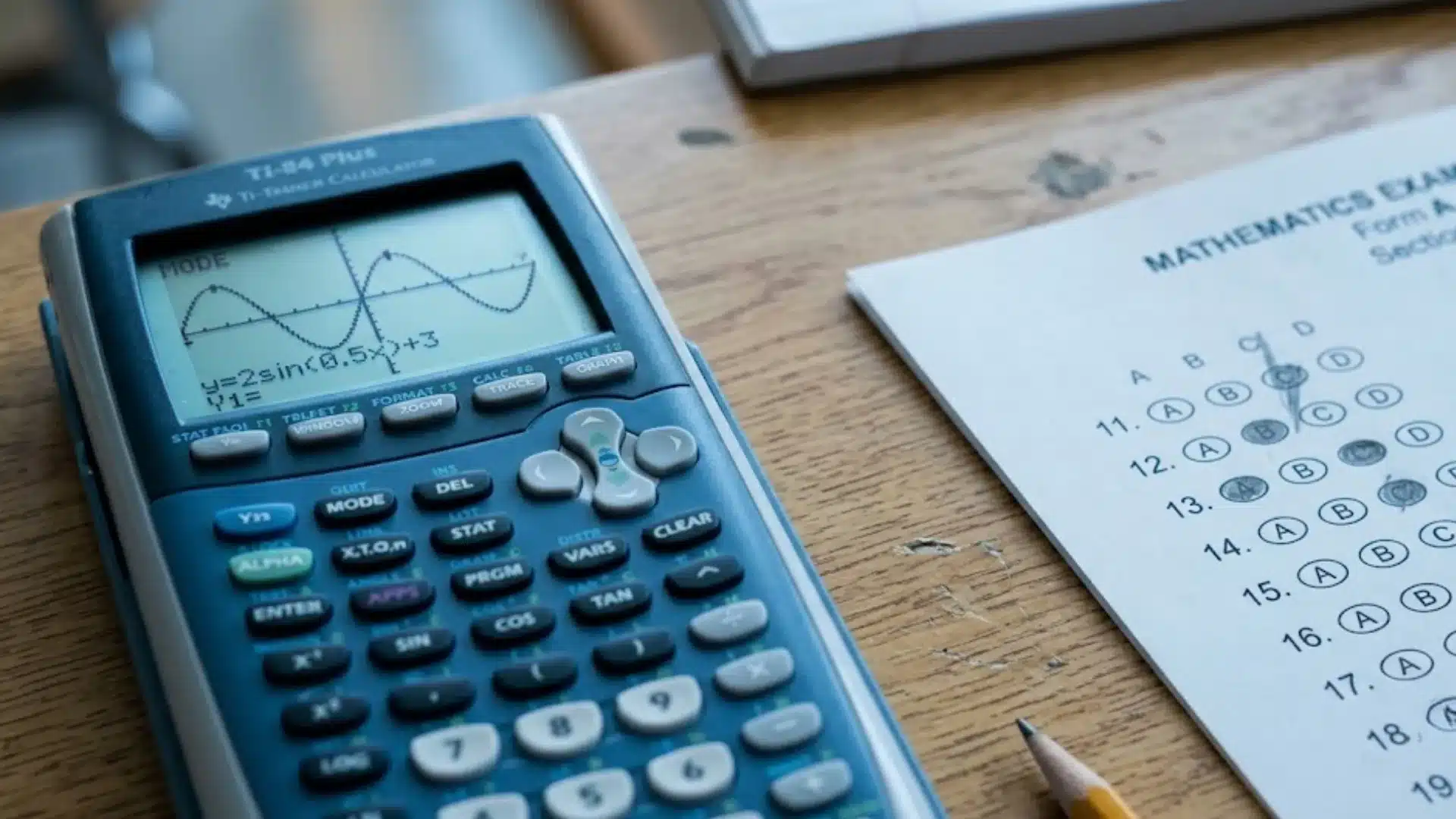
Section I tests conceptual understanding and procedural fluency across all AP Calc AB topics.
Every correct answer adds to your raw score, and there is no penalty for wrong answers, so leaving a question blank is never the better move.
Part A: No Calculator (29 Questions, 62 Minutes)
Questions pull from limits, continuity, differentiation rules, and basic integration, all without any calculator support. Most are straightforward if your algebra fundamentals are solid.
A practical time management tip: flag anything taking longer than 90 seconds, move on, and return at the end.
The AP program uses it across subjects, and the AP Psychology exam timing breakdown follows a similar two-section structure with its own calculator rules.
Part B: Calculator Required (13 Questions, 38 Minutes)
Part B is where a graphing calculator becomes a real asset.
Questions here often involve numerical derivatives, definite integrals, and graph analysis that would be tedious to solve by hand.
You still get roughly 3 minutes per question, so use that time to set up problems carefully before reaching for your calculator.
Only College Board-approved graphing calculators are permitted.
Section II: Free Response Questions (FRQ)
Unlike multiple-choice questions, FRQs are graded using detailed scoring rubrics, in which each question is worth a set number of points, earned step by step.
Partial credit is available, meaning that an incorrect final answer does not erase correct work shown along the way.
Part A: Calculator Active (2 Questions, 30 Minutes)
You have 15 minutes per question in Part A, and a graphing calculator is expected, not optional.
These questions commonly involve rate-of-change problems, accumulation over an interval, and interpreting the area under a curve in context.
Your calculator handles the computation heavy lifting here, so spend your time setting up the problem correctly and communicating your process on paper.
The College Board awards points for method, not just the final number.
Part B: No Calculator (4 Questions, 60 Minutes)
Part B gives you 15 minutes per question across four problems, all without a calculator.
Questions here test the Fundamental Theorem of Calculus, analytical differentiation, and conceptual understanding of function behavior.
Expect to justify answers, analyze graphs, and work through multi-part problems that build on each other.
Write every step clearly since rubric points are tied to your shown work, not just your conclusion.
AP Calculus AB Exam Topics and Units Covered
The AP Calculus AB exam covers eight major topic areas that test students’ understanding of limits, derivatives, integrals, and their real-world applications.
Reviewing these concepts helps students focus their preparation on the skills required for the exam.
Unit | Key Concepts | Exam Weighting |
|---|---|---|
Limits and Continuity | Evaluating limits, continuity, and the Intermediate Value Theorem | 10-15% |
Differentiation: Definition and Fundamental Properties | Derivative definitions, basic derivative rules, estimating derivatives | 10-15% |
Differentiation: Composite, Implicit, and Inverse Functions | Chain rule, implicit differentiation, inverse and inverse trig derivatives | 5-10% |
Contextual Applications of Differentiation | Motion problems, related rates, linearization, L’Hospital’s Rule | 10-15% |
Analytical Applications of Differentiation | Extrema, concavity, the Mean Value Theorem, optimization, curve sketching | 15-20% |
Integration and Accumulation of Change | Antiderivatives, definite integrals, the Fundamental Theorem of Calculus | 15-20% |
Differential Equations | Slope fields, separation of variables, exponential growth and decay models | 5-10% |
Applications of Integration | Area between curves, volume by cross-sections, disc and washer methods | 10-15% |
AP Calc AB Review: How to Use the Exam Format to Study Smarter?
The AP Calc AB exam format should shape your study plan. Focus your review on each section’s rules, timing, and question types instead of practicing randomly.
- Start Section I Part A Without a Calculator: Every question in that part is no-calculator, so practicing with one builds the bad habit. Train your algebraic fluency from the beginning.
- Practice FRQs Using College Board Released Questions: These come with official scoring rubrics so you learn exactly which steps earn points and which explanations fall short.
- Time Yourself Section by Section Before Attempting a Full Exam: Jumping straight to timed full practice tests before you know your pacing per section leads to uneven performance and harder-to-diagnose weak spots.
- Use AP Classroom for Official Practice Material: The College Board’s AP Classroom platform has progress checks and topic-specific questions built directly from the course framework.
- Pull Prior-Year FRQs From the College Board Site: They are free, organized by year, and the closest thing to real exam conditions you will find anywhere.
Formatting knowledge without a study plan behind it does not move your score. Use the structure of the exam to decide what to practice, in what order, and under what conditions.
How is the AP Calc AB Exam Scored?
Your final AP score runs from 1 to 5, built equally from both sections. Section I and Section II each count for 50% of your composite score, with no penalty for wrong answers on MCQs and partial credit available on every FRQ.
AP Score | Credit Eligibility | % of Students (approx.) |
|---|---|---|
5 | Most selective colleges | 18% |
4 | Many 4-year colleges | 19% |
3 | Some colleges | 21% |
2 | Rarely accepted | 22% |
1 | Not accepted | 20% |
Score distributions shift slightly each year, so check the latest numbers directly on the College Board site before building expectations around a specific cutoff.
Approved Calculators for the AP Calc AB Exam
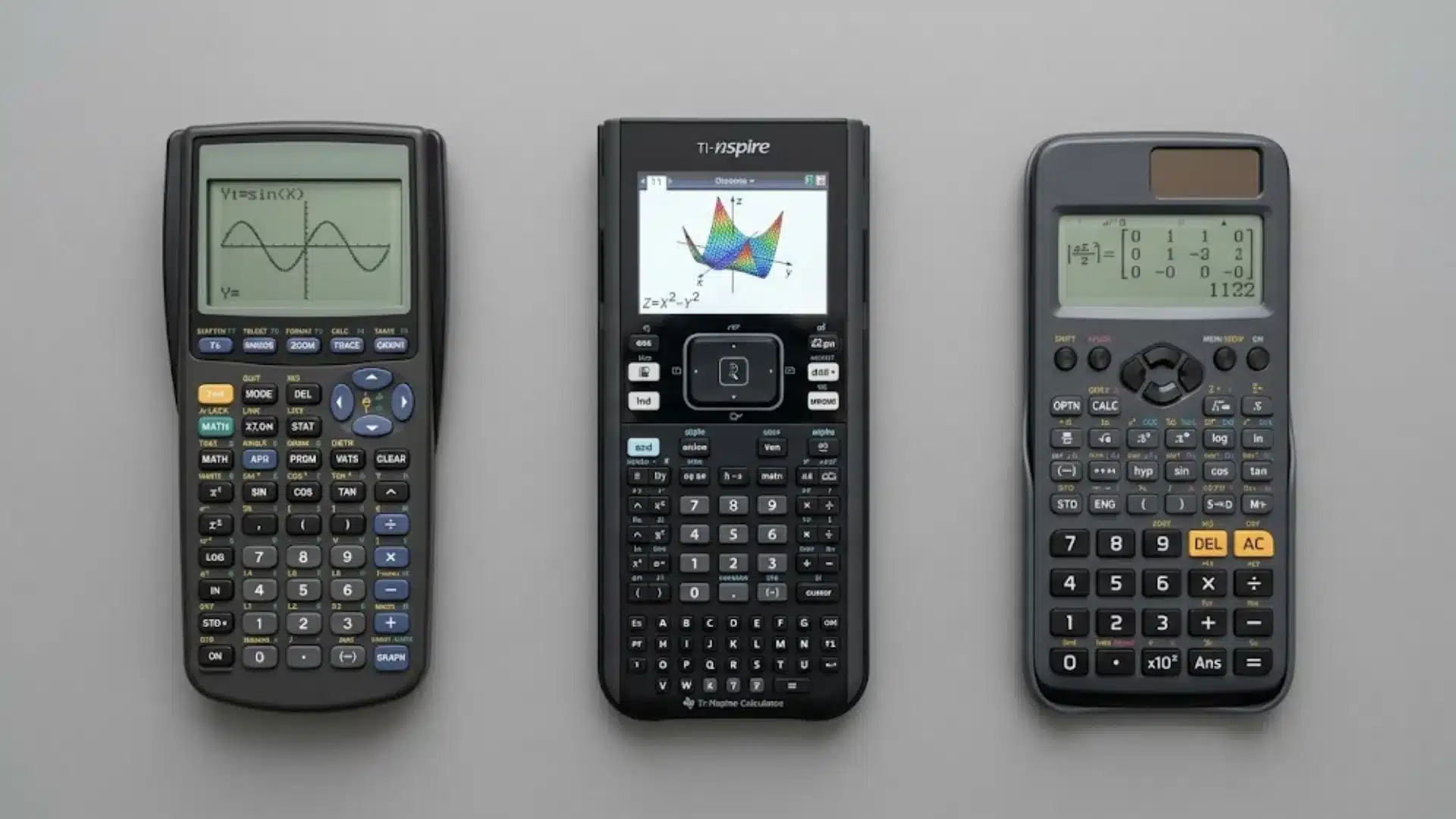
Not every graphing calculator makes the cut. The College Board maintains a specific approved list, and showing up with a non-permitted device means going without, even if your calculator is more advanced.
Commonly approved graphing calculators include:
- TI-84 Plus / TI-84 Plus CE: The most widely used in US classrooms with reliable features for AP Calculus calculations.
- TI-Nspire CX (non-CAS): Offers advanced graphing features, but the CAS version is not permitted.
- Casio fx-9750GIII: A solid budget-friendly option with essential graphing and calculation functions.
- HP Prime (non-CAS): Confirm your model before exam day to ensure it meets College Board requirements.
CAS-enabled calculators, laptops, and tablet-based calculators are not allowed under any circumstances.
Calculator rules for the SAT allow a somewhat different set of devices, so don’t assume a model cleared for one exam automatically clears for another.
AP Calc AB vs. AP Calc BC Exam Format Differences
If you are still deciding between the two courses, this section is for you. AB and BC share the same basic structure, but the content depth and scoring options differ in ways that matter for both your prep time and college credit outcomes.
Feature | AP Calc AB | AP Calc BC |
|---|---|---|
Total Questions | 48 | 48 |
Exam Duration | 3 hr 15 min | 3 hr 15 min |
Topics Covered | Limits through integration (8 units) | AB + series, parametric, polar(10 units) |
AB Subscore | N/A | Yes (BC includes AB score) |
The Bottom Line
Understanding the AP Calculus AB exam format can make your preparation more focused and less stressful.
Knowing how the sections are structured, what question types to expect, and which topics are tested allows you to build a smarter review plan.
From limits and derivatives to integrals and real-world applications, every concept plays a role in helping you succeed on exam day.
With consistent effort and the right strategy, you can approach the AP Calculus AB exam with greater clarity.
Have you started preparing for AP Calc AB, or do you have any review tips to share? Leave your experience in the comments below.
Frequently Asked Questions (FAQs)
Is the AP Calc AB Exam Digital or Paper-Based?
It’s a hybrid digital exam. You answer the multiple-choice section on a laptop through the College Board’s Bluebook app, then switch to a paper booklet for the free-response section.
Do You Get a Formula Sheet During the Exam?
No. There’s no reference or formula sheet provided for AP Calculus AB, unlike some other AP science and math exams, so memorizing your derivative and integral rules cold is part of the prep.
Can You Self-Study for the AP Calc AB Exam Without Taking the Class?
Yes. Homeschooled and independent students can register for the exam through a local AP coordinator at a participating school, even without sitting in an AP Calculus classroom all year.
Can You Retake the AP Calc AB Exam if You’re Unhappy with Your Score?
Yes. You can sit for the exam again in the future; there’s no formal limit on retakes, though most students only repeat a subject if they genuinely need a higher score for credit or admission purposes, since your full score history stays on record unless you actively cancel a score.