


Have your sights set on nursing but are unsure where to begin?
One of the first questions many aspiring nurses ask is: What prerequisites do I need for nursing?
The answer can vary by program, but most schools expect applicants to meet specific academic and admission requirements before applying.
Understanding these expectations early can help you plan your coursework, avoid delays, and build a stronger application.
Here, you will find a clear breakdown of the requirements many nursing schools look for and practical information to help you plan your next move.
Why Does Nursing School Have Specific Entry Requirements?
Nursing is a healthcare profession focused on caring for patients, supporting recovery, promoting health, and assisting people through different medical conditions.
Because nursing involves working directly with people and making important healthcare decisions, schools set specific nursing school requirements for admission.
These requirements help ensure that applicants have the academic background needed to understand nursing coursework and complete clinical training successfully.
Schools often review high school or college coursework, academic performance, and other admission materials before accepting students.
While requirements can vary by program, their main purpose is to prepare students for the demands of nursing education and the responsibilities they will face in patient care settings.
Overview of Nursing School Requirements
This table summarizes the main nursing school requirements covered so far, giving you a clear view of what most programs expect from applicants.
|
Requirement Category |
Why It Matters |
|---|---|
|
Builds the academic foundation needed for nursing coursework |
|
|
Develops communication, analytical, and interpersonal skills |
|
|
Demonstrates academic readiness and consistency |
|
|
Assesses preparedness for nursing-level study |
|
|
Shows familiarity with healthcare settings and patient care |
|
|
Supports eligibility for clinical training and program admission |
|
|
Helps applicants choose a pathway that matches their qualifications |
This overview serves as a quick checklist to help you understand the key requirements before moving forward with your nursing school application.
Admission Requirements vs. Program Requirements

Nursing schools often separate requirements into two categories: admission requirements and program requirements.
Admission requirements are the qualifications you must meet before applying or being accepted into a nursing program.
These commonly include prerequisite courses, minimum GPA standards, entrance exam scores, transcripts, recommendation letters, and personal statements.
Program requirements are completed after admission and are usually necessary before starting clinical training or progressing through the program.
These may include background checks, health clearances, immunization records, CPR certification, clinical hour requirements, and graduation standards.
Why Do Requirements Differ Between Schools?
Requirements vary because each nursing school follows its own admission policies, curriculum structure, and enrollment capacity.
Some programs receive a high number of applications and may set more competitive standards, while others have different prerequisite course requirements or testing policies.
State regulations, accreditation standards, and clinical placement agreements can also influence admission criteria.
Comparing requirements across multiple schools can help you identify programs that match your qualifications and academic goals.
Academic Requirements for Nursing Programs
Nursing schools assess both coursework and academic performance. Meeting these requirements helps demonstrate readiness for nursing education and clinical training.
Science Courses Required for Nursing Programs
Science courses form the foundation of most nursing programs. While course requirements can vary by school, the subjects listed below are commonly required in the nursing admissions process.
|
Course |
What the Course Typically Covers |
Why It Matters for Nursing |
|---|---|---|
|
Biology and Human Anatomy |
Cell structure, genetics, body systems, organs, tissues, and human anatomy |
Builds knowledge of the human body. |
|
Microbiology |
Bacteria, viruses, fungi, parasites, immunity, infection control, and disease transmission |
Supports infection prevention and patient safety. |
|
Chemistry |
Atoms, molecules, chemical reactions, solutions, acids and bases, and basic biochemistry |
Helps with medication and treatment concepts. |
|
Physiology |
Body functions, organ systems, circulation, respiration, digestion, and nerve signaling |
Explains how body systems function. |
These science courses provide the knowledge needed for nursing school coursework and help meet common admission requirements.
Non-Science Courses That Nursing Schools Require
Science prerequisites are only part of the admission process. Many nursing schools also expect applicants to complete courses that strengthen communication, analytical thinking, and interpersonal skills.
English and Communication
Common topics may include:
- Reading comprehension
- Academic writing
- Grammar and composition
- Public speaking
- Professional communication
Strong communication skills help nurses explain information clearly, understand patient concerns, and work effectively with healthcare teams.
Psychology and Sociology
Common topics may include:
- Human behavior
- Mental health concepts
- Personality development
- Social relationships
- Cultural and community influences on health
These subjects help nursing students understand how emotional, social, and environmental factors can affect patient care.
Statistics and Math
Common topics may include:
- Basic algebra
- Ratios and percentages
- Data interpretation
- Probability
- Statistical concepts
Math and statistics support accurate calculations, data analysis, and evidence-based decision-making in healthcare settings.
GPA and Academic Standards for Nursing Admission
Understanding GPA requirements can help you determine whether you meet admission standards and identify areas that may need improvement before applying.
Minimum GPA Requirements
Nursing schools use GPA as one measure of academic readiness. While exact standards vary, most programs set a minimum GPA requirement that applicants must meet before their application can be reviewed.
|
GPA Range |
What It Typically Means |
|---|---|
|
2.5 GPA |
The minimum requirement for nursing and associate degree programs. |
|
3.0 GPA |
Frequently required by many nursing schools. |
|
3.5 GPA or Higher |
Preferred by competitive nursing programs. |
Many schools also place additional emphasis on grades earned in science prerequisites such as biology, chemistry, anatomy, and physiology.
How Competitive GPA Affects Your Chances
Meeting the minimum GPA requirement makes you eligible to apply, but admission is often more competitive than the minimum standard suggests.
Nursing programs may receive more qualified applicants than available seats, leading schools to compare candidates based on academic performance.
A stronger GPA can help your application stand out, especially when paired with good grades in prerequisite courses.
Understanding GPA expectations early can help you set realistic admission goals and strengthen your application before applying to nursing programs.
Standardized Tests and Entrance Exams for Nursing School
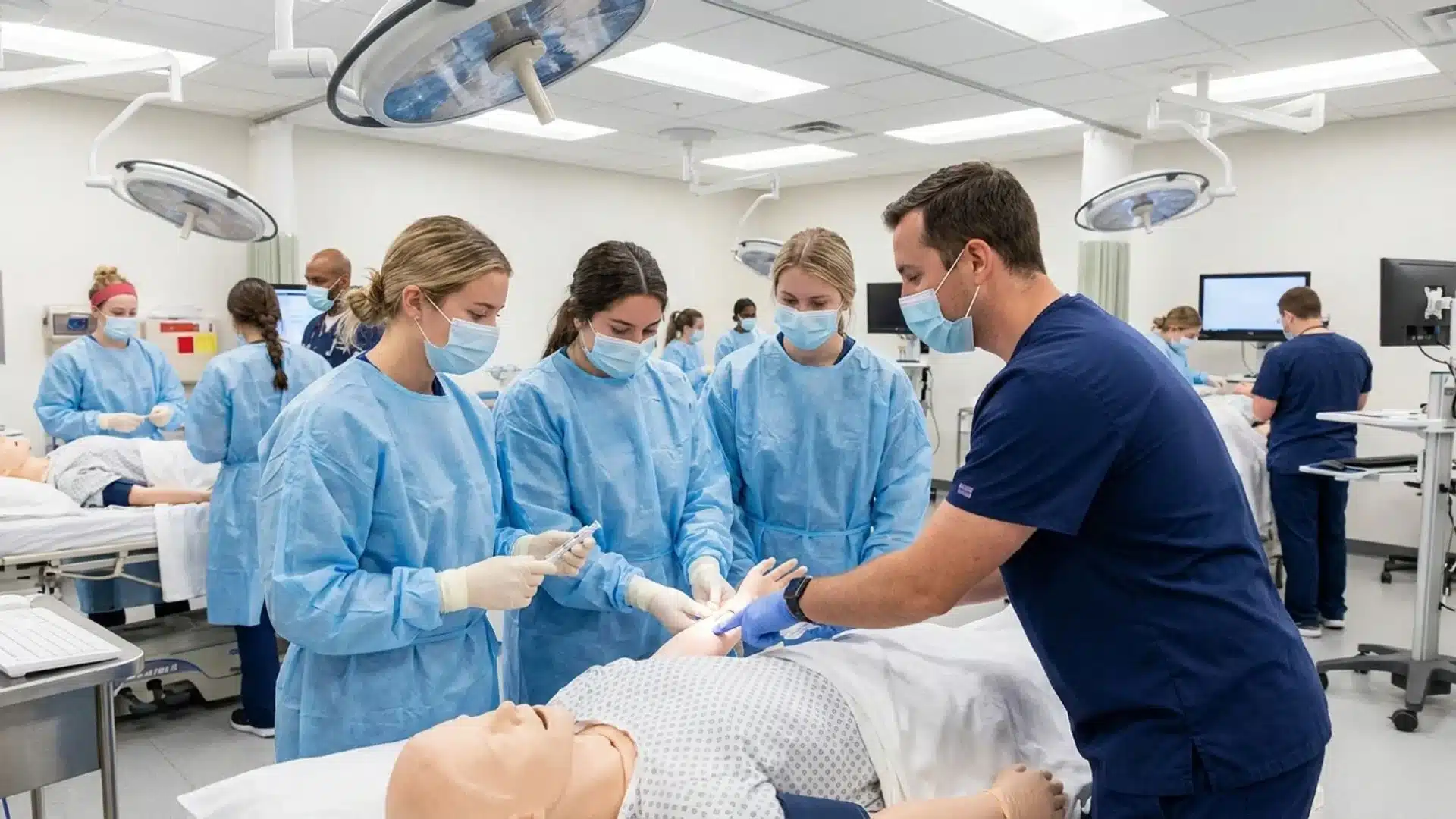
Many nursing programs use entrance exams to assess academic readiness. Understanding common test formats and subjects can help applicants prepare more effectively.
TEAS Exam
The Test of Essential Academic Skills (TEAS), administered by ATI Testing, consists of 170 questions, including 150 scored questions, and has a testing time of about 209 minutes.
According to the official ATI syllabus, the exam covers Reading, Mathematics, Science, and English and Language Usage. The Science section includes anatomy and physiology, biology, chemistry, and scientific reasoning.
Many nursing schools use TEAS scores to assess an applicant’s academic preparation before admission.
HESI A2 Exam
The Health Education Systems, Inc. Admission Assessment (HESI A2) is administered by Elsevier and uses a flexible format that allows nursing schools to choose the sections they require.
Common subjects include Reading Comprehension, Vocabulary, Grammar, Mathematics, Biology, Chemistry, and Anatomy and Physiology.
Since schools select their own testing requirements, the total number of questions and exam length can vary. HESI A2 scores are commonly used to evaluate readiness for nursing education.
Checking entrance exam requirements early can help you prepare effectively and avoid delays during the nursing school application process.
Healthcare Experience and Clinical Hours
While many nursing programs do not require prior experience, some schools consider it a valuable addition during the admissions process.
Volunteering
Volunteering allows students to gain exposure to healthcare settings without being employed in a medical role. While volunteers do not provide direct patient care, they often assist staff, support patients, and learn how healthcare facilities operate.
Common volunteer opportunities include:
- Hospital volunteer
- Nursing home volunteer
- Community health volunteer
- Hospice volunteer
Many applicants complete 50 to 200 volunteer hours, although requirements vary by program, and many schools do not require volunteer hours at all.
Paid Work Experience
Paid healthcare roles provide hands-on experience and greater responsibility than volunteer positions. These jobs often involve direct patient interaction and can help applicants develop practical skills before entering nursing school.
Common paid healthcare roles include:
- Certified Nursing Assistant (CNA)
- Medical Assistant
- Patient Care Technician
- Home Health Aide
Competitive applicants often have 6 months to 2 years of healthcare experience, though most nursing programs do not require prior employment in a healthcare setting.
Both volunteering and paid healthcare experience can be valuable and can help applicants gain insight into the nursing profession and demonstrate commitment to the field.
Differences in Requirements by Program Type

Nursing school requirements can vary based on the type of program you choose. Understanding these differences can help you identify the pathway that best matches your academic background and career goals.
1. ADN Programs
ADN programs are often chosen by students seeking a shorter path into the nursing profession.
- Program Type: Associate Degree in Nursing
- Typical Length: 2 years
- Minimum GPA: 2.5–3.0
- Prerequisites: Science and general education courses
- Entrance Exam: TEAS or HESI A2 may be required
- Additional Requirements: Health clearances, background check, and CPR certification
2. BSN Programs
BSN programs provide broader nursing education and are commonly offered through colleges and universities.
- Program Type: Bachelor of Science in Nursing
- Typical Length: 4 years
- Minimum GPA: 3.0 or higher
- Prerequisites: Science courses and general education requirements
- Entrance Exam: TEAS, HESI A2, or school-specific assessments may be required
- Additional Requirements: Personal statement, recommendation letters, health clearances, and background check
3. Accelerated BSN Programs
Accelerated BSN programs are designed for students who already hold a bachelor’s degree in another field.
- Program Type: Accelerated Bachelor of Science in Nursing
- Typical Length: 1–2 years
- Minimum GPA: 3.0 or higher
- Prerequisites: Required science courses and a completed bachelor’s degree
- Entrance Exam: Varies by program
- Additional Requirements: Official transcripts, health clearances, background check, and CPR certification
4. RN-to-BSN Programs
RN-to-BSN programs are designed for licensed registered nurses who already hold an associate degree or diploma in nursing and want to earn a bachelor’s degree.
- Program Type: RN-to-BSN
- Typical Length: 1–2 years
- Minimum GPA: Often 2.5–3.0
- Prerequisites: Active RN license and prior nursing education
- Entrance Exam: Usually not required
- Additional Requirements: Official transcripts and proof of RN licensure
5. LPN-to-RN Programs
LPN-to-RN programs allow licensed practical nurses to advance their education and qualify for registered nurse licensure.
- Program Type: LPN-to-RN
- Typical Length: 1–2 years
- Minimum GPA: Often 2.5–3.0
- Prerequisites: Active LPN license and required coursework
- Entrance Exam: May require TEAS or HESI A2
- Additional Requirements: Official transcripts and proof of LPN licensure
Requirements vary by institution, so always review the admission criteria of your chosen nursing program before applying.
Other Admission Requirements for Nursing Programs
In addition to academic qualifications, many nursing schools require applicants to submit supporting documents and complete health-related requirements before admission.
|
Requirement |
What It Includes |
Typical Requirement |
|---|---|---|
|
Letters of Recommendation |
References from teachers, employers, academic advisors, or healthcare supervisors |
Usually 1–3 letters |
|
Personal Statement |
Written essay explaining nursing goals and motivation |
Required by many nursing programs |
|
Background Check and Health Clearances |
Criminal background screening, immunization records, tuberculosis screening, physical examination, and vaccination documentation |
Commonly required before clinical placements |
|
CPR Certification |
Basic Life Support (BLS) or equivalent CPR training from an approved provider |
Required by some schools before or shortly after admission |
These requirements help schools assess readiness for nursing education and clinical training. Completing these requirements early can help avoid application delays and ensure readiness for nursing school and clinical training.
How Long Does It Take to Complete Nursing Prerequisites?
The time required to complete nursing prerequisites varies based on your educational background, course availability, and study schedule.
For full-time students, prerequisite coursework often takes 1 to 2 years to complete, while part-time students may need 2 to 4 years depending on their course load.
Students who have already completed some college-level science or general education courses may finish their prerequisites more quickly than those starting with no prior credits.
Transfer credits can shorten the process if they meet a nursing school’s admission requirements.
Because nursing programs differ in their course requirements, it is important to review the prerequisite list for each school early and create a plan that aligns with your intended application timeline.
Competitive Factors That Can Improve Your Nursing School Application
Meeting the minimum requirements may allow you to apply, but these factors can help make your application more competitive.
- Strong GPA: Earn good grades, especially in prerequisite science courses.
- High Exam Scores: Perform well on required entrance exams such as TEAS or HESI A2.
- Healthcare Experience: Gain exposure through healthcare jobs, shadowing, or patient care roles.
- Volunteer Work: Participate in hospitals, clinics, nursing homes, or community health programs.
- Professional References: Secure strong recommendation letters from teachers, employers, or healthcare professionals.
- Personal Statement: Write a clear and compelling statement that explains your interest in nursing and career goals.
Strong academics combined with healthcare-related experience can help your application stand out during the admissions process.
What to Do If You Do Not Meet Nursing School Requirements Yet?

Not meeting the requirements right away does not close the door. Many students take time to build their academic profile before applying. There are clear, practical steps you can take to get there.
If Your Grades in Prerequisite Courses Are Too Low
To Do: Retake the course and focus on the specific areas where you lost marks the first time. Build a weekly study plan from day one. Check with the program on how they count repeated course grades before re-enrolling.
Not to: Retake the course without a changed approach. Repeating the study habits will give you the same results. Do not assume a slightly better grade will be enough without first checking the program’s minimum accepted score.
If You Are Missing Required Courses
To Do: Enroll at an accredited community college and map out missing courses against the next available semester. Register early as science sections fill up. Confirm with the nursing program if the credits will transfer before you begin.
Not to: Enroll in courses without verifying they will be accepted by your target program. Not all course titles are equivalent across schools.
If Your Overall GPA Does Not Meet the Minimum
To Do: Use a GPA calculator to find out exactly how many strong grades you need to reach the minimum. Take 2 to 3 courses per semester, prioritizing science subjects, and maintain consistency across each one.
Do Not Do: Take on too many courses at once, trying to raise your GPA quickly. Spreading yourself thin often leads to average performance across all subjects.
If You Lack the Required Healthcare Experience
To Do: Apply to at least two or three hospitals, clinics, or care facilities at the same time. Pursue roles like a certified nursing assistant or patient care technician and start logging hours early against your target program’s experience.
Do Not Do: Wait for one facility to respond before applying elsewhere. The placement process takes time, and delays add up. The gap between where you are now and where you need to be is closable. Take it one requirement at a time.
How to Check a Nursing School’s Admission Criteria?
Reviewing admission criteria early can help ensure you complete all requirements before submitting your application.
- Step 1: Visit the nursing school’s official admissions website.
- Step 2: Review the list of prerequisite courses and minimum grade requirements.
- Step 3: Check whether an entrance exam is required.
- Step 4: Confirm application deadlines and document requirements.
- Step 5: Verify health clearance, background check, and CPR certification policies.
- Step 6: Contact the admissions office if any requirement is unclear.
Checking admission criteria regularly can help you avoid missing important requirements and application deadlines.
Ready to Take the First Step?
Every nurse starts in the same place. The difference is knowing what comes next. If you have been asking, what prerequisites do I need for nursing, you now have a clear roadmap.
From science courses and GPA requirements to entrance exams and admission documents, this article has outlined the key steps nursing schools expect applicants to complete.
Use this information to assess where you stand and what you still need to finish. Review the requirements of your preferred programs today and start checking them off one by one.
Your nursing career starts with the choices you make now.
Frequently Asked Questions (FAQs)
Are Online Prerequisite Courses Accepted by Nursing Schools?
Many nursing schools accept online prerequisite courses from accredited institutions. Always verify transfer policies, laboratory requirements, and course acceptance before enrolling.
Can Prerequisite Courses Expire for Nursing School Applications?
Yes. Some nursing schools only accept science prerequisites completed within the past 5–10 years. Check individual program policies for details.
Can Work Experience Replace Prerequisite Courses?
No. Healthcare experience may strengthen an application, but it usually cannot replace required prerequisite coursework or academic requirements.
How Many Nursing Schools Should I Apply To?
Applying to multiple programs can increase your chances of admission, especially if schools have different GPA, prerequisite, and entrance exam requirements.