

A PMP practice exam shows you how ready you actually are for test day.
It points out which topics still need more review before you sit down.
From there, practice helps you get comfortable with real project scenarios, not just facts.
Formulas like EVM and risk calculations feel much easier once you work through them.
Both free and paid options give you solid ways to build that skill. This blog covers a PMP practice exam early, which gives you time to fix weak spots. Steady practice now means fewer surprises later.
Project Management Professional Exam Overview
PMI updated the PMP structure in July 2026, and the details below outline how you should approach every practice attempt:
Detail | Current PMP Exam Format |
Total questions | 180 (170 scored, 10 unscored pretest) |
Time limit | 240 minutes, with two scheduled breaks |
Domains tested | People (33%), Process (41%), Business Environment (26%) |
Reference framework | PMBOK Guide, 8th Edition |
Question types | Multiple choice, multiple response, matching, hotspot, fill-in-the-blank |
Delivery options | Pearson VUE test center or online proctored |
Exam fee | $405 for PMI members, $575 for non-members (before August 6, 2026) |
Eligibility (Option 1) | Four-year degree, 36 months leading projects, 35 hours of PM education |
Eligibility (Option 2) | High school diploma or associate degree, 60 months leading projects, 35 hours of PM education |
Your prep should mirror this structure, as PMI’s domain weighting guides your exam focus.
You can confirm the latest eligibility rules and register directly through PMI’s official website.
Syllabus Breakdown: High-Scoring Topics To Ace Your Exam
Some topics quietly determine whether you pass or retake the exam. Here’s where PMI focuses its toughest questions:
CPI, SPI, EAC, and TCPI stop being formulas here and start being decisions you have to make fast, under a ticking clock.
Probability, impact, and expected monetary value collide in these scenarios, along with residual risk and secondary risk.
One project, two approaches. You’ll be asked to judge when predictive planning wins and when agile wins.
A vendor dispute arrives; knowing if it’s fixed-price or cost-reimbursable guides your response.
Every decision links to strategy, regulation, or benefit, and the exam demands proof of this connection.
Master these five areas and the rest of the syllabus falls into place behind them.
Best Free PMP Practice Exam Resources To Score Higher
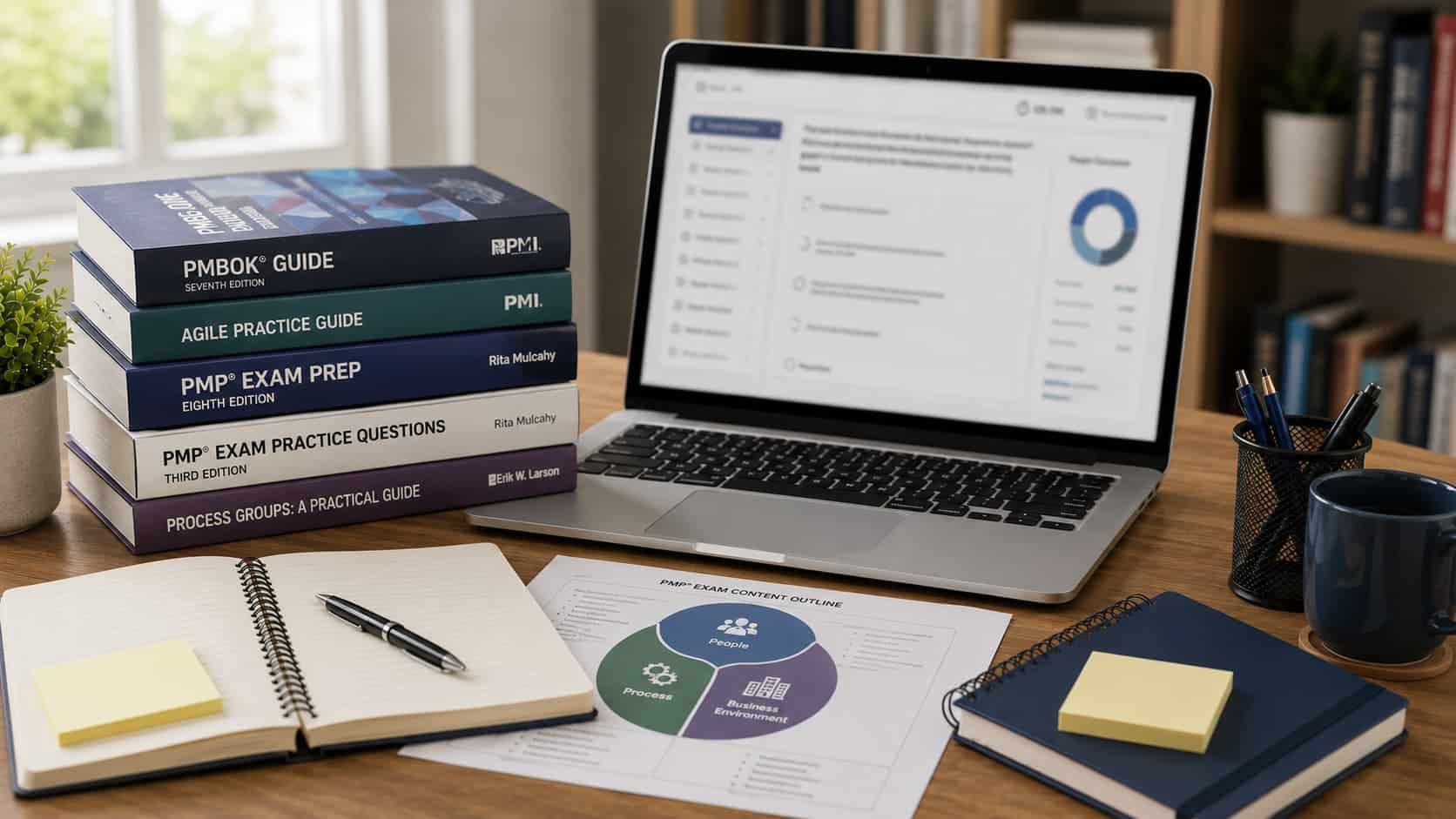
Free resources vary wildly in quality, and picking the wrong one can waste weeks of prep time on outdated content.
Here are top resources worth your attention, each one tested for accuracy against the current PMI exam structure:
1. Mometrix’s Free PMP Practice Exam
Mometrix offers a rotating set of scenario-based questions covering People, Process, and Business Environment, updated to reflect the current exam format.
Each question comes with a rationale explaining why the correct answer works and why the others fall short.
Use it early in your prep to gauge baseline knowledge, then revisit it weekly.
To optimize results, time yourself on each attempt rather than answering at a relaxed pace.
2. Andrew Ramdayal’s PMP Training Playlist
This playlist walks through different questions with full explanations, recorded specifically for the current PMP format.
Videos are grouped by difficulty and topic, so you can target weak domains instead of watching randomly. Pause after each question, attempt an answer yourself, then compare your reasoning to the explanation given.
Short daily sessions work better than binge-watching, since retention improves with spaced repetition rather than one long sitting.
3. Oliver Lehmann’s Free PMP Practice Questions
Oliver Lehmann’s question bank has circulated among PMP candidates for years and stays current with each exam update.
Questions lean heavily on judgment-based scenarios rather than simple recall, closely mirroring the real test’s tone.
Work through these in timed blocks of ten to fifteen questions, then review every explanation carefully, even for questions answered correctly, since the reasoning behind each option often reveals gaps in understanding.
4. PM Study Circle’s PMP Sample Questions
PM Study Circle organizes its free questions by knowledge area and difficulty, making it easy to isolate specific weak spots rather than testing everything at once.
The explanations reference specific PMBOK and Agile Practice Guide concepts, which helps connect individual questions back to broader principles.
Use this resource after your first practice test to target the exact domains where your score dipped, rather than working through it from start to finish.
5. Simplilearn’s Project Management YouTube Playlist
Simplilearn’s playlist blends concept walkthroughs with applied practice questions, which is useful when a topic needs reinforcement before you test yourself on it.
Videos cover both predictive and agile scenarios, matching the current exam’s blended approach.
Rather than watching passively, note down any question you get wrong and revisit that specific video segment later.
This turns a video resource into an active study tool instead of background viewing.
6. ExamCert’s Free PMP Practice Test
ExamCert provides a sizable free question bank with detailed explanations and domain-based filtering, letting you build a test around your weakest area.
Its format closely mirrors the actual exam’s multiple-choice and multiple-response style.
Set a personal benchmark score before starting, then retake the test after a week of focused review to measure genuine improvement rather than just familiarity with repeated questions.
7. PMP Exam Practice Questions Playlist
This playlist covers hundreds of walkthrough sessions on both PMP and CAPM material, which is useful if your prep also touches entry-level concepts.
Each video isolates a single question, explains the correct choice, and flags common wrong-answer traps.
Treat it as a supplement to full-length practice tests rather than a primary tool, using it to reinforce tricky concepts flagged during your other practice sessions.
Paid PMP Resources Worth Your Investment
Free questions build a base, but closing the final gap often takes a resource built for full simulation.
PM PrepCast Simulator: Thousands of ECO-aligned questions with domain-level performance analytics.
PMI Study Hall: PMI’s own official question bank, matched directly to current exam content.
Project Management Academy’s Exam Simulator: Over 1,700 questions with explanations for all options.
Andrew Ramdayal’s PMP Practice Exams on Udemy: Full-length exams with video walkthroughs for tricky questions.
Master of Project Academy’s PMP Bundle: Video training with 2,000+ practice questions and mock exams.
Simplilearn PMP Certification Training: Live instructor-led sessions with practice assessments, perfect for guided learners.
Pick one that matches your budget and study style, and let it carry you through the final stretch before exam day.
Download Your Free PMP Sample Questions PDF
This free PMP practice exam PDF gives you 46 exam-level questions.
Each one mirrors the scenario-based style of the real test. No fluff. No filler. Just questions and detailed explanations.
Every question maps to a specific PMI domain: People, Process, or Business Environment.
You get calculation-based questions on EVM, float, and TCPI. You also get judgment-based scenarios on leadership, risk, and stakeholder management. The answer key breaks down why each correct choice works.
It also explains why the other options fall short. Use it as a diagnostic tool.
Take it once, review your weak spots, then retake it before your actual exam date.
Your 6-Week PMP Exam Schedule: A Week-by-Week Plan
Cramming rarely works for an exam this scenario-heavy. Spreading your prep across six focused weeks builds real retention, and the table below maps out exactly where your energy should go each week:
Week | Focus Domain | Core Topics | Practice Target (Daily) | Milestone Check |
Week 1 | Process fundamentals | Scope, schedule, WBS basics | 20 questions | Score 60% |
Week 2 | Cost and risk management | EVM formulas, EMV, reserves | 30 questions | Score 65% |
Week 3 | People domain | Conflict, leadership, teams | 30 questions | Score 70% |
Week 4 | Agile and hybrid approaches | Sprints, velocity, backlogs | 30 questions | Score 70% |
Week 5 | Business environment | Compliance, benefits, strategy | 40 questions | Score 75% |
Week 6 | Full-length mock exams | Timed, mixed-domain practice | One full mock | Score 80% |
This pacing keeps every domain fresh right up to exam day, and each weekly milestone gives you a clear signal to move forward or slow down and review.
Mistakes that Quietly Sink First-Time Test Takers
Passing the PMP often comes down to avoiding a handful of predictable traps, not knowing more content.
Watch out for these common missteps:
Knowing that EAC equals BAC divided by CPI is meaningless if you freeze when a scenario hides the numbers in a story.
Many PMP questions have two correct answers, and missing the best one often results from rushing past key details.
Candidates who focus only on predictive methods get blindsided by the exam’s heavy blend of agile scenarios.
Relying on a single question bank narrows your exposure to PMI’s varied question styles and phrasing.
Technical questions feel safer to study, but leadership and conflict scenarios carry serious weight on the exam.
Reading calmly at home feels nothing like answering 180 questions inside a ticking clock, and pacing problems only surface under real time pressure.
Frequently Asked Questions (FAQ’s)
How Long Is the PMP Certification Valid For?
PMP certification is valid for three years; afterward, earn 60 PDUs and pay a renewal fee to maintain it.
What Happens If You Fail the PMP Exam?
You can retake the PMP exam up to three times within one year, though PMI requires a waiting period between each attempt.
How Many PDUs Are Required to Maintain PMP Certification?
PMP holders must earn 60 professional development units every three years, split across education and giving back to the profession.
What Is the Difference Between PMP And CAPM Certification?
CAPM suits entry-level professionals with limited experience, while PMP targets experienced project leaders who already manage teams and full project lifecycles.
How Long Does It Take to Get PMP Exam Results?
Most candidates receive PMP exam results immediately after finishing the test, showing an overall pass or fail with domain-level performance breakdowns.
Final Verdict
A PMP practice exam is the clearest way to see where preparation actually stands before test day.
Reviewing every question sharpens judgment on tricky scenario problems. Formulas stop feeling confusing once you practice them under a clock. Free resources build the foundation, while paid simulators further polish weak spots.
Agile scenarios, EVM math, and leadership questions all deserve equal attention.
Treat each PMP practice exam like a rehearsal for the real test.
Drop the toughest PMP question in the comments below and get direct answers.