
The MCAT covers a lot, from biochemistry pathways and amino acids to psychology theories and physics equations. Trying to memorize all of it can quickly feel overwhelming.
But you do not need every tiny detail in your head. What matters is knowing the concepts that actually show up on the exam and being able to recall them when you need them.
That is where MCAT review sheets come in. They bring the most important information together in a simple format, so you can spend less time sorting through notes and more time actually studying.
Keep reading to see how they can make your MCAT prep easier and more focused.
What are MCAT Review Sheets?
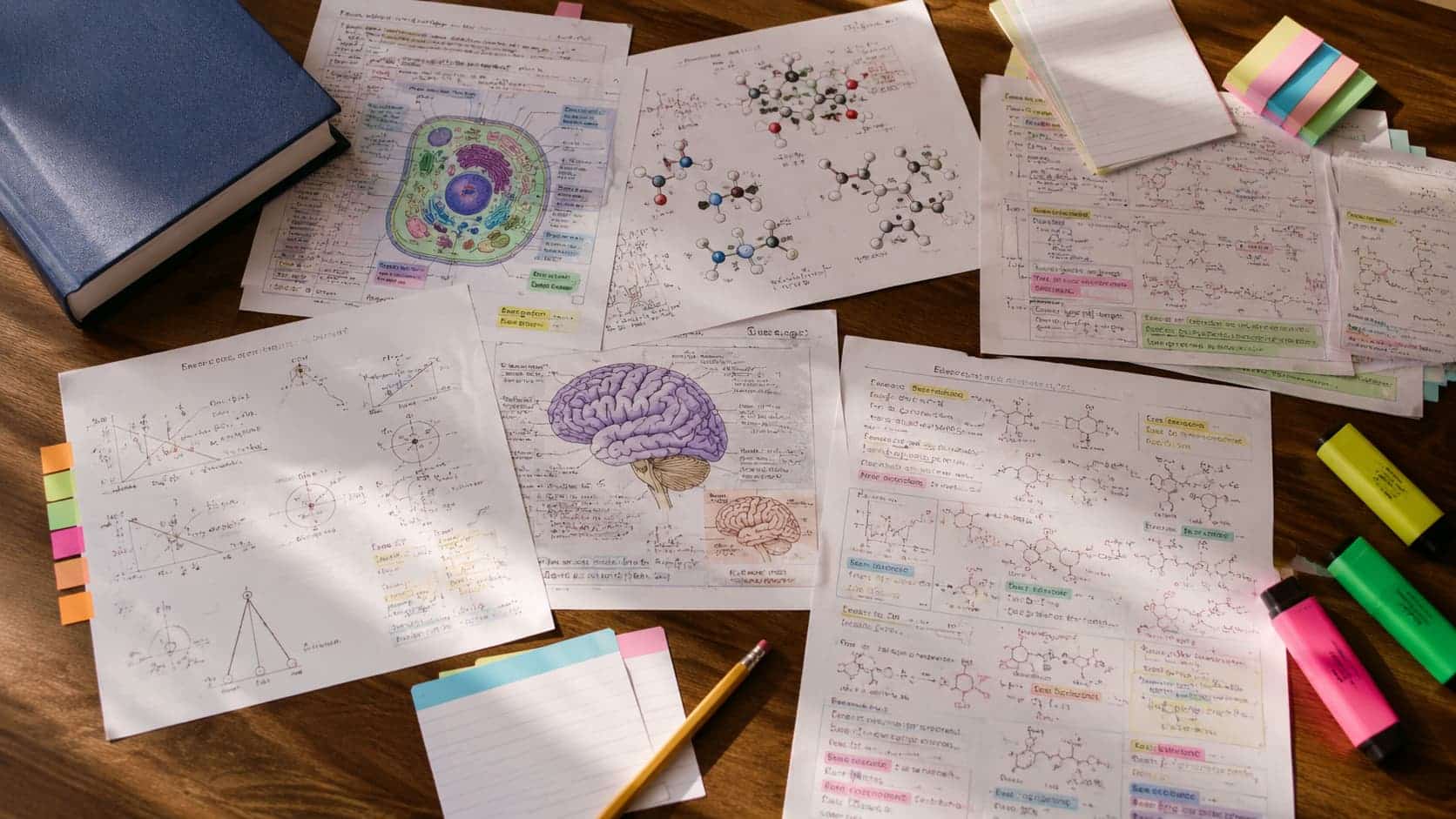
An MCAT review sheet is a condensed summary of high-yield concepts, formulas, and key facts. It is not a rewritten textbook or a dump of every lecture note. Think of it as a curated shortcut built for fast, focused revision.
Review sheets differ from full notes and flashcards in one important way: scope. Full notes capture everything. Flashcards test one concept at a time. A review sheet sits in between, giving students a bird’s-eye view of an entire subject on one page.
Strong MCAT cheat sheets include tested formulas, mnemonics, and topic-specific patterns that appear repeatedly on the exam. They skip filler and prioritize retention.
The best formats are one-pagers, section-specific sheets, or subject-by-subject breakdowns. A cluttered sheet with too much text defeats the purpose. If it takes more than a glance to find something, it needs editing.
Why Do MCAT Cheat Sheets Work Better Than Re-Reading Notes?
Re-reading your notes for the third time feels productive. But research shows it is one of the least effective study strategies for high-stakes exams.
- The Retrieval Advantage: Pulling information from memory strengthens recall far more than passively rereading it.
- Re-Reading Falls Short: Students often confuse familiarity with actual knowledge, leading to poor performance under pressure.
- Condensed Beats Comprehensive: A focused one-page sheet forces your brain to process only what truly matters for the exam.
- Active Recall in the Final Weeks: Cheat sheets work best in the last four to six weeks when reinforcing high-yield content daily.
Knowing why cheat sheets work is just the start. The next step is finding the right ones to use.
Best MCAT Review Sheets Students Recommend on Reddit
When it comes to MCAT prep, textbooks and question banks only take you so far. A good review sheet is what ties everything together.
Here is a closer look at the best review sheets out there:
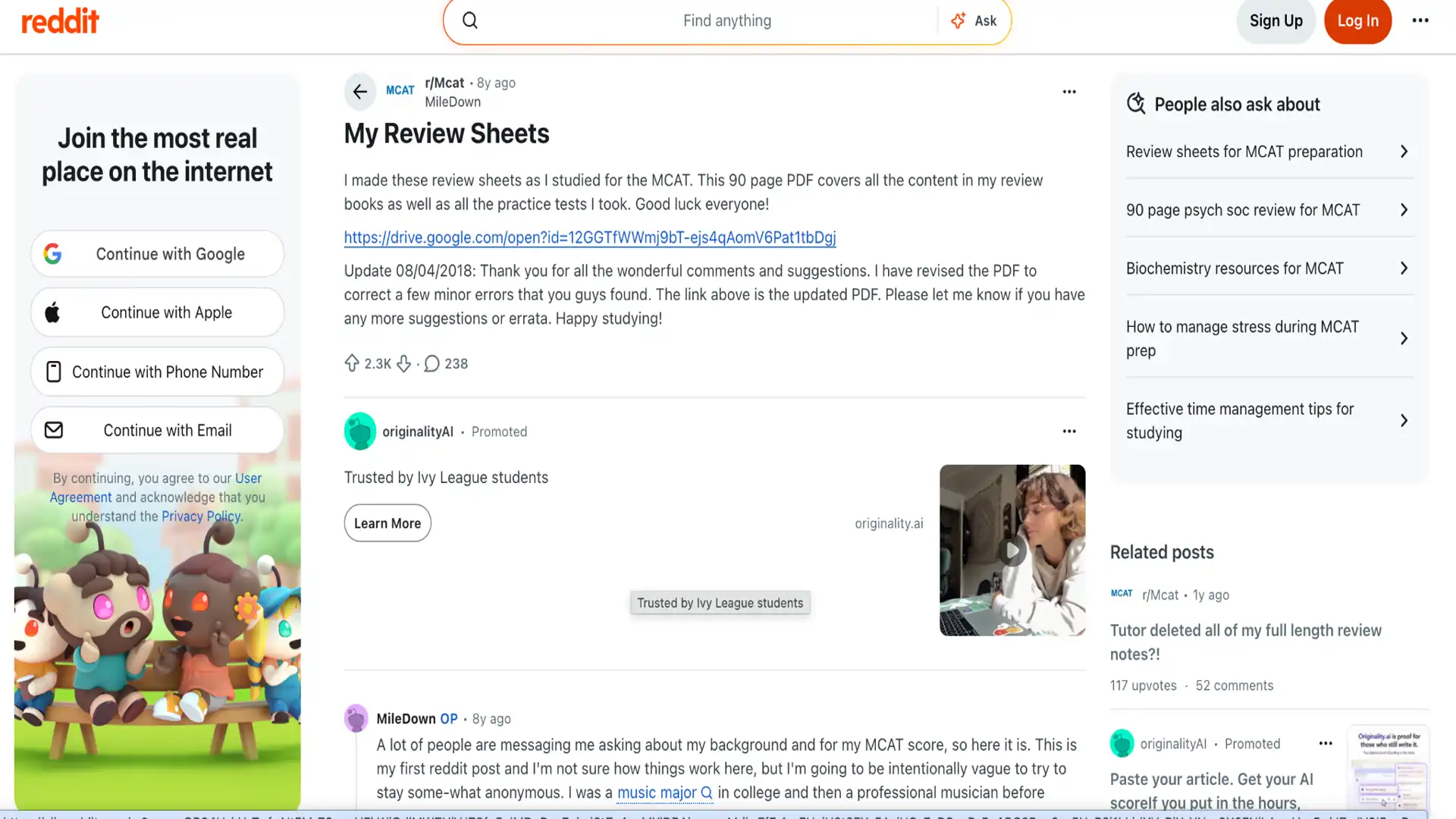
1. MileDown MCAT Review Sheets
- Topics Covered: General Chemistry, Biology, Biochemistry, Physics, Organic Chemistry, Psychology, and Sociology.
- Why Students Love It: A student-built resource created during real MCAT prep, which means it reads the way a peer explains things rather than a textbook.
Ideal for quick content refreshers in the final days before the exam, and the relatability factor keeps dense material digestible.
Gaps exist in niche biochemistry pathways and certain psychology subfields, so pairing them with a secondary resource is strongly recommended wherever any subject feels unclear.
2. Kaplan MCAT Quick Sheets
- Topics Covered: General Chemistry, Biology, Biochemistry, Physics, and Organic Chemistry.
- Why Students Love It: Professionally designed and free, making it a high-yield resource students use for content review or as a starting-point overview before the exam.
Once the content review is solid, the sheets are phenomenal for quickly refreshing information without having to return to detailed notes.
Psych/Sociology coverage is limited, so pairing with a secondary resource for behavioral sciences is strongly recommended.
3. MedLife Mastery Cheat Sheets
- Topics Covered: Biochemistry, Biology, Physics, Organic Chemistry, General Chemistry, and Psychology/Sociology.
- Why Students Love It: Created by top MCAT scorers, these beautifully designed downloadable PDFs blend content with test-day strategy, something most sheets skip entirely.
A free 17-page mnemonic guide shortcuts your way to content mastery and is widely praised for its approachable format.
You need a free account to access it. Your weakest sections benefit most here, but pairing with a content-heavy resource fills any remaining gaps.
4. Gold Standard MCAT Pull-Out Science Summaries
- Topics Covered: Biochemistry, Physics, General Chemistry, and Organic Chemistry.
- Why Students Love It: These full-color, glossy pull-out pages come bundled with seven full-length MCAT practice tests and 1,610 questions formatted exactly like the real AAMC exam.
Your review sheets and practice tests come together in a single package, making targeted last-minute review highly efficient.
Keep in mind that it is a paid resource, and sociology is not included in the pull-out summaries, so you will need separate resources to cover these sections before test day.
More MCAT Resources Worth Bookmarking
Beyond the sheets already covered, these resources cover everything from visual mnemonics to official AAMC content alignment, and each one serves a distinct role in your review strategy:
5. UWorld MCAT Physics and Chemistry Formula Sheet
- Topics Covered: Physics and General Chemistry.
- Why Students Love It: A free formula sheet outlining the physics and chemistry equations you need for a top score. It pairs directly with UWorld’s QBank, reinforcing formulas through application rather than passive reading.
Best for students in the final two weeks who want a clean, scannable physics and chemistry reference without having to sift through textbook chapters.
It may lack deeper conceptual explanations and is limited to physics and chemistry only, without broader MCAT coverage.
6. Sketchy MCAT
- Topics Covered: Biology, Biochemistry, General Chemistry, Organic Chemistry, Physics, Psychology, and Sociology.
- Why Students Love It: Sketchy uses storytelling and visuals across MCAT topics with 1,000+ lessons and 6,000+ questions for practice-based learning.
If you are a visual learner who struggles to retain content through reading alone and want storytelling-based lessons that you can revisit repeatedly, then this is the one.
CARS is not included in the core Science Review program and is only available through the bundled Prep Essentials package, which considerably increases the total cost.
7. Picmonic for MCAT
- Topics Covered: Biochemistry, Biology, Psychology, and Sociology.
- Why Students Love It: Picmonic uses audiovisual mnemonics to support faster recall and stronger retention compared to traditional text-based MCAT study methods.
Best for students who have finished content review and want a fast, memorable way to lock in high-yield Biology and Psych/Soc facts.
Physics and CARS are not covered. Picmonic works best as a supplement rather than your primary review tool.
8. MileDown Anki Deck
- Topics Covered: Biology, Biochemistry, General Chemistry, Organic Chemistry, Physics, Psychology, and Sociology.
- Why Students Love It: One of the most popular MCAT decks in the Anki community, with 2,900 cards divided into seven subdecks and linked to Khan Academy or YouTube wherever possible.
It is a free, well-organized spaced-repetition deck that covers the full exam without needing to build their own cards from scratch.
The deck was built in 2018, so certain concepts may be outdated or absent; cross-referencing against the current AAMC outline is strongly recommended.
9. Princeton Review MCAT Tear-Out Cheat Sheet
- Topics Covered: Biology, Biochemistry, Organic Chemistry, General Chemistry, Physics, Mathematics, Psychology, and Sociology.
- Why Students Love It: A full-color tear-out reference sheet covering key formulas, diagrams, concepts, and charts across all MCAT sections, included in a boxed set with multiple subject guides and online practice tests.
If you prefer a single physical book investment that doubles as both content review and a compact, tear-out summary for test-week use, then it is the best option out there.
The cheat sheet is not sold separately; you must purchase the full book to access it, which may not suit students who only need the reference material.
10. AAMC MCAT Content Outline
- Topics Covered: Biology, Biochemistry, General Chemistry, Organic Chemistry, Physics, Psychology, Sociology, and CARS.
- Why Students Love It: This resource outlines all MCAT competencies across core concepts, content categories, and reasoning skills, and includes 120 free practice questions from the retired Official Guide.
If you want to audit your existing review sheets against what the AAMC officially tests. Check all the boxes you have covered.
It is not a review sheet in the traditional sense; depth per topic is thin, and niche subtopics are often listed without explanation, making it insufficient as a standalone resource.
11. JackSparrow2048 Anki Deck
- Topics Covered: Biology, Biochemistry, General Chemistry, Organic Chemistry, Physics, Psychology, Sociology, and CARS.
- Why Students Love It: An MCAT Anki deck covering all subjects and equations, created by a high scorer and known for its detailed, high-yield content across every section.
Best for advanced students targeting 515+ who want the most thorough free Anki deck available and are comfortable doing some deck maintenance along the way.
The deck was never intended for public release, so formatting is uneven, and some cards contain errors; plan to edit and filter as you go.
12. Khan Academy MCAT Collection
- Topics Covered: Biology, Biochemistry, General Chemistry, Organic Chemistry, Physics, Psychology, and Sociology.
- Why Students Love It: Created with AAMC support, this collection includes 1,100 videos and 3,000 review questions covering all four sections of the exam, all completely free with no account required.
If you need clear, free video explanations for subjects that you struggled with in coursework, particularly Biology and Biochemistry, it is the one.
Explanations can occasionally oversimplify concepts tested at the passage level, and the CARS strategy is not meaningfully covered through videos alone.
13. Blueprint MCAT Free Study Guides
- Topics Covered: Biology, Biochemistry, General Chemistry, Organic Chemistry, Physics, Psychology, Sociology, and CARS.
- Why Students Love It: Blueprint’s free guides provide section-wise MCAT overviews, high-yield topics, resource lists, a CARS guide, and 50+ mnemonic concepts for quick review.
Ideal for early-stage students who want a clear section-wise overview before moving into a full MCAT content review resource.
The guides are section-level overviews rather than dense content sheets; they orient your studying but do not replace subject-specific review.
14. UWorld MCAT QBank
- Topics Covered: Biology, Biochemistry, General Chemistry, Organic Chemistry, Physics, Psychology, Sociology, and CARS.
- Why Students Love It: UWorld offers 3,000+ questions that closely match MCAT logic and difficulty, making test day feel like practice, while My Notebook helps organize key explanations for review.
Best for students in Weeks 3 and 4 of a 30-day plan who want to drive review through practice-based error correction rather than passive content re-reading.
It is a subscription platform rather than a static sheet; students who prefer printable references will need to build their own summaries from UWorld’s explanations.
15. MCATBros Free Review Notes
- Topics Covered: Psychology/Sociology, Biology, Physical and Chemical Systems, and Lab Techniques, structured around all three MCAT sections.
- Why Students Love It: The 300-page Psychology/Sociology notes, built from Khan Academy transcripts, became one of the most widely used P/S resources in the pre-med community.
All materials are free to access after a no-cost sign-up, with print versions available at a nominal fee for students who prefer physical copies.
Science section notes are thorough but work best alongside active practice rather than as a standalone
Free vs. Paid MCAT Review Sheets: Is It Worth Spending?
Choosing between free and paid MCAT review sheets trips up many students.
Here’s a clear breakdown to help you decide what’s actually worth your money.
Factor | Free Sheets | Paid Sheets |
Content Coverage | Core concepts, commonly tested topics | Comprehensive, section-specific, regularly updated |
Accuracy | Varies by source; always verify | Reviewed by MCAT experts and educators |
Format & Design | Basic; sometimes cluttered | Clean, structured, easy to scan |
Customization | Limited; use as-is | Some include editable versions |
Best For | Budget-conscious students, early prep | Final stretch, high-stakes revision |
Popular Examples | MileDown, Reddit community sheets | Kaplan, Bootcamp, MedLife Mastery |
Cost | Free | Ranges from affordable to premium |
Paid sheets offer polish and depth, but free resources paired with your own additions can be just as powerful. Your study strategy matters far more than your budget.
How to Build Your Own MCAT Cheat Sheet?
Pre-made sheets give you a starting point, but building your own forces your brain to process, prioritize, and retain; that active effort is studying in itself.
- Start With Your Weak Spots, Not Your Strengths: Pull directly from practice test results. Flag every concept you missed more than once; those repeated misses are your sheet content.
- One Subject Per Sheet: Keep biochem, physics, and psychology completely separate. Mixed sheets become cluttered and rarely get opened during review.
- Prioritize White Space: Leave breathing room between concepts so your eyes move quickly. A cramped sheet slows down review and kills retention.
- Keep Color-Coding Simple: Assign one color per system or theme, nothing more. Overcomplicating the color system defeats the purpose entirely.
- Choose Tools That Match Your Style: Handwritten sheets build stronger retention; Notion or Google Docs allow easy updates as weak spots shift. Pick function over aesthetics.
Use this approach consistently across all four weeks of your 30-day strategy, and your cheat sheets will become one of your strongest MCAT revision assets.
30-Day MCAT Review Sheet Strategy
The final 30 days before your MCAT demand structure, not cramming. This plan breaks your last month into four focused weeks, covering content, practice, and memorization, with daily schedule tasks:
Phase | Daily Schedule | Resources | Review Sheet Strategy |
Week 1 | 3 hrs content + 1 hr review | Kaplan, Princeton Review books | Build one sheet per subject daily |
Week 2 | 3 hrs weak areas + 1 hr sheets | AAMC Content Outline | Add mnemonics, diagrams, and key terms |
Week 3 | 1 full-length + 2 hr error review | Practice Exams, UWorld | Flag missed topics; revise sheets |
Week 4 | 2 hrs active recall daily | Sketchy, Picmonic, Anki | Condense all sheets to one-pagers |
Resource Rotation | Alternate Anki + textbook daily | UWorld, Sketchy, Princeton | Cross-reference sheets with missed Qs |
Sheet Integration Rule | Review all sheets every Sunday | All accumulated resources | Consolidate, color-code, prioritize |
Mistakes That Make Your Cheat Sheets Useless
A cheat sheet can either sharpen your prep or quietly derail it. The difference usually comes down to a few habits most students don’t catch until it’s too late.
- Cramming Too Much Content: Your sheet becomes another textbook, defeating its entire purpose.
- Passive Rereading Only: Skimming your sheet without actively recalling trains your eyes, not your memory.
- Wrong Timing: Starting sheets too early results in outdated gaps; starting too late leaves no time to use them.
- No Self-Testing Habit: A sheet you read but never get tested on builds false confidence fast.
- Copying Low-Yield Topics: Spending time on rarely tested content crowds out what actually matters on exam day.
The goal of your MCAT review sheets is not to feel prepared. It’s to actually be prepared. Fix these habits early, and your sheets will work the way they’re supposed to.
The Bottom Line
No review sheet does the work for you, but the right one puts everything you need within reach when it matters. MCAT review sheets are only as powerful as the strategy behind them.
You’ve seen what works, what doesn’t, and how to build a system that actually holds up under pressure.
Now it’s your turn to put it into practice.
Have a go-to sheet that made a real difference in your prep? Share it in the comments; your recommendation might be exactly what another student needs right now.
Frequently Asked Questions (FAQs)
Can MCAT Review Sheets Replace Full Content Study Books?
Review sheets are a recall tool, not a teaching tool. They work best after you have already studied the full content. Using them as your only resource leaves critical gaps in your understanding of concepts.
How Many Pages Should an MCAT Review Sheet Be?
There is no perfect number, but high-scoring students tend to use sheets ranging from 15 to 90 pages. Anything longer starts to resemble notes, which defeats the purpose entirely.
When Should You Start Using MCAT Review Sheets in Your Study Plan?
Introduce them mid-prep after your first full content pass. Then rely on them heavily in the final four to six weeks as a rapid recall and gap-filling tool.