


Most students spend hours studying every grammar rule they can find and still lose easy points on the ACT English section.
The problem is not how much time they put in. It is what they are spending that time on.
The ACT doesn’t test all of grammar. It tests a specific set of rules, over and over, in predictable ways.
Once you know which rules matter most, your score can improve faster than you would expect.
This blog breaks down the exact ACT grammar rule categories, the trap questions that trip up even prepared students, common errors, and a quick checklist you can use before test day.
Where ACT Grammar Rules Fit in the Exam
The ACT exam measures students’ skills in English, Math, Reading, Science, and an optional Writing section.
The English section is the first part of the test and includes questions based on passages that check grammar, punctuation, sentence structure, and writing clarity.
Following the 2025 Enhanced ACT redesign, the English section now gives 35 minutes for 50 multiple-choice questions, about 42 seconds per question on average.
Topics like agreement, pronouns, punctuation, modifiers, verb tense, and sentence structure are tested repeatedly in predictable patterns.
ACT grammar rules play a major role in this section because many questions focus on identifying and correcting errors in sentences.
ACT English Test Categories and Grammar Weight
As per ACT, Inc.’s official description of the English test, the section is scored across three reporting categories, and grammar rules make up the largest share of two of them:
| Reporting Category | Share of Questions | What It Covers |
|---|---|---|
| Conventions of Standard English | 38-43% | Sentence structure, punctuation, and usage, home base for most ACT grammar rules |
| Production of Writing | 38-43% | Purpose, organization, and topic development |
| Knowledge of Language | 18-23% | Precision, concision, and consistent tone |
This breakdown matters for pacing: since Conventions questions alone can make up over 40% of the section.
A student who locks down grammar rules first is already covering the single largest reporting category before touching style and organization.
ACT Grammar Rules to Know
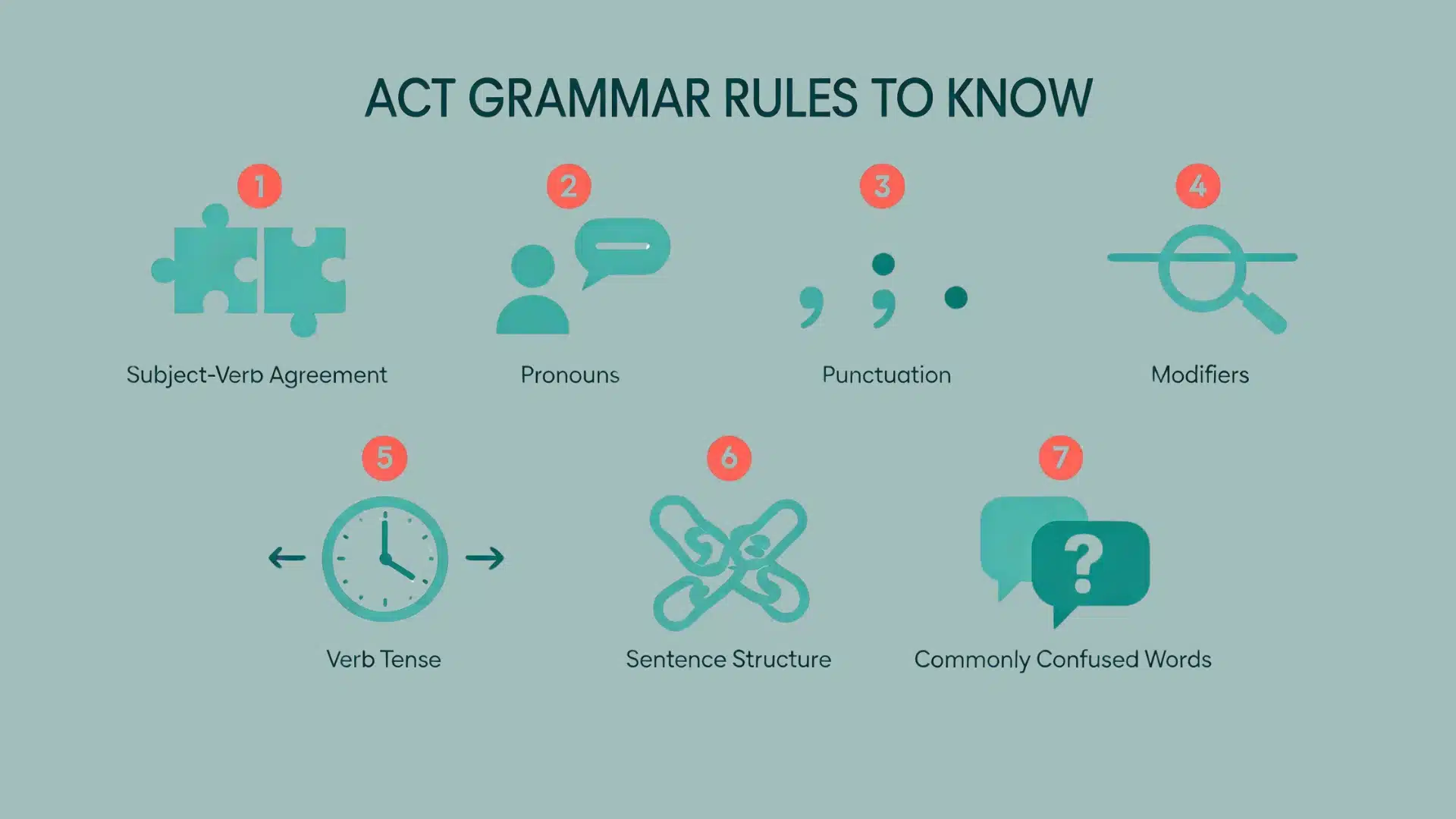
Learning these rules does not just help with one or two questions. It builds the kind of pattern recognition that makes the entire English section faster and more accurate.
The rules covered below are among the most tested on the exam. Work through each one and watch how quickly the section starts to feel more manageable.
1. Subject-Verb Agreement
Subject-verb agreement means the verb must match its subject, not the nearest noun, not the longest phrase, just the actual subject.
The ACT skips the easy cases and goes straight for the tricky ones.
Core rules to know:
- Intervening phrases are distractors: Ignore the words that sit between the subject and the verb. Find the real subject first, then pick the verb.
- Collective nouns take a singular verb: Words like “team,” “committee,” and “group” act as one unit and always use a singular verb.
- Indefinite pronouns are singular: “Everyone,” “each,” “either,” and “nobody” take singular verbs, no exceptions.
- With “either/or” and “neither/nor,” match the verb to the closer subject: Whichever subject sits closest to the verb controls the verb form.
Common Error Patterns:
| Incorrect | Correct |
|---|---|
| The results of the experiment was surprising. | The results of the experiment were surprising. |
| The team are playing well this season. | The team is playing well this season. |
| Each of the students are responsible. | Each of the students is responsible. |
2. Pronouns
The ACT tests three core pronoun issues: whether the pronoun matches its antecedent, whether it clearly refers to one specific noun, and whether the correct pronoun case is used.
These errors are easy to miss because incorrect sentences often sound natural when read quickly.
Core Rules to Know:
- Pronouns must agree with their antecedent: A singular noun takes a singular pronoun, and a plural noun takes a plural pronoun.
- Ambiguous pronoun reference is a common trap: If a pronoun could refer to more than one noun in the sentence, the ACT will flag it as an error.
- Pronoun case must be correct: Use subject pronouns like “he” and “she” for subjects and object pronouns like “him” and “her” for objects.
- Indefinite pronoun antecedents are always singular: When the antecedent is “everyone,” “each,” or “anyone,” the pronoun referring to it must also be singular.
Common Error Patterns:
| Incorrect | Correct |
|---|---|
| The stack of books were left on the desk. | The stack of books was left on the desk. |
| The committee made their decision. | The committee made its decision. |
| Me and John finished the project. | John and I finished the project. |
3. Punctuation
Commas appear most often and cover comma splices, nonessential clauses, and sentence boundaries.
Semicolons and colons test how well two clauses are connected, and apostrophes come down to possession versus contraction.
Core Rules to know:
- A semicolon joins two independent clauses: Both sides must be able to stand alone as complete sentences.
- A colon introduces a list, explanation, or example: It must be preceded by an independent clause.
- Apostrophes show possession for nouns: They are never used with possessive pronouns like “its,” “their,” or “whose.”
- Commas are required around nonessential clauses: Used after introductory phrases and before coordinating conjunctions in compound sentences.
Common Error Patterns:
| Incorrect | Correct |
|---|---|
| The exam was hard, she still scored well. | The exam was hard; she still scored well. |
| The student, who studied hard passed. | The student who studied hard passed. |
| She brought snacks; chips and juice. | She brought snacks: chips and juice. |
4. Modifiers
The ACT tests two modifier problems: dangling modifiers and misplaced modifiers. A dangling modifier has no clear subject to describe.
A misplaced modifier is too far from the word it is supposed to modify, making the sentence awkward or illogical.
Core Rules to know:
- Keep modifiers close to what they describe: The modifier must sit as close as possible to the word it describes. Distance between the two creates confusion and errors.
- Introductory phrases must modify the subject right after the comma: Whatever opens the sentence must logically describe the noun or pronoun that immediately follows the comma.
- A missing subject means a dangling modifier: If the word being modified does not appear in the sentence at all, the modifier is dangling, and the entire sentence needs to be rewritten.
Common Error Patterns:
| Incorrect | Correct |
|---|---|
| Running to the bus, the rain soaked her. | Running to the bus, she got soaked in the rain. |
| She almost drove her kids to school every day. | She drove her kids to school almost every day. |
| Visiting relatives can be exhausting. | Visits from relatives can be exhausting. |
5. Verb Tense
The ACT tests verb tense by embedding tense shifts inside longer passages where they are easy to miss.
The rule is simple: tense must stay consistent unless the meaning of the sentence genuinely requires a change.
Core Rules to know:
- Tense consistency is non-negotiable: Tense must stay the same throughout a passage unless the sentence clearly signals a shift in time through context.
- Mixing past and present tense is always an error: Switching between past and present tense within the same sentence or paragraph will be flagged as wrong on the ACT every time.
- Perfect tenses signal sequence, not just completion: Forms like “had finished” or “had left” tell the reader that one action happened before another. Use them only when the order of events actually matters.
Common Error Patterns:
| Incorrect | Correct |
|---|---|
| She studied hard and goes to bed early. | She studied hard and went to bed early. |
| By the time he arrived, she left already. | By the time he arrived, she had already left. |
| He walks into the room and said hello. | He walked into the room and said hello. |
6. Sentence Structure: Fragments, Run-Ons, and Comma Splices
Sentence structure questions show up more often on ACT English than any other single grammar category, so a fragment or run-on buried in a long sentence can cost more points than a single wrong pronoun.
Core rules to know:
- A complete sentence needs a subject, a verb, and a full thought: Missing any piece turns the sentence into a fragment, even if it reads long enough to sound complete.
- A comma alone cannot join two complete thoughts: Connecting two independent clauses with only a comma creates a comma splice, a specific type of run-on.
- Participial phrases often disguise fragments: An “-ing” or “-ed” phrase can look like a full sentence while lacking an actual subject-and-verb pair.
- Semicolons, periods, and conjunctions fix run-ons: Pick the option that turns two complete thoughts into two correctly joined or separated sentences.
Common Error Patterns:
| Incorrect | Correct |
|---|---|
| Running through the park on a sunny afternoon. | She was running through the park on a sunny afternoon. |
| The bus was late, we still made it to the exam on time. | The bus was late, but we still made it to the exam on time. |
| Because the passage confused half the class. | The passage confused half the class because the wording was unclear. |
7. Commonly Confused Words
The ACT tests word pairs that sound alike or look alike but do different grammatical jobs, and missing the difference is an easy way to lose a point on an otherwise clean sentence.
Core rules to know:
- “Its” vs. “it’s “: “its” shows possession, and “it’s” is a contraction for “it is” or “it has.” Never use an apostrophe to make “it” possessive.
- “Their,” “there,” and “they’re “: “their” shows possession, “there” points to a place, and “they’re” is a contraction for “they are.”
- “Then” vs. “than”: “then” marks time or sequence, and “than” sets up a comparison.
- “Affect” vs. “effect”: “affect” is almost always a verb meaning to influence, and “effect” is almost always a noun meaning a result.
- “Who” vs. “whom”: “who” acts as the subject of a clause, and “whom” acts as the object.
Common Error Patterns:
| Incorrect | Correct |
|---|---|
| The dog wagged it’s tail. | The dog wagged its tail. |
| Their going to the game later. | They’re going to the game later. |
| She studied harder then her friend. | She studied harder than her friend. |
| The medication will effect his focus. | The medication will affect his focus. |
ACT Grammar Rules: Test Strategies
ACT grammar rules become faster to apply with practice, and with the right English test tips, one can ace the section.
If a question feels unclear after two reads, eliminate the obviously wrong options, make a choice, and move on. These strategies help boost the ACT grammar section score:
- Always read the full sentence, not just the underlined part: The underlined portion is where the error lives, but the sentence around it tells what the error actually is.
- Identify the rule being tested before picking an answer: A habit that carries over into broader ways to improve test scores across every ACT section, not just English.
- Do not skip questions: There is no wrong answer penalty on the ACT, so never leave any question blank.
- Simulate real test conditions during practice: Timed practice builds the kind of stamina and speed that shows up on test day.
- Keep track of mistakes and the grammar rules behind them: Over time, patterns emerge. Targeting those patterns in practice is far more effective than broad, unfocused studying.
ACT Grammar Practice: Building a Study Plan That Works
A structured ACT practice plan makes the difference between scattered studying and real score gains.
Spend the first week drilling individual grammar rules and the second week applying them under timed conditions by solving ACT English practice test questions.
| Phase | Task | What to Avoid |
|---|---|---|
| Days 1-3 | Study one grammar rule per day: subject-verb agreement, pronouns, punctuation. | Trying to study all rules at once. One rule per day sticks better. |
| Days 4-5 | Targeted drills on rules covered; focus only on error correction. | Moving on without understanding why each answer was wrong. |
| Days 6-7 | One full timed passage set review; review every wrong answer and log the rule behind each mistake. | Skipping the error log. |
| Days 8-10 | Repeat rule drills for weak areas identified in the error log | Drilling strong areas instead of the ones the error log flagged. |
| Days 11-12 | Two full timed passage sets back to back, pacing to about 7 minutes per passage | Pausing between passages. |
| Days 13-14 | Final review of error log and quick checklist. No new material, only reinforce what is already known. | Introduce new topics or rules. This phase is only for reinforcement. |
ACT Grammar Rules: Quick Review Checklist
The night before the test is not the time to learn new material. It is the time to make sure everything already studied is locked in.
These four steps work best as a routine:
- Review the core rule list: Go over subject-verb agreement, pronouns, punctuation, modifiers, and verb tense one final time.
- Revisit common trap patterns: Intervening phrases, ambiguous pronouns, comma splices, and tense shifts are the ones that cost the most points.
- Run one last timed practice set: Simulate real test conditions. Give yourself 45 minutes, no pauses, no looking anything up.
- Check the error log: Find every rule that came up more than once in wrong answers and do a final quick review of that rule only.
For the timed ACT grammar practice phase, work through full timed passages rather than only isolated rule drills, since applying rules under real time pressure is closer to the best way to study.
Conclusion
The ACT English section is winnable, and grammar is where the points are easiest to lock in.
Working through subject-verb agreement, pronouns, punctuation, modifiers, and verb tense one rule at a time builds the kind of accuracy that holds up under time pressure.
Pairing that with a structured practice plan and smart test-taking strategies is what turns preparation into results.
Use the checklist, stick to the practice plan, and trust the prep.
Have a grammar rule or ACT English strategy that helped improve your score? Share your experience in the comments.
Frequently Asked Questions
How Long Should I Study ACT Grammar Rules Each Week?
Three to four sessions per week, 20 to 30 minutes each, is enough for steady improvement. Consistency matters more than long study sessions.
Is the ACT English Section Hard?
It is manageable once the core rules are learned. The challenge is speed, not difficulty. The same grammar patterns repeat across every test, so focused preparation makes a significant difference.
Can I Improve My ACT English Score by Focusing only on Grammar?
Yes, significantly. Grammar questions make up the largest portion of the English section. Mastering the core ACT grammar rules alone can lead to a noticeable score improvement without touching rhetorical skills.