

Preparing for a challenging physics exam can feel confusing, especially when you are unsure what kinds of questions you will face on test day.
Many students spend hours reviewing concepts but still wonder if their practice matches the real exam experience.
Working through an AP Physics C Mechanics practice test can help bridge that gap by giving you a clearer sense of the question style, difficulty level, and problem-solving approach needed for success.
Below, you will find practice question resources, expert tips, a study schedule, and a free downloadable PDF.
What is the AP Physics C: Mechanics Exam?
The AP Physics C: Mechanics Exam assesses advanced physics knowledge, covering motion, forces, energy, momentum, rotation, and calculus-based problem-solving.
Before diving into practice tests, it helps to understand exactly what you are preparing for. Knowing its structure upfront helps you study smarter, not just harder:
Feature | Section 1: MCQ | Section 2: FRQ |
|---|---|---|
Format | Multiple-choice questions | Free-response questions |
Questions | 42 questions | 4 questions |
Time Allowed | 85 minutes | 95 minutes |
Calculator | Permitted | Permitted |
Score Weight | 50% of the total score | 50% of the total score |
Scoring Scale | Combined composite score | Scored on a 1-5 scale |
Many students weighing how AP Physics 1 compares in difficulty find that the calculus requirement is the biggest jump between the two courses.
What Topics Appear Most on the AP Physics C Mechanics Exam?
The College Board’s Course and Exam Description makes it clear that not all units deserve equal study time. Here’s how the weight is distributed:
Kinematics (10-15%): Covers motion in one and two dimensions, including derivatives and integrals of velocity and acceleration.
Force and Translational Dynamics (20-25%): The heaviest unit on the exam. Expect free-body diagrams, net force problems, Newton’s laws, constraint systems, and friction throughout.
Work, Energy, and Power (15-25%): Centers on the work-energy theorem, conservative forces, potential energy functions, and power.
Linear Momentum (10-20%): Covers center of mass, impulse, and elastic and inelastic collision problems.
Torque and Rotational Dynamics (10-15%): Includes torque, moment of inertia, angular acceleration, and rotational kinematics. Questions here are frequent and often multi-part.
Energy and Momentum of Rotating Systems (10-15%): Focuses on rotational kinetic energy, angular impulse, and conservation of angular momentum.
Oscillations (10-15%): Focuses on simple harmonic motion, spring-mass systems, and pendulums. These concepts often appear in energy problems.
Building your study plan around the exam’s actual weighting helps you prioritize concepts most likely to appear in both multiple-choice and free-response questions.
Best AP Physics C Mechanics Test Resources
Not all practice resources are equal. Using the wrong ones wastes time and builds false confidence. The resources below are either fully official or widely trusted.
Disclaimer: Some sample practice tests may reflect an older exam format, so use them for question practice while following the latest official AP Physics C: Mechanics exam pattern and timing.
1. College Board Past Free-Response Questions
AP Central publicly releases the three most recent years of free-response exam materials. Each download includes the questions, scoring guidelines, sample student responses, and scoring distributions.
Starting in 2021, the College Board introduced two separate exam sets per year, giving you more material to work with. Focus on how graders award partial credit.
Studying scored sample responses teaches you what a strong answer actually looks like.
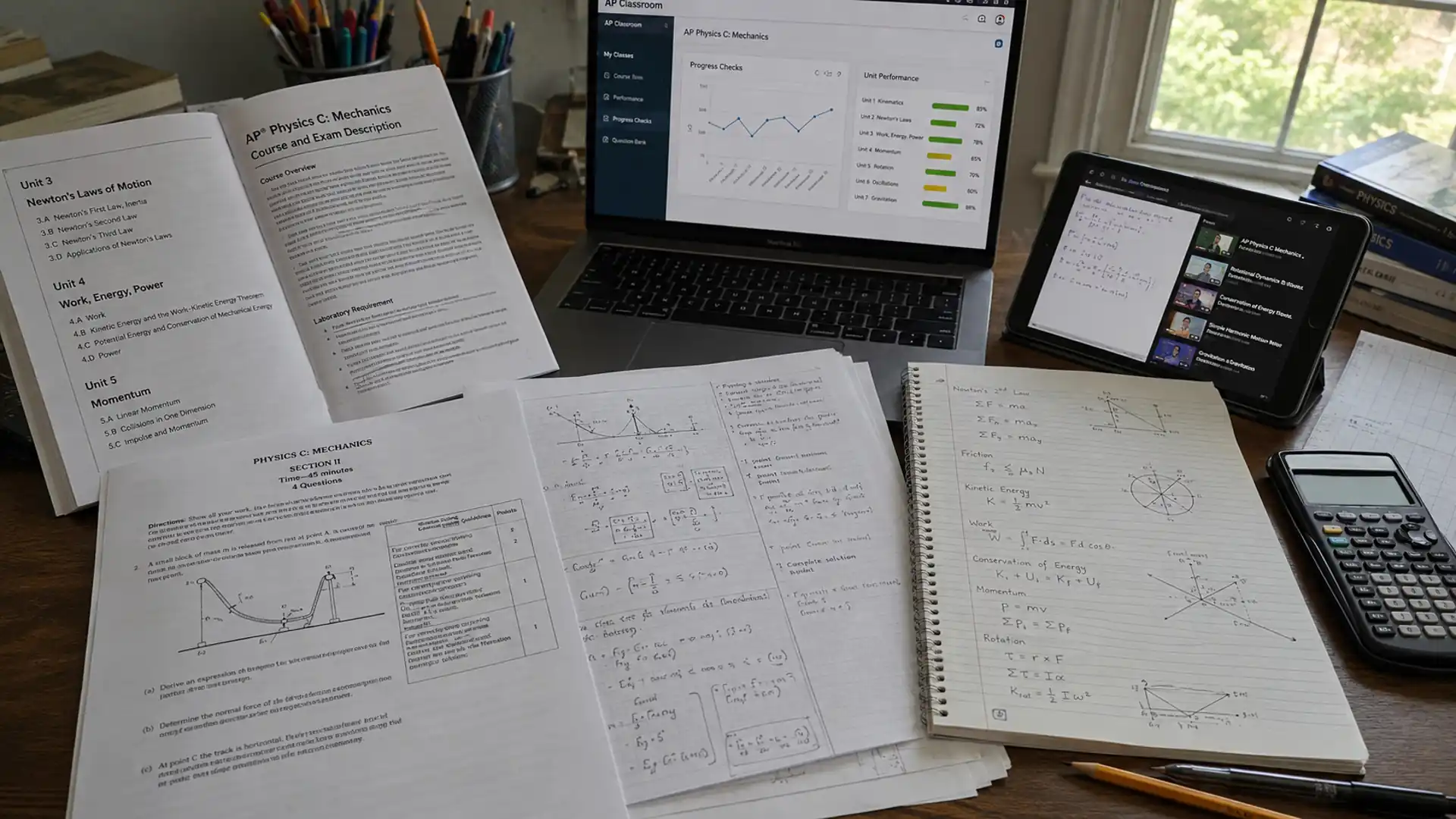
2. AP Classroom
Once you join your AP class section online, you can access videos, teacher assignments, and your results inside AP Classroom.
Each unit includes Progress Checks with MCQs and all four FRQ types: Mathematical Routines, Translation Between Representations, Experimental Design, and Qualitative/Quantitative Translation.
You need a College Board account linked to an active AP class section.
The pacing habits built from AP World multiple-choice practice sets carry over well, since discrete-question strategy transfers even when the content doesn’t.
3. AP Physics C: Mechanics Practice Workbook (via Gonzmosis)
This PDF is a compiled workbook of official College Board problems organized by topic.
It covers all major Mechanics units: kinematics, dynamics, work and energy, momentum, rotation, gravitation, and oscillations. Each chapter includes both multiple-choice and free-response questions with full answer keys.
Use it to drill topic by topic rather than jumping between units. The problems vary in difficulty, making it useful at any stage of your prep.
4. CrackAP
CrackAP.com hosts a series of free, topic-specific practice tests for AP Physics C: Mechanics, organized by unit rather than by full-length exam, covering everything from kinematics through rotation and gravitation.
It is not an official College Board resource, so treat it as a supplement for isolating and drilling one weak unit at a time rather than a substitute for released FRQs or a full-length practice exam.
5. Khan Academy
Khan Academy has announced it is building brand-new AP Physics C courses, with the Mechanics course arriving in mid-2026.
Currently, its calculus-based physics content is spread across existing physics and mathematics libraries.
Use Khan Academy to strengthen your foundation in calculus, such as integration and differentiation, before applying them to mechanics problems.
It works best as a concept-building supplement, not a standalone AP Physics C Mechanics practice test resource.
Download Our Free AP Physics C Mechanics Practice Test PDF
Preparing for the AP Physics C Mechanics exam takes more than reading textbooks. You need real practice with exam-level questions. Our free PDF gives you exactly that.
It includes multiple-choice and free-response questions built to match the actual exam format. Every question comes with a detailed explanation. You will understand not just the answer but the reasoning behind it.
The PDF covers all major topics, including kinematics, rotation, and energy. It is printable, self-paced, and completely free.
Free AP Physics C Mechanics Practice Test PDF
How to Use AP Physics C: Mechanics FRQs Effectively
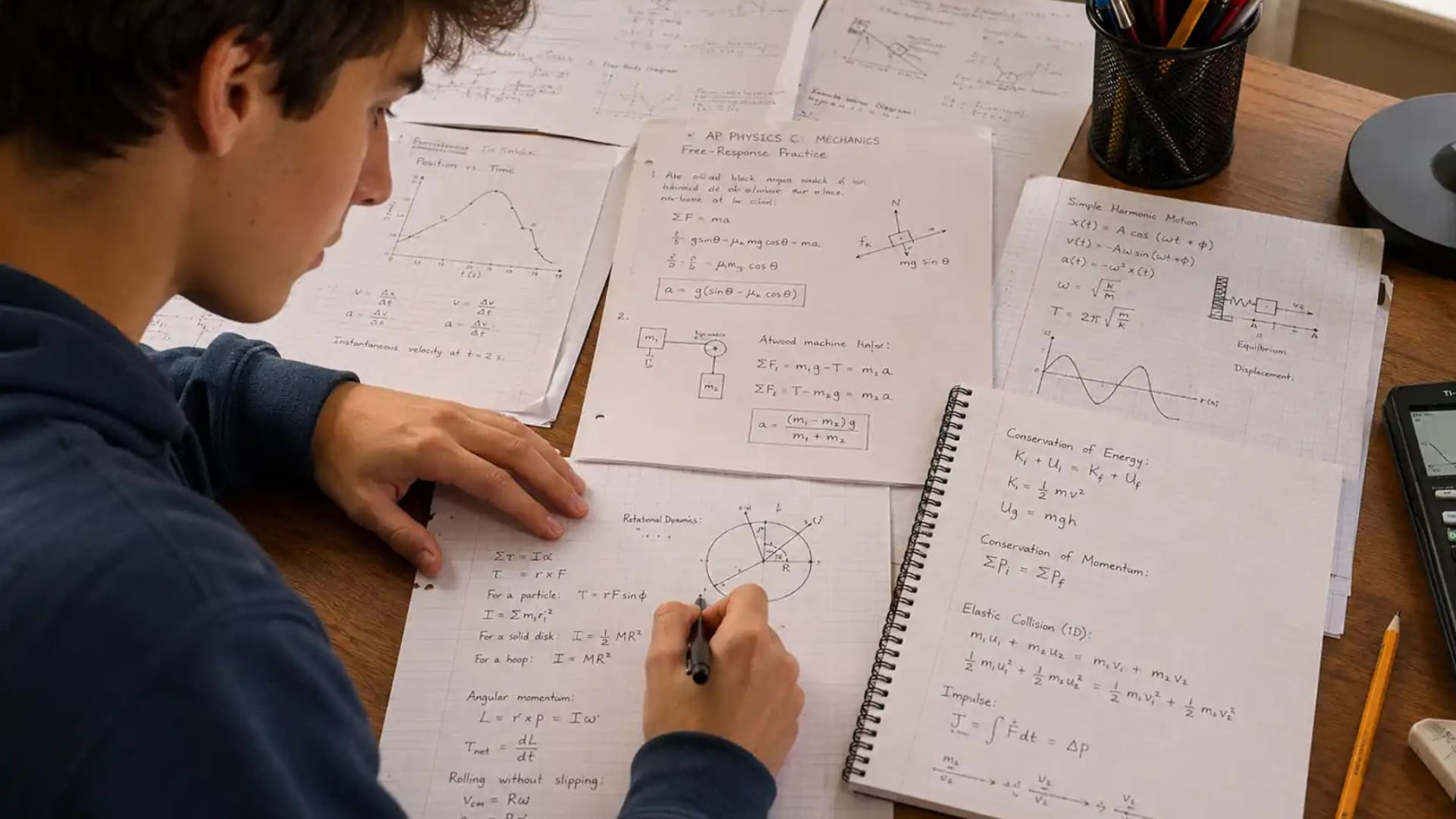
Downloading past FRQs is only the first step. How you practice with them determines your actual score. Follow this approach every time you sit down with released materials:
Attempt Under Timed Conditions: Give yourself 24 minutes per FRQ before checking anything. Timed practice builds the pacing instincts your real exam will demand.
Grade Against the Official Rubric: Do not guess at your score. Match your response point by point against what graders look for in the scoring guidelines.
Study Partial Credit Responses: Read the sample student responses, especially ones that earned partial credit. They show you where points are recoverable even when your physics understanding is incomplete.
Build an Error Log: After grading, write down every missed point and the specific reason. Track wrong formulas, missing units, incomplete justifications, and conceptual gaps separately.
Rework Missed Questions From Scratch: Return to every question you lost points on and attempt it again without looking at your previous response or the solution.
Each of these steps builds on the one before it. Skipping any part of this process, especially the error log and rework steps, reduces the extent to which each practice session actually improves your score.
Best AP Physics C Mechanic Practice Schedule For You
Starting early and following a structured plan makes a real difference. Use this 8-week schedule to build topic strength before moving to full practice tests:
Week | Focus Topic | Study Activity | Goal |
|---|---|---|---|
1 | Kinematics | Review concepts, solve basic problems | Build foundation |
2 | Newton’s Laws and Dynamics | Practice FRQs involving force diagrams | Strengthen application |
3 | Work, Energy, and Power | Mixed MCQ and FRQ practice | Deepen understanding |
4 | Systems of Particles and Linear Momentum | Timed problem sets | Improve speed |
5 | Rotation and Torque | High-weight topic, prioritize FRQs | Master calculus application |
6 | Oscillations and Gravitation | Review and practice past questions | Consolidate weak areas |
7 | Full-Length Practice Test 1 | Timed exam simulation | Identify gaps |
8 | Full-Length Practice Test 2 and Review | Target weak topics from Test 1 | Peak readiness |
Rotation consistently carries the highest exam weight, so never rush through week 5. By week 7, you should be solving under real exam conditions.
Test-Day Strategies To Increase Your Points
Small habits on exam day can protect the points you already earned in practice. Follow these tips for scoring your best on exam day:
Bring an Approved Graphing Calculator: It is allowed and necessary. Check the College Board-approved list before exam day, not the morning of.
Pace Each Section Intentionally: You get 85 minutes for 42 MCQs and 95 minutes for 4 FRQs. That is roughly 2 minutes per MCQ and 24 minutes per FRQ.
Draw and Label Every Diagram: Even a rough force diagram earns partial credit. Graders reward a clear setup, not just correct final answers.
Show Every Step in FRQs: Write your equations before substituting numbers. An incorrect answer using the correct method still earns points.
Skip and Return on Stuck Questions: Mark it, move forward, then return later. Spending five minutes on one MCQ costs you elsewhere.
During the last days, your focus needs to shift from learning new material to avoiding preventable mistakes and using your time as effectively as possible on test day.
Conclusion
Consistent practice is what turns difficult physics concepts into skills you can apply with confidence.
An AP Physics C Mechanics practice test gives you a valuable way to measure your progress, identify areas that need more attention, and strengthen your exam strategy.
By working through realistic questions and reviewing your approach, you can build stronger problem-solving habits before test day.
Start using official practice resources today, track your improvement, and share your preparation experience or questions in the comments to help others on their AP Physics C journey.
Frequently Asked Questions
Is AP Physics C Mechanics Harder Than AP Physics 1?
Yes. AP Physics C Mechanics uses calculus, making it significantly more challenging. AP Physics 1 is algebra-based. Students with strong foundations in calculus generally find the transition manageable.
Can I Self-Study AP Physics C Mechanics Without Taking the Class?
Yes, many students self-study successfully. Strong calculus knowledge is essential beforehand. Use official College Board materials, quality textbooks, and consistent practice tests to stay structured.
What Score Do Most Students Get on AP Physics C Mechanics?
The exam has a high 5 rate compared to other AP exams. About 40% of test-takers score a 5, reflecting a self-selected, well-prepared student population.
Does AP Physics C Mechanics Have a Formula Sheet?
Yes, the College Board provides an official formula sheet during the exam. However, knowing when and how to apply each formula correctly still requires thorough preparation and practice.