

Your pencil hovers over the first question, and the clock on the wall suddenly feels louder. That flicker of panic does not come from world history itself. It comes from not knowing your pacing.
A clear sense of the timing can calm nerves, build confidence, and help you avoid the panic of watching the clock run down.
Understanding how long the AP World Exam is helps you plan your approach, manage each part confidently, and know what to expect from the various question formats before exam day.
Your score depends on how long you linger, how quickly you move, and how each section pulls your attention in a different direction.
This covers every section, every question type, and the scoring system behind it all.
What is the AP World History: Modern Exam?
The AP World History: Modern exam is a college-level history test administered by the College Board. It covers global developments from around twelve hundred CE to the present.
Spanning empires, revolutions, trade networks, and the modern world. The exam is administered entirely digitally through the College Board’s Bluebook app.
High school students take it to earn college credit, place out of introductory history courses, or strengthen their applications. It is one of the most widely taken AP exams available.
Most colleges award credit for a score of three or higher, making it a real opportunity to get ahead before your first college semester even begins.
How Long is the AP World Exam?
The exam splits into two sections, and every minute of your 3 hours and 15 minutes has a job to do.
Here is exactly how the time and questions break down:
Section | Part | Question Type | No. of Questions | Time | Score Weight |
|---|---|---|---|---|---|
Section I | Part A | Multiple Choice (MCQ) | 55 | 55 minutes | 40% |
Section I | Part B | Short Answer (SAQ) | 3 | 40 minutes | 20% |
Section II | Part A | Document-Based Question (DBQ) | 2 | 60 minutes | 25% |
Section II | Part B | Long Essay Question (LEQ) | 1 of 3 | 40 minutes | 15% |
No points are deducted for wrong answers, so leaving any question blank does not count against your score. Each section tests a different skill, and the next part breaks down exactly what each question type asks of you.
AP World Exam Section Breakdown
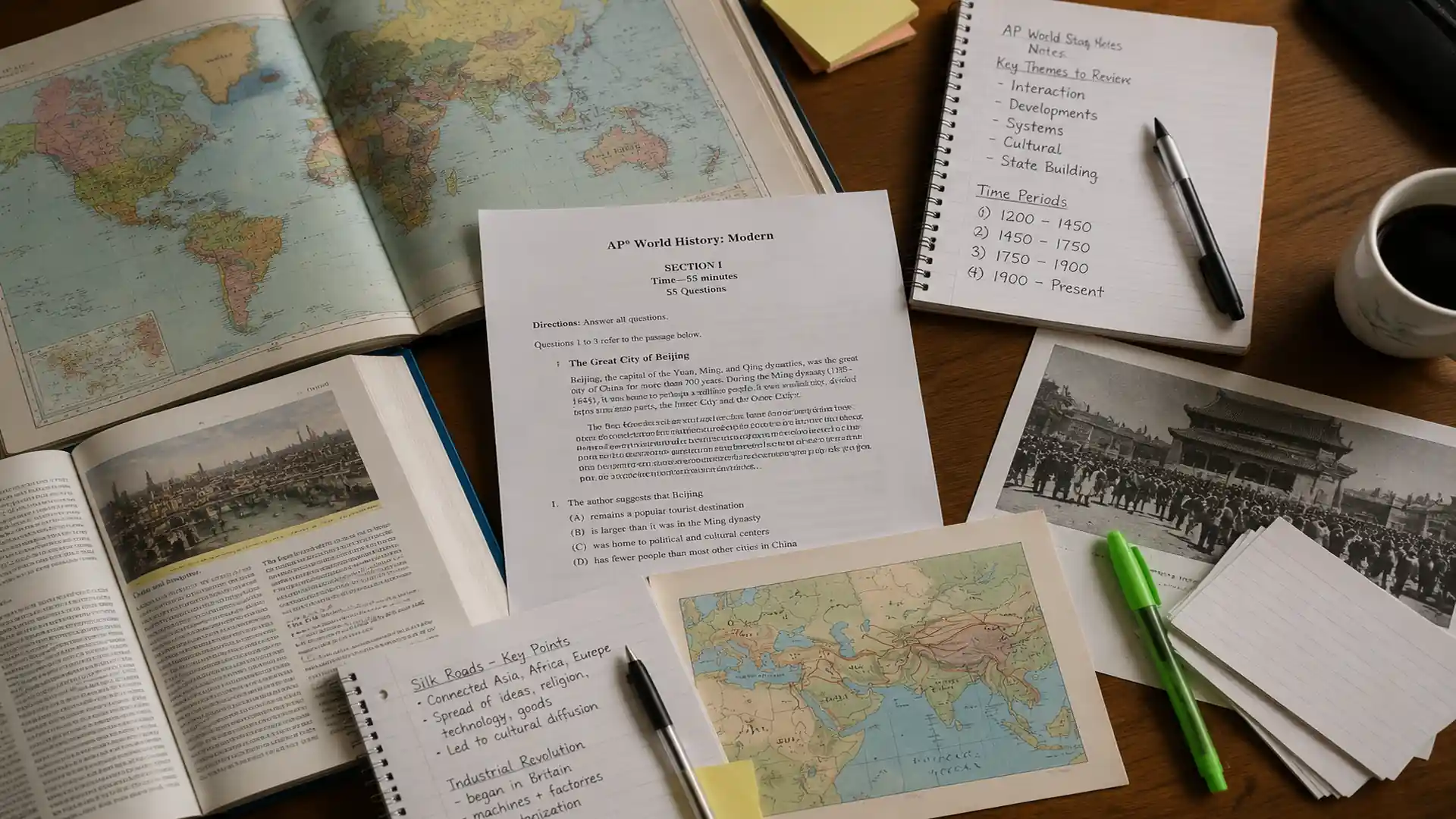
Four question types, each testing a different skill. Here is what each one asks of you and how your time gets used across both sections.
1. Multiple-Choice Questions (MCQ)
MCQs arrive in sets of three to four questions, each tied to a source such as a map, an image, or a historical text. You work through all fifty-five in fifty-five minutes.
Aim for roughly one minute per question. Bluebook lets you flag questions and return to them, so do not let one difficult set slow down your entire section.
Running through AP World MCQ practice sets ahead of time builds the speed this section rewards.
What it tests: Source interpretation, historical pattern recognition, cross-regional connections
How scoring works: One point per correct answer; no deduction for wrong ones
2. Short-Answer Questions (SAQ)
Four SAQs appear, but you only answer three. Questions one and two are required. Each SAQ has three parts, each worth 1 point.
Questions three and four are source-free, each covering a different time period, so choose the one that plays to your stronger content knowledge.
What it tests: Direct historical analysis, evidence use, source interpretation (Q1–Q2 only)
How scoring works: One point per part answered correctly; no thesis needed
3. Document-Based Question (DBQ)
Seven documents arrive with the prompt, and you need to use at least six. Your sixty minutes include a built-in fifteen-minute reading period before writing begins.
This is the single highest-weighted question on the exam, so the fifteen-minute planning window is not optional; use every second of it.
What it tests: Argument construction, document analysis, sourcing, contextualization, outside evidence
How scoring works: Seven-point rubric covering thesis, evidence, analysis, and complexity
4. Long Essay Question (LEQ)
Three prompts appear, each anchored to a different time period. You pick one and write a full historical argument in forty minutes using only your own knowledge, no documents provided.
The time period options let you play to your strengths, so know which era you are most confident in before exam day.
What it tests: Thesis construction, historical reasoning, argument complexity, evidence use
How scoring works: Six-point rubric rewarding structure, specific evidence, and reasoning depth
How is Your AP World Score Calculated?
Your raw points from all four sections are converted into a weighted composite, then mapped onto a final scale.
That final result lands on a one-to-five scale. A three is the threshold most colleges recognize for credit or placement.
Scoring below that does not erase the value of your coursework, but it does close the door on college credit at most institutions.
A score of four or five signals stronger readiness and often satisfies more selective credit policies.
The DBQ alone controls a quarter of your score. One well-argued, well-sourced essay can push a borderline two into a solid three, or a three into a four.
If your prep time is limited, that is where it pays to focus first.
Best Study Resources for AP World History
The right resources save you hours of guesswork and keep your prep focused on what actually shows up on exam day. Start with official sources, then layer in free tools that match how you learn:
- Khan Academy World History Project AP: Free mastery-based exercises and videos aligned directly with the AP CED work through the units in order and use the built-in quizzes to track weak spots.
- Heimler’s History YouTube Channel: A widely recommended free playlist that breaks down every AP World unit and essay skill in short, exam-focused videos, ideal for visual learners who want to cover content quickly.
- College Board Bluebook App: The digital testing platform where your exam is administered. Download it early and write at least two practice essays inside the app before exam day.
- College Board Official Sample Papers and PYQs: Released past exam questions with sample responses and scoring commentary, the closest simulation of real exam conditions available anywhere.
A Six-Week AP World History Study Schedule
Spreading your prep across six weeks builds the kind of layered understanding that cramming simply cannot replicate. Here is a week-by-week breakdown of what to focus on and why:
Weeks | Focus Area | Daily Goal | Key Activities |
Week 1 | Units 1–3 | One unit overview daily | CED readings, Khan Academy videos, timeline notes |
Week 2 | Units 4–5 | One unit overview daily | Connect patterns across regions, note key themes |
Week 3 | MCQ and SAQ practice | Timed question sets daily | 55 MCQs in 55 mins, two SAQ attempts per week |
Week 4 | DBQ skill building | One DBQ draft per week | Document annotation, argument outlining, and sourcing practice |
Week 5 | Full practice exam | One-time exam in Bluebook | Strict section timing, review all wrong answers |
Week 6 | Essay refinement | DBQ and LEQ polish | Contextualization drills, College Board sample responses |
Stick to the order: Content first, then skills, then full simulation. Jumping straight to practice tests before your content foundation is solid wastes both time and effort.
Score Higher on Your Exam With These Targeted Tips
Knowing the format is only half the battle; how you navigate each section determines where your score lands. If exam-day nerves tend to derail your pacing, brushing up on focused test anxiety techniques can help you maintain your rhythm.
These tips address the specific moments where points are most commonly lost:
- Flag and Keep Moving: Spending too long on one MCQ costs you easy points later; flag it in Bluebook and return once you’ve answered everything else.
- Plan Before You Write the DBQ: Use all fifteen reading minutes to annotate documents and outline your argument before typing a single sentence.
- Guard Your LEQ Time: Start the long essay with at least forty minutes on the clock; a focused thesis written quickly beats a polished one started too late.
- Practice Inside Bluebook First: The testing interface feels different from a regular word processor, so essay-writing practice should take place in the app itself.
- Answer Every MCQ: No points are deducted for wrong answers, so a guess always gives you a better chance than a blank.
Small adjustments in how you manage your time, read questions, and approach writing tasks can make a noticeable difference on AP World exam day.
The Bottom Line
Knowing how long the AP World exam lasts gives you a clearer picture of what test day will look like, but strong preparation depends on how you use that information.
Each section has a set time limit, a specific question style, and a clear role in your final score.
Practicing within those limits helps you build confidence, improve pacing, and avoid spending too long on a single difficult task.
The exam structure also gives you a reliable framework for planning study sessions, timed drills, and full-length practice tests.
When you become familiar with the format, the pressure feels more manageable, and your decisions become more focused.
Drop a comment below and share which AP World exam section you plan to practice first.
Frequently Asked Questions (FAQs)
What Happens If You Miss the AP World History Exam Date?
The College Board offers a late-testing window for documented conflicts. Contact your AP coordinator immediately; missing without approval typically means waiting until the following year.
How Early Should You Arrive on AP World History Exam Day?
Arrive at least thirty minutes early. You need time to set up your device, log in to Bluebook, and complete identity verification before the official start time.
Does the AP World History Score Expire?
Scores do not expire officially. However, some colleges set time limits on accepting AP credit, so check each institution’s policy before submitting older scores for placement consideration.
Can You Cancel or Withhold Your AP World History Score?
Yes, the College Board allows score cancellation or withholding before results are sent. Fees may apply, and withheld scores are never seen by the colleges you have designated.