

Getting into Cornell is about more than hoping your application stands out.
You naturally want to know where your academic profile fits before investing your time and effort.
Search results throw around a single Cornell average SAT number like it settles the question, but your odds depend on far more than where you land against one figure.
Your GPA, your coursework, and even which Cornell college you’re applying to all shape how that score gets read.
This blog covers what actually goes into building your competitive profile, beyond the number everyone fixates on.
Cornell University at a Glance
Before comparing your scores, get a quick overview of admissions profile, academic reputation, and key application facts:
Category | Details |
Location | Ithaca, New York |
Undergraduate Enrollment | Around 15,000 students |
Undergraduate Colleges | Eight distinct colleges, each with its own admission review |
Campus Setting | Rural college town, spread across a large hilltop campus |
Housing Requirement | First- and second-year students live on campus |
Application Deadline | Early Decision in November, Regular Decision in January |
These basics shift slightly depending on which Cornell college you’re applying to, but they set the stage for the part that actually determines your odds: how your academic profile measures up.
Is Cornell Test Optional?
No, Cornell is no longer test-optional.
Starting with Fall 2026 applicants, every undergraduate college at Cornell requires you to submit either SAT or ACT scores.
That marks a real shift from the past few admission cycles.
For several years, Cornell let applicants choose whether to send scores at all. Only students confident in their results tended to submit them, which pushed the reported score ranges higher than they might have been otherwise.
That’s part of why older ranges look tighter and more competitive than they truly were.
One exception remains: transfer applicants. SAT or ACT scores are neither required nor expected for transfer applicants, so this requirement applies only to first-year applicants.
If you’re planning your application now, treat testing as a fixed requirement, not an optional boost.
Build your prep timeline around that from the start, and don’t count on skipping the test to strengthen a weaker profile.
What SAT Score Do You Need for Cornell
A single average tells you almost nothing about where you personally stand, which is why the score and the percentile behind it deserve separate attention.
Cornell Average SAT Score
Cornell’s admitted students mostly cluster in the upper range, with scores climbing steadily over recent admission cycles.
A score near the last of that range still gets you considered, but it won’t carry the rest of your application.
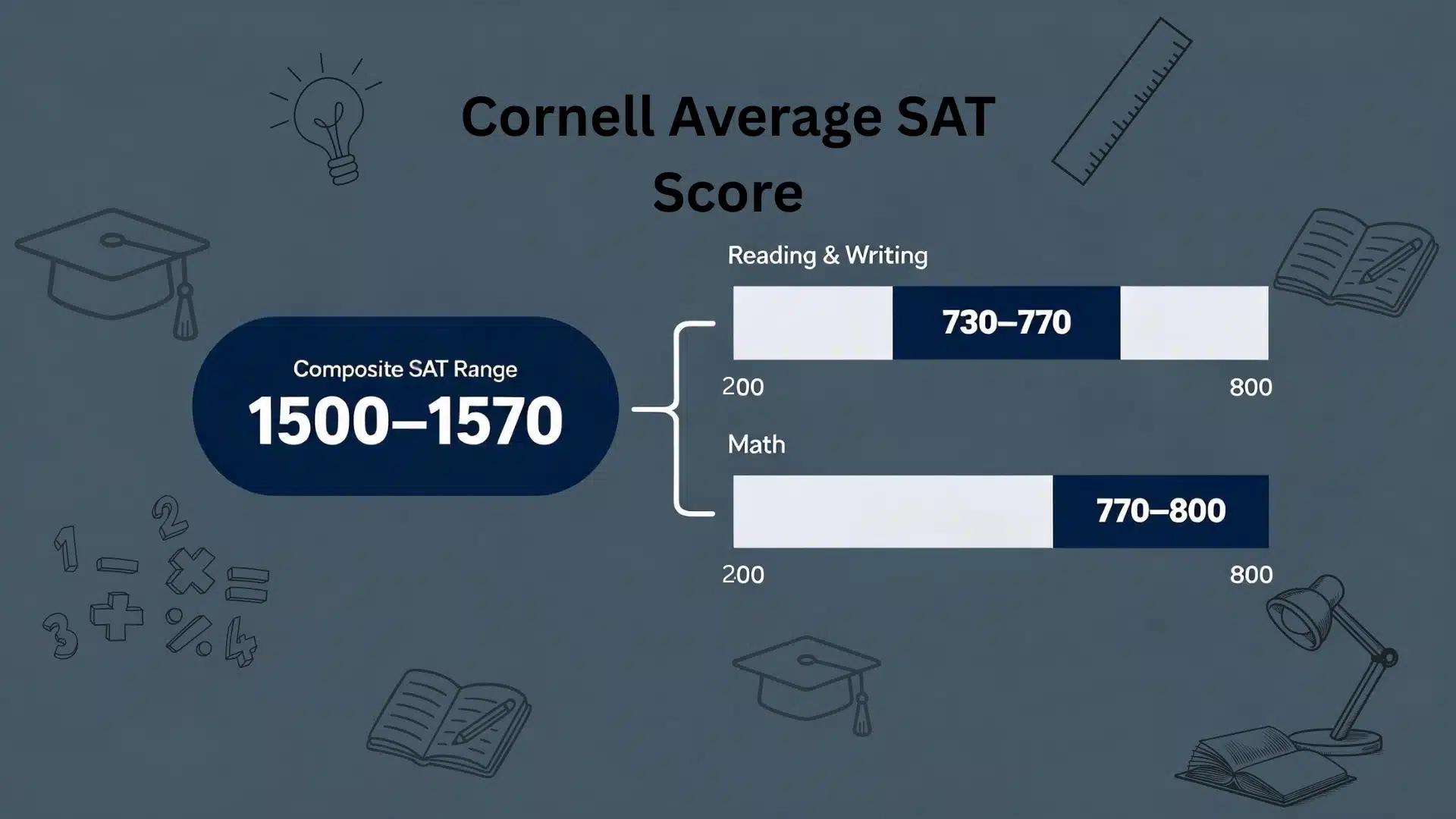
According to BigFuture by the College Board, Cornell’s SAT range sits at 1500 to 1570.
That range has climbed steadily over recent admitted classes, reflecting tougher competition rather than a stricter cutoff.
Your Section-by-Section Score Target
Cornell’s official range breaks down clearly by section.
Reading and Writing sits between 730 and 770, while Math runs higher at 770 to 800.
Don’t split your prep time evenly between sections and assume it balances out.
Math carries more weight in the range, so a soft Math score drags your composite down faster.
If you’re prepping on the digital format, it helps to understand how the digital SAT format sections and timing changed, since the adaptive structure affects how you should pace each module.
Section-level breakdowns vary somewhat from source to source and update each admissions cycle, so treat these as a close estimate rather than a locked figure.
Cornell GPA Requirements
Cornell doesn’t publish an official minimum GPA for admitted students, but most enrolled students carry a GPA close to a perfect 4.0, often unweighted.
That consistency across four years tells admissions officers more than a single number ever could.
Your GPA and SAT score work together, not as substitutes for each other.
A strong test score won’t make up for uneven grades, and a high GPA earned through easy coursework won’t offset a weaker score either. Both get read side by side.
A competitive GPA usually comes from steady performance every year, not just a strong finish senior year, paired with advanced or honors-level classes in your core subjects.
Since high schools calculate grades so differently, it’s worth understanding before you try to benchmark your own transcript against Cornell’s numbers.
That combination signals you can handle Cornell’s academic pace, which is exactly what admissions officers are trying to predict before you even arrive on campus.
Other Admission Requirements For Cornell

Numbers get you into the conversation, but they rarely decide who gets the offer.
Here’s what admissions officers weigh once your score and GPA have already cleared the bar:
1. Your Essays and Personal Story
Your essays are where you stop being a data point and become a person. Admissions officers read thousands of similar transcripts each cycle, so a specific story about how you think or what drives you carries real weight.
Generic essays about leadership or overcoming challenges blend together fast.
So, avoid generic themes that anyone could write. Instead, be specific, honest, and reflective.
The best essays sound like you, not the applicant you think Cornell wants.
2. Extracurriculars That Actually Stand Out
Extracurricular activities can reveal qualities that grades and test scores cannot.
Cornell looks beyond the number of activities you list and focuses on the dedication, initiative, and impact behind your involvement.
Here’s what to focus on:
Sustained involvement in one or two activities over several years.
A leadership role you earned, not just held.
A project or initiative you started rather than joined.
Impact that’s specific and measurable, not vague.
Interests that connect naturally to what you plan to study.
3. Recommendations and Demonstrated Interest
A strong recommendation letter does something your transcript can’t: it shows how you show up in a classroom or community.
Teachers who can speak to your curiosity or growth carry more weight than ones who simply confirm good grades.
Pairing that with clear, specific interest in Cornell- why this college, why this program- signals you’ve thought this through rather than applying on reputation alone.
Tips to Strengthen Your Cornell Application
A few strategic moves can meaningfully improve your odds, especially if you start early enough to act on them.
Here’s what to prioritize:
Retake the SAT Strategically: Focus your preparation on weaker sections before retaking the exam to improve your overall score and strengthen your academic profile.
Use Superscoring Effectively: Take advantage of Cornell’s superscoring policy by submitting your strongest section scores from multiple test dates when applicable.
Choose Challenging Courses: Select the most rigorous classes available at your school to demonstrate academic curiosity and readiness for Cornell’s demanding coursework.
Write Specific Personal Essays: Create essays with detailed personal experiences and meaningful examples instead of using general topics about leadership or success.
Build a Balanced Application: Treat your SAT score as one part of your application by combining strong academics, activities, recommendations, and personal achievements.
Start Early: Begin preparing your application well in advance, so you have enough time to improve scores, refine essays, and strengthen your overall profile.
These moves work best together, not in isolation. A stronger score means little if the rest of your application stays generic.
Final Thoughts
Chasing a single Cornell average SAT figure was never going to give you the full picture, and now you know why.
Your score matters, but it works alongside your GPA, your course rigor, and the story your application tells as a whole.
Two applicants with identical numbers can land completely different outcomes based on everything else surrounding those scores.
Where does your current profile stand against what you’ve read here?
Drop your score and GPA combo in the comments, and let’s talk through where you might have room to strengthen things.
Frequently Asked Questions
Is Cornell Need-Blind for Financial Aid?
Yes, Cornell reviews domestic applications without considering financial need. Cornell evaluates admission decisions and your ability to pay completely separately throughout the process.
Can Waitlisted Applicants Still Get Into Cornell?
Yes, though waitlist movement varies significantly by year and college. Staying enrolled on the waitlist and sending a brief update letter can occasionally improve your chances.
What is Mark Zuckerberg’s SAT Score?
Mark Zuckerberg reportedly scored 1600 out of 1600 on the SAT, achieving a perfect score before attending Harvard University, where he studied computer science and psychology.
Can I Self-Report My SAT or ACT Scores to Cornell?
Yes. Cornell lets you self-report scores on the Common Application or through the Applicant Portal, but enrolling students must later send official scores from the testing agency.