
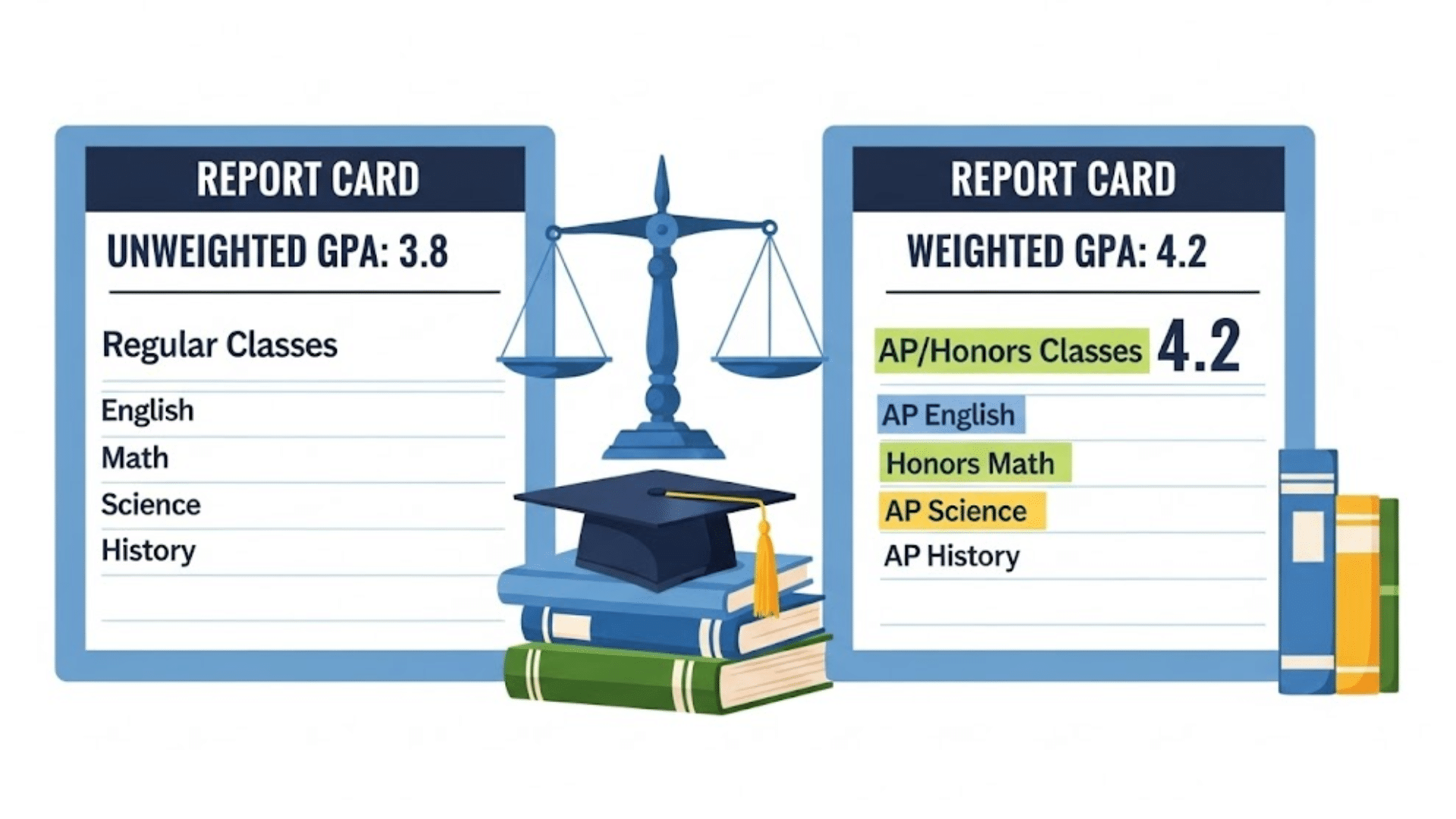
Ever looked at your transcript and seen two different GPAs staring back at you? This happens to most students.
You might feel confused when both a weighted and unweighted GPA show up on your records.
The big question is: which one actually matters for college admissions? The answer isn’t as simple as you might think.
Both types serve different purposes, and colleges look at them in unique ways.
Let’s break down what each GPA means, how schools calculate them, and most importantly, which one carries more weight when you’re applying to college.
By the end, you’ll know exactly how to make sense of both numbers on your transcript.
What is an Unweighted GPA?
An unweighted GPA uses a simple 0.0 to 4.0 scale. Every class gets treated the same way, no matter how hard it is. This means an ‘A’ in regular math counts exactly the same as an ‘A’ in AP (Advanced Placement) Calculus.
Here’s how it works: ‘A’ equals 4.0, ‘B’ equals 3.0, ‘C’ equals 2.0, and so on. Your school adds up all your grade points and divides by the number of classes you took.
The biggest thing to remember? Difficulty doesn’t matter here.
Whether you ace an easy elective or crush the hardest AP course, that A still equals 4.0 points.
What is a Weighted GPA?
A weighted GPA gives you extra credit for taking tough classes. Instead of stopping at 4.0, it can go up to 5.0 or even higher. This system rewards students who challenge themselves with harder courses.
Here’s the difference: an ‘A’ in a regular class still equals 4.0 points. But an ‘A’ in an AP, IB (International Baccalaureate), or honors class might equal 5.0 points.
Some schools even give different bonus amounts depending on the course level.
The student taking advanced classes would have a higher weighted GPA than someone taking only standard courses.
How to Calculate Each GPA
Understanding how schools calculate your GPA helps you track your academic progress. The math is straightforward once you know the basic formulas.
Unweighted GPA Calculation
Start by converting each letter grade to points:
- A equals 4.0
- B equals 3.0
- C equals 2.0
- D equals 1.0
- F equals 0.0
Add up all your grade points from every class. Then divide that total by the number of courses you took.
This gives you your unweighted GPA on the standard 4.0 scale.
Weighted GPA Calculation
Follow the same steps as unweighted, but add bonus points first:
- Honors classes: add 0.5 points
- AP and IB classes: add 1.0 point
So an A in AP Biology becomes 5.0 instead of 4.0. Add up these adjusted grade points and divide by your total courses.
Pro Hack: Keep a running spreadsheet of your grades throughout the semester. Update it after each test or assignment to see exactly how each grade affects your GPA in real time.
How Do Colleges Evaluate GPAs?

Colleges don’t just look at one number when reviewing your application. They want the full picture of your academic performance and the difficulty of the courses you chose.
1. Colleges Review Both GPA Types
Most admissions officers examine both your weighted and unweighted GPAs.
The unweighted GPA shows your raw academic performance, while the weighted GPA reveals how much you challenged yourself with rigorous courses.
This dual approach helps them understand both your grades and your course selection strategy.
2. Schools Often Recalculate Your GPA
Many colleges don’t trust your school’s GPA calculation. Instead, they create their own standardized system using your transcript.
This helps them fairly compare students from different high schools that might use varying scales or weighting systems. Some focus only on core academic subjects, too.
3. Elite Universities Emphasize Course Rigor
Top-tier schools pay special attention to weighted GPAs and course difficulty. They understand that a 3.7 GPA with multiple AP classes often beats a 4.0 GPA with only standard courses.
Context matters more than the raw number when evaluating competitive applicants.
Why GPA Type Matters?
Each GPA type serves a specific purpose in college admissions, and understanding both gives you a strategic advantage.
Unweighted GPA shows your raw academic ability. It strips away all the extras and reveals your true grade performance. Colleges use this to see if you can consistently earn good grades regardless of class difficulty.
Weighted GPA proves you take academic risks. It shows you chose challenging courses even when easier options existed. This signals to admissions officers that you’re ready for college-level work and won’t shy away from difficult subjects.
Together, both GPAs give the full picture. A 3.7 unweighted with a 4.3 weighted shows you tackled AP classes and mostly succeeded.
That’s often more impressive than a 4.0 unweighted with a 4.0 weighted from only standard courses
Comparison Table
Here’s a quick breakdown of how weighted and unweighted GPAs stack up against each other:
| GPA Type | Scale | Pros | Cons |
|---|---|---|---|
| Unweighted GPA | 0.0–4.0 | Easy to compare across schools, consistent standard scale, shows true grade performance | Doesn’t reflect course difficulty, penalizes students taking harder classes |
| Weighted GPA | Up to ~5.0 or higher | Shows academic rigor, rewards AP/Honors courses, and motivates challenging coursework | Varies by school system, harder to compare between students, can be confusing to interpret |
Pro Tip: Calculate how many B’s you can get in AP classes while still maintaining a 4.0 weighted GPA to strategically balance your course load.
What Does This Mean for You?
Here’s your game plan for maximizing both types of GPA to strengthen your college applications:
- Aim for a high unweighted GPA close to 4.0 to show consistent academic achievement
- Enroll in challenging AP, IB, or Honors courses to boost your weighted GPA significantly
- Balance is key: don’t sacrifice your unweighted GPA by taking too many difficult courses at once
- Remember that colleges will recalculate your GPA using their own standards for fair comparison
- Focus on meaningful rigor in subjects related to your intended major for maximum impact
Strong performance in challenging courses gives you the best shot at impressing admissions officers who value both consistency and academic courage.
The Bottom Line
Both weighted and unweighted GPAs tell important parts of your academic story.
Colleges don’t just look at one number. They want to see consistent grades, challenging courses, and how well you handled the rigor.
Your winning strategy is simple: keep your grades high while taking advanced courses you can actually succeed in.
Don’t bite off more than you can chew, but don’t play it too safe either.
This balanced approach shows admissions officers that you’re both smart and willing to challenge yourself.