

Every SAT test taker eventually asks the same question: how many reading passages are on the SAT actually show up on test day?
The digital format changed that answer completely, and the shift catches most students off guard the first time they open a practice test.
That structure changes how you pace yourself, how you read, and how you handle the craft and structure questions that carry the largest share of the section.
This blog breaks down the exact passage count, the four content domains you will face, and how the current format compares to the paper SAT.
How Many Passages in SAT Reading?
The SAT Reading and Writing section contains 54 passages in total, each paired with exactly one question. That is the direct answer.
The SAT is a standardized college admissions test administered by the College Board and taken by high school students applying to colleges and universities across the United States.
Many students begin SAT preparation expecting a few long reading passages, but the Digital SAT takes a different approach.
Instead of answering multiple questions about a single lengthy text, you work through short passages of 25 to 150 words throughout the Reading and Writing section.
This format lets you focus on one text at a time while covering a wider range of topics and skills. Understanding this structure is the first step towards preparing effectively for test day.
SAT Reading and Writing Section Breakdown
The SAT Reading and Writing section follows a fixed structure. Knowing how it is organized can help you use your time wisely and avoid surprises during the exam.
Feature | Details |
|---|---|
Total questions/passages | 54 |
Modules | 2 |
Questions per module | 27 |
Time per module | 32 minutes |
Total section time | 64 minutes |
Passage length | 25 to 150 words |
Questions per passage | 1 |
What the Digital SAT Looks Like
The SAT is now delivered in a fully digital format, allowing students to take the test on a laptop or tablet through the Bluebook testing application.
Students used to studying against the older paper-based scoring scale should expect a different end-to-end experience, not just a different screen.
The Reading and Writing section uses shorter passages and an adaptive structure that adjusts the difficulty of the second module based on performance in the first.
This adaptive design lets the test accurately gauge your skill level without requiring extra sections.
Every question in the section also falls into one of four content domains, and each domain tests a distinct skill.
What Types of Passages Appear on the SAT?
The SAT Reading and Writing section includes passages from four main content areas. The table below shows what each passage type covers and the skills it is designed to assess.
Passage Type | What You’ll Read | Example Question Focus |
|---|---|---|
Literature | Excerpts from novels, short stories, and other fictional works | What does a character’s reaction reveal about their feelings or motivations? |
History and Social Studies | Texts about historical events, economics, government, psychology, or society | Which statement best reflects the author’s main argument about a historical event? |
Humanities | Passages covering art, culture, philosophy, and literature | How does the author support their viewpoint on the topic discussed? |
Science | Texts based on scientific studies, experiments, or discoveries | Which finding from the passage best supports the researchers’ conclusion? |
Becoming familiar with each category can help you recognize common question patterns and approach passages with greater confidence.
What the Reading and Writing Questions Are Like
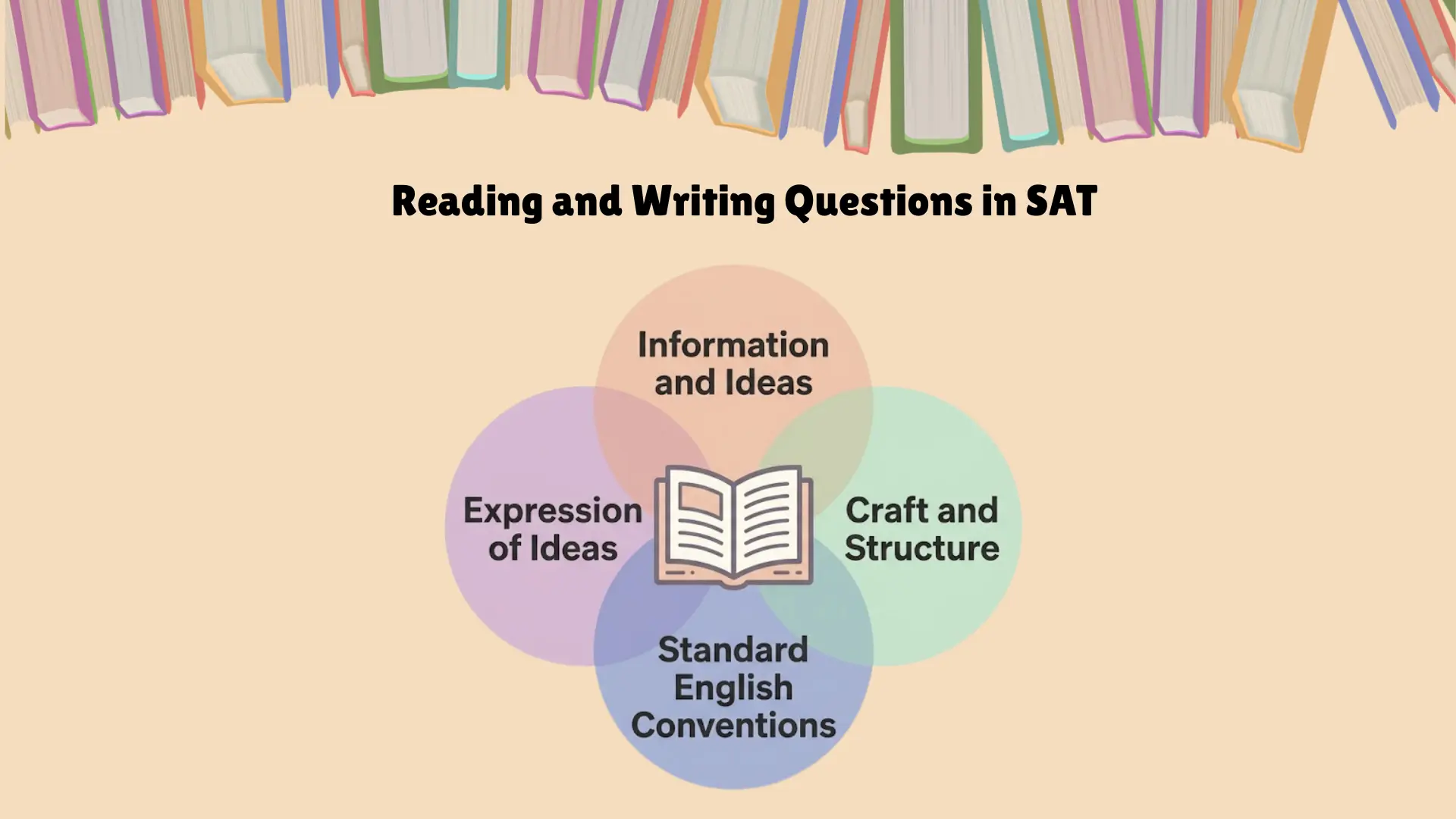
Every question in the SAT Reading and Writing section belongs to one of four content domains. Each domain targets a specific, trainable skill.
Here is what each one tests and what a real question looks like in practice.
1. Information and Ideas
This domain measures your ability to read a passage and work with what it actually says.
That includes locating specific details, understanding the central idea, drawing conclusions, and integrating information from both a written text and a data visual such as a table or bar graph.
Sample Question:
Passage: Marine ecologist Dr. Sione Tuilagi studied coral reef recovery rates across three Pacific reef systems following bleaching events.
His 2022 report found that reefs in areas with reduced fishing activity recovered significantly faster than those in heavily fished zones, suggesting that local human pressure compounds the stress of climate-driven bleaching.
Which choice best states the main finding of the passage?
- (A) Climate change is the leading cause of coral reef bleaching across the Pacific Ocean
- (B) Reduced fishing activity alone is sufficient to reverse coral bleaching damage
- (C) Local fishing pressure worsens the impact of climate-driven bleaching on reef recovery
- (D) Dr. Tuilagi’s report focused on reef systems outside the range of climate impact
Correct Answer: (C). The passage states that local fishing pressure compounds climate stress, making (C) the most accurate summary of the finding.
2. Craft and Structure
This domain measures vocabulary in context, rhetorical analysis, and the ability to connect ideas across two short related texts. You are not being tested on definitions in isolation.
The question always asks what a word, phrase, or structural choice does within the specific argument of the passage.
Sample Question:
Passage: Economist Rafael Souza describes the current shift toward decentralized currency systems not as a financial experiment but as a calculated response to repeated institutional failures.
In his view, the growing adoption of alternative currencies reflects a deliberate and measured public rejection of centralized financial control.
As used in the passage, “measured” most nearly means:
- (A) calculated using standard financial metrics
- (B) cautious and carefully considered
- (C) deliberate and proportionate in scale
- (D) recorded and tracked over time
Correct Answer: (C) In context, “measured” describes a public response that is intentional and proportionate, not one that is literally quantified or tracked.
3. Expression of Ideas
This domain measures your ability to improve how a text is written, not to analyze what it says.
Questions here ask you to select the sentence that best meets a specific writing goal or to choose the transition that most logically connects two ideas within a passage. The skill is judgment, not grammar.
Sample Question:
A student is writing an article arguing that schools should integrate financial literacy into core curricula. The student wants to conclude the paragraph by emphasizing the long-term personal benefit to students.
Which sentence best meets this goal?
- (A) Many countries already require financial literacy courses as part of their national education standards
- (B) Teachers would need additional training before financial literacy courses could be introduced effectively
- (C) Students who understand budgeting, saving, and debt management before adulthood are far better positioned to build financial stability throughout their lives
- (D) Financial literacy covers a broad range of topics that could be difficult to fit into an already full school schedule
Correct Answer: (C) It directly addresses long-term personal benefit to students, which is the stated rhetorical goal of the sentence.
4. Standard English Conventions
This domain measures your ability to identify and correct errors in grammar, punctuation, and sentence structure.
Questions cover sentence boundaries, subject-verb agreement, modifier placement, and proper punctuation between clauses. Speed and accuracy with core grammar rules are the key skills here.
Sample Question:
Passage: The research team, together with three external reviewers, ________ currently analyzing the data and plans to publish its findings before the academic year ends.
Which choice correctly completes the sentence?
- (A) are
- (B) is
- (C) were
- (D) have been
Correct Answer: (B) The subject is “the research team,” which is singular. The phrase “together with three external reviewers” is a modifier, not part of a compound subject. Singular subjects take singular verbs.
The best way to build familiarity with all four domains is through full-length practice under real test conditions.
The College Board offers free adaptive practice tests through Bluebook, the official digital testing app.
Reading and Writing: Number of Questions by Domain
Here is a side-by-side comparison of how questions are distributed across all four domains.
Content Domain | Approximate Number of Questions | Approximate Share of Section |
|---|---|---|
Information and Ideas | 12 to 14 | 26% |
Craft and Structure | 13 to 15 | 28% |
Expression of Ideas | 8 to 12 | 20% |
Standard English Conventions | 11 to 15 | 26% |
Total | 54 | 100% |
Use this breakdown to identify which domains need the most attention in your study plan.
What is Craft and Structure on the SAT?

This section is one of the four content domains in the SAT Reading and Writing section. It focuses on how authors use language, organize ideas, and communicate meaning.
Rather than testing basic comprehension alone, these questions assess your ability to understand how a text is written and why specific choices were made.
You may be asked to:
- Determine the meaning of words and phrases in context
- Identify an author’s purpose or perspective
- Understand how ideas are connected within a text
- Compare information across paired texts
- Analyze the impact of specific words or sentences
These questions test how well you understand an author’s word choices, tone, and purpose, not just the main point.
Getting stronger in this area supports your overall Reading and Writing score and helps you move through questions faster.
SAT Reading and Writing Topics You Should Study
The SAT Reading and Writing section covers a mix of skills you can build with steady practice. Here is a quick breakdown of what to expect:
Skill Area | What It Covers | What It Tests |
|---|---|---|
Main ideas | Finding the central point of a passage | Your understanding of the author’s overall message |
Inference | Reading between the lines to draw conclusions | Your ability to think beyond the text |
Evidence | Picking text that best supports an answer | Your ability to back up claims with proof |
Vocabulary in context | Understanding word meaning based on surrounding text | Your ability to read tricky wording |
Grammar rules | Applying correct grammar within a sentence | Your grip on clear and accurate writing |
Sentence improvement | Making sentences clearer and more effective | Your skill at expressing ideas well |
Organization | Arranging ideas in a logical order | Your ability to help readers follow along |
Transitions | Connecting ideas smoothly between sentences | Your skill at linking ideas clearly |
Practicing each of these areas can help you feel more confident on test day. Focus on one skill at a time to build steady, lasting progress.
How to Prepare for SAT Reading and Writing
Knowing how the section is organized helps you build a more focused study plan.
Beyond section-specific practice, day-to-day study habits that move the needle on any standardized test still apply here, so keep these habits in mind as you prepare:
- Practice context-based reading skills: Focus on identifying the meaning of words within a passage and understanding how an author’s language shapes tone, purpose, or argument.
- Work with passages and data together: Read short texts alongside charts, tables, or graphs and practice combining information from both sources to answer questions accurately.
- Strengthen revision and editing skills: Review passages the improve clarity, organization, and effectiveness.
- Master key grammar rules: Regularly practice punctuation, sentence structure, verb agreement, and other commonly tested conventions to improve both speed and accuracy.
- Use official SAT practice tests: The Bluebook app offers full-length practice tests that mirror the actual exam format and provide experience with authentic College Board questions.
Where to Find Official Practice Passages
Using official SAT materials is the best way to become familiar with real passage formats, question styles, and difficulty levels.
The resources below provide authentic practice content directly from the organizations behind the SAT.
Resource | What It Offers | Best For |
|---|---|---|
Full-length digital SAT practice tests with authentic Reading and Writing passages and adaptive modules | Simulating the actual test experience and tracking readiness | |
Thousands of official SAT questions that can be filtered by domain, skill, and difficulty level | Targeted practice on specific question types and content areas | |
Free practice questions, lessons, quizzes, and personalized study recommendations developed with the College Board | Building skills in specific domains and creating a structured study plan |
These resources can help you move beyond theory and gain hands-on experience with the exact types of passages and questions you’ll encounter on test day.
Final Thoughts
Now you know how many passages you will face in the SAT reading section. That structure keeps every task simple and easy to manage.
Skip the fear of one huge passage draining all your time. Work through quick bursts of reading and quick decisions instead.
Practice with official Bluebook tests to build real test-day comfort. Study each content domain on its own to build steady skill.
Drop a comment below and share which domain feels toughest for you.
Frequently Asked Questions
Does the SAT Reading and Writing Section Have a Time Limit per Passage?
No set time limit applies per passage. You have sixty-four minutes total to manage across all questions in both modules.
Are All SAT Reading Passages from Real Published Sources?
Yes. The College Board uses authentic texts from published literature, academic writing, history, science, and the humanities.
Is the SAT Reading Section the Same for Every Test-Taker on The Same Test Date?
Module one is the same. Module two differs based on each student’s performance in the first module