


Still searching for how many questions are on the ACT, only to find answers about a test that no longer exists?
The ACT has changed significantly since before.
The new ACT format is shorter, more flexible, and structured differently than what most prep books still describe.
Knowing exactly what the current test looks like is not optional. It is where preparation has to start. This blog covers every section, the updated question counts, timing per section, and the key changes that matter most for your score.
The New ACT Format
The ACT format changed in 2025, and the numbers most students have memorized are no longer accurate.
For years, the ACT was a four-section, roughly three-hour test with 215 questions.
The format has changed. The test that students sit for today is shorter, has fewer questions across every core section, and calculates the composite score differently from before.
Section | Questions (Old) | Questions (New) | Time (Old) | Time (New) |
|---|---|---|---|---|
English | 75 | 50 | 45 min | 35 min |
Math | 60 | 45 | 60 min | 50 min |
Reading | 40 | 36 | 35 min | 40 min |
Science | 40 (required) | 40 (optional) | 35 min | 40 min |
Writing | 1 | 1 | 40 min | 40 min |
Core Total | 215 | 131 | 175 min | 125 min |
The updated test is officially called the Enhanced ACT.
It rolled out in 2025 and is now the only version available; the legacy format no longer exists.
Science stayed at 40 questions but became optional. The scoring scale remains 1 to 36, and the composite is now the average of English, Math, and Reading only.
Question Count and Time Limit for Each Section
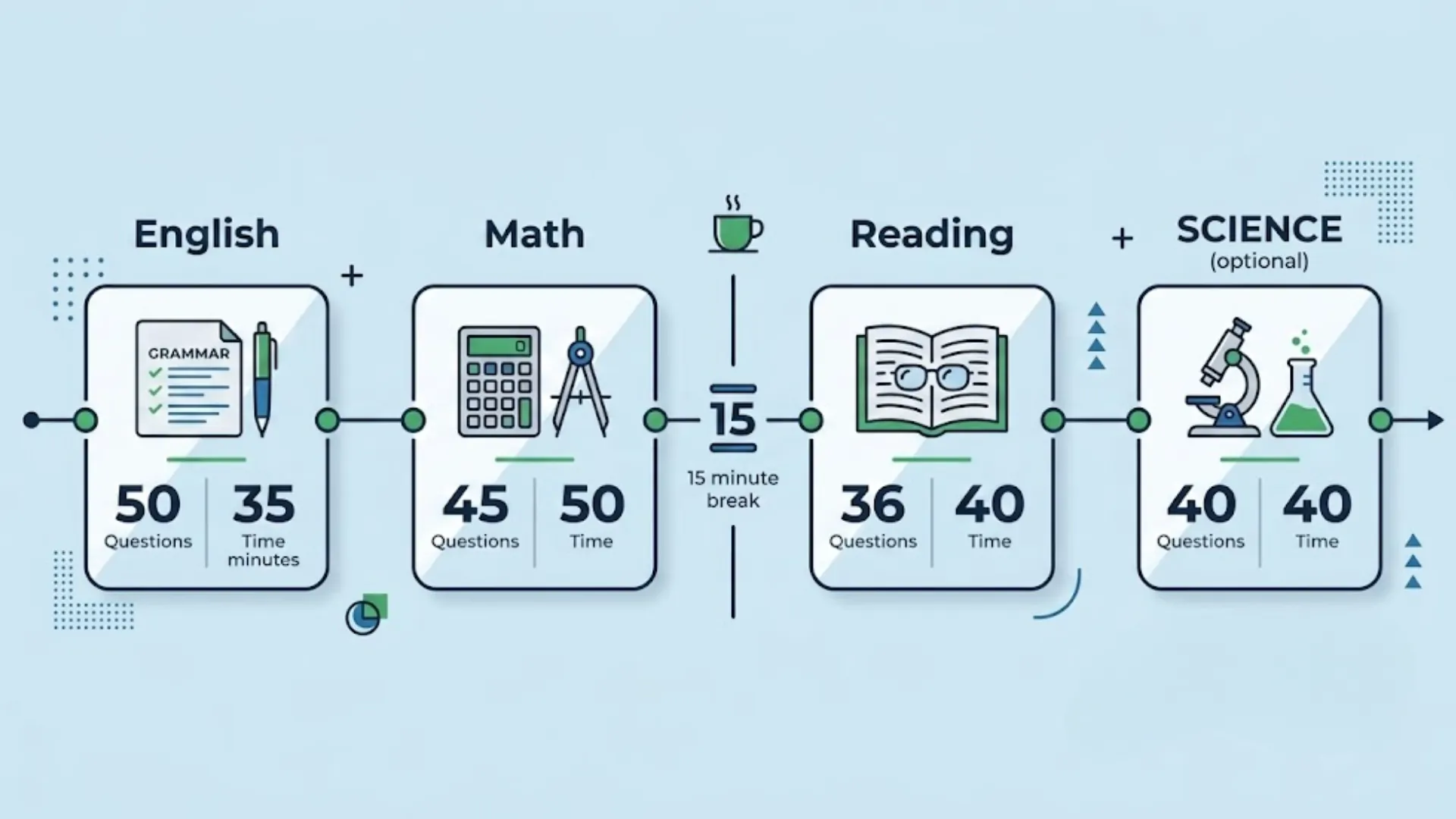
Is the ACT timed? Yes, the ACT is timed, and every section now runs on its own clock.
Each section below covers the exact question count, time limit, and the per-question pace students work at on test day.
1. English: 50 Questions in 35 Minutes
The English section lost 25 questions but kept a similar structure.
Students work through five passages, each with 10 questions. The bigger change is in how questions are now presented, which changes how students need to read and approach each question in this section.
Here is what changed in this section under the new ACT format:
Questions per passage dropped from 15 to 10, reducing reliance on passages.
Each question now includes an explicit prompt instead of just underlined text.
The question-stem format removes the need to reread the section instructions.
2. Math: 45 Questions in 50 Minutes, But Only 41 Count
The Math section gives students the most time per question of any core section.
Four of the 45 questions are unscored field-test items placed invisibly throughout the section and cannot be identified, so treat every question as if it counts.
Here is what changed in this section under the new ACT format:
The question count dropped from 60 to 45, and the time dropped from 60 to 50 minutes.
Answer choices were reduced from five to four, raising the odds of guessing from 20% to 25%.
No formula sheet is provided, so all geometry and trigonometry formulas must be memorized.
Questions are now arranged by difficulty, moving from straightforward to complex.
3. Reading: 36 Questions in 40 Minutes
The Reading section is the only core section where total time increased despite fewer questions.
Students now have 66 seconds per question, compared to 53 seconds on the old format, making this the most comfortable section in terms of pacing.
Here is what changed in this section under the new ACT format:
The question count dropped from 40 to 36, while the time increased from 35 to 40 minutes.
Questions per passage reduced from 10 to 9 across four passages.
Passages are shorter than the old format, reducing the text you process per question.
The extra time per question rewards careful reading rather than skimming.
4. Science: 40 Questions in 40 Minutes (Optional)
When practicing for the Science section, keep in mind that the new format has the same number of questions as the old format but is no longer compulsory.
Students who choose to take it will find the pacing slightly more comfortable than before, with 5 extra minutes added to the section.
Here is what changed in this section under the new ACT format:
Section timing increased from 35 to 40 minutes, adding roughly 7.5 more seconds per question.
Science no longer counts toward the composite score and is reported as a separate standalone score.
Students who take Science also receive a STEM score, which is the average of Math and Science.
5. Writing: One Optional Essay in 40 Minutes
The ACT still offers an optional Writing section: one essay, still 40 minutes, still scored on its own separate scale.
Writing was not part of the Enhanced ACT redesign, and it has never factored into your Composite or your STEM score.
Students who add both Science and Writing to a single test date should plan for close to three hours of total seated testing time, not counting breaks or check-in.
Which Version of the Test Will You Actually Sit For?
The new ACT format did not go live everywhere on the same day. The version a student sits for depends entirely on when and how they are testing. Getting this wrong means preparing with the wrong question counts and timing.
This is exactly how the enhancement rollout happened:
Rollout Phase | Date | What Changed |
|---|---|---|
National Online Tests | April 2025 | The enhanced format went live for online Saturday tests only. Paper tests remained in the legacy format. |
All National and International Tests | September 2025 | Applied the enhanced format to all Saturday and international tests. New three-section composite applied universally. |
State, District, and School-Day Tests | Spring 2026 | All school-day tests moved to Enhanced format. Science dropped from the composite for all administrations. |
How Does the New Format Change Your Composite Score?
The composite score calculation changed significantly with the new ACT format.
Understanding how the composite is now built helps students make smarter decisions about where to focus preparation time and which sections carry the most weight on test day.
What the New Composite Calculation Looks Like
The composite score is now the average of English, Math, and Reading scores only, reported on the familiar 1 to 36 scale.
Students who choose to take the optional Science section will receive a separate Science score in addition to a STEM score, which is the average of Math and Science. Neither score affects the composite.
This means a strong or weak Science performance has no impact on the score colleges use for admissions decisions.
Each Section Now Carries One-Third of Your Score
This is the most important strategic shift students need to understand about the new format.
Under the old ACT, four sections fed into the composite.
A weaker Reading score could be balanced out by a stronger Science result. That is no longer possible.
English, Math, and Reading now each carry exactly one-third of the composite score.
The weakest section of a student now influences the final score more than it previously did. Prioritizing that section early and allocating dedicated preparation time to it is the most effective way to utilize study hours in the new format.
How Does Superscoring Work Across Old and New Formats?
Students who took the legacy ACT before the 2025 changes do not lose those scores.
The highest section score from any test administration, whether taken on the old format or the new Enhanced ACT, can be combined into a superscore.
This flexibility is also why many students space out multiple attempts, focusing each retake on the section that needs the most work.
The composite uses the best English, Math, and Reading scores from the test date on which they were recorded.
Students should review their score reports carefully to understand which sections contribute to their final superscore.
Science scores from legacy tests are not included in the superscore composite but will still appear on the score report for reference and evaluation.
How to Prep for the Enhanced ACT?
Preparing for the Enhanced ACT requires understanding the updated test structure and adjusting your study approach.
Review the New ACT Format: Understand the updated section structure, question types, scoring changes, and timing so you know what to expect during the exam.
Practice With Official ACT Materials: Use updated practice tests and resources from ACT to become familiar with the new format and improve your performance.
Improve Time Management Skills: Practice answering questions within the given time limits to build pacing strategies and avoid spending too long on difficult questions.
Strengthen Core Subject Skills: Focus on improving English, Math, and Reading skills since these sections directly contribute to your composite ACT score.
Take Full-Length Practice Tests: Complete realistic practice exams regularly to track progress, identify weak areas, and build confidence before the actual test.
Should You Take the Optional Science Section?
The optional Science section can be a useful choice depending on your college goals and academic strengths.
Science is no longer included in the required ACT composite score calculation.
When someone plans to apply to colleges that value Science scores or require them for specific programs, like Georgetown University
Students interested in science, engineering, healthcare, or related fields may also benefit from including a Science score.
However, if your target colleges do not consider it and you want to reduce testing time, skipping the section may be a better option. Review college requirements before deciding.
Conclusion
Understanding the Enhanced ACT format can make your preparation more focused and help you approach test day with greater confidence.
The updated exam structure, question changes, timing details, and optional Science section are important factors to consider when planning your study strategy.
Use official ACT resources, practice regularly, and choose the sections that match your college goals.
If you have taken the new ACT or are preparing for it, share your experience and tips in the comments.
Frequently Asked Questions
Can I Add the Science Section After I Register?
No. Science must be selected at the time of registration. It cannot be added after booking, which is why students with any uncertainty about college requirements should include it upfront.
Is ACT Going Entirely Digital Like The SAT?
The ACT is moving toward digital testing options, but it is not becoming entirely digital like the SAT. Students may still have paper-based testing choices in some locations.
Is 27 Out Of 36 a Good ACT Score?
A 27 ACT score is considered strong and can make students competitive for many colleges. It is above the national average and may support admission goals.