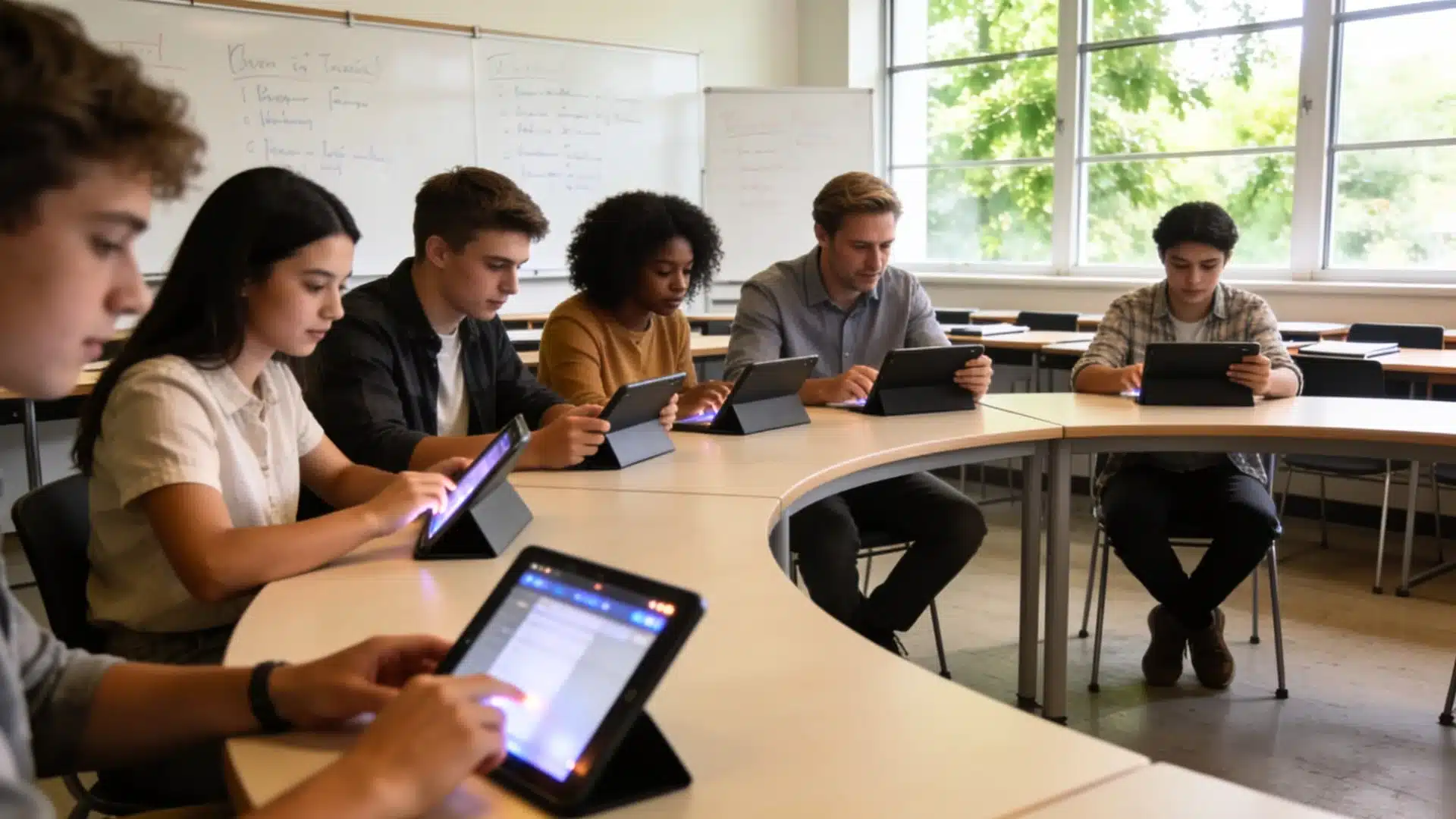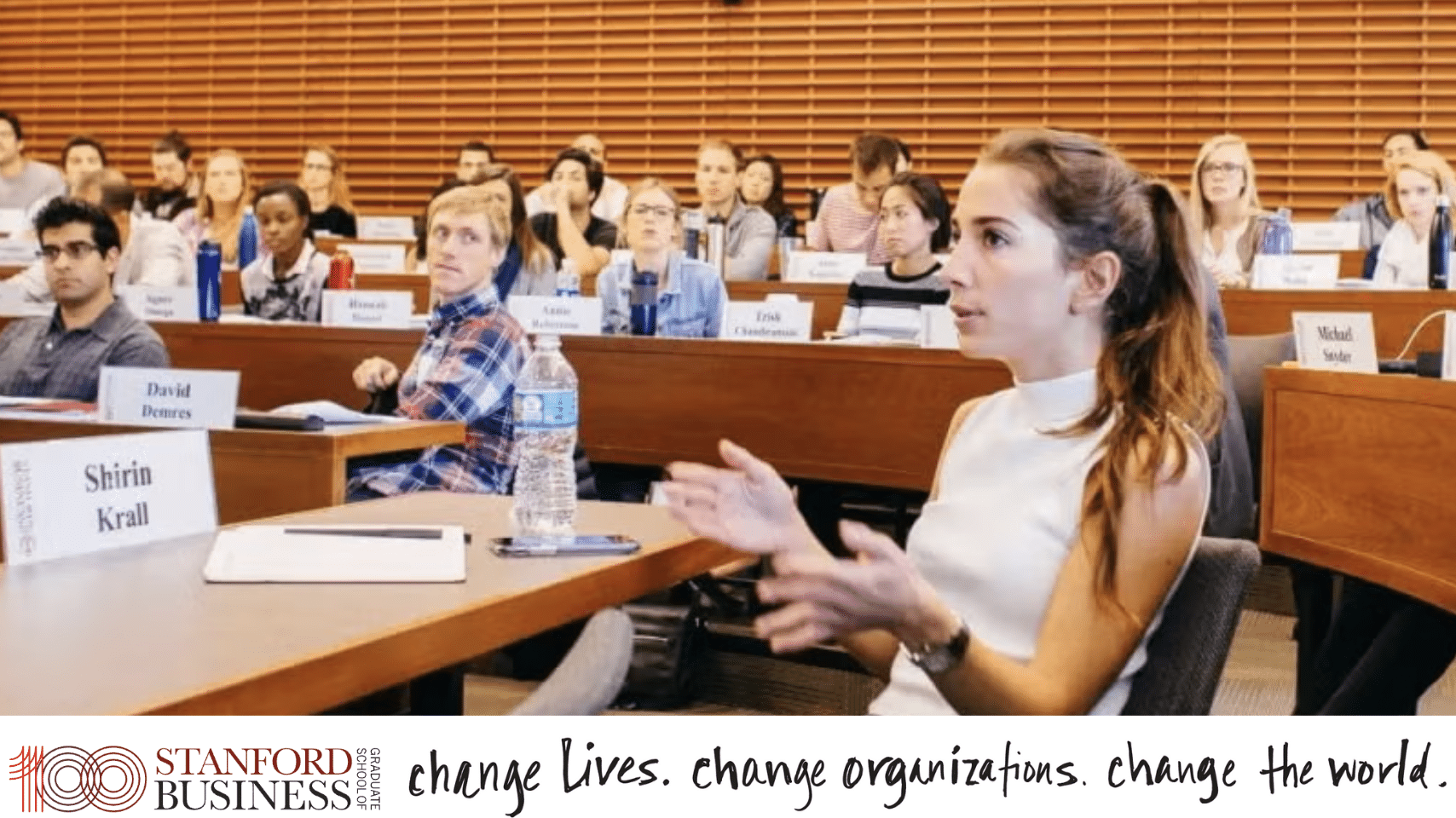

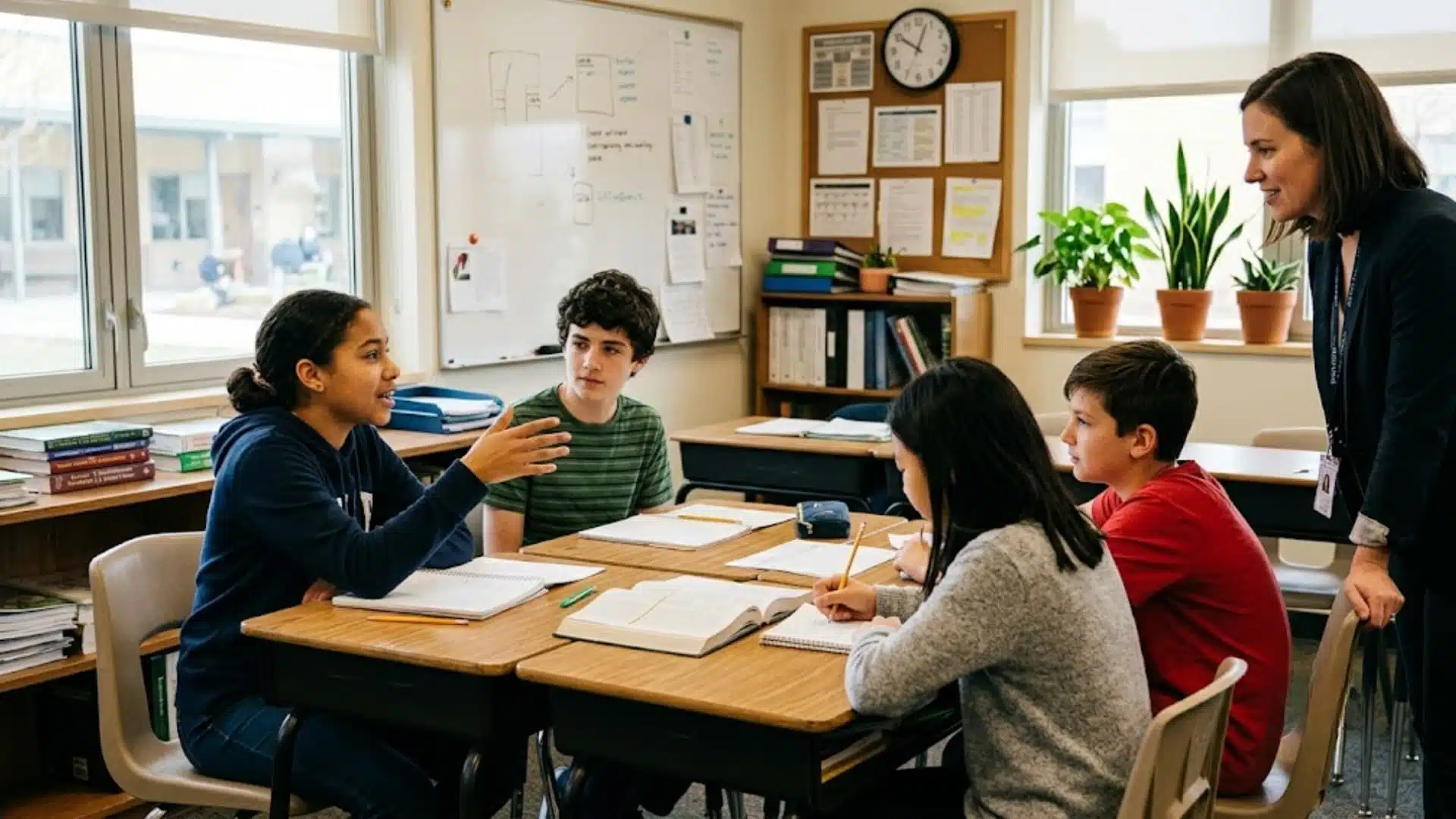
Picture a classroom where students are more vocal than the teacher. It’s a thoughtful arrangement, not just chaos.
Lectures feel efficient, but they rarely stick the way hands-on work does.
Students forget slides within days and remember debates, projects, and mistakes for years.
Active learning strategies exist to shift learning onto students, where it belongs.
This blog walks through what makes these strategies work, how you can use them tomorrow, and how to tell if they’re actually landing with your class.
What is Active Learning and What Makes It Different?
Active learning reverses the traditional classroom approach.
Instead of passively receiving information, students actively engage with it.
They solve problems, debate ideas, teach concepts back, or apply them to real scenarios. This is the main distinction from passive learning, where students merely watch, listen, and hope the material sinks in on its own.
Students in active classrooms retain more and perform better on assessments than those in lecture-only settings.
The idea traces back to a widely cited 1991 report by researchers Charles Bonwell and James Eison, who described active learning simply as anything that gets students doing things and thinking about what they’re doing.
It works because the brain processes information differently when a student acts on it instead of just receiving it.
Group work, case studies, and hands-on exercises all count.
The common thread is asking students questions instead of asking them to memorize answers.
How Active Learning Improves the Learning Process
Engagement changes what the brain actually retains. Here’s how active learning creates that shift for students:
- Boosts long-term retention by forcing recall instead of recognition.
- Builds critical thinking through analysis and application, not memorization.
- Increases motivation since you see immediate relevance to real problems.
- Strengthens peer learning through discussion and collaborative problem-solving.
- Improves exam performance by mimicking how information gets tested.
- Develops self-monitoring skills as you catch gaps in your own understanding.
- Makes lessons stick longer by connecting new material to prior knowledge.
Effective Active Learning Strategies and Examples
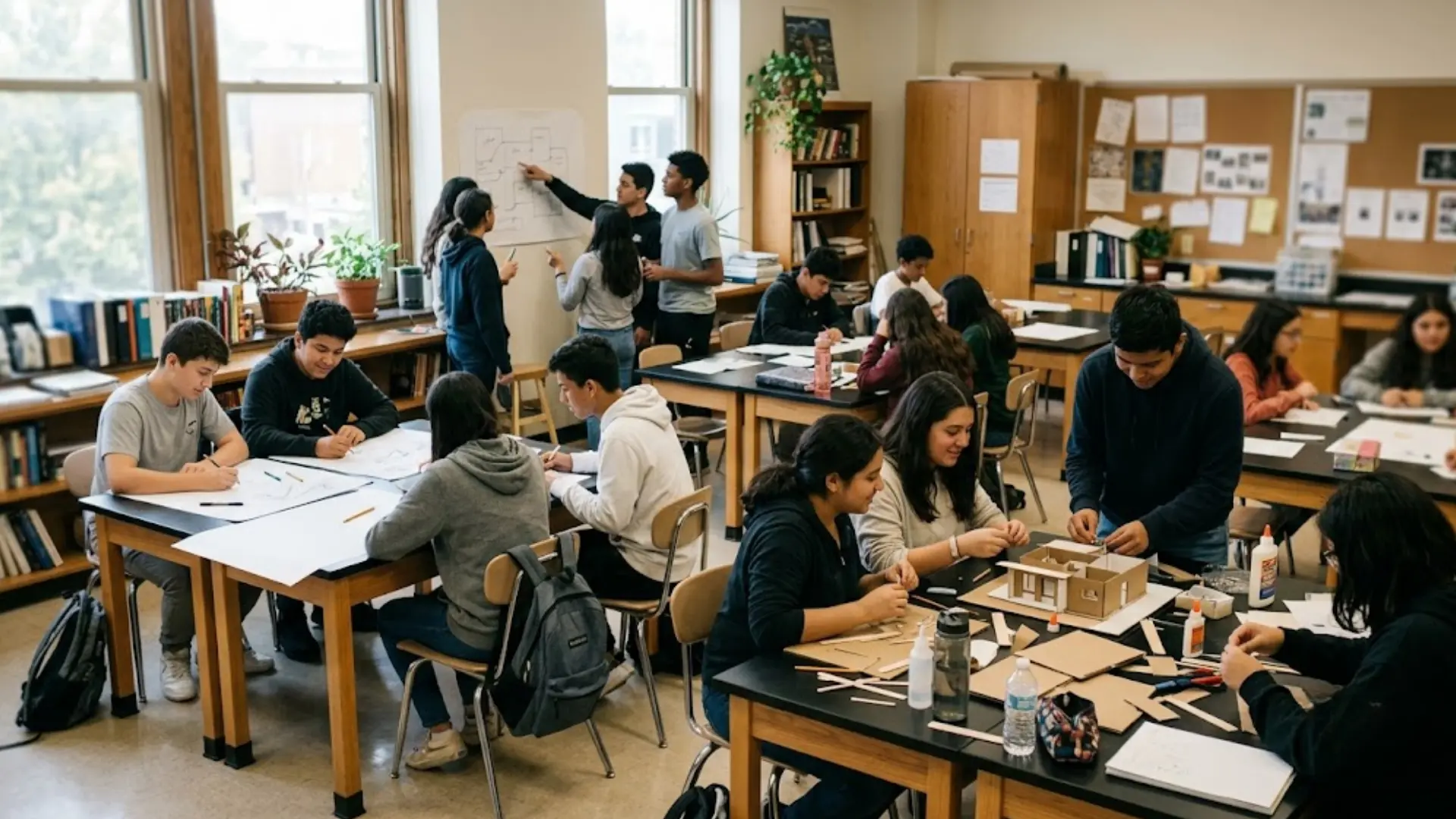
Find these active learning strategies that can change student engagement and improve learning outcomes.
1. Think-Pair-Share
Students first think individually, then discuss with a partner, and finally share with the class.
It works in almost any subject and needs no special materials.
Example Situation
A science teacher asks why a helpful trait might become harmful in a new environment.
Each student jots down one idea alone for 60 seconds.
They turn to a partner and compare answers, adjusting their thinking based on the discussion. Pairs then report out, and the teacher uses the spread of answers to correct misconceptions on the spot.
2. Problem-Based Learning (PBL)
Students tackle real, complex problems with no clear-cut answer. They work in groups to research, analyze, and propose solutions. The problem drives the learning, not the other way around.
Example Situation:
A social studies class gets a fictional town facing a water shortage.
Each group splits research tasks: one member studies environmental impact, another cost, another public opinion.
They reconvene, weigh trade-offs together, and draft an evidence-based recommendation, which they present to a mock town council for feedback.
3. Inquiry-Based Learning
Students form their own questions and investigate to find answers. The teacher guides instead of lecturing.
Example Situation:
Students notice some garden plants thrive while others don’t.
The teacher asks what they’re curious about instead of explaining.
Each group picks one variable, sunlight, water, or soil, designs a simple way to track it over two weeks, records daily observations, and presents what the data showed.
4. Collaborative Group Work
Small groups work toward one shared goal.
Each student is individually accountable, so no one coasts on the group’s effort.
Example Situation:
A history class splits WWI causes among groups: nationalism, militarism, alliances, imperialism.
Each student researches their assigned cause alone and writes an individual summary first.
Only after that does the group meet to build one shared visual showing how all four causes connected.
5. Peer Teaching
Students explain concepts to classmates.
Teaching forces deeper understanding than studying alone, and preparing to teach exposes gaps early.
Example Situation:
Before a biology exam, students research one body system and prepare a brief explanation with a real-life example.
Students rotate through partner pairs, teaching their system each round. Because they know a peer will quiz them afterward, they rely on active recall techniques to prepare rather than just rereading their notes.
6. Case Study Analysis
Students apply theory to a real-world scenario.
They examine what happened, why, and how it connects to course content.
Example Situation:
A nursing class reads a case where a patient refuses treatment.
In small groups, students first list the patient’s concerns, then the family’s, then the care team’s.
They draft a response that balances all three, then debrief as a class, tying their reasoning back to the informed-consent law they studied earlier.
7. Role-Playing Activities
Students take on roles and respond as those characters or stakeholders would.
This builds perspective-taking and communication skills.
Example Situation:
An economics class assigns roles as workers, union reps, managers, and shareholders.
Each group spends time in character, listing what their role wants and fears. They then hold a live negotiation session in those roles, and the debrief connects the outcome to real bargaining history.
8. Classroom Debates
Students research a topic, take a position, and argue it.
Assigning sides rather than letting students choose usually produces stronger results.
Example Situation:
A civics class debates warrantless searches of student belongings.
The teacher assigns perspectives regardless of personal views and requires students to research opposing arguments. Each side presents a timed opening statement and a rebuttal.
The class examines actual court rulings to understand how real judges have decided similar cases.
9. Flipped Classroom
Students absorb content at home through video or reading. Class time shifts to application and problem-solving.
Example Situation:
A math teacher posts a 12-minute video explaining a new equation method the night before.
Students arrive having already seen the concept and note one thing they understand and one they don’t.
Class opens by addressing the shared confusion, then students spend the rest of the period working practice problems in pairs with the teacher circulating for support.
10. Brainstorming Sessions
Students generate ideas freely, without judging or filtering.
This activates prior knowledge before structured work begins.
Example Situation:
A creative writing class gets 8 minutes to list every story idea they can think of, no matter how rough.
No one critiques during this phase. Afterward, students group their own ideas by theme, pick their top two, and the teacher points out patterns across the whole class to show what makes a premise work.
11. Jigsaw Learning
Each student masters one piece of a topic, then teaches it to peers who studied other pieces.
Everyone is both learner and teacher.
Example Situation:
A psychology class covers five therapy approaches in one week.
Students first meet in “expert groups” with others studying the same approach and work together to master it.
Then they regroup into mixed teams where each person is the only one who knows their approach, and they teach it in turn. A quiz covering all five holds everyone accountable for listening, not just teaching.
12. Concept Mapping
Students diagram how ideas connect, using labeled arrows between concepts.
This makes relationships visible instead of leaving facts isolated.
Example Situation:
After a cell biology unit, students draw a map starting with “cell” in the center and branching out to related structures.
Two students compare maps: one associates mitochondria with ATP production, while the other additionally links them to cellular respiration.
The teacher uses that difference to prompt a class discussion neither map alone would have sparked.
13. Minute Papers
Students respond to one or two quick questions during the final minute of class.
Teachers get instant feedback on what’s landing and what isn’t.
Example Situation:
After a lecture on the Great Depression, students get 90 seconds to write one connection to today’s economy.
The teacher reads through the stack that evening and notices most students understand the banking crisis, but few mention consumer debt. The next class opens by filling that specific gap.
14. Exit Tickets
Students complete a short task before leaving class, tied to one specific skill.
Example Situation:
After a fractions lesson, students solve one division problem on an index card before leaving. The teacher sorts the cards into “correct” and “incorrect” piles and finds 8 of 24 students made the same last-step error.
She reteaches just that step at the start of the next session instead of repeating the whole lesson.
15. Gamified Learning Activities
Points, teams, and instant feedback turn review into something students want to repeat.
Example Situation:
A Spanish class reviews 30 vocabulary words through team-based Kahoot before a test.
The live leaderboard keeps every team engaged through the full round.
Afterward, the teacher pulls up the five questions with the lowest scores and spends 8 minutes reteaching those specific words with new example sentences.
16. Interactive Polls and Quizzes
Real-time response tools show understanding as it happens, with results visible to the whole class.
Example Situation:
During an economics lecture, the professor poses a supply-and-demand scenario through Slido.
The results display live and show a three-way split in answers. Instead of just giving the right answer, she has students turn to a partner and defend their choice before the class works through the disagreement together.
17. Learning Stations
Students rotate through different activities, all tied to one learning objective.
Example Situation:
A water-cycle review sets up five stations: diagram labeling, a short reading, a movement activity, a video with reflection questions, and group drawing.
Small groups spend a set number of minutes at each station before rotating.
The teacher remains at the drawing station, giving hands-on feedback to each group throughout the period.
18. Socratic Seminars
Students analyze problems through questions and reasoning, while the teacher guides without directing answers.
Example Situation:
A high school English class sits in a circle to discuss who bears more moral responsibility in Frankenstein.
Students take turns posing questions and must support their points by citing specific passages.
The teacher only steps in to ask a clarifying question, letting students build directly on each other’s arguments toward the analytical essay they’ll write next.
19. Project-Based Learning
Students work on an extended project driven by one central question, ending in a public product or presentation.
Example Situation:
A math class tackles the question, “How can our school cafeteria improve?” Over several weeks, students design and run a survey, analyze wait-time and seating data, and draft recommendations.
They present findings to the principal, who gives real feedback on what’s actually feasible.
20. Reflective Journaling
Students write regularly about what they understood, what confused them, and what’s still unclear.
This builds awareness of their own learning patterns.
Example Situation:
In a college psychology class, students write a 5-minute journal entry after every session covering what clicked and what didn’t. After three weeks, the teacher reads through the entries.
She notices most students struggle to link attachment theory to adult relationships.
She rebuilds the next lesson around case examples that target that exact gap.
21. Simulation Activities
Students interact with a realistic system by making decisions and observing the results.
Unlike role-play, the focus is on the system rather than individual characters.
Example Situation:
A high school economics class runs a trading simulation where students start with different amounts of currency and goods. Midway through, the teacher introduces a sudden resource shortage.
Students need to modify their trading approach in real time.
The debrief links recent events to inflation, scarcity, and actual market behavior.
How to Choose the Right Active Learning Strategy?
Not every strategy fits every lesson. The right choice depends on your goal, group size, and available time.
- Match the strategy to your learning objective, not the other way around.
- Consider class size; some methods work better in small groups.
- Factor in available time, since some strategies need multiple sessions.
- Check your students’ comfort level with open discussion or public speaking.
- Account for subject matter; abstract topics often need concrete anchors.
Start with a simple strategy, test it, gather feedback, and adjust before scaling up.
How to Turn a Passive Lesson Into an Active Learning Lesson

Start with what students already do passively: listen, read, watch.
Pick one moment and insert a task. Pause a lecture and ask students to predict what comes next.
Replace a silent reading assignment with a quick written reaction. Swap a demonstration for a hands-on attempt, even a rough one. You don’t need to redesign the whole lesson.
Change one segment at a time, test it, then expand.
Small edits compound faster than a full overhaul, and they’re easier to troubleshoot when something doesn’t land.
Active Learning Strategies Across Different Educational Settings
Context is crucial. Techniques effective in a graduate seminar may not translate well to an elementary classroom.
| Setting | Best-Fit Strategies | Why It Works |
|---|---|---|
| Elementary School | Learning Stations, Gamified Activities | Needs movement and variety |
| Middle School | Jigsaw Learning, Exit Tickets | Builds accountability early |
| High School | Classroom Debates, Socratic Seminars | Sharpens independent reasoning |
| Undergraduate | Flipped Classroom, Case Studies | Balances theory with practice |
| Graduate School | Project-Based Learning, Peer Teaching | Fits self-directed research |
| Online Learning | Interactive Polls, Reflective Journaling | Keeps remote students present |
| Corporate Training | Simulations, Role-Playing | Mirrors real work decisions |
How to Assess Whether Active Learning Strategies Are Working
Watch participation first. Are more students speaking, writing, or contributing than before?
Then check retention through short, low-stakes recall tasks days later, not just immediate reactions.
Building in a bit of spaced recall practice makes this kind of delayed check more reliable than a same-day quiz.
Compare error patterns to identify real understanding; fewer repeats indicate learning. Ask students what helped or didn’t, since grades don’t fully reflect engagement, which often shows up before scores.
Track changes over several weeks, not one class period.
If nothing shifts after a fair trial, adjust the strategy rather than abandoning the approach altogether.
Common Active Learning Mistakes that Reduce Its Effectiveness
Good intentions don’t ensure proper implementation. Be cautious of these common mistakes:
- Adding activity without a clear learning goal behind it.
- Overloading one session with too many different strategies.
- Skipping debrief time, so insights never get connected.
- Letting strong personalities dominate group discussions.
- Using the same strategy repeatedly until it loses impact.
- Failing to explain why the method is being used.
- Treating noise or motion as proof that learning is happening.
Frequently Asked Questions (FAQ’s)
1. Does Active Learning Work for Every Subject?
Yes, though the specific strategy should match the subject’s demands.
2. Is Active Learning Harder to Implement than Lecturing?
It takes more upfront planning but less effort to sustain once routines are set.
3. Can Active Learning Work in Large Lecture Halls?
Yes, methods like Think-Pair-Share and Interactive Polls scale well to large groups.
4. How Much Class Time Should Active Learning Take Up?
Even 10-15 minutes per session can produce a measurable difference.
5. Does Active Learning Replace Direct Instruction Entirely?
No, it works best paired with direct instruction, not as a full replacement.
Bottom Line
Strong teaching often means stepping back at the right moments, not talking longer or louder.
Active learning strategies work because they hand students the wheel, even briefly, and let them steer through confusion toward real understanding.
Pick one method from this list and try it in your next lesson.
Small shifts in how a lesson runs often produce bigger results than a full redesign.
Which active learning strategy has worked best in your classroom? Tell us in the comments below.