



Your focus fades a little more each week, and it’s starting to bother you. “I can’t focus on anything” is the thought that keeps looping in your head. Maybe you reread the same line five times.
Maybe you open your phone without even meaning to. It feels frustrating, and it feels confusing too. Your mind used to feel sharper, and now it slips constantly.
This scattered feeling can come from stress, poor sleep, or something deeper going on inside your brain. Naming the problem is the first real step forward.
A foggy mind can clear up with the right changes and reduce the doubts of “why can’t I focus?”
What Does “I Can’t Focus on Anything” Actually Imply?
When you say those words out loud, you’re describing more than a bad day at your desk.
Your mind might jump from thought to thought, or it might go blank the moment you sit down to work.
Sometimes it shows up as forgetting why you walked into a room, or losing track of a conversation mid-sentence.
This pattern often has layers behind it: your sleep, your stress load, your daily habits, and sometimes your brain’s wiring itself.
Conditions tied to attention, like ADHD, can play a role for some people, though your experience may stem from something else entirely. Understanding what’s happening starts with naming it clearly.
See the everyday causes behind your shrinking attention span.
Common Causes of Lack of Concentration and Focus in Adults

Concentration problems rarely have a single cause. Most adults who struggle with focus are dealing with a combination of factors that compound each other.
A few of the causes below touch on mental health and medication. This is for informational purposes only and isn’t a substitute for advice from a doctor or licensed therapist.
1. Stress and Anxiety
When you’re stressed, your brain shifts into threat-detection mode, causing it to focus on problems instead of deep work.
Anxiety similarly hampers focus with racing thoughts and mental restlessness, pulling your attention toward worst-case scenarios.
If that restlessness tends to spike specifically before a big test, the same techniques used for calming pre-exam nerves can carry over to everyday focus struggles.
2. Sleep Deprivation and Poor Sleep Quality
Sleep is essential for the brain to consolidate memories, remove metabolic waste, and restore neural systems vital for attention.
Even a single or two nights of poor sleep can significantly impair concentration and working memory.
Adults experiencing chronic sleep deprivation often feel a persistent mental fog that persists despite high caffeine intake, highlighting the critical importance of sufficient, quality sleep for cognitive health.
3. Burnout and Emotional Exhaustion
Burnout is more than just tiredness; it’s a prolonged state of depletion that impacts brain function.
Those experiencing burnout often feel a mental flatness: tasks once manageable now seem overwhelming, and the energy to begin or complete activities has vanished.
This mental exhaustion can significantly impair daily functioning and overall well-being.
4. Depression and Low Motivation
Depression impacts concentration in ways that often go unnoticed as symptoms.
It can cause difficulty making decisions, slowed thinking, trouble retaining information, and an overall inability to get started.
If these cognitive issues occur alongside feelings of low mood, fatigue, or loss of interest in activities, this pattern is significant and worth noting.
5. Information Overload
The amount of information adults handle daily- emails, news, social media, work messages, and podcasts- is remarkably high compared to past eras.
The brain has its limits, and when these are frequently surpassed, focus and concentration decline.
Many individuals notice that after a certain point in the day, they are unable to process or respond effectively to new information.
6. Excessive Screen Time and Digital Distractions
Screens are designed to capture your attention through notifications, algorithms, and auto-playing videos that interrupt whatever you’re doing.
Over time, this environment conditions your brain to have shorter attention spans, making focused, uninterrupted work increasingly challenging.
7. Physical Health Factors
Several physical health issues can impair cognitive functions, such as thyroid problems, iron-deficiency anemia, vitamin B12 deficiency, and chronic pain.
Dehydration can also significantly affect concentration.
Shifts in hormones like estrogen, testosterone, and thyroid hormone are also linked to changes in concentration, which is one reason focus can dip during pregnancy, perimenopause, or an untreated thyroid condition.
8. Medication Side Effects
Some prescription medications, such as antihistamines, blood pressure drugs, sleep aids, and certain antidepressants, list brain fog or concentration difficulties as side effects.
If you experience changes in focus after starting a new medication, it’s important to discuss these effects with your prescribing doctor to ensure proper management and potential alternatives.
9. Attention Disorders Such as ADHD
ADHD in adults remains widely underdiagnosed, especially in women and those who developed strong coping strategies during school.
If you have persistent concentration issues impacting work, relationships, finances, or time management, and these do not improve with rest or stress relief, an ADHD assessment could be beneficial.
Small Shifts That Help You Reclaim Your Focus
Small, consistent changes often make the biggest difference in how steady your mind feels.
Several of these also double as exercises for building a longer attention span over time, not just getting through today’s task list.
Here are a few shifts that have genuinely worked for people in your exact situation:
- Set a single task in front of you and close every other tab or app.
- Break your work into short, timed chunks with real breaks in between.
- Keep your phone in another room while you work.
- Get sunlight and movement early in your day.
- Protect your sleep schedule like it’s non-negotiable.
- Write your next task down before you finish your current one.
- Keep your workspace clear of anything you’re not using right now.
- Drink water and eat on a regular schedule, not as an afterthought.
- Give yourself a set time to worry, then let it go.
Ahead, you’ll find how other people describe their own struggle with focus, and why so many of them feel exactly like you do.
Why Can’t I Focus: What Other People Shared
Real threads from people asking this same question often reveal patterns you might recognize in yourself. Here are two discussions worth your attention:
Your Mind Constantly Filled With Mental Noise?
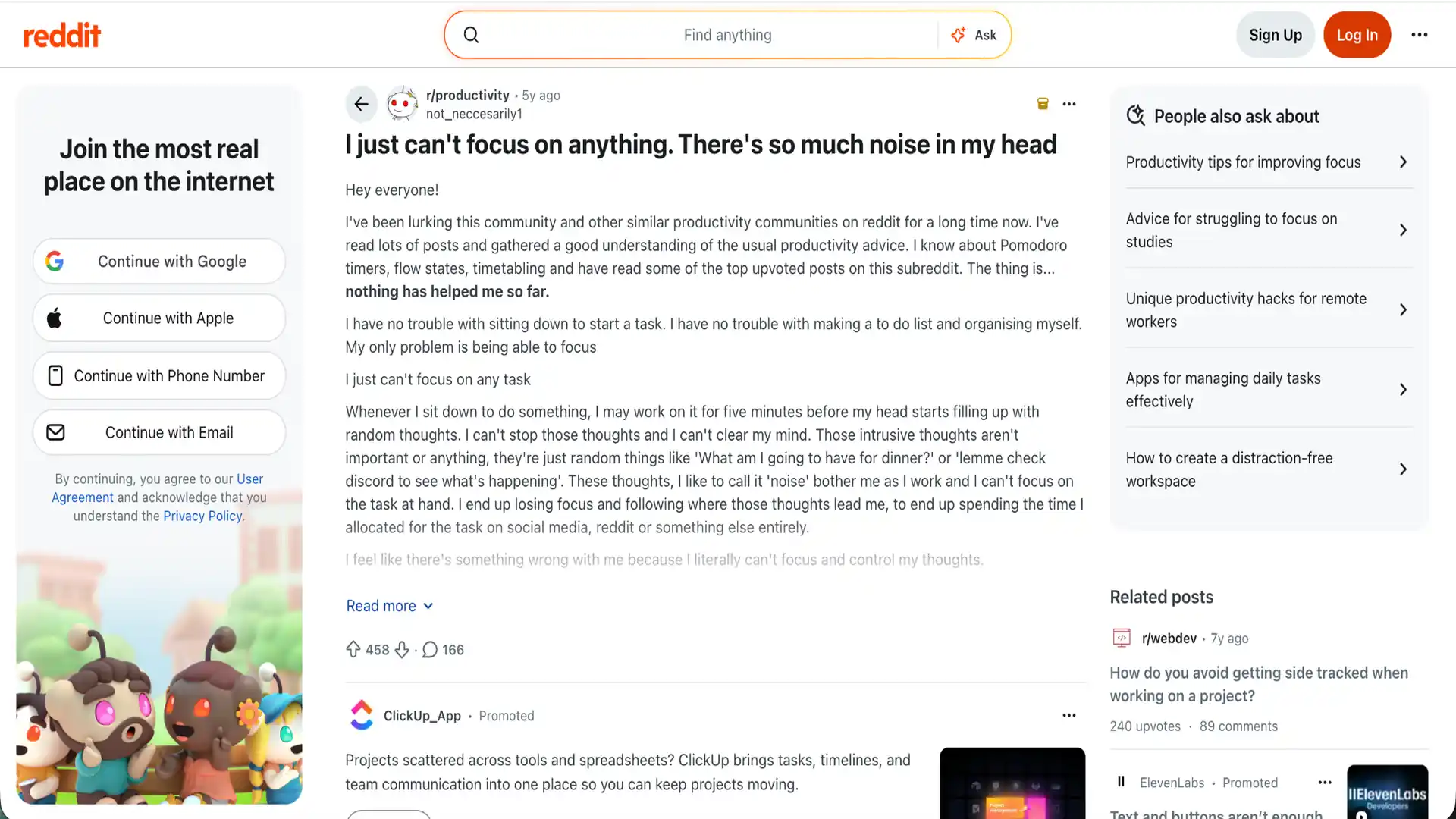
A user named not_neccesarily1 shared their struggle on Reddit, describing constant mental noise that pulled their attention away within minutes of starting any task.
Random thoughts about dinner or social media kept intruding, no matter how organized their to-do list looked. Commenters pointed toward possible ADHD.
Suggested screening tools and shared how meditation and physical movement helped quiet their own racing thoughts.
Remember, people noted this pattern felt lifelong rather than situational.
When Starting Feels Impossible: Stuck Before the First Step
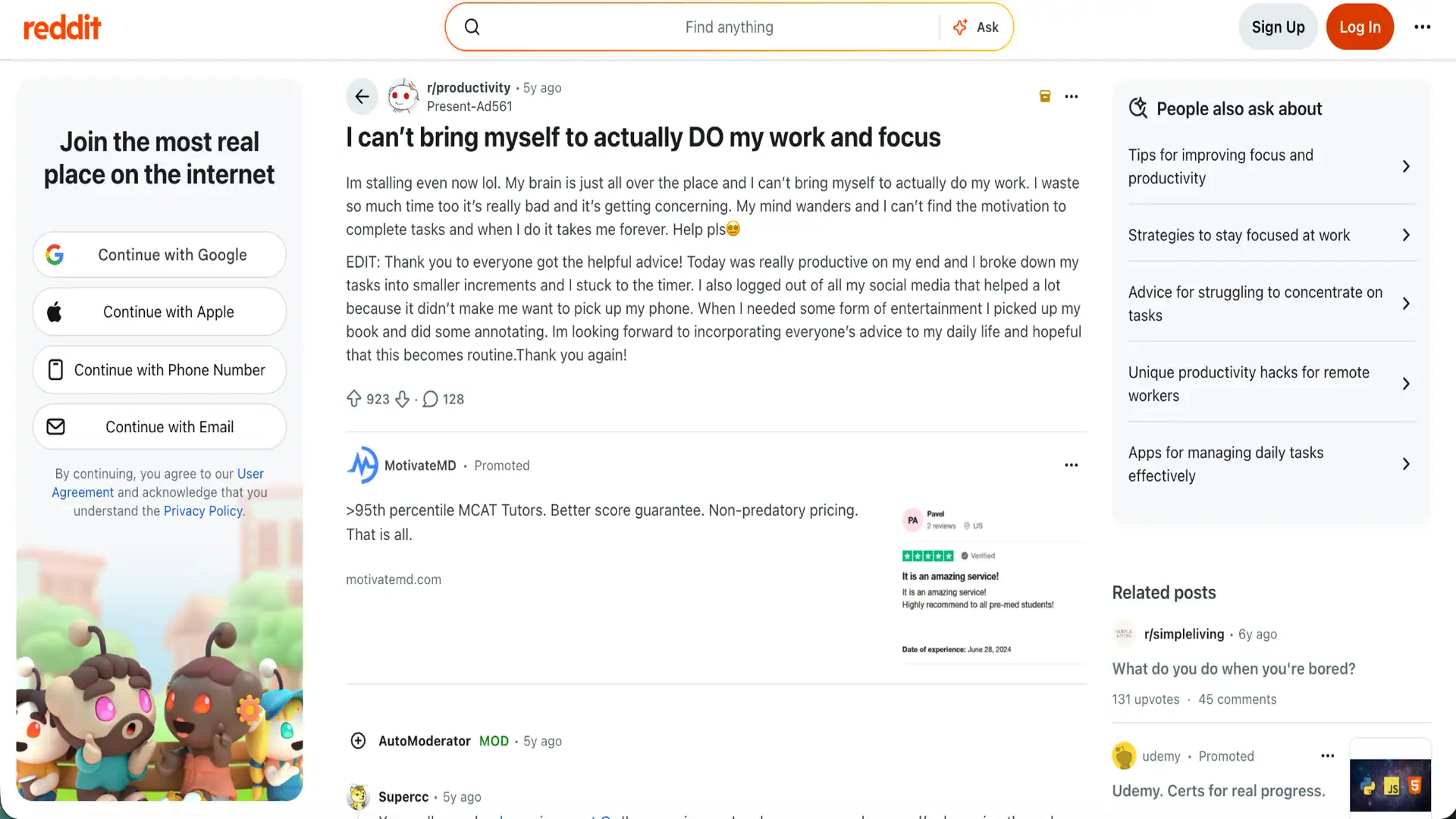
Another user, Present-Ad561, posted on Reddit about wasting hours unable to begin tasks despite wanting to finish them. Their mind wandered constantly, and motivation never seemed to arrive on its own.
Replies centered on dopamine resets, cutting back screen time, and swapping scrolling for offline habits like walking or reading.
The OP later returned to share genuine progress after breaking tasks into smaller pieces and logging out of distracting apps, showing your own small changes.
Why Some Days Feel Harder Than Others

Focus isn’t fixed from one day to the next, and several factors quietly shape how sharp or scattered your mind feels.
Your stress levels play a major role, since a packed schedule or unresolved worry narrows your attention and makes settling into a task feel far harder than usual.
Sleep matters just as much: a poor night’s rest slows your working memory and drains your ability to stay locked in the next day.
Your physical health counts too, as illness, fatigue, or a dip in blood sugar can quietly limit the mental energy you have available.
Your environment adds another layer, since background noise, constant interruptions, or a cluttered desk force your brain to work harder just to concentrate. Your emotional state also competes for space.
Recognizing these patterns helps you respond to a hard day with more patience instead of frustration.
Screen Habits: The Hidden Drain on Your Attention
Your daily digital habits quietly shape how well you concentrate. Here’s how common patterns affect your focus, and what helps instead:
Habit | What Happens | Why It Hurts Focus | What Helps Instead |
Social media scrolling | Delivers quick, frequent rewards | Trains your brain to crave novelty | Set fixed times to check apps |
Constant notifications | Interrupts your current task | Refocusing takes longer than the alert | Turn off non-essential notifications |
Multitasking | Forces rapid task-switching | Each switch drains mental energy | Work on one task at a time |
Phone-checking habits | Triggers dopamine anticipation | Makes slow tasks feel unrewarding | Keep your phone out of reach |
Endless content feeds | Removes natural stopping points | Weakens your ability to self-regulate | Use built-in screen time limits |
Background screen use | Splits your attention silently | Reduces depth of concentration overall | Play music instead of video |
None of these habits mean your focus is permanently broken. Small shifts in how you use your phone often bring real relief to your concentration over time.
What Not to Do When You Can’t Focus
Some of the most common responses to concentration problems make them worse. These are patterns worth recognizing and changing.
- Blaming Yourself: Focus problems often have real causes, and self-criticism creates additional mental strain rather than improving concentration.
- Trying to Multitask Everything: Switching between multiple tasks reduces efficiency and makes it harder to stay focused on any one thing.
- Ignoring Stress and Burnout: Concentration is unlikely to improve in the long term if underlying stress, exhaustion, or burnout is left unaddressed.
- Comparing Yourself to Others: Measuring your productivity against others creates unnecessary pressure and rarely provides useful insights.
- Expecting Instant Results: Improving focus takes consistent effort over time, and lasting progress usually comes from small, gradual changes.
The goal isn’t to be productive every minute of the day. By avoiding these common habits and giving yourself time to improve, you’ll build stronger concentration.
Procrastination or a Real Focus Problem?
Not every “I can’t focus on anything” moment is actually a focus problem.
Sometimes it’s plain avoidance of a task you don’t want to do, and the two feel almost identical from the inside.
A useful way to tell them apart: procrastination usually clears up the moment a deadline gets close enough, and you can typically focus fine on other things, just not the task you’re avoiding.
A genuine concentration problem tends to follow you across tasks you actually want to do, including ones you enjoy.
If you notice you can focus easily on a hobby or a low-stakes chore but not on the task in front of you.
The fix is usually about the task itself: break it into a smaller first step, remove ambiguity about what “done” looks like, or address whatever makes it unpleasant.
If focus is scattered no matter what you’re doing, that points more toward the causes covered above.
When Should You Seek Professional Help?
Not every focus problem needs professional help, but some do. These signs suggest it may be time to speak with a doctor or therapist:
- Focus problems last for months: if lifestyle changes have not helped, get checked for conditions like ADHD or anxiety.
- Daily tasks keep slipping: missed bills, appointments, or messages for more than two weeks are worth tracking and discussing with a doctor.
- Work or school performance drops: falling grades or work output tied to focus issues are a clear sign to ask for support.
- Emotional strain builds up: stress, shame, or relationship trouble linked to focus problems are valid reasons to talk to someone.
- Therapy can help with both: a therapist can treat the focus problem and the stress that comes with it.
Reaching out early can help you find a plan that works. A doctor or therapist can guide you through the next steps.
Final Remarks
The next time you think “I can’t focus on anything,” it usually means something in your routine needs to change.
This could mean small changes to your schedule, a conversation with someone you trust, or a visit to a doctor or therapist.
Sleep, screen time, and stress levels can all play a role in how well you concentrate. You do not need to fix everything at once, and small changes often add up over time.
Focus can improve with consistent habits and support from others.
Share what has helped you concentrate, or what you are still working through in the comments below.
Frequently Asked Questions
Is Brain Fog The Same As Lack Of Focus?
Not exactly. Brain fog involves mental cloudiness and slow thinking, while focus issues specifically involve difficulty sustaining attention on a single task.
Can Anxiety Cause Sudden Trouble Concentrating?
Yes, anxiety floods your mind with racing thoughts and worry, using up mental resources that would otherwise go toward sustained concentration and attention.
Does Aging Naturally Affect Your Ability To Focus?
Yes, natural aging can slow processing speed and reduce working memory slightly, though significant, sudden decline often points toward another underlying cause.