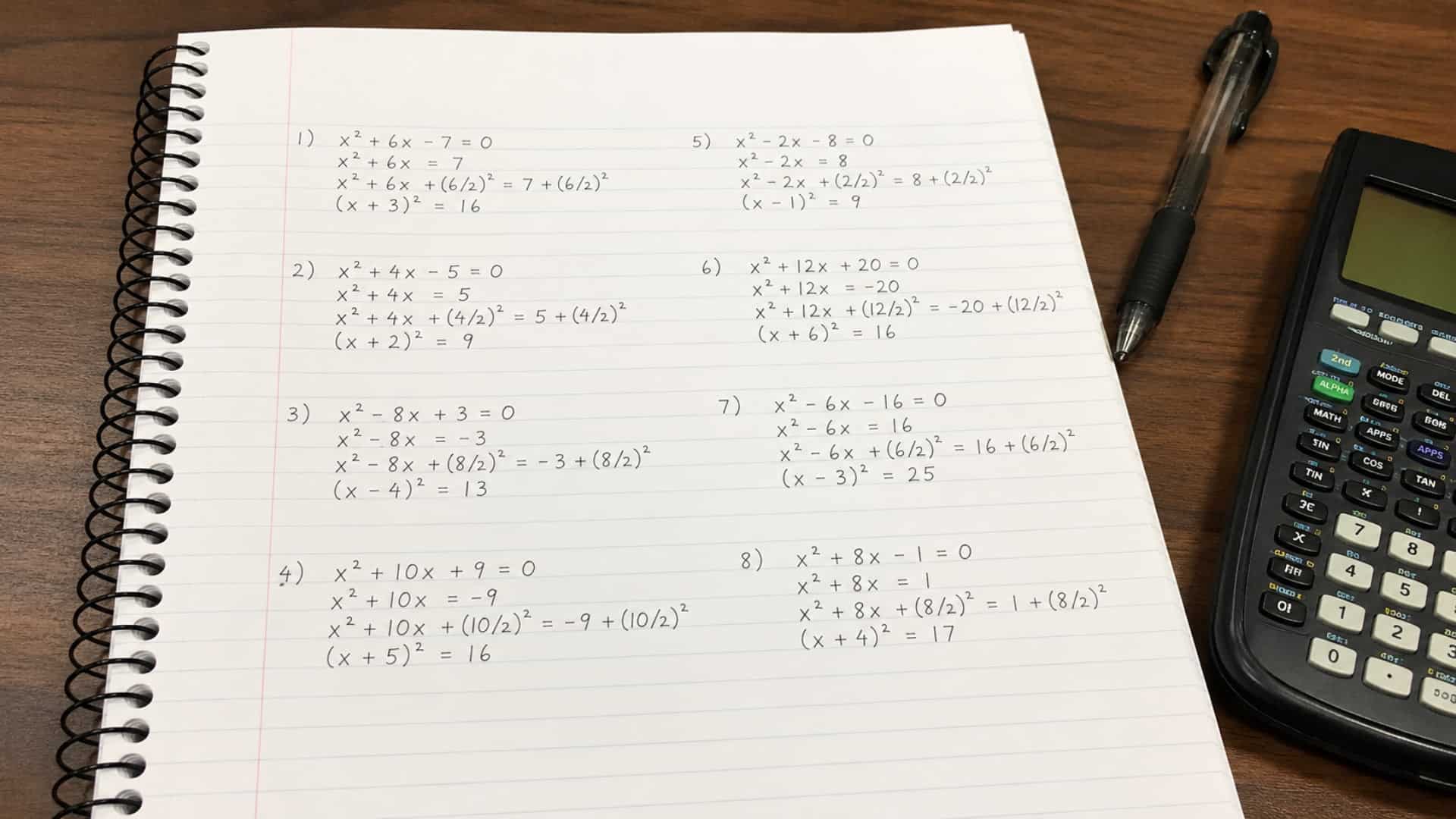


The question comes up constantly, and for good reason: knowing the MCAT calculator policy changes how preparation needs to be approached entirely.
Calculator access shapes study strategy, time management, and the kind of quantitative fluency the exam actually rewards.
The answer is no, and what follows that answer matters just as much.
Understanding why the policy exists, which math skills the exam tests, and how to build mental math habits that make it all manageable is what turns a daunting policy into a preparation advantage.
Do You Get a Calculator on the MCAT?
No. Students do not get a calculator on the MCAT.
According to the AAMC’s official test day guidelines, the testing center does not permit any calculators, including basic handheld calculators, scientific calculators, or phone applications.
The MCAT is a computer-based exam administered at Pearson VUE centers, and the on-screen interface does not provide a digital calculator.
The official AAMC policy states: “To make any notes or calculations during your exam, you will be given a noteboard booklet and fine-point marker.”
This means every calculation must be completed manually. Students are provided with a noteboard booklet and fine-point marker to work through calculations on test day.
Why Does the MCAT Not Allow Calculators?
The MCAT is not a math exam. The AAMC designed it to measure whether a student can think, reason, and make sound decisions under pressure.
Removing the calculator is not about making the exam harder. It is about making sure the exam measures the right things.
At its core, the MCAT is built around one idea:
- Future physicians reason through problems; they do not compute them.
- Reasoning ability and conceptual understanding matter far more than arithmetic speed.
The absence of a calculator is not a disadvantage. It is a deliberate choice by the AAMC.
How is Math Tested on the MCAT Without a Calculator?
The MCAT does not expect perfect arithmetic. It expects smart reasoning.
The focus is never on a precise number. It is about understanding what the numbers mean and reasoning toward the correct answer.
Math on the exam falls into three consistent patterns:
Mental Math Expectations
- Estimation is prioritized over exact calculation
- Scientific notation simplifies large and small numbers
Simplified Calculations
- Numbers are chosen for quick manual handling
- Emphasis is on reasoning, not lengthy computation
Approximation Over Precision
- Exact answers are rarely necessary
- Spaced answer choices make strategic elimination effective
Which MCAT Sections Require Math?
Not every section of the MCAT places the same demand on mathematical ability.
Some sections require active calculation and quantitative reasoning. Others require none at all. Knowing where math appears helps students prioritize their preparation effectively.
1. Chemical and Physical Foundations of Biological Systems
This is the most math-intensive section of the MCAT. Physics, general chemistry, and organic chemistry all require active calculation and quantitative reasoning without a calculator.
Students can expect:
- Physics calculations involving force, motion, and energy
- General chemistry equations, including stoichiometry and acid-base calculations
- Unit conversions and scientific notation throughout
- Quantitative reasoning applied to experimental data and graphs
2. Biological and Biochemical Foundations of Living Systems
This section is less calculation-heavy than Chem/Phys but is not entirely math-free. The emphasis here is on data interpretation and reasoning rather than lengthy arithmetic.
Students should be prepared for:
- Interpreting experimental data presented in graphs and tables
- Basic biological calculations, such as enzyme kinetics and concentration problems
- Applying mathematical equations to solve passage-based problems
3. Psychological, Social, and Biological Foundations of Behavior
Math in this section is limited but present in a specific and often overlooked form.
Students should expect:
- Basic statistics such as mean, median, and standard deviation
- Interpreting research study data and identifying variables
- Understanding concepts like correlation and effect size
Quantitative reasoning here is light and conceptual rather than computational.
4. Critical Analysis and Reasoning Skills (CARS)
CARS contains no math whatsoever. One can approach this section without any concern for arithmetic or calculation skills.
Students can expect:
- No calculations or equations of any kind
- No quantitative reasoning requirements
- No numerical data or statistical interpretation
It tests critical thinking and reading comprehension exclusively through passage-based questions drawn from the humanities and social sciences.
What Types of Math Appear on the MCAT?
The MCAT does not test advanced mathematics, but it does expect fluency in a specific set of quantitative skills. Knowing exactly which ones appear keeps preparation focused and efficient.
Math Type | What It Covers | Where It Shows Up |
|---|---|---|
Basic Arithmetic | Addition, subtraction, multiplication, division | Across all sections, embedded in multi-step problems |
Scientific Notation | Converting and manipulating powers of ten | Physics equations, chemistry concentrations, lab data |
Logarithms | pH calculations, acid-base relationships | General chemistry and biochemistry questions |
Ratios and Proportions | Concentrations, dilutions, scientific relationships | Biology, chemistry, and research design questions |
Percentages and Fractions | Data interpretation, experimental results | Critical analysis and reasoning, biology, chemistry |
Unit Conversions | Common physics and chemistry applications | Physics kinematics, thermodynamics, and lab-based questions |
Why Do Students Worry About Not Having a Calculator?
The concern is completely understandable.
Most pre-med students spend years in calculator-dependent coursework. Physics labs, chemistry problem sets, and biochemistry exams almost always permit calculators.
Transitioning to an exam that removes that tool entirely feels like a step backward.
The fear usually comes down to two things: making arithmetic errors under time pressure and believing the MCAT math is harder than it actually is.
Both concerns are valid but largely unfounded. The MCAT is designed around the absence of a calculator, which means the math is intentionally kept at a manageable level.
What Premed Students Say About Calculators on the MCAT
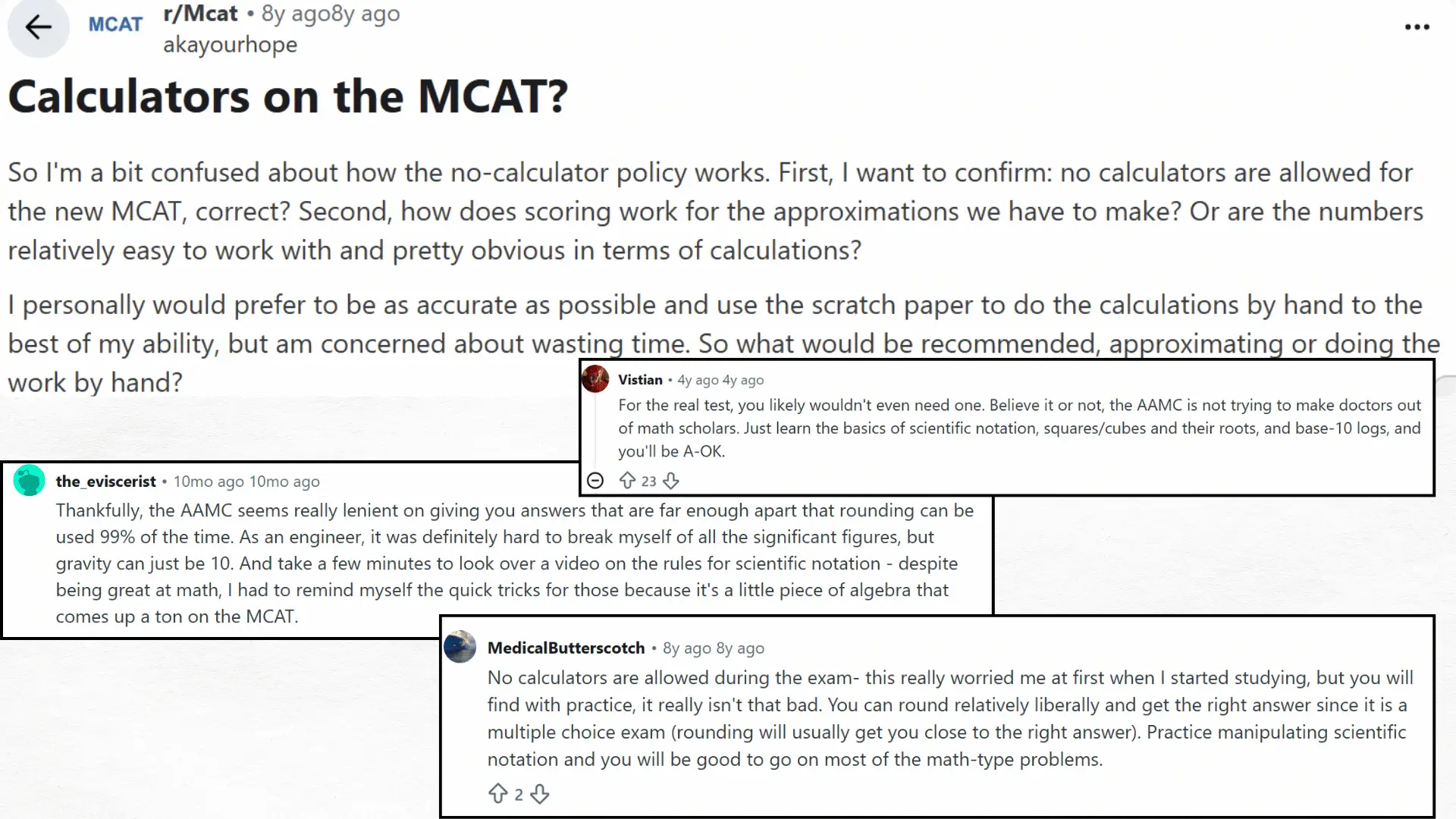
Real students on r/Mcat have raised the exact same concern.
One user admitted the no-calculator rule was alarming at first but found that consistent practice made it entirely manageable on test day.
Another commenter, an engineer by background, shared that breaking the habit of precise calculation was the hardest part, but simplified values were more than sufficient.
A third response reinforced that answer choices on the MCAT are spaced far enough apart that rounding reliably works the vast majority of the time.
The consensus across the thread is clear: the rule feels more intimidating before the exam than it ever does inside the testing room.
Read the full thread on r/Mcat →
How to Handle MCAT Math Without a Calculator?
The calculator never shows up on test day, so it should not show up in your prep either. Building these habits early is what separates confident test-takers from ones who freeze mid-question.
- Practice Mental Math Daily: Short timed drills train your brain to compute quickly and accurately under pressure.
- Master Scientific Notation: A high-yield skill that appears across chemistry, physics, and biology questions consistently.
- Learn Estimation Strategies: Narrowing answer choices by elimination is faster and more reliable than solving to the exact digit.
- Memorize Common Logarithm Relationships: pH and pKa calculations become significantly faster when log values are already committed to memory.
- Use MCAT-Style Practice Questions: Simulating real testing conditions is the only way to build the speed and composure the exam demands.
None of these skills develop overnight, but a few weeks of consistent practice make calculator-free math feel far less intimidating by test day.
Essential Mental Math Techniques for the MCAT
These techniques are what high scorers use to move through quantitative questions quickly and accurately without second-guessing every calculation.
Technique | Best Used For | The Mental Shift | Why It Works |
|---|---|---|---|
Rounding Strategically | Multi-step, non-critical calculations | Solve directionally, not precisely | Close enough to eliminate is close enough to move on |
Powers of Ten | Scientific notation in physics and chemistry | Exponent first, coefficient second | Turns complex expressions into one-step math |
Fraction-to-Decimal Conversions | Ratio and probability questions | Recognize the equivalent, skip the division | Memorized conversions remove computation mid-question |
Percentage Estimation | Genetics ratios and proportional change | Approximate with intention, not guesswork | Precise enough to eliminate distractors confidently |
Fast Multiplication and Division | Calculations with factorable numbers | Break the number down before operating | Smaller factors are faster under timed pressure |
Can You Use a Calculator During MCAT Practice Tests?
Technically, nothing stops a student from using a calculator during practice. But doing so is one of the most counterproductive habits in MCAT preparation.
The actual exam allows no calculator. Practicing with one creates a false sense of security and leaves students unprepared for the mental shift required on test day.
Building speed and accuracy without a calculator takes time. Starting calculator-free from the very first practice problem is the most effective way to develop that skill gradually and arrive at test day feeling genuinely confident.
Calculator Policy Compared With Other Exams
Every major admissions exam has its own stance on calculators, and the differences are more significant than most test-takers expect.
Here is how the MCAT stacks up.
Exam | Calculator Policy | What It Signals | Official Resource |
|---|---|---|---|
MCAT | No calculator permitted at any point | Tests scientific reasoning and mental math fluency over computational ability | |
SAT | Permitted on specific sections only | Balances computational and analytical skills depending on the section | |
GRE | Built-in on-screen calculator provided | Prioritizes data interpretation over raw calculation speed | |
DAT | No calculator permitted | Emphasizes quantitative reasoning and applied problem-solving under pressure |
Medical school admissions tests are designed to assess how you think through scientific problems, not how efficiently you operate a calculator.
The no-calculator policy on the MCAT and DAT reflects a deliberate emphasis on reasoning under pressure, which is far closer to the demands of clinical decision-making than any arithmetic tool could replicate.
Biggest Myths About MCAT Calculators
Most of that fear surrounding the no-calculator rule is built on misconceptions that circulate widely in pre-med communities and study groups.
Myth 1: You Need a Calculator to Succeed
Fact: The MCAT is deliberately designed so that no calculator is needed. The numbers are kept clean, and estimation is sufficient to arrive at the correct answer on a multiple-choice exam.
Myth 2: MCAT Math is Extremely Difficult
Fact: MCAT math is limited to high school-level arithmetic, algebra, and basic trigonometry. There is no calculus, no complex statistics, and no matrix algebra anywhere on the exam.
Myth 3: High Scorers Are Math Geniuses
Fact: High scorers are not exceptional at arithmetic. They are exceptional at reasoning. The ability to estimate quickly and think conceptually matters far more than computational speed.
Myth 4: Every Question Requires Detailed Calculations
Fact: The majority of MCAT questions test conceptual understanding, not computation. Calculation-heavy questions make up a small proportion of the exam.
Final Tips for MCAT Test Day
Walking into the exam without a calculator is not a disadvantage. It is a level playing field.
These four habits make the biggest difference on test day:
- Trust Estimation Methods: Rounding and approximation are sufficient. Precision is rarely necessary on a multiple-choice exam.
- Focus on Concepts Over Arithmetic: The correct answer almost always comes from understanding the relationship between variables, not from exact calculation.
- Manage Time Effectively: If a calculation feels too complex, step back and re-evaluate the approach.
- Avoid Getting Stuck on Calculations: Move on, flag the question, and return with fresh eyes.
Final Thoughts
No calculator, no problem, as long as the preparation reflects that reality from day one.
The MCAT is not testing arithmetic ability; it is testing how well scientific reasoning holds up under pressure, and mental math is simply part of that skill set.
The students who stop reaching for a calculator during practice are the ones who feel genuinely steady on test day.
Now that the answer to “do you get a calculator on the MCAT?” is settled, the focus can shift entirely to building the skills that make the policy irrelevant.
Which mental math technique are you starting with? Share below.
Frequently Asked Questions (FAQs)
Does the Calculator Policy Vary by Test Date or Location?
The no-calculator rule is uniform across all test dates, testing centers, and locations worldwide. No exceptions exist regardless of when or where the exam is taken.
How Are Students Expected to Solve Math Without a Calculator?
All calculations are completed manually using the noteboard and fine-point marker provided at the testing center. The exam is deliberately designed so that estimation and rounding are sufficient to arrive at the correct answer.
What Happens if a Student is Caught With a Calculator?
Possession of a calculator during the MCAT violates AAMC testing policies. This can result in immediate score cancellation and may impact eligibility for future test sittings.
Does the Exam Software Provide Any Digital Calculation Tools?
There are no built-in calculation tools in the MCAT interface. The only on-screen aid provided is a periodic table, accessible during the relevant science sections.