


Sitting down to give your best for MCAT, or searching for a fast-track study schedule that actually works?
Many students begin their preparation assuming a single fixed timeline fits everyone.
MCAT success depends heavily on current knowledge, study consistency, target score, and daily availability.
Some students improve in three months.
Others need six months of structured prep to strengthen weak science foundations and boost test endurance.
This blog helps students understand the MCAT structure, preparation timelines, study hours, and schedules needed for realistic score improvement.
Know What the Exam Demands: How Long to Study for MCAT
Strong MCAT scores rarely come from random study sessions or rushed preparation plans.
Students preparing seriously for the exam spend about three to six months studying consistently, with daily sessions focused on content review, practice questions, and full-length exams.
Some students may dedicate around 400 total study hours for balanced preparation.
Others may spend closer to 600 hours strengthening weaker subjects and improving score consistency.
Establishing a good routine is as important as study hours. Consistency boosts scores and confidence over time.
How Study Background Affects MCAT Preparation Time

Academic strength influences how quickly students grasp passage-based and critical reasoning questions.
Identifying weak subjects early helps students avoid wasting time and creates a more focused preparation schedule from the beginning.
| Subject | Minimum Weeks | What it Includes |
|---|---|---|
| Biology | 5–7 Weeks | Cell biology, Genetics, Body systems, Evolution, Metabolism |
| Biochemistry | 4–6 Weeks | Amino acids, Enzymes, Metabolic pathways, Protein structure |
| General Chemistry | 3–5 Weeks | Reactions, Thermodynamics, Acids and bases, Atomic structure |
| Organic Chemistry | 3–4 Weeks | Functional groups, Reactions, Bonding, Stereochemistry |
| Physics | 3–5 Weeks | Mechanics, Electricity, Fluids, Optics, Equations |
| Psychology & Sociology | 2–4 Weeks | Behavior, Learning theories, Social systems, Cognition |
| CARS | Daily Throughout | Comprehension, Logical reasoning, Argument, and passage analysis |
How Your Baseline Score Can Change Everything
Before choosing an MCAT study schedule, students should take a diagnostic test to assess their strengths, timing, and readiness, and then select a six-, four-, or three-month preparation plan.
Step 1: Take a Full-Length MCAT Practice Test
Attempt a full MCAT practice exam under realistic conditions without notes, breaks, or outside help.
Strong performance = 3 points
Average performance = 2 points
Low performance = 1 point
Step 2: Check Subject-Wise Strengths and Weaknesses
Review performance in biology, chemistry, physics, psychology, and reasoning sections after the test.
Strong in most subjects = 3 points
Balanced strengths and weaknesses = 2 points
Weak across multiple subjects = 1 point
Step 3: Measure Timing and Endurance Levels
Track if you completed sections comfortably or struggled with focus and engagement during longer parts.
Comfortable timing and focus = 3 points
Minor timing struggles = 2 points
Major timing and endurance issues = 1 point
Step 4: Compare Baseline Score with Target Score
Identify how far your current score realistically is from your ideal medical school target score.
Small score gap = 3 points
Moderate score gap = 2 points
Large score gap = 1 point
Step 5: Review Consistency in Problem-Solving
Analyze if mistakes stem from weak concepts, rushed timing, or inconsistent reasoning.
Consistent accuracy = 3 points
Moderate inconsistency = 2 points
Frequent repeated mistakes = 1 point
Total Your Score Before Choosing a Schedule
- 13 to 15 points: Best suited for a3-month MCAT study schedule.
- 9 to 12 points: Best suited for a 4-month MCAT study schedule.
- 5 to 8 points: Best suited for a6-month MCAT study schedule.
Hours and Months Mapped to Your Target Score
Understanding how study hours relate to target scores helps students build realistic schedules without overloading themselves early.
| Target Score | Timeline | Weekly Hours | Why it Differs |
|---|---|---|---|
| Below 500 | 6 Months | 20–25 hrs | Needs more time to rebuild foundations and review content. |
| 500–510 | 4 Months | 25–30 hrs | Core concepts are familiar; focus shifts to practice and timing |
| Above 510 | 3 Months | 30–40 hrs | Intensive weekly study with advanced testing and detailed error analysis |
The target score directly shapes how many hours students should commit each week.
Students aiming for competitive scores spend more time reviewing difficult concepts, completing full-length exams, and analyzing mistakes carefully
6 Months MCAT Study Plan
Students opting for this MCAT schedule often require extra time for science review, passage practice, and revision.
This schedule works best for students balancing college classes, part-time work, weaker science backgrounds, or larger score gaps from their target score.
| 1st Month | Week 1 | Week 2 | Week 3 | Week 4 |
|---|---|---|---|---|
| Weekly Study Hours | 18–20 hrs | 18–20 hrs | 20 hrs | 20 hrs |
| Main Subjects | Biology, General Chemistry | Biology, Physics | Biochemistry, Psychology | Organic Chemistry, CARS |
| Area to Cover | Cell biology, atomic structure, reactions | Genetics, mechanics, equations | Enzymes, metabolism, and behavior theories | Functional groups, reading comprehension |
| 2nd Month | Week 1 | Week 2 | Week 3 | Week 4 |
|---|---|---|---|---|
| Weekly Study Hours | 20–22 hrs | 20–22 hrs | 20 hrs | 20–22 hrs |
| Main Subjects | Biology, Biochemistry | Chemistry, Physics | Psychology, Sociology | Organic Chemistry, CARS |
| Area to Cover | Molecular systems, proteins | Thermodynamics, electricity | Learning theories, social behavior | Reaction analysis, passage reading |
| 3rd Month | Week 1 | Week 2 | Week 3 | Week 4 |
|---|---|---|---|---|
| Weekly Study Hours | 22–25 hrs | 22–25 hrs | 22 hrs | 25 hrs |
| Main Subjects | Biology, Physics | Biochemistry, Chemistry | Psychology, CARS | Full Subject Rotation |
| Area to Cover | Timed passage solving | Integrated science practice | Reading speed, reasoning | Mixed question revision |
| 4th Month | Week 1 | Week 2 | Week 3 | Week 4 |
|---|---|---|---|---|
| Weekly Study Hours | 25–28 hrs | 25 hrs | 25–28 hrs | 28 hrs |
| Main Subjects | Full-Length Exam | Weak Subject Review | Mixed Passage Practice | Full-Length Exam |
| Area to Cover | Timing analysis, endurance | Weak concept improvement | Scientific reasoning | Score tracking, mistake review |
| 5th Month | Week 1 | Week 2 | Week 3 | Week 4 |
|---|---|---|---|---|
| Weekly Study Hours | 28–30 hrs | 28 hrs | 28–30 hrs | 28 hrs |
| Main Subjects | Full-Length Exam | Biology, Biochemistry | Chemistry, Physics | Psychology, CARS |
| Area to Cover | Incorrect answer analysis | High-yield revision | Timed calculations | Reading accuracy, reasoning |
| 6th Month | Week 1 | Week 2 | Week 3 | Week 4 |
|---|---|---|---|---|
| Weekly Study Hours | 30 hrs | 28–30 hrs | 28 hrs | 20–22 hrs |
| Main Subjects | Full-Length Exam | Weak Section Review | Mixed Subject Practice | Light Revision |
| Area to Cover | Final score evaluation | Focused weak-area revision | Balanced reinforcement | Mental recovery, test readiness |
The goal over these six months is to gradually build subject confidence.
Also, improving timing, endurance, and test accuracy, without feeling overpowered early in preparation.
4 Months MCAT Study Plan
Students choosing a four-month MCAT schedule usually already know core science concepts but still need strong revision, timing control, and repeated testing practice.
This plan is ideal for students seeking balanced score improvement without lengthening preparation time.
1st Month: Building Core Subject Understanding
This month focuses on reinforcing core science concepts and developing daily MCAT study habits.
Week 1.1
Revise cell biology, amino acids, metabolism, enzymes, and genetics while gradually improving foundational scientific understanding.
Focus on building consistent study habits and strengthening memory retention by using shorter, timed passages.
- Main Subjects: Biology, Biochemistry,
- Weekly Study Time: 22–25 hrs
Week 1.2
Study atomic structure, mechanics, equations, chemical reactions, and scientific calculations for the MCAT.
Focus on improving formula use and accuracy in timed practice.
- Main Subjects: General Chemistry, Physics,
- Weekly Study Time: 22–25 hrs
Week 1.3
Cover cognition, learning theories, memory, social behavior, and research interpretation through repeated passage-based practice questions.
Focus this week on improving terminology retention and reasoning accuracy during longer reading-heavy sections.
- Main Subjects: Psychology, Sociology,
- Weekly Study Time: 24 hrs
Week 1.4
Revise functional groups, stereochemistry, reaction mechanisms, and reading comprehension strategies needed for critical analysis passages.
Focus on consistently improving reading endurance and scientific reasoning under timed conditions.
- Main Subjects: Organic Chemistry, CARS,
- Weekly Study Time: 24–26 hrs
2nd Month: Timed Practice and Weak Area Improvement
Students should increase timed practice, improve weaker subjects, and boost question-solving accuracy.
Week 2.1
Carefully study human body systems, motion, fluids, equations, and biology-heavy scientific interpretation passages throughout the week.
Focus this week on improving concentration and reducing timing mistakes during longer passage-solving sessions.
- Main Subjects: Biology, Physics,
- Weekly Study Time: 26 hrs
Week 2.2
Revise protein structures, equilibrium, acids and bases, metabolic pathways, and chemistry application questions that require a deeper understanding.
Focus on boosting scientific reasoning and connecting chemistry concepts with biology-based MCAT questions.
- Main Subjects: Biochemistry, General Chemistry,
- Weekly Study Time: 26–28 hrs
Week 2.3
Study concepts in reasoning skills, motivation, reading comprehension, and social behavior through daily, timed passage practice.
Focus this week on maintaining steady pacing and improving reading consistency across difficult passage sets.
- Main Subjects: Psychology, CARS,
- Weekly Study Time: 25 hrs
Week 2.4
Revise weaker science sections, mixed MCAT concepts, repeated mistakes, and difficult passage types affecting practice scores regularly.
Focus this week on improving timing control and consistently strengthening accuracy during mixed-subject practice sessions.
- Main Subjects: Mixed Subject Practice,
- Weekly Study Time: 28 hrs
3rd Month: Full-Length Exams and Performance Analysis
This stage emphasizes practice exams, endurance, timing, and reviewing mistakes.
Week 3.1
Focus on biology weaknesses, endurance building, timing analysis, and score evaluation after completing full-length practice testing sessions.
Focus on reviewing incorrect answers carefully and improving concentration during longer testing periods.
- Main Subjects: Full-Length Exam, Biology Review,
- Weekly Study Time: 30 hrs
Week 3.2
Revise calculations, equations, scientific reasoning, reaction analysis, and difficult chemistry-based MCAT passage questions consistently throughout practice sessions.
Focus this week on reducing repeated calculation mistakes and improving timed passage-solving accuracy steadily.
- Main Subjects: Chemistry, Physics
- Weekly Study Time: 30–32 hrs
Week 3.3
Study weak psychological concepts, reasoning gaps, and passage-interpretation strategies.
Affecting the consistency of overall scores during testing sessions. Focus this week on maintaining balanced pacing and improving stable performance across all MCAT sections.
- Main Subjects: Full-Length Exam, Psychology Review
- Weekly Study Time: 32 hrs
Week 3.4
Revise argument analysis, reasoning, reading comprehension, and weaker topics for review before the final stages.
Focus this week on consistently strengthening the accuracy of critical analysis during advanced timed reading passages.
- Main Subjects: CARS, Mixed Practice
- Weekly Study Time: 30 hrs
4th Month: Final Revision and Exam Readiness
The final month highlights confidence-building, high-yield review, timing, and staying calm before the exam.
Week 4.1
Focus on high-yield revision, repeated mistakes, timing review, and full-length exam performance analysis before the final preparation stage.
Focus this week on building confidence through repeated testing and detailed score reviews.
- Main Subjects: Full-Length Exam, Mixed Review
- Weekly Study Time: 32–35 hrs
Week 4.2
Revise the lowest-scoring science topics, difficult equations, and repeated MCAT question patterns requiring additional improvement before exam day. Focus this week on strengthening weaker sections and improving confidence through regular, focused revision practice.
- Main Subjects: Weak Subject Reinforcement
- Weekly Study Time: 30 hrs
Week 4.3
Focus this week on simulating actual testing conditions and on improving attention during longer exam sections.
Study reading endurance, timing precision, passage interpretation, and reasoning consistency during full-length testing practice throughout the week.
- Main Subjects: Full-Length Exam, CARS
- Weekly Study Time: 35 hrs
Week 4.4
Revise quick notes, equations, high-yield science concepts, and important reasoning strategies before the official MCAT exam arrives.
Focus this week on mental recovery, confidence building, and maintaining calm before the final test day.
- Main Subjects: Light Revision, Formula Review
- Weekly Study Time: 18–22 hrs
3-Month MCAT Study Plan
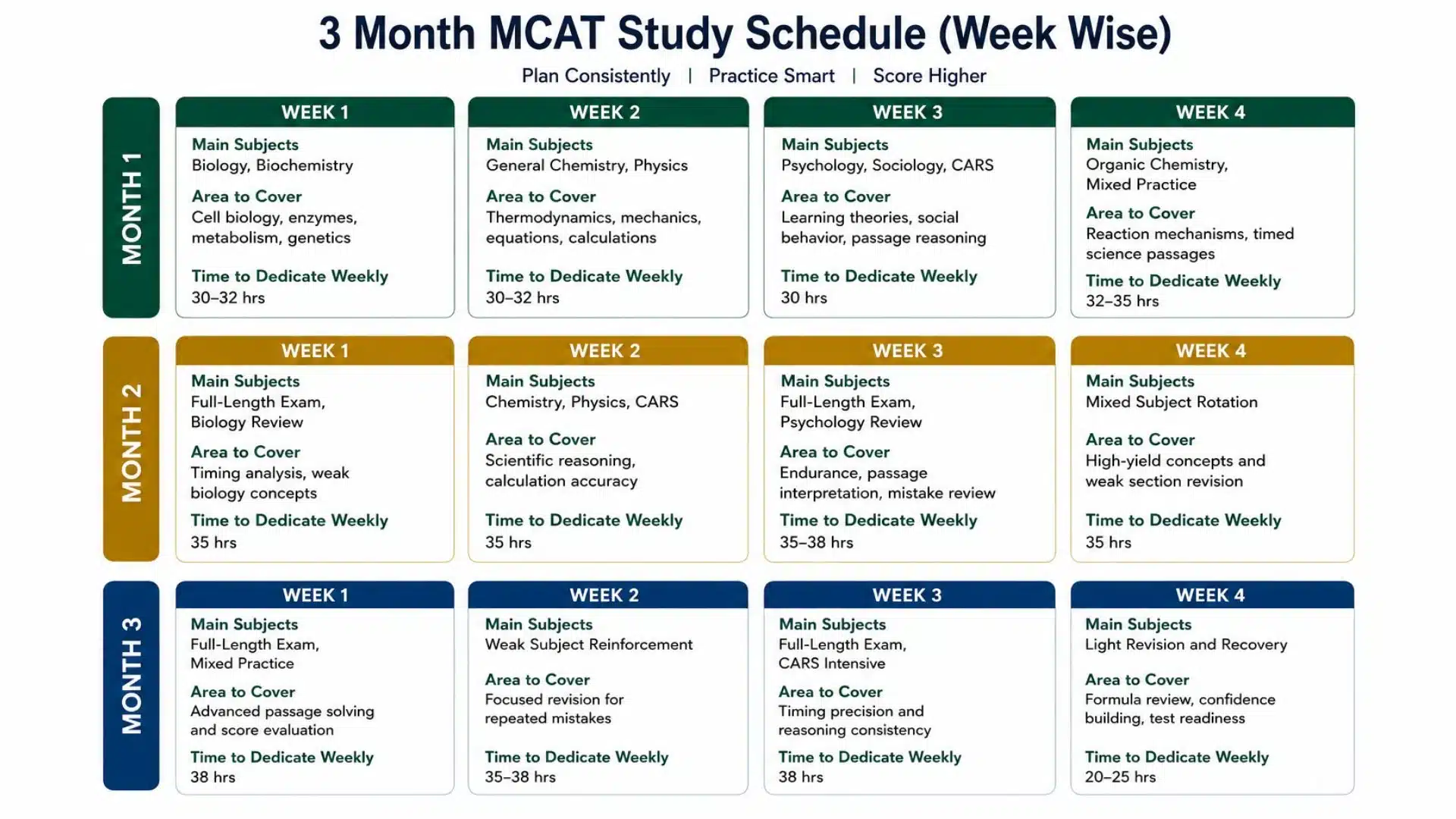
This works with focused, consistent preparation centered on daily practice instead of passive review. Disciplined study, regular full-length exams, and targeted revision of weak subjects make this timeline realistic.
Staying consistent throughout improves timing, endurance, and test confidence before exam day.
Full-Time vs. Part-Time Prep
Balancing MCAT preparation with college, jobs, or daily responsibilities often leaves students unsure which schedule is realistic. Available study hours, personal routine, and consistency should guide that decision.
Full-Time Students
Students managing classes, internships, or part-time work perform better with slower, more balanced schedules.
Study 15–25 hours per week across a 4–6 month plan.
Keep daily sessions shorter and focused. Use weekends for full-length practice and review. Avoid combining multiple difficult science subjects in a single day.
Gap Year Students
A gap year allows more flexibility, longer study hours, and faster content progression.
Study 30–40 hours per week within a 3–4 month intensive plan. Complete content review earlier to allow more time for testing. Build fixed daily study blocks rather than studying whenever time allows.
Prioritize sleep and recovery to maintain retention and avoid burnout.
MCAT Study Mistakes to Avoid

Many students prepare for the MCAT for months but still struggle to improve their scores because their study methods remain ineffective.
- Starting without a diagnostic test causes students to overlook weaker subjects and waste study time.
- Months of textbook reading have slow progress since the MCAT tests reasoning and passage analysis, not memorization.
- Skipping daily CARS practice weakens reading speed, timing, and reasoning accuracy when it matters most.
- Taking full-length exams without reviewing mistakes leads to repeated errors and little real improvement.
- Switching between prep books, apps, and question banks causes confusion and disrupts revision momentum.
Identifying these mistakes early helps students study smarter, stay consistent, and prevent burnout during long prep periods.
Tools & Resources to Help with Your Exam Prep
The tools below are worth your time, chosen because they directly support how the MCAT is actually structured, not because they’re the most popular options on prep forums.
1. Official AAMC MCAT practice materials
These materials match the MCAT format closely and help students practice under realistic conditions.
Offers free concept explanations and subject-specific review videos to help students gradually strengthen their understanding of weaker science topics.
Help students boost timing, passage accuracy, and familiarity with real MCAT questions before the exam.
4. Anki
One of the most widely used MCAT flashcard tools for long-term memory retention and active recall practice.
5. Notion
Helps students organize repeated mistakes, weak topics, and practice-test review on structured pages.
Frequently Asked Questions (FAQ’s)
1. How Long Should One Study for the MCAT if I Am Retaking it?
Retakers usually need 8-12 weeks of targeted review after identifying weaknesses from previous attempts. Studying everything again wastes time, so focusing on specific sections is more effective.
2. Is There a Best Time of Year to Sit for the MCAT?
Starting preparation 4 to 6 months before your date allows time for full-length practice tests and score gain.
3. How do I Know I Am Genuinely Ready to Sit the MCAT?
Consistent full-length practice test scores within 2-3 points of your target across three attempts indicate strong readiness; a single good score is insufficient confirmation.
4. Does Taking a Gap Year Give a Real Advantage for MCAT Preparation?
A dedicated gap year offers 6 to 9 months of focused, distraction-free prep, linked to higher scores than students with multiple commitments.
Final Thoughts
Feeling confident about your MCAT study timeline now? Everything you need to plan smart is right here.
From understanding exactly how long to study for MCAT based on your target score to breaking down total study hours and ideal preparation months, you now have a clear picture.
The only step left is taking action.
Pull out your calendar, lock in your test date, map your monthly milestones, and commit to your daily study hours.
A good score is earned by students who plan deliberately and start early.
Your structured, goal-driven MCAT preparation begins right now.