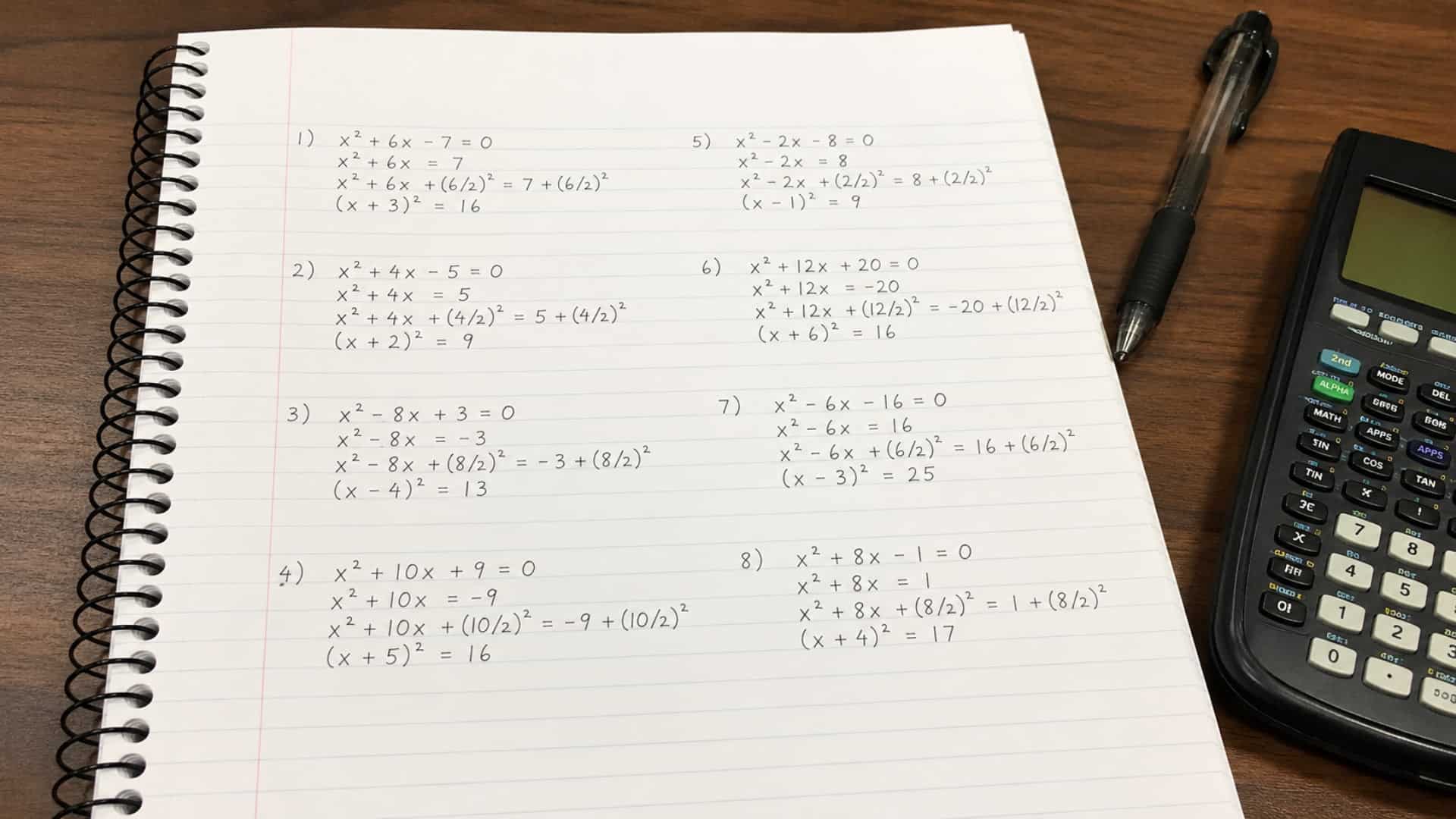


Every strong SAT score starts with knowing what the test actually covers. Students searching for how many math questions are on the SAT exam are usually trying to answer one question: where should my study hours go first?
Each part tests a different math skill in its own way. Some questions ask you to pick an answer from choices given.
Others ask you to type in your own answer directly. Knowing this setup helps you build a simple study plan.
You do not need to guess what to study first. Understanding the format gives your prep a clear starting point.
A Snapshot of the SAT Exam
The SAT is a standardized test used widely for college admissions in the United States.
It measures reading, writing, and math skills through a digital, adaptive format. Here is a quick look at the key details:
Detail | Information |
|---|---|
Conducted By | College Board |
Exam Mode | Digital |
Sections | 2 (Math and Reading & Writing) |
Total Questions | 98 |
Duration | 2 hrs 14 mins |
Score Range | 400–1600 |
Test Format | Adaptive |
Negative Marking | None |
Test scores help colleges consider applicants consistently. Knowing these basics helps you develop an effective study plan.
How Many Math Questions Are on the SAT
The SAT has 44 math questions, split across two modules of 22 questions each, with 35 minutes per module. Of the 22 questions per module, 20 are scored, and 2 are unscored pretest questions.
About 75 percent of math questions are multiple choice.
The remaining 25 percent are student-produced responses, where you type in your own numerical answer.
You will not be told which questions are unscored, so treat them all the same.
Pacing works the same way in both modules; see the Time Allotment section below for exact per-difficulty targets.
How Is the SAT Math Section Scored?
Math is scored on a scale of 200 to 800.
The College Board combines this with your Reading and Writing score for a total between 400 and 1600.
The test is adaptive, so your Module 1 score decides if Module 2 is easier or harder. A stronger Module 2 raises how high your final score can go. Only 44 questions decide both modules, which is why early accuracy carries so much weight.
The scoring rule stays the same for both modules.
Correct answers earn one point; wrong or blank answers earn zero. Always answer, as there is no penalty for guessing.
Since only strong Module 1 scores unlock the harder Module 2, guessing there is risky if you want a top score.
Quick takeaway: Answer every math question, including grid-ins. A guess costs nothing and offers a chance at a point. To see where your target number lands, check what counts as a strong SAT score for your target schools.
Math Domains and What They Cover
The College Board organizes SAT math into four content domains, and each one appears across both modules:
Domain | Weight | Questions |
|---|---|---|
Algebra | 35% | 13–15 |
Advanced Math | 35% | 13–15 |
Problem-Solving and Data Analysis | 15% | 5–7 |
Geometry and Trigonometry | 15% | 5–7 |
1. Algebra
Algebra covers linear equations in one and two variables, along with linear inequalities and functions.
It also includes systems of two linear equations and graphing lines on a coordinate plane. Questions test whether you can set up, solve, and interpret linear relationships.
Some problems use abstract equations, while others apply linear thinking to real-world situations.
This section rewards steady algebra skills built through repeated, focused practice.
- Weight: 35 percent
- No. of questions: 13 to 15
2. Advanced Math
Advanced Math covers nonlinear equations and functions, including quadratics, exponentials, and polynomials, as well as rewriting expressions and analyzing nonlinear graphs.
Questions test if you can manipulate and interpret complex equations beyond straight lines, connecting equations to their graphs. This section rewards comfort with abstract manipulation and pattern recognition.
- Weight: 35 percent
- No. of questions: 13 to 15
3. Problem-Solving and Data Analysis
Problem-Solving and Data Analysis covers ratios, rates, percentages, and unit conversions, along with reading data from tables, graphs, and scatterplots.
It also includes probability, statistics, and evaluating data collection methods.
This section rewards careful reading and comfort working with numbers in real-world contexts.
- Weight: 15 percent
- No. of questions: 5 to 7
4. Geometry and Trigonometry
Geometry and Trigonometry covers area, volume, lines, angles, and triangles, along with circles and right triangle trigonometry.
It includes applying the Pythagorean theorem and trigonometric ratios to solve for missing values.
This section rewards familiarity with formulas and consistent shape-based practice.
- Weight: 15 percent
- No. of questions: 5 to 7
What’s on the SAT Math Reference Sheet
A reference sheet is shown on screen throughout the Math section, so you do not need to memorize everything.
- Area and circumference of a circle
- Area of a rectangle, triangle, and trapezoid
- Volume formulas for a cube, rectangular prism, cylinder, sphere, cone, and pyramid
- The Pythagorean theorem and the side ratios for 30-60-90 and 45-45-90 triangles
- The number of degrees in a circle, a straight line, and the interior angles of a triangle
What it does not include matters just as much. The quadratic formula, the slope formula, the distance formula, the midpoint formula, and the basic trigonometric ratios are not on the sheet, so memorize them before test day.
The sheet’s exact layout has stayed identical across every recent test form, so it is worth confirming the current version in the Bluebook app or on the College Board’s official site before you finalize your memorization list.
Can You Use a Calculator on Every SAT Math Question?
The digital SAT permits a calculator on every math question, unlike the old paper SAT’s no-calculator section.
You can use the built-in Desmos graphing calculator, available directly on the test screen, or bring your own approved device.
This applies across all sections, including algebra, advanced math, geometry, and trigonometry questions.
Since calculator access is no longer restricted, practicing efficient calculator use, rather than avoiding it, becomes part of your prep strategy. Knowing when a calculator saves time versus mental math improves test pacing.
Review SAT calculator rules and approved models before test day for full details.
Time Allotment by Question Difficulty
Time management is one of the biggest factors separating average scores from high scores.
- Easy questions (roughly 7 to 8 per module): Spend 30 to 60 seconds. Read, solve, and move on. Do not second-guess yourself on these.
- Medium questions (roughly 8 to 9 per module): Spend 60 to 90 seconds. Set up your approach first before calculating.
- Hard questions (roughly 5 to 7 per module): Give yourself up to 2 to 3 minutes. If you are stuck after 90 seconds, flag the question in the Bluebook app and move on. Come back with remaining time.
The flagging feature in the digital test is genuinely useful.
Students who use it consistently tend to manage time better than those who try to work through every question in order.
What Students Say About SAT Math Score
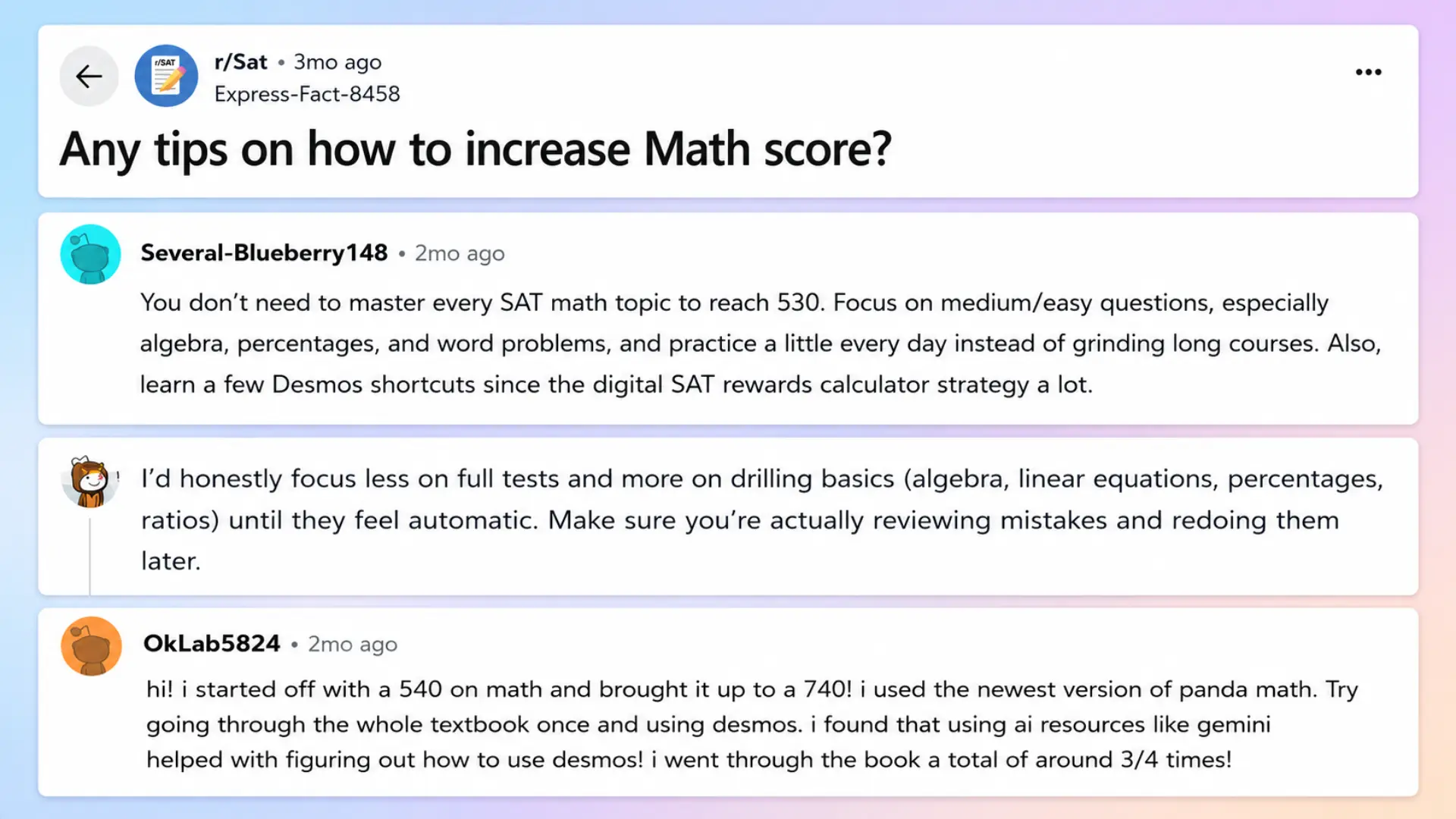
Students on Reddit consistently emphasize that improving your SAT Math score is less about mastering every advanced topic and more about building confidence with the fundamentals.
Students suggest mastering algebra, percentages, linear equations, and word problems before tackling tougher questions.
They emphasize reviewing errors, practicing regularly over cramming, and learning Desmos calculator shortcuts.
One student improved from the low 500s to the 700s after using a math textbook and AI tools to better understand the material.
Such jumps vary by starting point and study time, so see it as encouragement, not a guarantee.
These firsthand experiences reinforce that consistent practice and smart strategy often lead to the biggest score improvements.
How to Prepare for SAT Math?
Following these steps in order helps you spend your prep time on what actually moves your score.
Consistency here beats cramming every time. Here are the key steps:
- Take an official practice test on the Bluebook app under timed conditions and categorize incorrect answers by domain.
- Work through one domain at a time, starting with Algebra, then Advanced Math, Data Analysis, and Geometry.
- Use the built-in calculator to solve quadratics, graph systems, and check geometry, and practice it in every timed session.
- Aim for 18 to 20 correct answers, since Module 2 difficulty depends entirely on Module 1 performance.
- Practice each domain under real conditions, like 22 questions in 35 minutes, since untimed practice builds knowledge but not pacing.
Mistakes to Avoid While Preparing for SAT
Even strong students lose points to avoidable habits, not lack of knowledge.
Avoiding these mistakes keeps your prep time focused on what actually raises your score.
Mistake | Cause | Fix |
|---|---|---|
Outdated Paper-Based Material | Doesn’t match digital, adaptive format | Use official digital resources |
Practicing Untimed Only | Builds knowledge, not pacing | Practice under real-time limits |
Jumping Between Domains | Prevents pattern recognition | Study one domain at a time |
Skipping Module 1 Accuracy | Lowers chance of unlocking Module 2 | Prioritize accuracy over speed |
Ignoring Desmos Practice | Wastes time on solvable questions | Practice Desmos in every session |
Not Reviewing Mistakes | Repeats the same errors later | Keep a weekly error log |
Frequently Asked Questions (FAQ’s)
1. Does SAT Math Get Harder in Module 2?
Yes, Module 2 difficulty adapts to Module 1 performance, so a strong first module unlocks harder second-module questions.
2. Can You Retake Just the SAT Math Section?
No. The SAT does not allow you to retake a single section, so you must retake the full test, including Reading and Writing.
3. Is There a Penalty for Wrong Answers on SAT Math?
No, blank and wrong answers both score zero, so always answer every question, including grid-ins, even if unsure.
End Note!
Math questions on the SAT follow a set pattern, and that pattern makes pacing easier once you know it.
Algebra, geometry, and data analysis each show up in their own way, and your accuracy in Module 1 directly shapes what you see in Module 2. You do not lose points for guessing, so fill in every answer.
Practicing under timed conditions helps you get used to the pace, and steady practice beats cramming every time.
Have you tried any of these strategies on a practice test? Share your SAT math prep tips in the comments below!