

The tax industry is growing, and so is the demand for qualified professionals who can represent taxpayers before the IRS.
Earning the Enrolled Agent (EA) designation is one of the smartest career moves you can make in tax.
But before you earn those letters after your name, you need to pass the EA exam, formally known as the Special Enrollment Examination (SEE).
If you are a working tax professional, an accountant weighing your next step, or someone breaking into the field, this post walks you through everything: the EA exam schedule, how the exam is structured, who is eligible, and what it takes to pass.
What is the Enrolled Agent Exam?
An Enrolled Agent (EA) is a federally licensed tax practitioner authorized by the U.S. Department of the Treasury to represent taxpayers before the IRS.
The credential is issued directly by the IRS and recognized across all 50 states.
EAs hold unlimited representation rights, meaning they can represent any taxpayer on any tax matter, including audits, appeals, and collections.
The enrolled agent exam, formally known as the Special Enrollment Examination (SEE), is the test you must pass to earn this designation.
Compared with other finance credentials, the CPA and CMA certification paths show why the EA’s narrower tax focus and lighter prerequisites make it a faster route into IRS representation work for someone starting from scratch.
Effective March 1, 2026 , the IRS moved administration of the SEE from Prometric to PSI Services.
Why Does the EA Exam Exist?
The EA exam exists for one core reason: to ensure that anyone representing taxpayers before the IRS meets a consistent and verified standard of federal tax knowledge.
Here is what the SEE is designed to test:
Tests | Why It Matters |
|---|---|
Individual tax law | Ensures accurate representation of personal tax matters |
Business tax law | Covers complex entity structures and payroll obligations |
IRS procedures and ethics | Guarantees professional and compliant client representation |
The IRS created the Special Enrollment Examination to verify that candidates are qualified to handle audits, appeals, collections, and complex tax matters on behalf of their clients.
Passing the SEE is not just a requirement; it is a commitment. It is proof that you have the technical knowledge to protect taxpayers and navigate the federal tax system with confidence.
It is ideal for tax preparers, accountants, bookkeepers, and career changers. No degree or prior experience is required.
EA Exam Structure: What’s Actually on the SEE
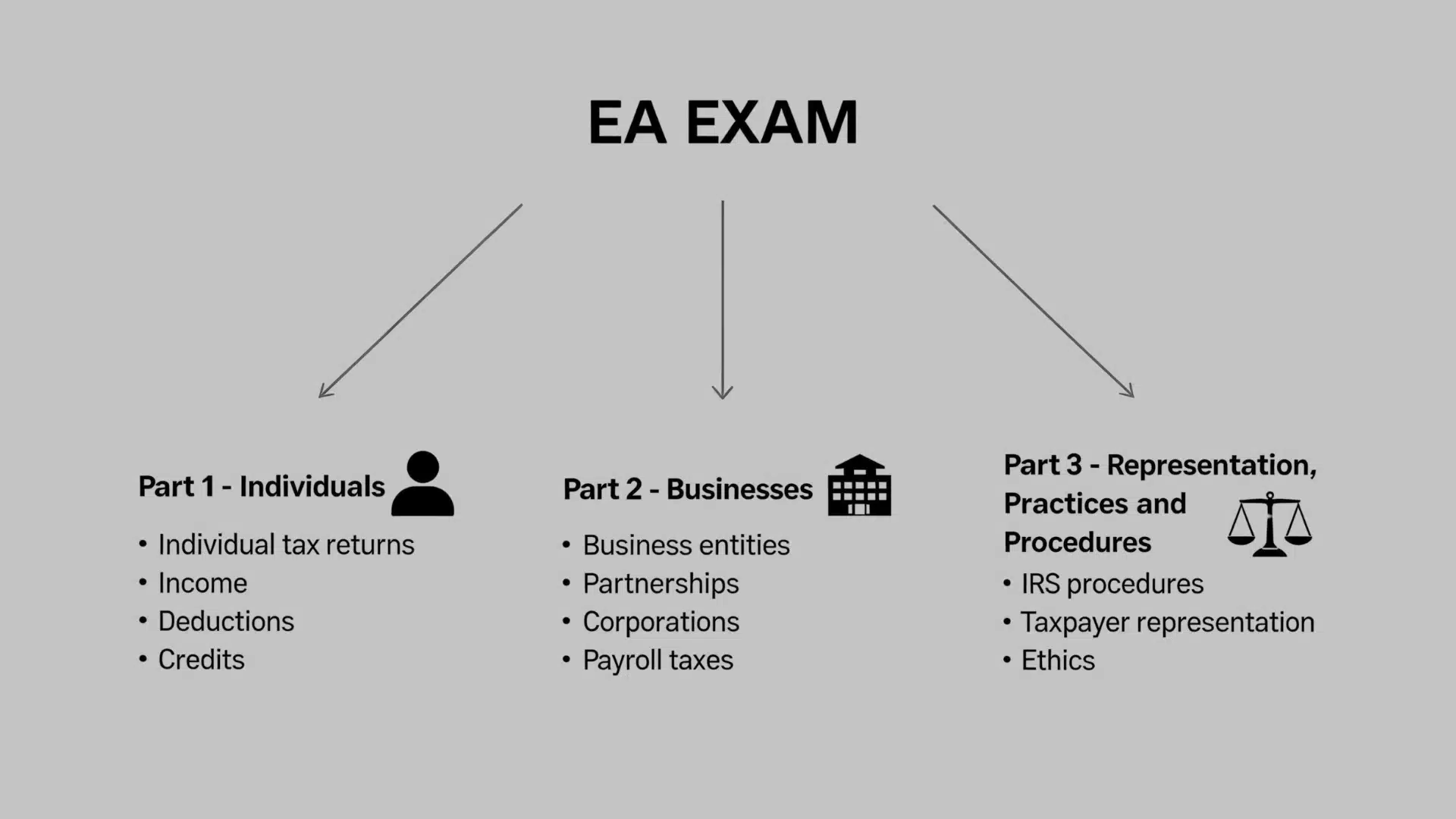
The exam is divided into three separate parts, each focusing on a distinct area of federal taxation:
- Part 1 – Individuals: Individual tax returns, income, deductions, and credits.
- Part 2 – Businesses: Business entities, partnerships, corporations, and payroll taxes.
- Part 3 – Representation, Practices and Procedures: IRS procedures, taxpayer representation, and ethics.
Each part consists of 100 multiple-choice questions and allows 3.5 hours to complete. The parts can be taken in any order and do not need to be completed in one sitting.
To pass, candidates must score at least 500 from the scaled score range of 200 to 800 on the scaled scoring system. Candidates must pass all three parts within a 3-year rolling window.
EA Exam Schedule: When Can You Take It?
For the current cycle, the domestic SEE testing window runs July 1, 2026, through February 28, 2027.
For international candidates, the test date has been delayed, with no new date confirmed yet.
This window is shorter than the traditional May-to-February cycle because of the vendor transition. The exam is unavailable in March and April each year.
Much like how candidates working through the actuarial exam testing calendar map all their sittings against one testing window at once.
Here is what you need to know about rescheduling and cancellation:
Timeframe Before Exam | Action | Fee |
|---|---|---|
Before 48 hours | Reschedule or cancel | No fee |
Less than 48 hours | Reschedule | Full Fee applies |
Planning your EA exam schedule early gives you the best shot at securing your preferred dates and avoiding unnecessary fees. Treat your exam date like a hard deadline and build your study plan around it.
EA Exam Requirements and Eligibility
One of the biggest advantages of the enrolled agent exam is its accessibility.
Unlike the CPA exam, which requires a college degree and work experience, the SEE has no educational or professional prerequisites. Here is what you need to get started:
- No degree required: You can sit for the EA exam regardless of your educational background. What matters is your knowledge of federal tax law, not your academic credentials.
- No work experience required: You do not need prior tax or accounting experience to register for and take the exam.
- A valid PTIN is mandatory: Every candidate must have an active Preparer Tax Identification Number (PTIN) issued by the IRS before registering.
- A suitability check is part of the process: After you pass all three parts, the IRS conducts a background check before granting enrollment, including a review of your tax compliance history.
- All three parts must be passed within a 3-year rolling window: The clock starts on the date you pass your first part. Scores that fall outside this window expire and must be retaken.
The low barrier to entry makes the EA exam one of the most practical credentials available to tax professionals at any stage of their career.
Enrolled Agent Exam Costs
Before registering, it helps to know what the EA exam will cost you in total. Here is a breakdown of the fees involved:
Cost Item | Details | Estimated Fee |
|---|---|---|
Exam fee | $317 per part x 3 parts | $951 |
IRS enrollment application | Paid after passing | $140 |
Prep course | Optional but recommended | $300 to $700 |
Estimated Total | – | $1,100 to $1,800 |
The IRS enrollment application fee is a one-time cost paid only after you pass all three parts.
Looking at what a comparable credential runs, CISM certification costs and lands in a similar four-figure range once exam fees and prep materials are added together
Prep courses from providers like Gleim, Surgent, or Fast Forward Academy are optional but can lower the risk of retakes, which add to your total cost.
How to Register for the EA Exam?
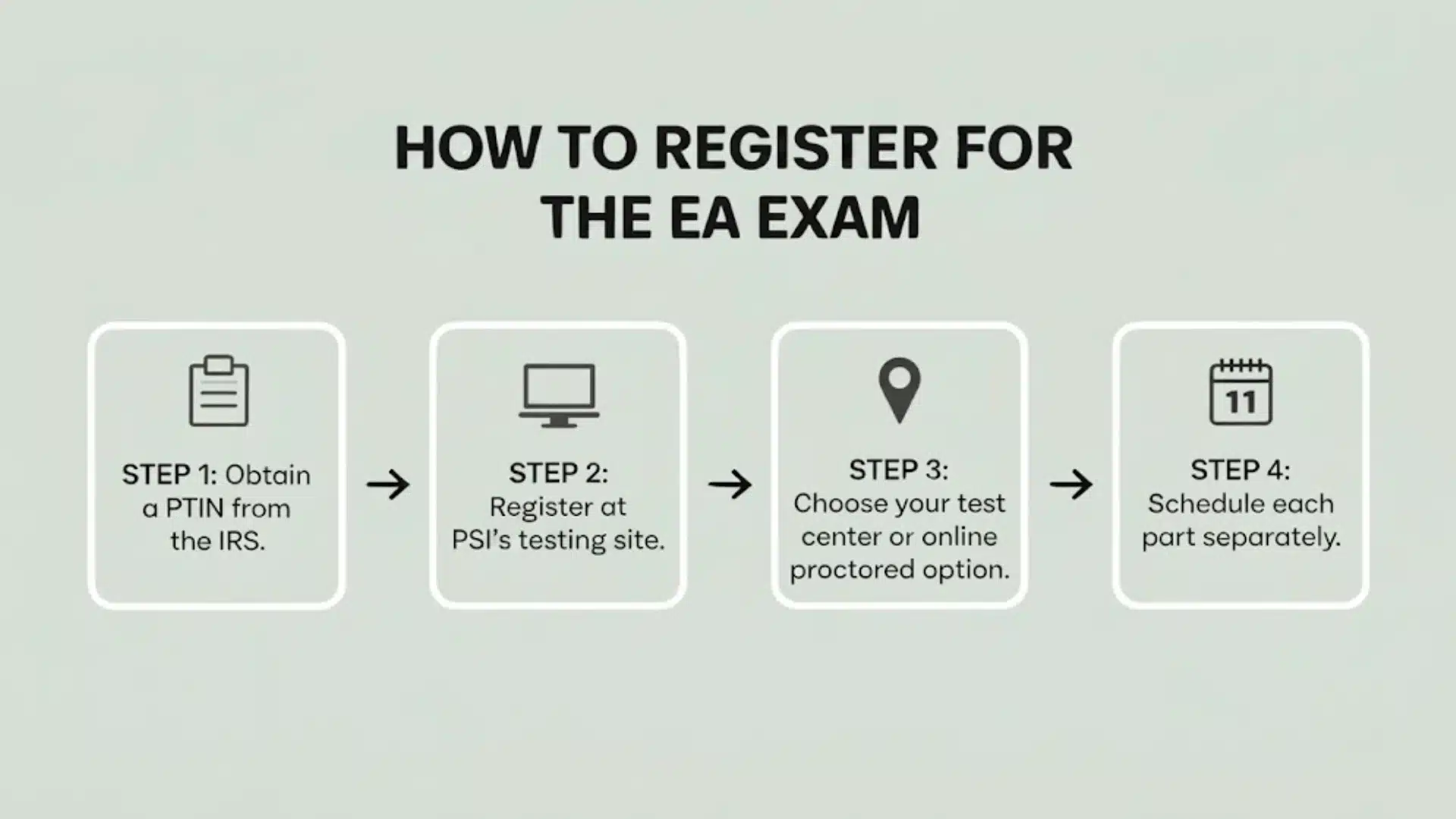
Learn the simple steps to register for the EA exam, from creating your account to scheduling your test and preparing for exam day.
Step 1: Obtain a PTIN from the IRS:
Before anything else, you need an active Preparer Tax Identification Number (PTIN). Register for one at the IRS website at no cost. This is required before you can schedule any part of the SEE.
Step 2: Register on PSI’s testing site:
You’ll need your PTIN and personal identification details to complete registration. Make sure all information matches your official identification documents.
Step 3: Choose your test center or online proctored option:
It offers two testing formats: in-person at an authorized test center or online with a live proctor. Choose the option that works best for your schedule and comfort level.
Step 4: Schedule each part separately:
Each of the three parts must be scheduled as an individual appointment. You can take them back-to-back or space them out across the testing window based on your preparation timeline.
Tips for Passing the EA Exam
Passing all three parts of the enrolled agent exam requires consistent preparation and a smart approach. Here is what works:
- Start with the part you feel most confident about: Building early momentum with a passing score keeps motivation high and reduces overall stress as you move into the harder parts.
- Use IRS publications as your primary study material: The SEE is based on federal tax law, and IRS publications are the most authoritative source.
- Invest in a reputable EA exam prep course: Structured courses from providers like Gleim, Surgent, or Fast Forward Academy cover the full exam syllabus.
- Practice with timed mock exams: Each part gives you 3.5 hours for 100 questions. Simulating real test conditions helps you manage time effectively and reduces surprises on exam day.
- Space out your parts strategically: Do not rush through all three parts back-to-back. Give yourself enough time to study thoroughly for each one within the EA exam schedule testing window.
The candidates who pass are not necessarily the ones who study the most hours. They are the ones who study consistently, practice under real conditions, and treat each part as its own goal.
After the EA Exam: What Comes Next?
Passing all three parts of the SEE is a major milestone, but there are a few final steps before you officially hold the EA designation:
- Apply for enrollment with the IRS: Submit Form 23 through Pay.gov along with the $140 enrollment fee. This formally kicks off the credentialing process with the IRS.
- Clear the background check: The IRS reviews your tax compliance history as part of a suitability check. Make sure your own tax filings are current and accurate before submitting your application.
- Complete continuing education every three years: Once enrolled, EAs must complete 72 hours of continuing education every 3 years, including a minimum of 16 hours per year.
- Consider joining the NAEA: The National Association of Enrolled Agents (NAEA) offers networking, professional resources, and continuing education support to help you build and grow your practice.
Earning the EA credential does not end with passing the exam.
Staying current with tax law and maintaining your credential through continuing education is what separates serious tax professionals from the rest.
Conclusion
The enrolled agent exam is one of the most valuable credentials a tax professional can earn.
It carries federal authority, requires no degree or prior experience, and opens the door to unlimited representation rights before the IRS.
The EA credential is one of the most accessible and career-defining designations in tax, and now you have a clear picture of what it takes to earn it.
Are you planning to take the Enrolled Agent exam? Share in the comments below, and let us know your experience or goals.
Frequently Asked Questions
How Many Times Can You Take the EA Exam?
Candidates can take each part up to four times per testing season. If you do not pass on the first attempt, you can reschedule and retake that part within the same testing window.
Is the EA Exam Hard?
The Enrolled Agent exam is challenging but very passable with The right preparation. Part 2, covering businesses, is widely considered the most difficult. .
How Long Do You Have to Wait to Retake a Failed EA Exam Part?
If you fail a part, you must wait 24 hours before scheduling another attempt for that same part. You can schedule an appointment for a different part immediately, without waiting.