

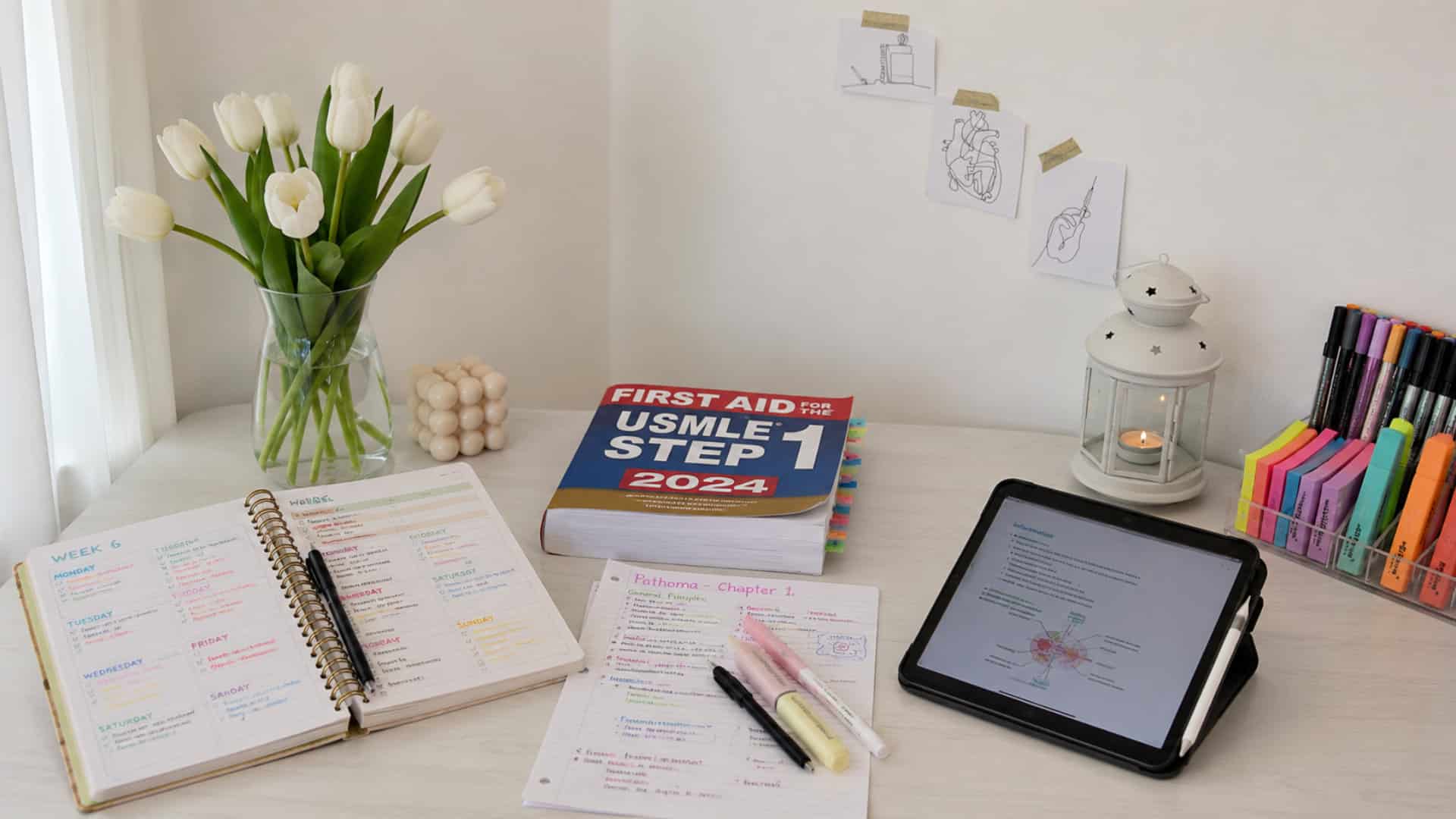
Your brain can hold every fact and still blank out under exam pressure.
You already know the subjects, but connecting them under pressure feels hard.
A solid Step 1 study schedule closes that gap for you.
It turns a huge exam into small daily steps you can actually handle. Weak subjects get extra time, daily questions build real recall, and rest days protect your energy. Each phase builds on the last, moving you steadily toward exam readiness.
A clear Step 1 study schedule keeps you calm, focused, and ready.
What Makes Step 1 Prep Different?
Class exams and the Step 1 test barely test you the same way, and that’s the part people miss.
In class, you learn a subject, take the test, and move on. Step 1 doesn’t let you off that easily.
It wants you to connect biochemistry, physiology, and pharmacology in the same sequence.
It doesn’t ask about what you’ve learned this week; it questions what remains in your mind months afterward.
Your study habits have to shift too: less rereading, more doing. Questions, flashcards, teaching it out loud, whatever forces your brain to actually retrieve the stuff instead of just recognizing it.
How Many MonthsDo You Need to Prepare for Step 1?
No two students need the same preparation timeline.
Your ideal Step 1 study schedule length depends on your medical school curriculum, baseline diagnostic score, and if you have dedicated study time or active coursework running alongside prep.
4-week plan: Suits strong baselines needing focused review only.
6-week plan: Most common dedicated study window for average preparedness.
8-week plan: Ideal for students needing deeper content reinforcement.
12-week plan: Best for students balancing coursework or rebuilding foundational weaknesses.
Always run an NBME diagnostic first; your score gap, not a generic timeline, should drive your decision.
How to Build an Effective Step1 Study Schedule

A clear schedule turns prep into a daily plan you can follow. Here are the key steps to build a schedule that actually works.
1. Set a Realistic Exam Date
Work backward from your target exam date before opening any resources.
Picking a date too soon adds pressure without giving you enough prep time. Students tend to do best when they set their exam date only after seeing steady improvement across several NBME practice tests.
Rushing this step often backfires later, so give yourself enough room to prepare properly.
2. Assess Your Baseline Knowledge
Take a baseline NBME or free 120 before locking in any schedule.
Your score shows exactly where you stand right now and how big your gap is.
It also tells you how intense your study plan needs to be from day one. Skipping this step means guessing instead of planning with real data.
3. Identify Strong and Weak Subjects
List every major subject and rate your comfort level honestly.
Biochemistry, pathology, pharmacology, and microbiology tend to show up the most on Step 1.
Subjects you rank as weak should get more study time each week. Subjects you already know well can move into light maintenance instead of deep review, which frees up more hours for the areas that need real work.
4. Divide Study Time by System and Subject
Organize your schedule by organ system instead of jumping between random subjects. Cardiovascular, renal, and respiratory systems carry a lot of weight on the exam.
Spending a full week on each system helps you connect ideas across subjects.
This works much better than splitting your attention across too many topics in a single day.
5. Schedule Practice Questions Daily
Start doing UWorld questions from week two, not just at the end.
Even small daily blocks of 20 to 40 questions make a real difference.
They build test-taking stamina and show you exactly where your gaps are. Reading alone will not prepare you the same way active practice does, so make daily questions part of your routine from the start.
6. Include Review and Rest Days
Rest days are not wasted time; they help your brain hold onto what you learned.
Build one lighter review day into your week from the very beginning.
Students who skip rest days often end up burned out. Their scores tend to drop right when they need to perform their best, during the final and most important weeks of prep.
Sample 8-Weekand 12-Week Step1 StudySchedules

If you have 8 or 12 weeks, the same three phases apply: foundation building, systems mastery, and intensive review.
Your timeline determines depth, not direction.
Phase 1: Foundation Building (Weeks 1 to 2 / Month 1)
Use the table below as a quick reference for allocating daily study hours and question targets across key subjects during both 8-week and 12-week USMLE Step 1 preparation schedules
Subject | 8-Week Daily Hours | 12-Week Daily Hours | Question Target |
|---|---|---|---|
Anatomy | 1.5 hours | 1 hour | 20 questions daily |
Physiology | 2 hours | 1.5 hours | 25 questions daily |
Biochemistry | 2 hours | 1.5 hours | 25 questions daily |
Anki Review | 1.5 hours | 1 hour | 100 to 150 cards daily |
Total Daily | 7 to 8 hours | 5 to 6 hours | 70 questions daily |
The 12-week schedule allows slower, deeper first-pass content review alongside Pathoma and Sketchy activation.
The 8-week schedule demands an immediate, full-day commitment from day one.
Phase 2: Systems-Based Learning (Weeks 3 to 6 / Month 2)
The following table outlines a recommended timeline for reviewing major organ systems in 8-week and 12-week Step 1 study plans, focusing on the most frequently tested topics.
Organ System | 8-Week Days | 12-Week Days | Key Focus Areas |
|---|---|---|---|
Cardiovascular | 3 days | 4 days | Heart failure, arrhythmias, pharmacology |
Respiratory | 2 days | 3 days | Obstructive vs restrictive lung pathology |
Renal | 3 days | 4 days | Acid-base, glomerular diseases, and diuretics |
Gastrointestinal | 2 days | 3 days | Liver pathology, GI bleeding, motility |
Endocrine | 2 days | 3 days | Diabetes, thyroid, and adrenal disorders |
The added weeks create room for comprehensive review, targeted practice, and gradual improvement, helping students build a stronger foundation before their final preparation phase.
Phase 3: High-Yield Subjects (Weeks 5 to 6 / Month 2 to 3)
Use the table below to focus your study time on the highest-yield Step 1 subjects when preparation time is limited, ensuring maximum return from both content review and question practice.
Subject | Daily Hours | Priority Topics | UWorld Target |
|---|---|---|---|
Pathology | 2.5 hours | Robbins high-yield, Pathoma review | 40 questions daily |
Pharmacology | 2 hours | Mechanisms, side effects, drug classes | 30 questions daily |
Microbiology | 1.5 hours | Sketchy review, bug and drug correlations | 25 questions daily |
Immunology | 1 hour | Hypersensitivity, immunodeficiencies, vaccines | 20 questions daily |
These four subjects dominate Step 1 questions; neither schedule treats them as secondary review.
Phase 4: Intensive Final Review (Weeks 7 to 8 / Month 3)
The table below shows the suggested frequency of key activities for 8-week and 12-week study plans to maintain progress.
Task | 8-Week Frequency | 12-Week Frequency | Target |
|---|---|---|---|
Mixed UWorld Blocks | Daily | Daily | 60 to 80 timed questions |
Weak Area Review | Every morning | Every morning | Lowest UWorld categories |
NBME Assessments | Every 4 to 5 days | Every 3 to 4 days | Full length, fully reviewed |
Free 120 Completion | Once | Once | 7 days before the exam |
Anki Daily Reviews | Daily | Daily | Zero backlog maintained |
Consistent upward NBME trends, a UWorld first-pass above 65 percent, and a cleared Anki backlog are your three clearest readiness signals, regardless of which schedule you followed.
Sample Daily Step 1 Study Schedule
A productive study day means protecting your peak-focus hours for your hardest material and ending each day knowing exactly what you retained.
7:00 AM: Light Anki cards, quick pathology diagrams, or pharmacology mnemonics before full cognitive demand begins.
8:00 AM: Your sharpest two hours belong to your hardest subject. No interruptions, no multitasking.
10:00 AM: 40 timed UWorld questions. Every wrong answer is a content signal, not a morale hit.
12:00 PM: Full stop. A genuine 45- to 60-minute reset directly improves the quality of afternoon retention.
1:00 PM: Pathoma, Sketchy, or First Aid annotation depending on your weekly system focus. Stay active, not passive.
3:00 PM: 20-40 mixed-subject questions simulating the unpredictability of real exams across content areas.
5:00 PM: Step away completely. Protecting this break prevents the cognitive flatline that kills the quality of evening study.
6:00 PM: Dedicated Anki session. Maintain zero backlog as a non-negotiable daily standard.
8:00 PM: Return to every flagged UWorld question. Read full explanations, not just correct answers.
9:00 PM: Close all materials. Consistent sleep directly impacts next-day memory consolidation.
Protect every block, especially your breaks and sleep.
Consistently following an 80% effort schedule daily is more effective than an aggressive plan abandoned by week three.
What to Expect on Step 1 Exam Day
Step 1 is a computer-based exam delivered at Prometric testing centers.
A good USMLE preparation course covers the format, but a few practical steps make exam day smoother:
Bring your scheduling permit and a valid photo ID matching the permit name.
Arrive early enough to complete check-in, including the palm vein scan and photo capture; most centers use
Plan your break time in advance across blocks because unused minutes usually carry over within the total.
Eat something familiar and light before. Avoid trying new breakfast or caffeine sources on test day.
Perform a final dry run of your commute and parking a day or two prior to the exam.
Eliminating logistical uncertainties allows you to focus more mental energy on the test itself.
Best Resources to Include in Your Step 1 Study Schedule
Every resource in your schedule should earn its place, as they deliver the highest return when used together.
Resource | Best For | How to Use It |
|---|---|---|
Performance and application | Start in tutor mode; shift to timed mode by week three | |
Pathology mastery | Watch once & annotate First Aid alongside each chapter | |
Microbiology and pharmacology | Use for initial learning; reinforce daily with Anki Sketchy cards | |
Long-term retention | Use the AnKing deck and maintain zero daily backlog | |
Exam prediction and benchmarking | Take one early as a baseline, then space the rest every four to five days. |
Students who score highest integrate all six consistently, not those who master one perfectly while neglecting the rest.
How Many Practice Questions Should You Do Each Day?
Increase question volume progressively throughout your Step 1 study schedule.
During the beginner phase, 20 to 30 tutor-mode questions daily build foundational skills without overwhelming new content.
Mid-preparation increases to 40-50 timed questions as system knowledge solidifies.
A dedicated study period requires 60 to 80 mixed-timed questions daily to build real exam stamina.
Throughout every phase, review strategy matters more than volume; spending equal time on explanations and questions separates improving students from those who plateau despite doing many questions.
How to Schedule Practice USMLE Exams

Spacing practice exams strategically turns them from score checks into effective preparation tools.
Take your first NBME early: Week one or two, purely as a diagnostic baseline, not a performance measurement.
Space subsequent exams: Every four to five days during your final three weeks, not clustered together.
Use every score to adjust your plan: Declining scores signal schedule problems, not intelligence problems.
Track trends, not individual results: A single bad NBME means nothing; a downward trend means everything.
Signs you are ready for exam day: Consistent upward NBME trends, UWorld first pass above 65 percent, zero Anki backlog, and no single subject scoring below your overall average.
Treat every practice exam as a diagnostic tool first and a confidence measurement second.
Students who use scores to adjust their schedule outperform those who use them only for reassurance.
How to AdjustYour Study Schedule if You Fall Behind
Falling behind does not mean you are failing, but it does require quick action.
Instead of trying to cover everything, focus on high-yield subjects such as pathology, pharmacology, and microbiology, as these often have the biggest impact on exam performance.
Cut back on low-value activities like rewatching videos, rereading familiar notes, or doing unfocused review sessions.
Add a dedicated daily catch-up block to make up for missed material without disrupting your main study plan.
Most importantly, use data from practice questions and assessments to identify weak areas and direct extra study time where it will make the greatest difference.
Subject-by-Subject Time Allocation for Your Step 1 Study Schedule
Allocate weekly hours based on question volume and diagnostic performance, as not all subjects warrant equal time.
Subject | Focus | Weekly Hours | Priority Reason |
|---|---|---|---|
Pathology | Highest | 10 to 12 hours | Dominates question volume across every system |
Pharmacology | High | 8 to 10 hours | High-yield mechanisms tested repeatedly |
Microbiology | High | 7 to 9 hours | Bug and drug correlations appear consistently |
Physiology | Medium | 6 to 8 hours | Foundation for every organ system block |
Biochemistry | Medium | 5 to 7 hours | Metabolic pathways and genetic disorders |
Anatomy | Medium | 4 to 6 hours | Clinical correlations and imaging questions |
Behavioral Sciences | Medium | 3 to 5 hours | Biostatistics and ethics carry a reliable point value |
Use UWorld data to adjust weekly; subjects below 55% correct earn more hours immediately, regardless of table position.
Common Step 1 Study Schedule Mistakes
Avoiding these mistakes helps students reach their target score and keeps them from repeating the same preparation cycle.
Passive reading feels productive but doesn’t enhance test skills. Each hour of reading should include a question block.
Daily question targets are non-negotiable; low volume before exams causes strong students to underperform.
Weak subjects require time, not avoidance; your lowest UWorld categories deserve the most focus in the morning.
Answer questions thoroughly; skipping review leads to a plateau. Match review time to question time daily.
NBME assessments are the only reliable indicator of readiness. Skipping them removes your ability to course-correct before exam day.
Frequently Asked Questions (FAQ’s)
Is 8 Weeks Enough for Step 1 Preparation?
Eight Weeks is Sufficient for Students with Solid Baselines and No Major Content Gaps. Weaker Foundations Genuinely Benefit from a 10- to 12-week timeline instead.
How Many UWorld Questions Should I Do Daily?
Begin with 20 to 30 Questions During Foundation Weeks, Then Progressively Build to 60 to 80 Timed Mixed Questions Throughout Your Dedicated Final Review Phase.
When Should I Start Taking NBME ES?
Take Your First NBME During Week One as a Diagnostic Baseline Only. Resume Scheduled NBME ES every four to Five Days During Your Final Three Preparation Weeks.
What is the Best Step 1 Study Schedule for Beginners?
A 12-week schedule combining First Aid, Pathoma, Sketchy, and UWorld in Tutor Mode Gives Beginners the Strongest Foundation Before Shifting to timed, Intensive Review.
End Note!
Daily questions build real skill, and rest days protect your energy.
Practice exams show your true progress, not just your effort. Weak subjects deserve extra attention, and strong ones need light upkeep. Consistency beats intensity when you follow your schedule most days.
Small daily wins add up to real exam readiness over time. Your Step 1 study schedule is your roadmap to a strong exam day.
Build it, follow it, and walk in ready. Drop your study questions in the comments below.