


Whilst two students sitting for the same SAT, answering the first section identically, can be handed completely different follow-up questions.
That is the reality of the current digital format, and it has sparked plenty of debate among students, parents, and tutors alike.
Some praise the shorter test time and instant question-level pacing. While many worry about strategy shifts and fairness across different test dates.
This piece breaks down how the format actually works in real time, unpacks what test-takers on forums and social media are saying, and weighs the genuine upsides against the real frustrations so you can walk into test day prepared.
SAT Test Structure Breakdown
The SAT test structure is composed of two sections: the Reading and Writing section and the Math section. Here is how it breaks down:
Section | Module 1 | Module 2 | Time Allotted | Question Count |
|---|---|---|---|---|
Reading and Writing | Mixed difficulty questions | Difficulty set by Module 1 performance | 32 minutes each module | 27 questions in each module |
Math | Mixed difficulty questions | Difficulty set by Module 1 performance | 35 minutes per module | 22 questions in each module |
Each section is divided into two equal-length modules, and there is a 10-minute break between the Reading and Writing section and the Math section.
The first module of each section contains a broad mix of easy, medium, and hard questions, and based on how a student performs on the first module, the second module will be either more or less difficult.
Is the SAT adaptive?
Yes, but not the way most people assume. The digital SAT uses multistage adaptive testing, not item-level adaptive testing like the GRE.
On the GRE, each question changes based on how you answered the one before it. The SAT works differently, using modules instead. Each Reading and Writing or Math section has two modules.
Your performance on the first module sets the difficulty of the second module, and that level stays fixed once assigned.
This keeps scoring accurate while limiting how often adjustments happen during the test.
How the SAT Scores are Calculated?

The scoring process behind the adaptive SAT works differently from a simple count of correct answers, and understanding the basics can clear up a lot of confusion for test-takers.
- Scoring uses Item Response Theory: Each question carries its own difficulty value, so the score reflects difficulty rather than just the number of correct answers.
- Raw correct answers don’t tell the full story: Fewer correct in a harder module can outscore more correct in an easier one.
- Harder modules carry more weight: Correct answers here unlock access to the top score ranges.
- Easier modules cap the score ceiling: Even a perfect score here still falls short of the harder module’s potential.
- Module 1 performance decides Module 2: Accuracy and consistency determine which difficulty tier a student receives.
Understanding this scoring logic shows why accuracy matters more than speed on the SAT.
It also explains why two students with similar correct answers can see very different results once the SAT score release comes through.
The Benefits SAT Test-Takers Report
Not every reaction to the new SAT format has been negative. Many students and parents have pointed out real advantages once they got used to the shift.
1. Shorter, Less Fatiguing Test Sessions
One of the most common reactions online is relief over the shorter test length.
Students who took both the paper and digital versions often mention feeling less drained by the end of the exam.
Sitting for close to three hours used to wear students down before they even reached the final section.
With the digital format cutting total time by close to an hour, test-takers report better focus and fewer careless mistakes toward the end of the test, especially during the Math section.
2. Faster Score Turnaround
Parents and students frequently bring up how quickly scores arrive compared to the old paper format.
Where scores once took weeks to process, digital scoring has cut that wait down to just a few days in most cases.
This matters most for students applying under early decision or early action deadlines, where a delayed score can affect the timing of their applications.
Faster results also mean students can decide sooner whether a retake makes sense, without losing weeks waiting for a mailed or emailed score report.
3. Reduced Ability to “Game” the Test With Leaked Forms
A recurring point of praise, especially from tutors and test-prep forums, is the tighter test security.
Since each student receives a slightly different version of Module 1, memorized answer keys or leaked test forms carry far less value than they did with the paper SAT.
It levels the playing field for students who cannot access insider information or paid leaks, making the exam feel fairer across different test centers and testing dates nationwide.
The Drawbacks and Frustrations People Talk About Regarding SAT
Not every reaction to the adaptive format has been positive. Here are the most common frustrations shared across forums and parent discussions, ranked by frequency:
- Not knowing tier: Students don’t find out which module tier they received until scores arrive weeks later.
- Module 1 anxiety: Pressure builds because early performance sets the tone for the whole section.
- Pacing dilemma: Students struggle between rushing early questions or slowing down for accuracy.
- Fairness concerns: Doubts remain about whether test forms are truly equivalent across different dates.
- Score ceiling fear: Worry persists that early performance alone locks in a lower ceiling.
- No revisiting modules: Once a module is submitted, there is no way to go back.
- Scoring confusion: Parents and repeat test-takers often find the new scoring model unfamiliar.
The adaptive format brings real convenience, but it also introduces a new layer of uncertainty. Knowing these frustrations ahead of time helps test-takers walk in with realistic expectations.
Test-Day Strategy for SAT

Knowing how the adaptive format works is only half the equation. The other half is adjusting how you prepare and pace yourself on test day.
1. Prioritize Accuracy Over Speed in Module 1
Since Module 1 performance determines the difficulty and scoring ceiling of Module 2, rushing through early questions to save time can work against you.
A careless mistake in Module 1 may route you to an easier second module, which caps how high your final section score can go.
Instead, slow down slightly on the first module, double-check answers when time allows, and treat those opening questions with the same care you would give the final ones on a fixed-form test.
2. Practice With Module-Based Timing, Not Total Time
Many students study using an overall time budget for a section instead of breaking it into module-specific chunks.
Reading and Writing give 32 minutes per module, and Math gives 35 minutes per module. Practicing this way trains you to pace each module independently rather than pacing the whole section at once.
Using official practice tests through the Bluebook app helps build this habit, since it mirrors the exact module structure and timing you will face on the actual test day.
3. Never Leave a Question Blank
There is no penalty for incorrect answers on the digital SAT, which means guessing is always better than skipping a question entirely.
Students sometimes leave questions blank near the end of a module due to time pressure, but even an educated guess carries a chance of being correct.
Since Module 1 accuracy affects your scoring path, this becomes even more important early in each section.
4. Simulate the Adaptive Experience Before Test Day
Because the second module’s difficulty depends on your performance, practicing with static, non-adaptive worksheets only tells part of the story.
Full-length official practice tests that follow the actual module structure provide a more realistic sense of pacing, shifts in difficulty, and the on-screen tools you will use, such as the built-in Desmos calculator and annotation features.
Taking at least one full simulation under timed conditions before test day helps reduce surprises and builds familiarity with how the format actually feels in practice.
5. Build Content Mastery Alongside Strategy
Adaptive pacing tips only go so far if the underlying content knowledge is weak, since no strategy can compensate for gaps in grammar rules, algebra fundamentals, or reading comprehension skills.
Balance format-specific practice with steady content review across Reading and Writing domains and Math topics like algebra, advanced math, and geometry.
Strong fundamentals make Module 1 accuracy easier to achieve naturally, which in turn improves your chances of reaching the harder, higher-scoring Module 2 in each section.
Community Opinions Roundup on SAP Being Adaptive or Not
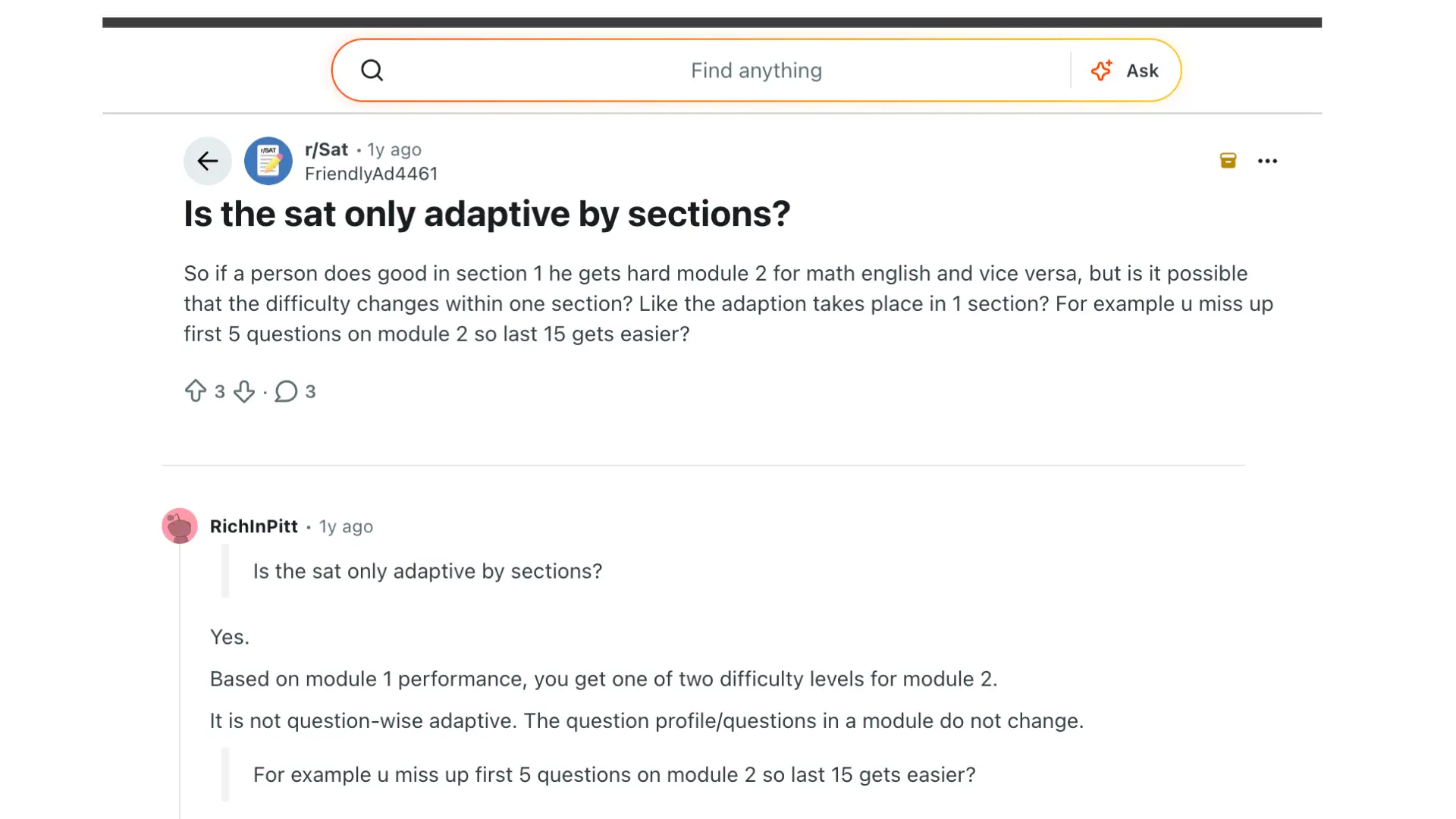
Online reactions to the adaptive SAT show a real mix of relief and frustration. One Reddit thread tackles a common point of confusion about how the format really works.
A top comment explains it simply: “Based on module 1 performance, you get one of two difficulty levels for module 2.” Comments like these help clear up confusion many students share.
Official practice tests only cover a narrow slice of the full question bank, so surprises happen.
Harder test dates tend to bring frustration and calls for a generous curve. Easier dates bring more relief, with test-takers calling the format fair.
Common Mistakes to Avoid While Studying for SAT
Even well-prepared students can lose points by falling into a few avoidable habits on test day. Knowing these mistakes ahead of time makes them easier to sidestep.
Common Mistake | Why It Hurts Your Score | What to Do Instead |
|---|---|---|
Rushing through Module 1 | Careless errors can lead to an easier Module 2, capping your score | Slow down and prioritize accuracy early on |
Leaving questions blank | No penalty for wrong answers, so blanks guarantee zero credit | Always fill in an answer, even a guess |
Practicing with total section time only | Doesn’t reflect real module-based pacing on test day | Time each module separately during practice |
Relying only on official practice tests | Represents a limited sample of the full question bank | Add other reputable practice material for variety |
Skipping built-in tool practice | Leads to slower pacing and avoidable errors | Practice using Desmos and annotation tools beforehand |
Avoiding these mistakes comes down to steady preparation rather than last-minute strategy changes. Small adjustments in how you practice can make a real difference in how confident you feel on test day.
The Bottom Line
The adaptive format is here to stay, and understanding how it works can take a lot of the mystery out of test day.
Once you know that performance on early questions shapes what comes next, the whole experience feels less like a black box and more like a system you can prepare for.
Community chatter reflects a mixed bag of relief over shorter sessions and lingering unease about pacing decisions, and both reactions are valid.
Start practicing with the adaptive format now so you can approach test day with a clear strategy.
Frequently Asked Questions
Can You Skip Questions and Come Back to Them Later on the SAT?
Yes, within the same module, but you cannot return to a module once it has been submitted.
Can You Retake the SAT if You Land in a Harder Module by Mistake?
Yes, students can retake the SAT on any future test date, regardless of which module they previously received.
What Happens if Your Device Malfunctions During an Adaptive Test Section?
Test center staff can pause the exam and restore progress through the Bluebook app’s built-in recovery system.