

Math can feel uniquely unforgiving because every concept builds on the last, and a small gap in understanding has a way of quietly affecting everything that follows.
Research on learning and skill development consistently shows that mathematical ability is not fixed.
It improves through the right habits, effective feedback, and strategies that actually match how your brain retains information.
If you have been looking into how to get better at math, the answer rarely comes down to more hours at the desk. It comes down to what you do with the hours you already have.
Why Does Learning Math Can Feel Difficult?
A student who misunderstood fractions in primary school will find algebra significantly harder, not because they lack ability, but because the foundation has a gap.
This cumulative structure means struggling students often fall further behind rather than catching up naturally. Math anxiety compounds the problem further.
According to the American Psychological Association, maths anxiety directly impairs working memory during problem-solving, even when the underlying knowledge exists.
As a result, students may perform below their ability because anxiety makes it harder to remember and use what they know.
19 Best Ways to Learn Math and Improve Your Skills

These are not generic study tips but specific evidence-based strategies that directly target the habits and approaches that separate students who improve at maths from those who stay stuck.
1. Start With an Honest Self-Assessment
Before studying anything, spend time identifying exactly which topics you find genuinely difficult versus which ones you simply dislike.
These are not the same thing. A topic you dislike may be one you understand well. A topic you find difficult is where your real work needs to happen.
Diagnosing accurately before studying saves you from spending the majority of your time reinforcing what you already know while your actual weaknesses go unaddressed.
2. Break Your Study Sessions Into Focused Blocks
The human brain maintains peak concentration for approximately twenty-five to forty-five minutes before attention begins to degrade.
Studying maths in blocks of this length, with short breaks between them, produces higher-quality learning than sitting for two uninterrupted hours.
The Pomodoro technique, twenty-five minutes of focused work followed by a five-minute break, is one of the most widely used and research-supported frameworks for structured study.
3. Learn the Language of Mathematics First
Mathematical terminology is its own language, and students who are unfamiliar with it struggle with problems before they have even begun to work through the maths itself.
Before starting any new topic, take fifteen minutes to learn the key vocabulary associated with it.
Understanding what words like coefficient, denominator, and hypotenuse actually mean removes a layer of confusion that slows down problem-solving and makes written questions significantly harder than the underlying maths.
4. Practice Mental Arithmetic Regularly
Calculators are useful tools, but over-reliance on them weakens the number sense that underpins all higher-level mathematical thinking.
Spending five to ten minutes each day on mental arithmetic, including multiplication tables, percentage calculations, and basic number operations, develops a fluency with numbers that makes every area of maths faster and more intuitive.
Students with strong mental arithmetic consistently process problems more efficiently than those who reach for a calculator at every step.
5. Simulate Test Conditions During Practice
There is a significant difference between doing maths in a relaxed setting with unlimited time and doing it under exam conditions.
Practicing only in low-pressure conditions builds a version of mathematical competence that can underperform under assessment pressure.
Regularly timing yourself, working without access to notes, and completing practice questions in one sitting without pausing builds the specific performance skills that timed assessments demand and reduces the cognitive shock of test day.
6. Read the Question Twice Before Starting
A significant proportion of marks lost in maths assessments are lost not because students cannot do the maths but because they answered a different question from the one that was asked.
Reading the question once quickly and launching into a solution is one of the most common and most avoidable errors students make.
Reading it twice, identifying exactly what is being asked, and noting any constraints before writing a single number eliminates this problem almost entirely.
7. Prioritize Conceptual Understanding Over Speed
Many students treat speed as the goal in maths when understanding is the actual goal.
Speed is a byproduct of genuine understanding, not a substitute for it. A student who truly understands why a method works will execute it quickly without trying.
A student who has memorized the method without understanding it will execute it slowly and inconsistently, and will fail completely when it appears in an unfamiliar form. Understanding always comes first.
8. Use Color Coding When Taking Notes
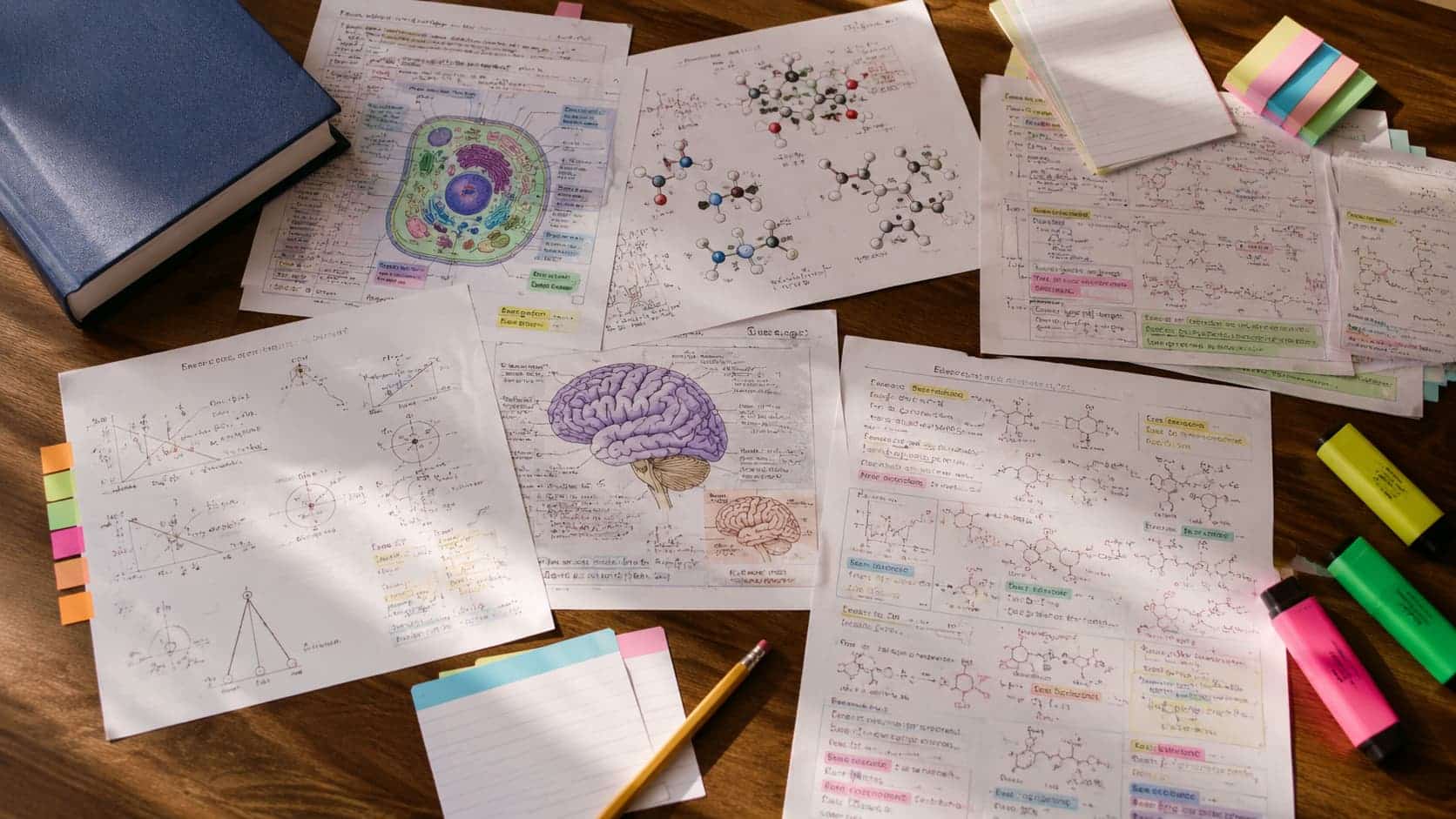
Organizing maths notes by color, using one color for formulas, another for worked examples, and another for common errors, makes information significantly easier to locate and review.
It also forces you to categorize information as you write, which deepens the initial processing.
Students who use structured, color-coded notes consistently report faster, more confident revision compared to those working from dense, unformatted pages of work that are difficult to navigate under time pressure.
9. Work Through Textbook Problems in Order
Textbooks sequence problems deliberately, beginning with the most accessible versions of a concept and gradually increasing in difficulty and complexity.
Skipping ahead to the hardest problems immediately or picking questions at random removes this scaffolding, making the learning process significantly harder than it needs to be.
Working through problems in the sequence the textbook presents them ensures you build competence incrementally rather than attempting steps before the foundational ones are secure.
10. Find a Study Partner or Accountability System
Working alongside another person who is also trying to improve their maths creates a layer of accountability that solo study does not.
A study partner does not need to be at the same level as you. Explaining a concept to someone who understands it less than you do strengthens your own understanding.
Being asked to explain something you cannot articulate clearly immediately identifies a gap you did not know you had.
11. Memorize Key Formulas Through Active Recall
Passive reading of a formula sheet before a test yields far weaker retention than actively recalling formulas without looking at them.
Write the formula from memory, check whether it is correct, identify any errors, and repeat.
This retrieval practice approach, supported by research from the Institute of Education Sciences, yields retention rates two to three times higher than rereading the same material an equivalent number of times.
12. Watch Video Explanations for Concepts That Confuse You
When a textbook explanation is not working, a different format often resolves the confusion immediately.
Video explanations differ from written ones because they show the process in real time rather than presenting a finished result.
Watching a problem being solved step-by-step, pausing to attempt each step yourself before the solution is revealed, and replaying sections that were unclear uses the medium in a way that produces genuine understanding.
13. Estimate Before You Calculate
Developing the habit of estimating an approximate answer before working through a problem precisely gives you a reference point that catches errors before they make it onto the page.
A student who knows the answer should be roughly forty will immediately recognize that ninety-four cannot be correct, and will check their working before submitting.
Estimation is not an alternative to accurate calculation. It is the quality control mechanism that makes accurate calculation more reliable.
14. Revisit Previously Mastered Topics Monthly
Mathematical knowledge that is not revisited decays faster than most students expect.
A topic that felt completely secure in October can feel unfamiliar by January if it has not been touched in the intervening months.
A monthly review of mastered topics takes little time but prevents the knowledge decay that turns familiar material into relearning work come exam season.
15. Seek Out Alternative Solution Methods
Most maths problems can be solved through more than one method. After solving a problem using the first approach that comes to mind, challenge yourself to find a second method that produces the same answer.
Knowing more than one way to solve the same problem type builds flexibility in your thinking and strengthens the conceptual understanding underneath it.
When a familiar method feels inaccessible, or a problem shows up in an unfamiliar shape, that range of approaches is what keeps you moving forward.
16. Create Your Own Practice Questions
Writing your own maths questions is one of the most underused learning strategies available. Creating a question requires you to understand the structure of the concept deeply enough to construct a version of it yourself.
This is a fundamentally different cognitive process from answering a question someone else has written.
Students who regularly create and then attempt their own questions develop a more thorough understanding of the underlying structure of mathematical problems.
17. Use Graph Paper for Any Work Involving Coordinates
Freehand sketches of graphs are almost always inaccurate enough to mislead your thinking and produce errors that would not have occurred on a properly scaled diagram.
Graph paper forces accuracy, makes relationships between variables visually clear, and produces a reference diagram you can annotate and return to during problem-solving.
For any topic involving coordinates, functions, or geometric figures, working on graph paper rather than plain paper is a simple change that consistently reduces errors.
18. Address Maths Anxiety Directly
Maths anxiety is a recognized and measurable phenomenon that directly impairs working memory during problem-solving, according to research from the American Psychological Association.
They are experiencing a psychological response that interferes with their ability to access the knowledge they actually possess.
Addressing it directly through breathing techniques before assessments, positive self-talk during practice, and gradual exposure to timed conditions can significantly reduce its impact over time.
19. Align Your Maths Practice With Your Energy Levels
Maths requires more sustained cognitive effort than most other study activities.
Complex problem-solving done on low energy produces weaker learning than the same practice attempted when your mind is actually fresh.
Scheduling your most demanding maths work during the time of day when your concentration is at its peak produces measurably better outcomes for the same time investment.
Quick Advice Every Math Student Needs to Hear
Most improvement advice focuses on what to study. These cut straight to the mindset and habits that determine whether any strategy actually sticks.
- Practice the topics you actively avoid, not the ones you already feel comfortable with.
- A wrong answer you fully understand is more valuable than a correct one you stumbled into.
- Confidence in maths comes from evidence of competence, so do the work and let the results speak.
- If you can solve a problem two ways, you understand it; if only one way, you have memorized it.
- Every session should end with you knowing something you did not know when you sat down.
None of these require extra resources or more time. They require a shift in how you think about the work you are already doing.
Common Mistakes That Prevent Improvement
Even with the right resources, most students hold themselves back through avoidable habits. These are the most consistent patterns that slow down mathematical progress:
Common Mistake | Why It Hurts Progress |
|---|---|
Practicing easy topics over hard ones | Strengthens what you already know, while weaknesses remain untouched |
Checking answers before attempting independently | Eliminates the struggle that builds genuine mathematical thinking |
Studying in distracting environments | Breaks the focus that maths problem-solving demands |
Treating correct answers as proof of understanding | Hides shallow knowledge that fails when problems change format |
Quitting a topic after one failed attempt | Prevents the repeated exposure to difficult concepts that actually need |
Every pattern on this list is a choice rather than a fixed habit, which means every one of them can be replaced with a more effective approach the moment you decide to change it.
Wrapping Up
Getting better at maths has less to do with shortcuts and more to do with applying a few effective strategies consistently.
Start with what addresses your biggest challenges, track your progress, and revisit difficult topics before they fade.
Small, steady improvements compound over time, and that is where real gains in confidence and problem-solving ability come from.
Which of these strategies are you adding to your study routine first? Drop it in the comments.
Frequently Asked Questions (FAQs)
What is the Single Most Effective Thing I Can Do to Improve at Maths?
Identify your specific foundational gaps and address them directly before attempting more advanced material, since unresolved gaps compound into much larger difficulties at every subsequent level.
Can Adults Get Significantly Better at Maths?
Yes. Mathematical ability responds to structured practice at any age, and many adults develop strong quantitative skills for career progression or professional certification using the same free resources available to students.
How Do I Stay Motivated when Maths Feels Too Difficult?
Track your progress weekly rather than daily, since daily fluctuations in performance are normal and misleading, while weekly trends reveal the consistent improvement that daily tracking often obscures.
Is It Possible to Become Genuinely Confident at Maths?
Yes. Confidence in maths is built through accumulated evidence of competence, which comes exclusively from doing the work consistently over time rather than from encouragement or reassurance alone.
What Should I Do the Day Before a Maths Exam?
Review your error log and key formulas briefly, attempt two or three practice problems at a comfortable level to build positive momentum, and then prioritize sleep over any further study.