

Reading faster sounds simple until your eyes move across a page and your mind realizes it has absorbed almost nothing.
That frustrating moment can make studying, working, or even finishing a book feel harder than it should.
Learning how to speed read is not about racing through words or skipping meaning. It is about training your attention to recognize ideas efficiently while staying focused on what matters.
The right speed reading techniques can help you reduce habits that slow you down, build smoother reading patterns, and feel more confident when facing long chapters or dense information.
What Happens in Your Brain When You Speed Read?
Speed reading works by training your brain to process words in groups rather than one at a time, reducing the number of eye movements needed per line, and eliminating habits that create unnecessary friction.
The average reader makes 5 to 7 fixations per line and spends additional time on regression, the habit of silently pronouncing words or drifting back to reread.
These small inefficiencies stack up across every page.
With deliberate practice, the brain learns to take in larger chunks of text per glance, trust its first pass without going back, and extract meaning without vocalizing every word internally.
The result is a faster reading pace that still supports real comprehension. The techniques below target each of these friction points directly.
How Fast Can You Actually Read?
Adults typically read silently at 238 words per minute for non-fiction, per a 2019 meta-analysis of 190 studies. Here is a breakdown:
|
Reader Type |
Words Per Minute |
Comprehension Level |
|---|---|---|
|
Average adult |
200 to 250 wpm |
High |
|
Proficient reader |
300 to 400 wpm |
High |
|
Trained speed reader |
400 to 600 wpm |
Moderate to high |
|
Claimed speed reader |
1,000 wpm and above |
Low, mostly skimming |
The goal is not to read as fast as possible but to find the pace where speed and retention both hold up for the material in front of you.
Speed Reading Techniques: Break the Habits Holding You Back
Before you can build speed, you need to identify what is slowing you down. They are deeply ingrained habits formed in childhood that no one ever taught you to unlearn.
Here are the most common ones and how to fix them:
1. Reduce Unnecessary Word-by-Word Subvocalization
Subvocalization is the habit of silently pronouncing every word in your head as you read. It is something most people learn in early childhood and never unlearn.
The problem is that your inner voice can only move as fast as you can speak, which caps your reading speed at roughly your talking pace.
Humming a low, consistent tone while reading keeps your mouth and throat occupied, making subvocalization harder to maintain.
2. Minimize Regression
Regression is when your eyes drift back to re-read words or sentences you have already passed.
It feels productive in the moment, but it is a habit rather than a genuine need for comprehension.
Move it forward at a steady pace and train your eyes to follow it without going back. This creates a simple rule for your eyes: forward only.
3. Expand Your Peripheral Vision
Every time your eyes land on a spot while reading, that is called a fixation. Most slow readers fixate on nearly every single word.
A simple drill to build this is to practice fixing your gaze on a single central point and identifying words on both sides without moving your eyes.
The soft focus method involves slightly relaxing your gaze so it feels less like zeroing in on one word and more like taking in a wider band of text.
4. Reduce Fixation Points Per Line
The average reader makes five to seven fixations per line of text.
Each fixation takes a fraction of a second, but across hundreds of lines, those fractions add up significantly.
Column reading practice is one of the best drills for this. Take a page of text and draw a faint vertical line about one-third from the left and another one-third from the right.
5. Use a Pacer or Pointer
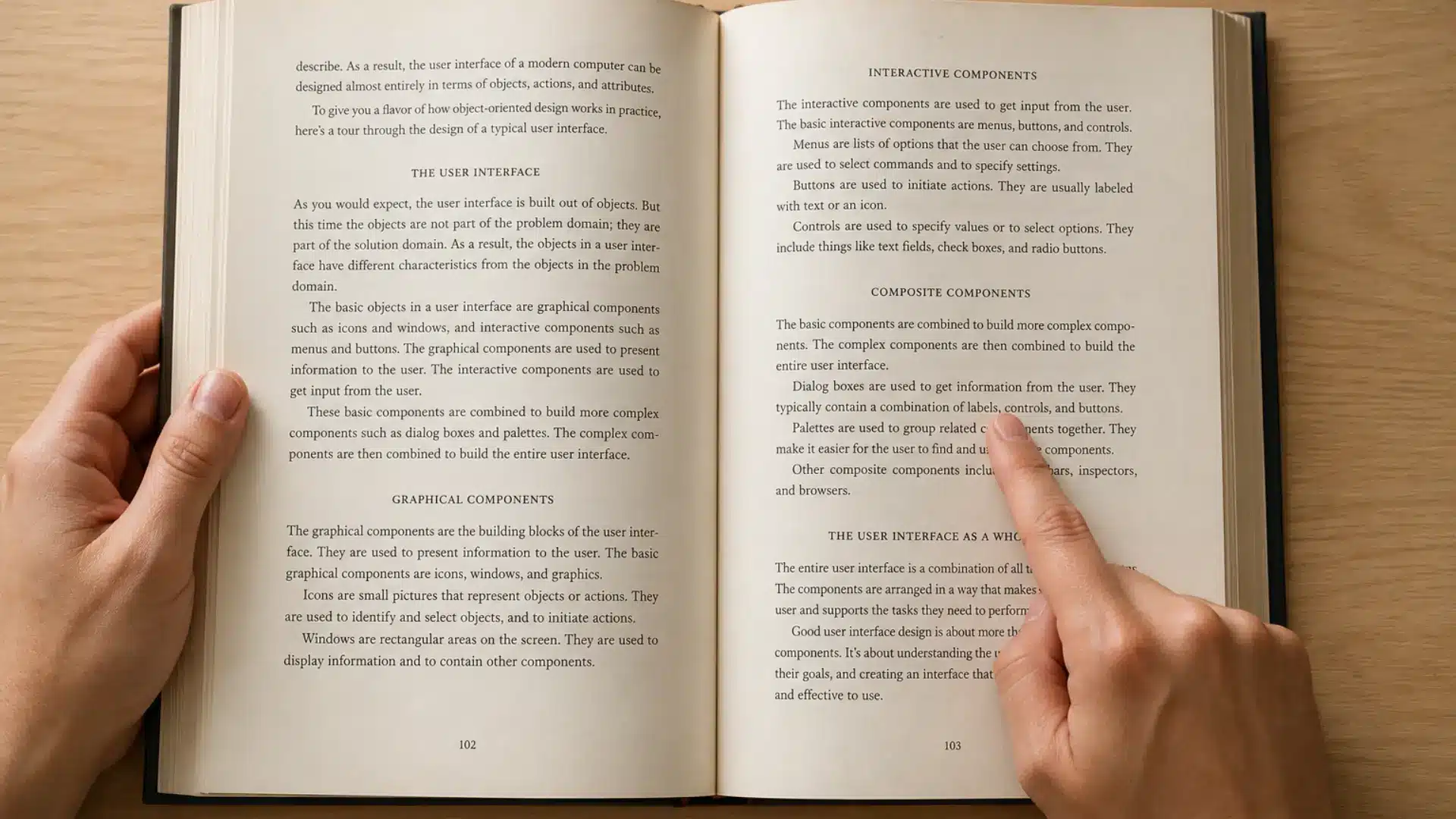
Using a pacer is one of the oldest and most effective speed-reading tools.
The idea is simple: move a finger, pen, or on-screen cursor along the line as you read, slightly ahead of your current position.
Your eyes naturally follow motion, so the pacer pulls your attention forward and discourages the eye from wandering or going back.
How to Speed Read Without Losing Comprehension?

This section focuses on strategies to maintain your understanding as your speed increases. Here is how to do it:
6. Preview Before You Read (Meta Guiding)
Before you read a single full sentence, spend sixty seconds scanning the entire piece.
Look at the headings, subheadings, bolded words, captions, and the first and last sentences of a few key paragraphs.
When your brain already has a rough outline of the content, it processes each sentence faster because it is not starting from zero.
7. The Chunking Method
The chunking method trains you to read in groups of two to four words, taking in whole phrases in a single glance rather than stopping at each individual word.
To practice, pick a paragraph and consciously try to group words together as your eyes move across the line.
It helps to use a pacer to guide your eye in smooth sweeping motions rather than individual hops.
8. The RSVP (Rapid Serial Visual Presentation) Method
RSVP is a digital speed-reading technique in which words are flashed one at a time at a fixed central position on the screen.
Because your eyes never need to move, the time lost to eye movement and fixation is eliminated entirely. You simply read the stream of words as they appear.
Apps like Spreeder and Reedy use this method and let you set your own words-per-minute rate.
9. The Skimming and Scanning Technique
Skimming and scanning are two distinct techniques that are often confused. Skimming is reading for the overall gist.
You move quickly through the text, catching the main idea of each section without absorbing every detail. Scanning is more targeted.
Neither replaces deep reading when full comprehension is required, but used strategically, they save significant time and help you decide which sections deserve your full attention.
10. Read the First and Last Sentence Only
This technique is built on a simple truth about how most paragraphs are written. The first sentence introduces the idea, and the last sentence closes or reinforces it.
This works particularly well for non-fiction, journalism, and academic writing, where paragraph structure is predictable and disciplined.
It is less reliable for narrative writing or content where the key point is buried in the middle.
Methods to Build Reading Speed Over Time

Knowing the techniques is one thing. Building the muscle memory to use them automatically is another. Here are structured methods to make faster reading your default:
11. The Push-Down Drill
The push-down drill is one of the most straightforward ways to build reading speed through repetition.
Reset and read the same passage again, this time pushing yourself to get past your previous mark before the minute is up. Repeat three to four times.
Because you already know the content on the second and third pass, your brain is not working to decode meaning. It is purely practicing speed.
12. Read Faster Than Comfortable (Over-Speed Training)
Over-speed training works on a simple principle.
If you repeatedly push your reading pace beyond what feels manageable, your brain eventually accepts a higher speed as normal.
To do this, pick a passage and move through it at a pace where comprehension starts to break down. You will not retain much in these sessions, and that is fine. The goal is not understanding; it is conditioning.
13. The Column Reading Technique
Column reading is a drill designed to reduce the number of fixations your eyes make per line by training them to rely more heavily on peripheral vision.
Take a page of text and draw or imagine a single vertical line running down the center.
Practice moving your eyes only down that center line, one fixation per line, and let your peripheral vision fill in the words on either side.
14. Use Speed Reading Apps and Tools
Technology has made speed reading practice more accessible than ever
Spreeder flashes words or phrases at a set pace using the RSVP method and lets you adjust speed and chunk size. Reedy works similarly and integrates with your browser for reading articles on the go.
BeeLine Reader uses color gradients across lines of text to guide your eye forward more smoothly and reduce regression.
Advanced Speed Reading Techniques to Push Your Pace Further
Most readers plateau after mastering the basics. These techniques push past that ceiling by targeting more specific reading behaviors and training your eyes and brain to work at a higher level:
15. The Z or W Pattern Reading Technique
Instead of reading every line left to right, your eyes sweep diagonally across the page in a Z- or W-shaped motion, catching the most important words with each pass.
This reduces the number of full-line reads needed without missing key information.
It works best for news articles, reports, and any content where a fast, structured first pass is needed before committing to a full read.
16. The Indentation Technique
Train your eyes to start slightly inside the left margin and stop slightly before the right margin on each line.
The words at both edges are picked up by peripheral vision rather than direct fixation, reducing eye stops per line and increasing pace.
Pair it with chunking for a compounded improvement in speed.
17. Read in Reverse to Build Focus
Reading sentences backward from the last word to the first is a concentration drill that forces your brain into a heightened state of attention.
Switch back to normal reading after five minutes, and your focus will feel noticeably sharper.
Use it as a warm-up before longer reading sessions.
18. Use Typographic Aids and Reading Tools
Clean sans-serif fonts, generous line spacing, and tools like BeeLine Reader and Readability make it easier for your eyes to move smoothly across text.
These adjustments work with your eyes rather than against them, reducing the cognitive load of processing text without requiring any additional practice with techniques.
Adjusting the format of what you read is one of the most immediate and underused ways to improve reading speed.
When Should You Speed Read and When Should You Slow Down?
Your reading pace should change based on the purpose and difficulty of the material. Use this table to decide when to move faster and when to take your time.
|
When to Speed Read |
When to Slow Down |
|---|---|
|
Reading familiar or easy-to-understand material |
Reading complex or unfamiliar information |
|
Scanning emails, reports, or general articles |
Studying textbooks, research, or technical content |
|
Looking for the main idea rather than every detail |
When you need to remember specific facts or instructions |
|
Reviewing material you have already read |
Learning a topic for the first time |
|
Searching for keywords or specific information |
When meaning depends on careful wording or context |
|
Previewing a chapter before deeper reading |
Reading legal, medical, or safety-related information |
Speed Reading Tips to Get the Most Out of Every Session
Even the best techniques fall flat in the wrong conditions. Keep these tips in mind as you practice:
-
Set a Reading Purpose Before You Start: Know exactly why you are reading before you begin. Your brain filters out what is irrelevant and moves through the text faster when it has a clear goal.
-
Optimize Your Reading Environment: Poor lighting, an incorrect font size, and bad posture all slow you down. Set your screen at eye level, use a comfortable font size, and ensure your lighting is easy on the eyes.
-
Take Mental Notes as You Go: After each section, pause briefly and ask yourself what the main point was. That single habit strengthens retention without adding time to your reading session.
-
Create a Mind Map After Longer Sessions: Start with the central topic and branch out with the key ideas and details you remember.
-
Practice with Varied Material: Non-fiction, news articles, and academic texts each build a different reading skill.
-
Stay Consistent: Short daily practice beats occasional intensive sessions every time. Even fifteen to twenty minutes a day compounds into significant improvement over weeks and months.
Small environmental and habitual adjustments compound quietly and make a bigger difference to your reading speed and retention than most people expect.
Speed Reading vs Skimming vs Scanning
These three terms get used interchangeably, but they are not the same thing. Each serves a different purpose and works best in different situations.
Understanding the difference helps you pick the right approach for whatever you are reading.
|
Method |
What It Is |
Best Used For |
Comprehension Level |
|---|---|---|---|
|
Speed Reading |
Reading all the text at an accelerated pace using trained techniques |
Books, long articles, study material |
High |
|
Skimming |
Moving quickly through the text to get the general idea |
Previewing content, deciding what to read fully |
Medium |
|
Scanning |
Searching for a specific word, fact, or piece of information |
Research, reports, reference material |
Low to targeted |
A smart approach is to first scan a document to assess its relevance, then skim it to get the structure, and finally speed-read the sections that actually matter.
Used in sequence, they work together rather than in competition.
Final Thoughts
Speed reading is not about rushing through every page. It is about finding a pace that helps you move faster while still understanding and remembering what you read.
As you practice, focus on simple habits like reducing unnecessary rereading, widening your visual focus, and staying fully engaged with the text.
If you keep practicing, even small gains can make long articles, study material, and work documents feel much easier to manage.
Have you tried any speed reading techniques before? Share your experience, challenges, or favorite tips in the comments below today.
Frequently Asked Questions (FAQs)
Is Speed Reading a Real Skill or a Myth?
The extreme claims about reading thousands of words per minute with full comprehension are not supported by research, but techniques such as reducing subvocalization and minimizing regression are well-supported and can meaningfully improve your reading pace.
How Long Does It Take to Learn Speed Reading?
Most people notice a difference within 2 to 4 weeks of consistent daily practice. Lasting improvement typically takes two to three months.
Does Speed Reading Hurt Comprehension?
Reading faster than your current skill level supports will reduce retention. Techniques such as previewing, chunking, and purposeful reading are designed to maintain comprehension while increasing reading speed.
Does Speed Reading Actually Work?
Yes, speed reading can improve reading efficiency with practice, but extreme speeds often reduce comprehension. The best approach balances faster reading with understanding and retention.