


Test day already carries enough pressure without wondering what’s actually on the exam.
If you’re asking how many questions the ACT has, you’re not alone, especially since ACT, Inc. changed the format for the 2025-26 testing cycle and retired the previous version.
This blog walks through the full ACT breakdown: section-by-section question counts, timing, and the ACT categories each part measures, from English usage rules to Math’s higher-level concepts.
Skip the outdated numbers floating around online and get the current picture before you sit down to test.
Inside the ACT Exam: A Brief Overview
The ACT, originally short for American College Testing, is a standardized exam assessing high school students’ readiness for college, covering English, math, reading, science, and an optional writing section.
It evaluates skills such as grammar, algebra, reading comprehension, and scientific reasoning, not general intelligence.
Accepted nationwide by all four-year colleges, ACT scores range from 1 to 36 and influence admissions decisions alongside GPA and extracurriculars.
National Saturday testing switched to the new format first, and school-day administrations followed by spring 2026.
The new format of ACThas brought small changes to timing and section structure in recent years. Some colleges also consider section scores for course placement.
How Many Questions is the ACT?
The current ACT has 131 questions across English, Math, and Reading. Adding the optional Science section brings the total to 171 questions for test takers.
The ACT is organized into four main sections of different durations, each assessing different academic skills.
ACT Section | Questions | Time |
|---|---|---|
English | 75 | 45 Minutes |
Math | 60 | 60 Minutes |
Reading | 40 | 35 Minutes |
Science | 40 | 35 Minutes |
Writing (optional) | 1 Essay | 40 Minutes |
The test runs 2 hours and 55 minutes without Writing, or 3 hours and 35 minutes with it. Students should plan for close to four hours at the testing center, including check-in time.
ACT Categories Explained Section-Wise
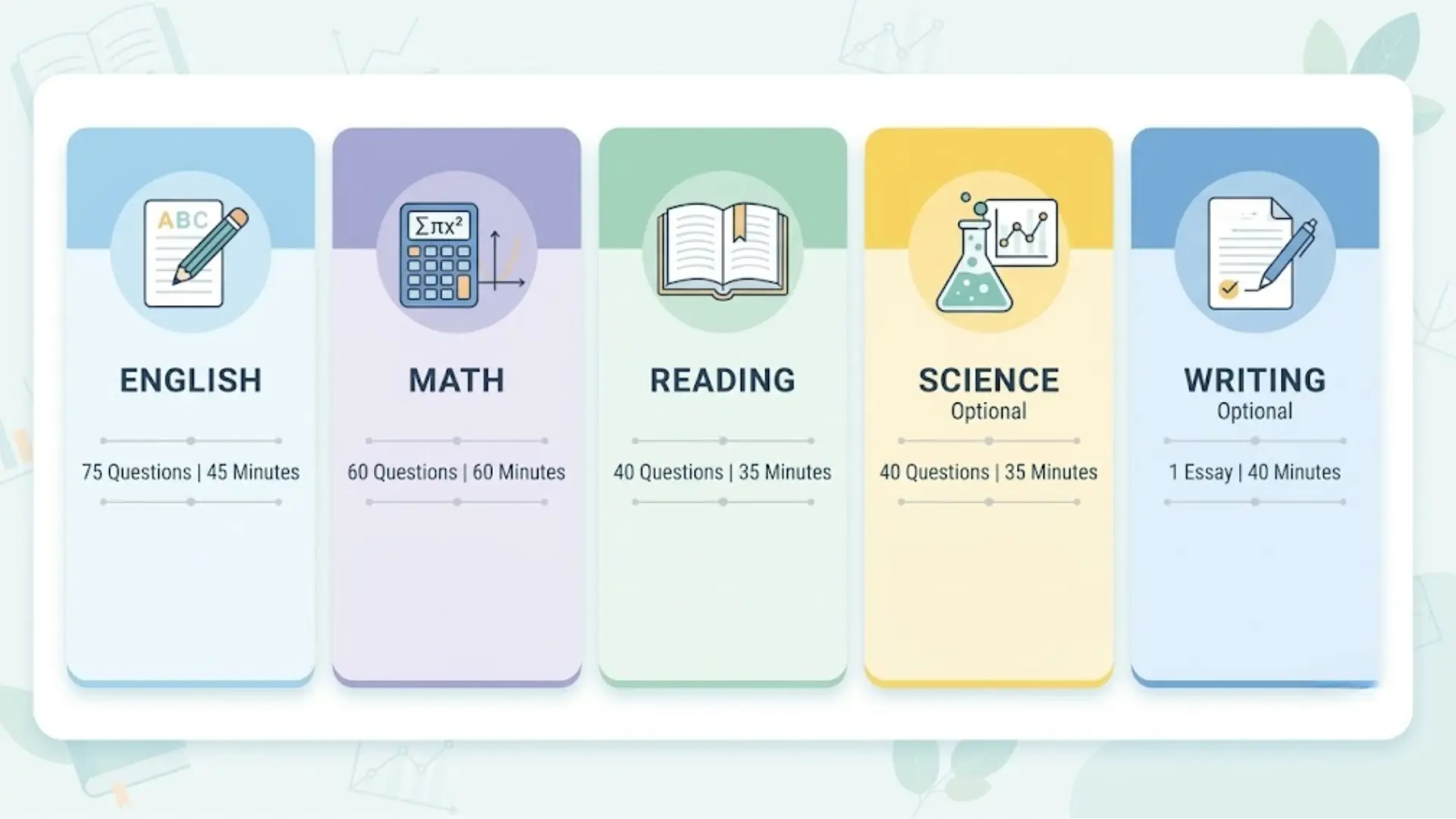
Knowing the categories tested in each section helps students focus their preparation on the right skills. Here is a closer look at what shows up inside the ACT:
1. English Categories
The English section covers three main reporting categories that test different writing skills. Each category focuses on a distinct part of strong, clear writing. Here are the three categories tested:
Production of Writing: Covers purpose, focus, and organization within a piece of writing.
Knowledge of Language: Tests word choice, style, and tone in different contexts.
Conventions of Standard English: Covers grammar, punctuation, sentence structure, and usage.
2. Math Categories
The Math section covers three broad categories built around real math skills. These categories move from foundational math to applied problem-solving. Here are the categories tested:
Preparing for Higher Math: Covers algebra, functions, geometry, and statistics taught in high school.
Integrating Essential Skills: Tests rates, percentages, area, and proportional reasoning together.
Modeling: Evaluates how well students build and apply math models to real situations.
3. Reading Categories
The Reading section covers three categories that test comprehension at different levels. Each category asks students to engage with the text in a different way. Here are the categories tested:
Key Ideas and Details: Tests central ideas, summaries, and logical inferences from the passage.
Craft and Structure: Focuses on word choice, sentence purpose, and overall text structure.
Integration of Knowledge and Ideas: Asks students to compare texts and evaluate evidence.
4. Science Categories
The Science section covers three formats built around scientific data and reasoning.
Each format tests a different way of working with scientific information. Here are the formats tested:
Data Representation: Tests how well students read graphs, tables, and figures.
Research Summaries: Asks students to evaluate experiment design, results, and conclusions.
Conflicting Viewpoints: Requires comparing two or more conflicting theories within one passage.
5. Writing Category (optional)
The Writing section presents a single essay prompt built around a current issue. Two categories are scored to evaluate the quality of the essay. Here are the categories scored:
Analysis and Argument Development: Evaluates how well students build and support their argument.
Organization and Language Use: Covers essay structure, paragraph flow, and language precision
Classic ACT vs Enhanced ACT: What Changed
If you’ve seen ACT prep material with different numbers than the ones above, it’s probably describing the retired classic format. Here’s a side-by-side look:
Feature | Classic ACT (Retired) | Enhanced ACT |
|---|---|---|
Total core questions | 215 | 131 |
English | 75 questions, 45 min | 50 questions, 35 min |
Math | 60 questions, 60 min, 5 choices | 45 questions, 50 min, 4 choices |
Reading | 40 questions, 35 min | 36 questions, 40 min |
Science | Required, 40 questions, 35 min | Optional, 40 questions, 40 min |
Composite formula | Average of all 4 sections | Average of English, Math, Reading only |
How to Make the Most of Your Break Time?
The ACT gives you one main break, plus a short extra one if you take Writing. Break time matters just as much as test time on the ACT.
A few small habits can help you reset and refocus fast. Here are simple ways to use your break wisely:
Hydrate: Drinking a little water can help maintain focus and alertness.
Have a Light Snack: A small protein-rich or naturally sweet snack can provide a quick energy boost.
Reset Your Mindset: Avoid dwelling on difficult questions from previous sections and focus on the section ahead.
Stretch and Move: Gentle stretching can relieve physical tension and help you feel refreshed before returning to the test.
Take Slow Breaths: A few deep breaths can lower stress and calm any test-day nerves.
A short break used well can carry you through the rest of the test. Small resets like these keep your mind sharp until the final section ends.
What to Expect on Test Day
Test day runs on a tight schedule from the moment you arrive. Knowing the timing ahead of time can help you stay calm and ready. Here is a simple breakdown of how the day usually flows:
Activity | Section | Duration |
|---|---|---|
Arrival and room assignment | Before testing | 15 mins |
Check-in and ID verification | Before testing | 45 mins |
Instructions and setup | Before testing | 15 mins |
English section | Section 1 | 45 mins |
Math section | Section 2 | 1 hr 15 mins |
Break | Break | 10 mins |
Reading section | Section 3 | 35 mins |
Science section | Section 4 | 35 mins |
Extra break | Break | 5 mins |
Optional Writing section | Section 5 | 40 mins |
Times can shift slightly depending on the test center and staff pace. Plan for the full morning so small delays do not throw off your focus.
What to Bring on ACT Test Day
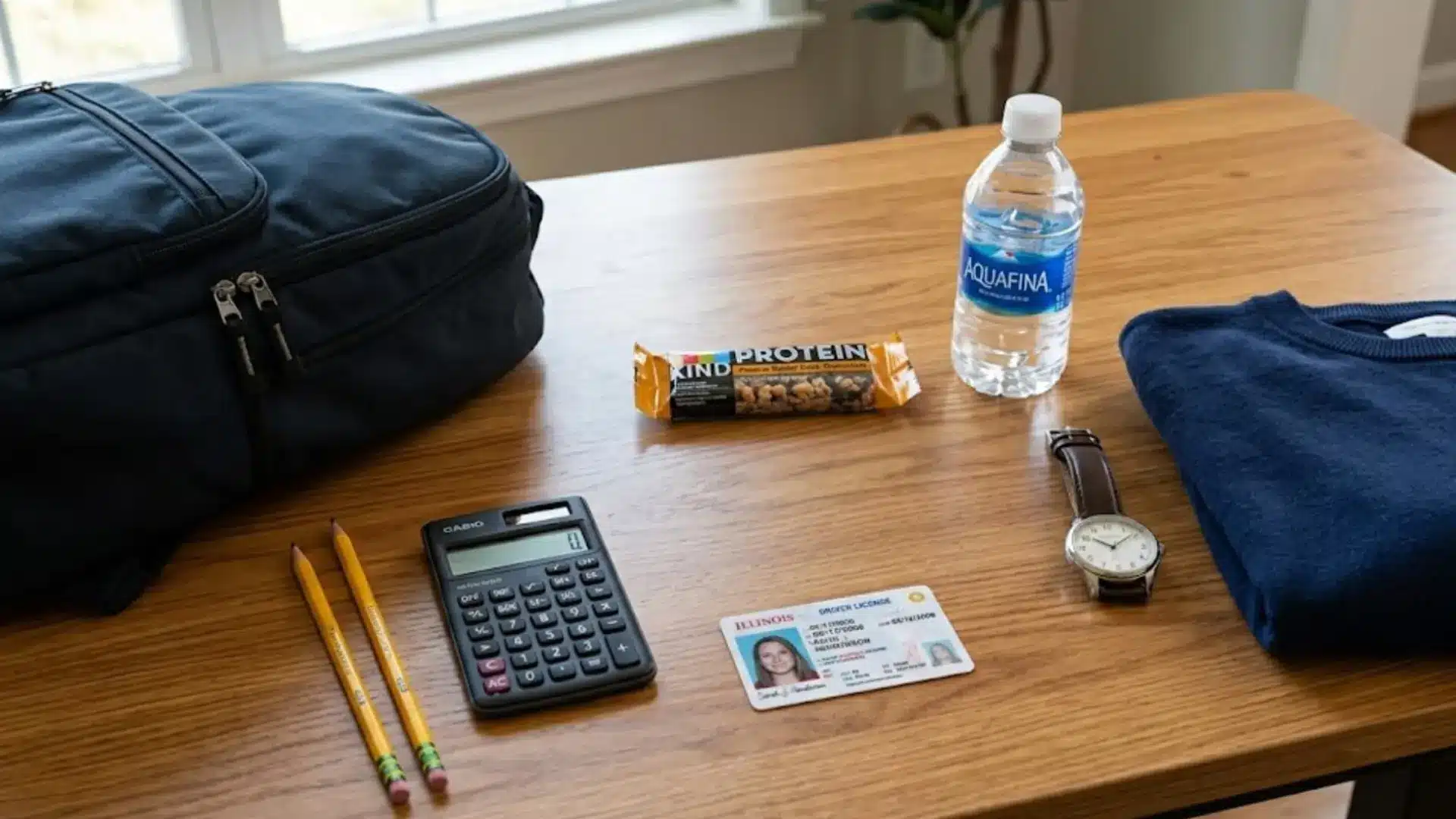
Test day goes smoother when you pack the right items ahead of time. From required documents to banned items, here is everything you need to know:
1. Required Items
Test day has a short list of must-have items. Forgetting even one can cause real delays at check-in. Here is what you need to bring:
A valid photo ID that matches your registration
Your printed or digital admission ticket
Two sharpened number two pencils with good erasers
2. Approved Calculators
Not every calculator is allowed inside the testing room. Checking the rules ahead of time saves you from last-minute stress. Here are the calculator basics to know:
Most graphing, scientific, and four-function calculators are approved
Calculators with internet access or phone features are banned
A backup calculator with fresh batteries is smart to bring
3. Optional Comfort Items
A few extra items can make the long test session easier. None of these are required, but they can help you stay comfortable. Here are some worth packing:
A watch without any alarm or smart features
A light snack and a bottle of water for breaks
A sweater or jacket in case the room feels cold
What Not to Bring on Test Day
Some everyday items are actually banned inside the testing room. Leaving them at home avoids confusion or confiscation on test day. Here is a quick look at what to leave behind:
Banned Item | Why It’s Not Allowed | Where to Leave It |
|---|---|---|
Cell phones or smart devices | Could be used to access outside help | At home or in your car |
Scratch paper, books, or notes | Could contain unauthorized answers | At home |
Mechanical pencils, pens, or highlighters | Only number two pencils are accepted | In your bag outside the room |
Smartwatches or fitness trackers | Can store or share data during the test | At home before you leave |
Earbuds or headphones | Could be used to receive outside audio | In your car or bag |
Bringing banned items can slow down check-in or lead to bigger problems. Packing the night before helps you avoid leaving any of these behind by mistake.
Final Thoughts
The ACT runs on a clear structure once you know the details. You now know how the sections flow and what each one checks.
Knowing how many questions the ACT gives you gives you real control over pacing.
Small habits during breaks can keep your mind sharp until the end. Walking out feeling confident starts with simple preparation like this.
Got a test day tip or a question of your own? Drop it in the comments below.
Frequently Asked Questions
Which ACT Section Has the Most Questions?
The English section has the most questions, at 75, followed by Math with 60. Reading and Science each have 40 questions.
Can You Skip Questions on The ACT?
Yes, students may skip questions and return to them before time is called in that section. However, once the time for a section ends, they cannot revisit it.
Is There a Penalty for Wrong Answers?
The ACT does not deduct points for incorrect answers. Unanswered questions score zero, so students should answer every question, even if it requires an educated guess, before time runs out.