



Preparing for the AP Psychology exam can feel exciting one moment and overwhelming the next.
You may understand a chapter while studying, then suddenly forget the details when a timed question appears. That frustration is normal, but it does not have to control your confidence.
An AP Psychology practice test gives you a clear way to see what you know, where you hesitate, and which topics need more attention.
Each question becomes a step toward feeling calmer and more prepared.
Instead of guessing how ready you are, you can measure your progress through realistic AP Psychology exam practice questions and focused review.
One practice session today could reveal the exact change that moves your score forward.
Understanding The AP Psychology Exam Structure
The AP Psychology exam is fully digital and has two sections. Multiple-choice and free-response.
Here is a full breakdown of what to expect:
| Section | Time Allowed | Number of Questions | Score Weight | What It Tests | Format |
|---|---|---|---|---|---|
| Multiple Choice | 90 minutes | 75 questions | 67% | Key terms, concepts, and theories | Single best answer, 4 choices |
| Article Analysis Question (AAQ) | Part of the 70-minute FRQ block | 1 question, 6 short parts | Part of 33% | Reading and interpreting one research study | Short-answer responses |
| Evidence-Based Question (EBQ) | Part of the 70-minute FRQ block | 1 question | Part of 33% | Building a claim from three sources | Extended written response |
Knowing this structure matters. It helps you figure out where to focus your practice time. That’s why the practice tests and questions in this guide cover both formats.
Registration deadlines and exact reporting times are set by your school, so confirm both with your AP coordinator and on AP Central as the date approaches.
If you want a deeper breakdown of how the multiple-choice and free-response time blocks fit together, this AP Psych exam timing breakdown walks through the full schedule.
AP Psychology Practice Test Links
When it comes to prepping for the AP Psychology exam, nothing beats materials made by the people who actually write it.
The College Board offers several official resources you can use, and they’re the most accurate representation of what you will see on exam day.
1. AP Psychology Course and Exam Description (CED)
The AP Psychology Course and Exam Description is the main official guide for understanding the course framework and exam expectations.
It outlines every unit, learning objective, skill, and topic students need to study.
The document also includes sample multiple-choice and free-response questions based on the current exam format.
Students can use these examples to understand question wording, difficulty level, scoring expectations, and the types of psychological concepts tested.
2. Bluebook Practice
Bluebook is the official digital testing application used for the AP Psychology exam, making it an important practice tool.
Students can complete full-length practice tests while becoming familiar with the screen layout, navigation tools, timer, and question interface.
Practicing inside Bluebook can reduce confusion and improve confidence on exam day. It also helps students learn how to manage time, review answers, and move between questions efficiently.
3. AP Psychology Exam Page on AP Central
The AP Psychology exam page on AP Central provides official details about the latest exam structure and testing requirements.
Students can review section timing, question formats, scoring information, and important exam policies in one location.
The page also includes links to sample questions, released free-response prompts, scoring guidelines, and course documents.
Sample AP Psychology MCQs You Can Try
Test your understanding with these AP Psychology multiple-choice questions covering key concepts and exam-style scenarios.
Here are a few sample questions from each unit.
Unit 1: Biological Bases of Behavior
1. Which neurotransmitter is most closely linked to mood regulation and depression?
A) Dopamine
B) Serotonin
C) Acetylcholine
D) Epinephrine
Answer: B) Serotonin
2. What is the main function of the cerebellum?
A) Language processing
B) Balance and coordination
C) Memory storage
D) Emotion regulation
Answer: B) Balance and coordination
3. Which term describes the brain’s ability to reorganize itself by forming new neural connections?
A) Neuroplasticity
B) Habituation
C) Lateralization
D) Homeostasis
Answer: A) Neuroplasticity
Unit 2: Cognition
1. Which type of memory stores general knowledge and facts about the world?
A) Episodic memory
B) Semantic memory
C) Procedural memory
D) Sensory memory
Answer: B) Semantic memory
2. A person assumes a talkative individual is more likely a salesperson than a librarian, ignoring actual population data. This is an example of what?
A) Availability heuristic
B) Representativeness heuristic
C) Anchoring bias
D) Overconfidence
Answer: B) Representativeness heuristic
3. Which term describes the tendency to overestimate how well you could have predicted an outcome after it happens?
A) Hindsight bias
B) Confirmation bias
C) Framing effect
D) Anchoring effect
Answer: A) Hindsight bias
Unit 3: Development and Learning
1. A dog that once salivated to a bell no longer responds after the bell is repeatedly presented without food. This illustrates what?
A) Spontaneous recovery
B) Extinction
C) Generalization
D) Discrimination
Answer: B) Extinction
2. According to Vygotsky, the range of tasks a child can do with guidance but not alone is called what?
A) Zone of proximal development
B) Object permanence
C) Conservation
D) Scaffolding
Answer: A) Zone of proximal development
3. Gradually rewarding closer approximations of a desired behavior is called what?
A) Chaining
B) Shaping
C) Flooding
D) Modeling
Answer: B) Shaping
Unit 4: Social Psychology and Personality
1. Judging someone based on the group they belong to, rather than their individual traits, is an example of what?
A) Prejudice
B) Stereotyping
C) Discrimination
D) Ethnocentrism
Answer: B) Stereotyping
2. According to social exchange theory, people stay in relationships mainly because of what?
A) A sense of moral duty
B) Weighing perceived rewards against costs
C) Fear of loneliness
D) Peer pressure
Answer: B) Weighing perceived rewards against costs
3. A person’s consistent pattern of shyness across different situations reflects what personality concept?
A) State
B) Trait
C) Archetype
D) Temperament
Answer: B) Trait
Unit 5: Mental and Physical Health
1. Repeated, unwanted thoughts paired with repetitive behaviors meant to reduce anxiety describe what disorder?
A) Generalized anxiety disorder
B) Obsessive-compulsive disorder
C) Panic disorder
D) Social anxiety disorder
Answer: B) Obsessive-compulsive disorder
2. A person who believes they have no control over stressful events, even when they do, may be experiencing what?
A) Learned helplessness
B) Cognitive dissonance
C) Self-efficacy
D) Reactance
Answer: A) Learned helplessness
3. Which therapy approach uses gradual exposure to a feared object paired with relaxation techniques?
A) Systematic desensitization
B) Psychoanalysis
C) Aversive conditioning
D) Rational emotive therapy
Answer: A) Systematic desensitization
I’ve linked a free downloadable PDF below with more AP Psychology practice questions covering all 5 units, with answers and explanations.
Sample AP Psychology FRQ Questions By Unit
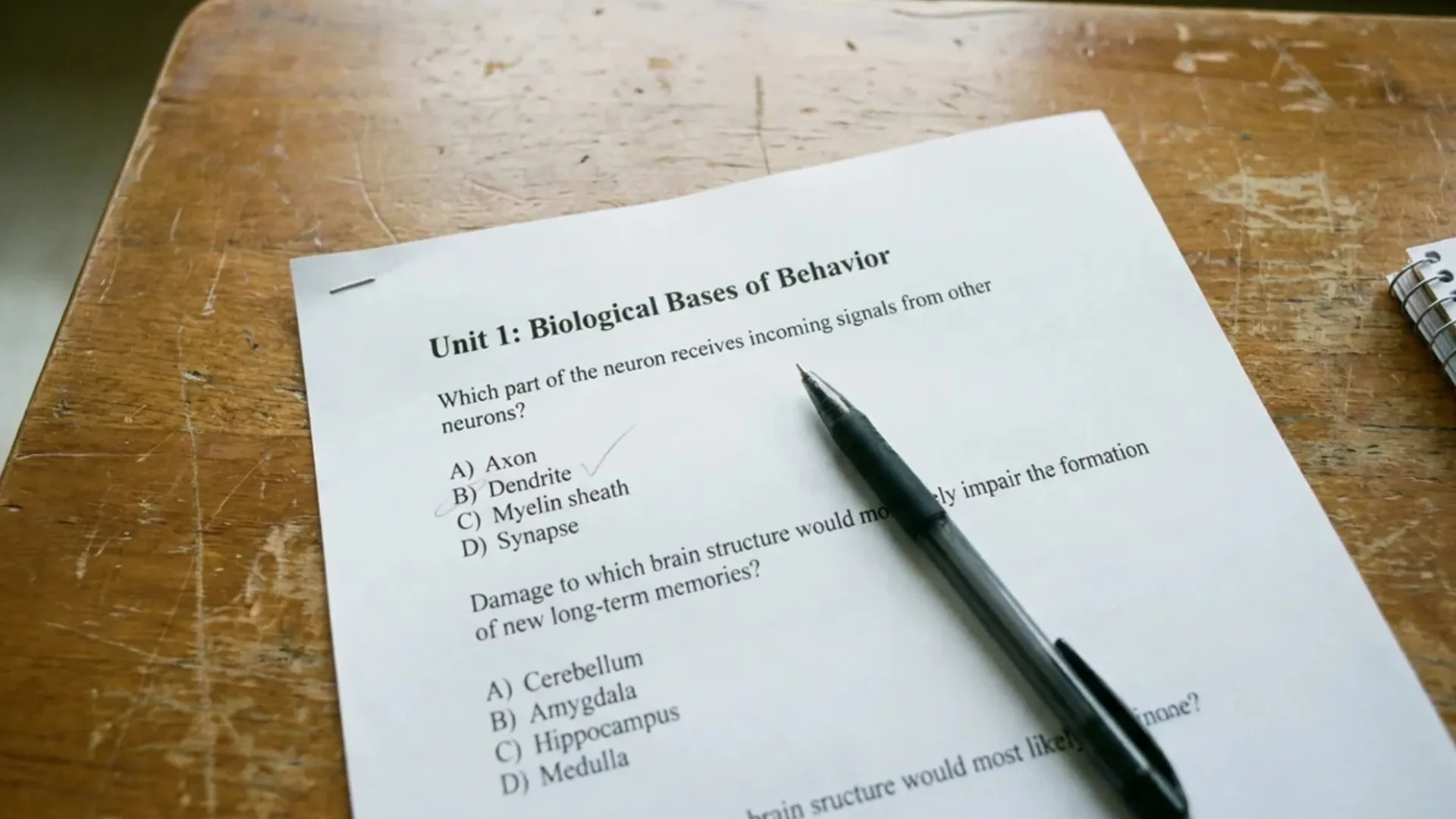
The free-response section has two parts: the Article Analysis Question (AAQ) and the Evidence-Based Question (EBQ).
The AAQ gives you a summary of one research study and asks six short questions about it, covering topics such as the research method, variables, and whether the results support the hypothesis.
The EBQ gives you three short sources on a topic.
You build a specific claim and support it using evidence from those sources along with psychological concepts.
Together, these make up 33% of your score, and you have 70 minutes to complete both.
I have added a downloadable link at the bottom with more free-response practice questions to work through.
Best Study Strategies to Improve AP Psychology Scores
Scoring well on the AP Psychology exam takes more than simply reading notes.
Combining active learning techniques with regular practice tests and consistent review helps strengthen understanding, improve recall, and build confidence before exam day.
- Use Active Recall: Test yourself without looking at notes by answering questions from memory. This strengthens long-term retention far better than passive rereading.
- Practice With Timed Tests: Complete multiple-choice and free-response questions under exam conditions to improve pacing and reduce test-day pressure.
- Review Every Mistake: Analyze incorrect answers to understand why they were wrong. Learning from mistakes helps prevent repeating them on future practice tests.
- Study With Spaced Repetition: Review important terms and concepts over several days or weeks instead of cramming everything into one study session.
- Create Flashcards for Key Vocabulary: Memorize psychological theories, researchers, brain structures, and important terminology using physical or digital flashcards.
- Focus on Frequently Tested Topics: Spend extra study time on research methods, biological psychology, learning, cognition, memory, and social psychology since they appear regularly on the exam.
- Practice Free-Response Questions (FRQs): Write complete responses using official scoring guidelines to improve organization, accuracy, and application of psychological concepts.
How to Use AP Psychology Practice Test Right?
Taking practice tests only helps if you use them the right way. Here’s how to actually make progress:
- Review Every Wrong Answer: Don’t just check your score and move on. Go back through every question you missed and understand why you missed it.
- Sort Your Mistakes Into Two Types: If it’s a concept issue, go back to your notes and relearn it. If it’s a careless mistake, note the pattern so you can avoid repeating it.
- Track Your Weak Spots: Keep a running list of topics you keep missing. This becomes your personal study guide as exam day gets closer.
- Practice Under Timed Conditions: Once you are comfortable with the content, set a 90-minute timer for multiple-choice questions and a 70-minute timer for free-response questions.
- Build Your Pacing Instincts: Timed practice helps you avoid rushing or running out of time on exam day. If nerves tend to throw off your timing, these test anxiety strategies pair well with timed practice sessions.
- Take One Full-Length Test Before Exam Day: Try to complete at least one timed, full-length practice test under real conditions before the actual exam.
The Bottom Line
Prepping for AP Psychology doesn’t have to feel overwhelming. It just takes the right approach.
With the right mix of official practice tests, sample questions, and consistent review, you’ll walk into exam day knowing exactly what to expect. No surprises, no last-minute panic.
Start with the resources in this guide. Track your weak spots as they show up, and don’t skip past them hoping they’ll fix themselves.
Keep practicing under real exam conditions as the exam date gets closer, so timing feels natural instead of stressful.
Every question you review now is one less surprise on test day.
Which AP Psychology topic challenges you the most right now? Share your answer or your favorite study tip in the comments below.
Frequently Asked Questions (FAQs)
Is AP Psychology Hard to Self-Study?
Not really. It’s considered one of the more approachable AP courses since it doesn’t involve heavy math, and the content connects easily to everyday life.
Can I Retake the AP Psychology Exam if I Don’t Score Well?
Yes, you can retake it every May for as long as you want. You’ll need to pay the exam fee again each time you retake it.
What Score Do I Need on AP Psychology to Get College Credit?
Most colleges require a 3 or higher out of 5 to grant credit or placement, though this varies by school. It’s worth checking your target college’s specific AP credit policy before exam day.