

Every year, many students walk into a testing room carrying the same quiet question: how high can I actually score?
The honest answer surprises most of them. The candidates for the ACT exam have it too, but chasing that number is a dicey way to approach the exam.
Here’s what separates students who improve fast from those who plateau: the max score barely matters.
What matters is the specific number that gets a particular student into a particular school, nothing more, nothing less.
This blog breaks down exactly how ACT scoring works, whats the highest score on the ACT, and how to build a target around real goals instead of guesswork.
ACT Exam At a Glance
The ACT is a standardized U.S. college admissions test, redesigned in 2025–26 into a shorter “Enhanced ACT” format. It measures readiness in English, math, and reading, with science now optional.
Here’s a precise breakdown of format, timing, and scoring:
Category | Details |
|---|---|
Core sections | English, Math, Reading |
Optional sections | Science, Writing |
Total questions | 131 |
Score range | 1-36 composite |
Writing score | 2-12 (separate) |
Total center time | 2.5-3.5 hrs |
The rollout is no longer staggered. National, international, and state-and-district testing all moved to the enhanced format by spring 2026, so nearly every student testing this fall sees the 131-question version.
The optional Writing section does not affect your composite ACT score. It is graded separately on a scale of 2 to 12. Your main 1 to 36 score depends entirely on the mandatory English, Math, Reading, and Science sections.
How is the ACT Scored?
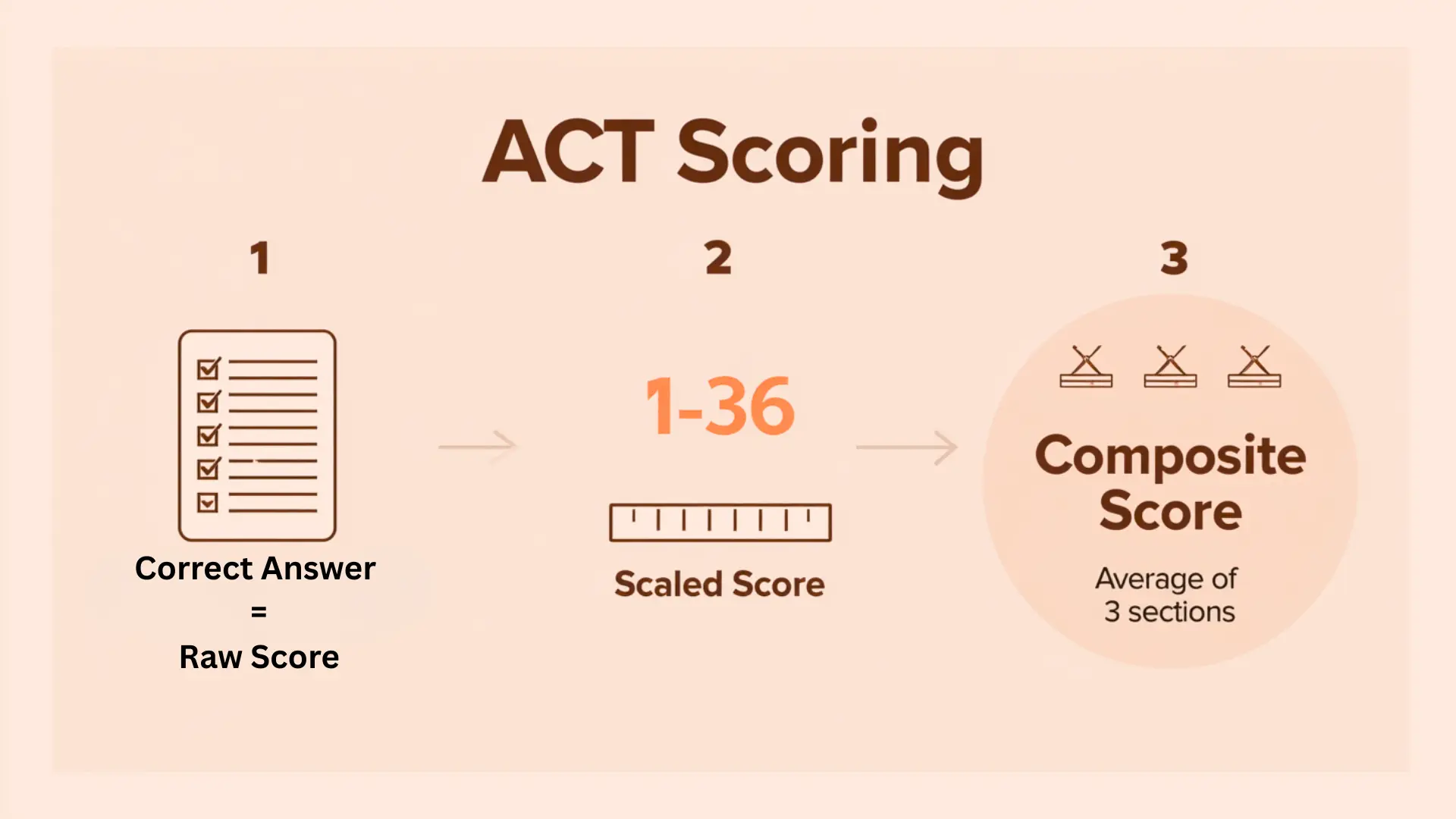
The ACT scoring system converts your answers into different score types that show your performance across sections and your overall result.
Understanding these scores helps you set realistic goals and prepare more effectively for college admissions.
Raw Score: This is the total number of questions you answer correctly in each ACT section. Incorrect answers do not reduce your score.
Scaled Score: Raw scores are converted into scaled scores from 1 to 36, allowing scores to be compared across different test versions.
Composite Score: The average of your English, Math, and Reading scores, rounded to the nearest whole number, ranging from 1 to 36. If you sit for the optional Science section, it produces its own 1 to 36 score, but it does not factor into the composite.
Your final score is based on correct answers, not the number of questions you miss. There’s no penalty for wrong answers, so answering every question maximizes the raw score.
What’s the Highest ACT Score Possible?
The highest ACT score possible is 36, which represents a perfect composite score from the four main ACT sections.
Since raw-to-scale conversion tables vary slightly by test date, a perfect raw score typically produces this result, though very rarely, a near-perfect raw score can still convert to 36 depending on that form’s difficulty curve.
If a student takes the optional Science section, a perfect 36 there is scored separately and doesn’t affect the composite.
The optional Writing essay, scored 2-12, is also reported independently. Fewer than 1% of test-takers reach a 36, making it exceptionally rare.
ACT Score Ranges, Percentiles, and College Tiers
An ACT composite score means little without context. Pairing it with national percentile data, typical college benchmarks, and real examples shows where a student stands and what score fits their target schools.
ACT Composite | National Percentile | General College Tier |
|---|---|---|
36 | 100th | Most selective schools nationally |
32-35 | 97th-99th | Ivy League and most selective private colleges |
30-31 | 95th-97th | Highly selective schools |
28-29 | 92nd-94th | Selective universities |
26-27 | 88th-90th | Moderately selective state universities |
22-24 | 73rd-81st | Non-selective to moderately selective state schools |
18-20 | 51st-63rd | Many open-admission and less selective schools |
13-17 | 20th-46th | Less selective, open-admission |
1-12 | Below 12th | Open-admission / community college |
Percentiles shift slightly year to year, and individual college ranges vary by program and applicant pool, so check a target school’s middle-50% range in its Common Data Set rather than relying on national averages alone.
What is Considered a Good ACT Score?
A good ACT score depends on the colleges you want to attend and how competitive your application needs to be.
The national average ACT score is around the low 20s, so a score above this range can be considered strong for many colleges.
Admissions officers weigh your ACT score alongside other academic markers, including how your unweighted GPA calculations stack up against a program’s typical admit.
Scores in the mid to high 20s may make students competitive at a wider range of schools, while scores of 30 or higher are often preferred by more selective universities.
A perfect score of 36 is excellent but not required for admission. Students should compare their ACT scores with the average scores of admitted students at their target colleges.
A strong ACT score is one that supports your academic goals and improves your overall application.
Tips to Achieve the Highest ACT Score Possible

Preparation makes a measurable difference on the ACT. Students who study strategically consistently outperform those who rely on natural ability alone. These are the approaches that have the most impact.
Take a Diagnostic Test First: Start with an official practice test to identify weaknesses, understand your baseline score, and plan preparation effectively.
Focus on Your Weakest Section: Improve your lowest-scoring ACT section first because raising weak areas can increase your overall composite score faster.
Never Leave a Question Blank: Answer every ACT question because incorrect answers do not reduce your score, while blanks guarantee no points.
Practice Under Real Conditions: Complete timed practice tests regularly to build speed, improve accuracy, and handle ACT exam pressure confidently.
Use the Superscore to Your Advantage: Retake the ACT strategically to improve individual sections and combine your highest scores from multiple attempts.
Study Your Mistakes: Review incorrect answers carefully to understand errors, strengthen concepts, and avoid repeating the same mistakes during future tests.
Most students see their biggest superscore gains within two or three well-prepared attempts, which is worth knowing before you decide how many times you should sit for the ACT.
ACT vs SAT: Maximum Scores Compared
The two tests measure similar academic skills but use entirely different scales, formats, and timing structures.
Feature | ACT | SAT |
|---|---|---|
Maximum Score | 36 | 1600 |
Score Scale | 1 to 36 per section | 200 to 800 per section |
Number of Sections | 3 required, 1 optional | 2 required |
Composite Calculation | Average of English, Math, and Reading | Combined Math and Evidence-Based Reading and Writing |
The ACT tops out at 36 while the SAT runs on a 1600-point scale, which often confuses students trying to compare scores across both tests.
Neither test is objectively better. The ACT tends to favor students who work well under tighter time pressure and have strong science reasoning skills.
Conclusion
The ACT has a fixed ceiling, but knowing where it sits is only step one.
The real purpose behind score ranges, percentiles, and college tier benchmarks: turning an abstract number into a concrete target rooted in actual goals, not national averages.
Plenty of students land at selective schools with scores well below perfect, because their prep was focused and their target was realistic.
Aim for a number that fits the goal, and focus energy on the section holding the composite back.
Share your ACT target score or preparation experience in the comments and help other students learn from your journey.
Frequently Asked Questions
Do You Need a Perfect Score on Every Section to Earn a Perfect Composite?
No. Because the composite is a rounded average, some variation across individual section scores is allowed, as long as the average rounds correctly.
Does the Order You Answer Sections in Ever Change Your Score?
No. Section order is fixed (English, Math, Reading, optional Science/Writing), and scoring only depends on correct answers within each section, never on sequence or which section a student tackles first.
What is an ACT Superscore?
ACT averages your highest section scores across multiple test dates to produce a Superscore. Many colleges accept this, making strategic retesting a worthwhile approach for most students.
What is the Average ACT Score Right Now?
The average ACT composite is 19.2, based on ACT’s national ranks for graduating classes of 2023 through 2025. Any score above 20 already places you above the typical test-taker nationally.