

A diploma will not guarantee a job, but its absence can still close doors.
Do you need a high school diploma to get hired or join the military?
The answer depends on the job and the field. Some jobs skip the paperwork and focus on skill instead. Others still expect a diploma as a basic requirement. Knowing what your target job needs can save you time.
This blog covers situations where a diploma matters and where it does not.
It also looks at college admission and military enlistment rules.
Read on to get clear, simple answers below. Your next step gets easier once you know the facts.
Understanding a High School Diploma
A high school diploma comes in more than one form, and not all versions carry the same weight with employers or schools.
A traditional diploma is earned through a public or private high school after completing required coursework.
An accredited online high school diploma follows the same academic standards but is delivered through a certified virtual program, often recognized by the U.S. Department of Education.
Adult high school diploma programs let older students finish coursework through local school district organizations.
A certificate of completion, by contrast, confirms attendance without meeting full graduation requirements, which many employers and colleges do not treat the same as an actual diploma.
Do You Need a High School Diploma?
No, a high school diploma is not required for every job, program, or career, though it still carries weight in many situations.
Retail positions, food service roles, and some skilled trades often hire without one, especially when experience or a strong work ethic is evident.
A diploma tends to matter more for government jobs, healthcare careers, and roles requiring formal certification, and in those cases, a high school GPA can factor into eligibility alongside the diploma itself.
Hiring standards have also loosened over the past decade as employers place greater emphasis on skills testing and hands-on ability rather than paper credentials alone.
A high school diploma isn’t legally required everywhere, but the details behind that answer change quite a bit depending on the path you choose.
Do Employers Require a High School Diploma?

Most employers still prefer a high school diploma, but the rules aren’t the same everywhere.
Requirements shift a lot based on the industry and the job itself:
1. Entry-level retail and customer service jobs
Store managers usually care about attitude, punctuality, and basic communication skills.
Many teens and first-time workers get hired for these positions. Training happens on the floor during the first few shifts. Cash handling and customer service are taught by coworkers or supervisors.
Showing up on time matters more than any paperwork here.
- Diploma Required: No
- Experience weight: Low
2. Warehousing and manufacturing
Supervisors care about physical stamina, safety habits, and following instructions. Most new hires get equipment training on the job. Forklift certification or basic machine skills can help someone get hired.
Shift reliability matters in most warehouses and factories.
Consistent attendance often helps workers move into better roles over time.
- Diploma Required: No
- Experience weight: Medium
3. Restaurants and hospitality
Kitchen speed and teamwork matter during busy meal times.
Managers often look at attitude first before checking any paperwork.
Hotels may want strong communication skills for front desk positions. Past work in a similar kitchen or hotel setting helps during hiring. Familiarity with restaurant routines can shorten the training period.
- Diploma Required: No
- Experience weight: High
4. Office and administrative roles
Basic computer skills and clear writing matter during most interviews.
Some roles ask for extra certifications in typing or software programs. Reading and math skills get tested in many hiring processes. Larger companies tend to stick with standard requirements for these roles.
Prior office work can reduce the amount of training needed.
- Diploma Required: Yes
- Experience weight: Medium
5. Skilled trades
Apprenticeship programs often test math and reading before enrollment begins.
Physical skill and a willingness to learn matter from the start.
Union programs guide new workers through licensing steps. Most trade skills get learned through hands-on training over time. Finishing an apprenticeship often matters more than the diploma itself.
- Diploma Required: Yes
- Experience weight: High
6. Government positions
Civil service exams often test basic reading, writing, and math skills. Some higher-level roles ask for extra training or certifications. Background checks and residency rules apply to most government jobs.
Following the application steps closely matters as much as meeting requirements.
Many entry-level roles include structured training after hiring.
- Diploma Required: Yes
- Experience weight: Medium
7. Healthcare careers
Entry-level roles like nursing assistants often require a short post-secondary course.
Hospitals follow strict safety and licensing rules for every hire. Clinical skills and licensing exams matter once someone meets basic requirements. Direct patient care hours often help workers move into better roles.
Safety standards leave little room for exceptions during hiring.
- Diploma Required: Yes
- Experience weight: High
8. Technology and startup companies
Coding tests and finished projects often matter more than paperwork. Startups sometimes hire self-taught workers who show strong technical skills. Larger tech companies tend to follow more standard hiring practices.
Portfolios and hands-on ability often carry weight during interviews.
Demonstrated coding skills can help someone stand out during hiring.
- Diploma Required: No
- Experience weight: High
Situations Where a High School Diploma May Not Be Required
Several career paths focus more on skill than on formal schooling. Here is a look at six such examples:
Situation | Why It Matters Less | Where It May Still Apply |
|---|---|---|
Family Businesses | Hiring relies on trust and work ethic. | Outside financing or licensing. |
Entrepreneurship | Success relies on skill, not academics. | Loans, licenses, or partnerships. |
Freelancing | Clients value portfolios over degrees. | Corporate or government contracts. |
Creative Industries | Talent outweighs formal schooling. | Teaching roles or grants. |
Skilled Trades | Entry-level work needs ability, not credentials. | Advanced licensing exams. |
Gig Economy Work | Only an application and background check are needed. | Higher-paying gig categories. |
A diploma can still matter in licensed or corporate fields. In other fields, skills and results often carry more weight.
Note: Across each of these paths, the pattern holds steady, a diploma may not open the door, but its absence can still limit how far someone walks through it once bigger opportunities appear.
Can You Go to College Without a High School Diploma?
College admission does not always hinge on a traditional diploma, since several pathways exist for students without one.
- Community colleges: Many community colleges accept students without a diploma through open enrollment policies, sometimes requiring an assessment test or GED in its place.
- Universities: Four-year universities generally expect a diploma or GED, though some offer alternative admission routes based on standardized test scores or portfolio review.
- Online colleges: Accredited online programs often mirror traditional admission rules, but certain platforms allow provisional enrollment for students actively completing a GED.
- Dual enrollment programs: High schoolers can earn college credit before graduating, which sometimes helps students who leave school early transition into degree programs later.
- Adult education pathways: Many colleges partner with adult education centers, allowing students to complete a GED or adult diploma while simultaneously enrolling in introductory coursework.
Do You Need a High School Diploma to Join the Military?

Yes, a high school diploma is generally required to join the military, though GED holders can still enlist under stricter limits.
Military enlistment standards place significant weight on education, with a traditional diploma preferred over a GED.
Recruits are typically sorted into education tiers, and Tier 1 status, reserved for diploma holders, offers the smoothest path into most branches.
GED holders fall under Tier 2, which often comes with stricter enlistment caps, since branches limit how many Tier 2 recruits they accept each year.
Standards also vary by branch, since the Air Force and Space Force enforce the strictest diploma requirements, while the Army has shown more flexibility for qualified GED holders.
What People Are Saying and How They Opted for Their Career: Reddit Discussion
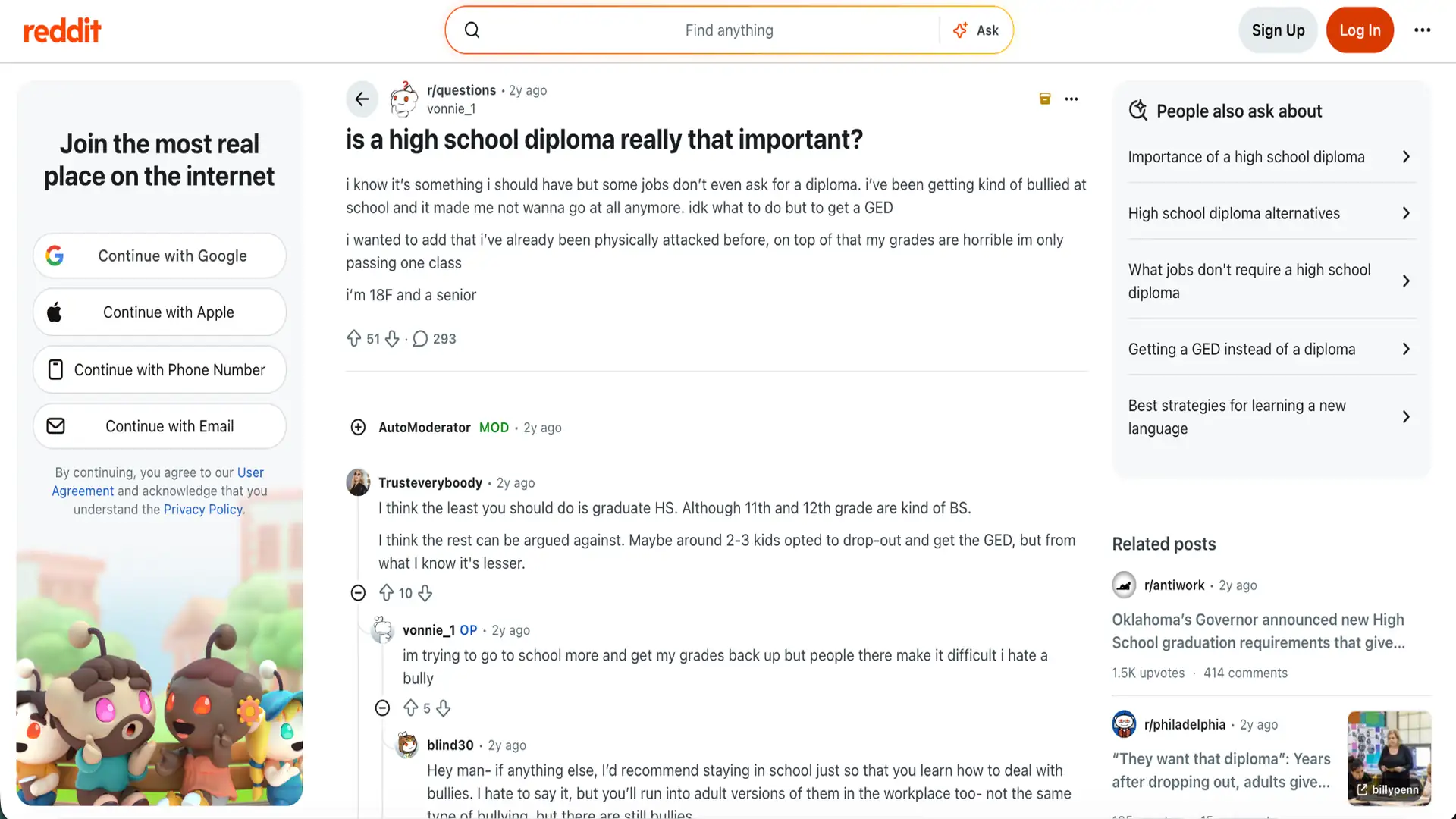
Opinions on this topic vary widely across Reddit threads.
Many commenters encourage finishing high school, especially for students close to graduation.
Others share personal stories of skipping a diploma entirely and still building stable careers through trades or self-taught skills. Several users point out that a GED works just as well for most employers.
Some mention specific fields, like construction or logistics, where experience outweighs credentials.
A recurring theme is that dropping out too early can limit future options, even if it feels manageable at first.
Others argue that persistence and skill development matter more in the long term than the paper itself.
The overall consensus leans toward finishing school when possible, while acknowledging that alternative paths can still lead to solid outcomes depending on the industry and personal circumstances involved.
High School Diploma vs. GED: What’s the Difference?
Both credentials confirm a high school education, but they differ in how they’re earned and how employers and colleges perceive each.
Feature | High School Diploma | GED |
What It Is | Diploma from a school | Exam-based equivalency credential |
Earned Through | High school coursework | Standardized exam |
Time Required | About four years | Varies, often faster |
Accepted by Employers | Yes | Usually |
Accepted by Colleges | Yes | Most colleges accept it |
Resume Perception | Seen as standard | Sometimes viewed as an alternative path |
Typical Purpose | Traditional education | Alternative credential |
Neither option guarantees the same opportunities in every situation, so the right choice often comes down to timeline, circumstances, and long-term goals.
Quick Tips for Deciding Your Next Step
Weighing whether to pursue a diploma, a GED, or another path becomes easier with a few practical guidelines.
- Check the actual requirements for your target job or program before assuming a diploma is mandatory.
- Compare timelines honestly, since a GED can sometimes get you moving faster toward work or school.
- Ask employers directly about education requirements rather than guessing based on the job listing alone.
- Keep future goals in mind, since some career paths require formal credentials even if your first job doesn’t.
- Explore adult education or online programs if returning to finish a diploma feels more realistic than starting over.
- Build a portfolio or skill set alongside any credential, since many employers value proof of ability just as much.
Frequently Asked Questions (FAQ.s)
Does a High School Diploma Expire?
No, a high school diploma never expires once earned. It remains valid permanently and continues to serve as proof of completed education throughout your life.
Can Homeschool Diplomas Be Used Like Traditional Ones?
Yes, employers and colleges generally accept homeschool diplomas, though some institutions may request additional transcripts or standardized test scores for verification.
Is a High School Equivalency Certificate Legally the Same as a Diploma?
Legally, equivalency certificates like the GED hold similar status to diplomas in most states, though acceptance can still vary by employer or institution.
Final Thoughts
After going through the details, whether you still need a high school diploma comes down to your goals and field.
Some jobs skip it and hire based on skill alone. Others still expect it as a basic requirement.
Colleges, employers, and the military judge it differently depending on the path.
Every situation looks a little different based on where you live and what you want.
A GED can open similar doors in many cases. Match your credential choice to your real career plan. Skills and persistence often carry more weight than paper alone. Check what your target path truly needs before deciding.
Plan ahead so you don’t feel stuck later. Drop a comment below and share which path you are choosing.