


Your MCAT score can open doors or quietly close them without you even realizing it. Understanding the MCAT score range is the first step to knowing exactly where you stand nationally.
Your score places you in a ranking against thousands of other applicants across the country. Knowing how the scoring system works helps you set goals that actually make sense.
You will see why two scores that look similar can mean very different things in practice. You will also learn how sections are scored and what schools actually look for.
Knowledge is your biggest advantage here. Read on, your score is about to make a lot more sense.
What is the MCAT Score Range?
Think of the MCAT as a test with its own scoring ladder, not just a simple percent score. The MCAT score range goes from 472 to 528 for your total score. That score comes from adding your four section scores together.
Each section is scored from 118 to 132, with 125 as the midpoint. These sections are Chem/Phys, CARS, Bio/Biochem, and Psych/Soc.
The midpoint for the full test is 500, which sits right in the center. But here is the part many students miss: your score is not just a percent correct.
The AAMC turns raw scores into scaled scores through equating. This helps scores mean the same thing across different test forms.
How Is the MCAT Scored?

The MCAT scoring system can feel confusing when you first see raw scores and scaled scores. Here is the simple way to understand it:
Raw Scores and Scaled Scores
Your raw score is the number of questions you answer correctly in each section of the MCAT. There is no penalty for guessing, according to the AAMC.
So, it is better to answer every question than leave one blank. After the test, your raw score is changed into a scaled score.
This helps adjust for small differences in difficulty across MCAT test forms. Not every MCAT form has the same questions or the same difficulty level.
Scaling helps make scores fair across test dates. A 510 should show the same level of performance on each test day.
Why MCAT Scores Are Scaled
MCAT scores are scaled to keep the test fair across different forms. The goal is to make scores easier to compare:
- Different questions: Each MCAT form has different questions, so the forms are not exactly the same.
- Difficulty changes: Some MCAT forms may be a little harder or easier than other forms.
- Equating: This adjusts for small differences in difficulty across MCAT test forms.
- Same score meaning: A 510 should show the same skill level across different MCAT test dates.
- Raw score limits: One raw score does not always match one scaled score on every test form.
That is why you should not link a single raw score to a single scaled score. The final score can change based on the test form.
What Are the Highest and Lowest MCAT Scores?

The MCAT score scale has a clear top and bottom, and both numbers are useful to know. Here is what the highest and lowest possible MCAT scores mean:
What Is the Max MCAT Score?
The max MCAT score is 528, which is the highest total score you can earn. To reach it, you would need top section scores across the whole test. Each of the four sections tops out at 132.
So, the full score is the sum of the four top section scores (132 × 4 = 528). But a perfect score is not required for medical school.
Schools look at your full application, including GPA, clinical work, research, service, essays, letters, interviews, and school fit.
What Is the Lowest MCAT Score?
The lowest possible total MCAT score is 472, which is the bottom of the MCAT scale. Each section starts at 118, so the lowest total is the sum of all four section scores (118 × 4 = 472).
A low score does not define your whole future as an applicant. It may mean you should retake the test, adjust your school list, raise your GPA, or build stronger experiences.
A good target score depends on the schools you plan to apply to.
What Is a Good MCAT Score?
A good MCAT score means different things for different students. It all depends on where you want to apply. Here is what you should know:
What Counts as a Good MCAT Score?
A “good” MCAT score is one that meets the requirements of the schools on your list. There is no single magic number.
The AAMC reported that 2025 applicants averaged a 506.3. Matriculants, students who got in, averaged a 512.1.
That gap matters. It tells you that getting in takes more than just applying. Your score needs to match your school list. Aim to be competitive, not just average.
General MCAT Score Categories
These ranges are a starting point for planning your school list. Use this table to get a general sense of where your score falls:
| MCAT Score Range | Percentile Rank | General Interpretation | Typical Applicant Pool | School List Fit |
|---|---|---|---|---|
| 472–499 | Below 48th | Below the midpoint | Limited options | Reapplication recommended |
| 500–505 | 48th–64th | Around average to moderately competitive | DO and some MD programs | Safety-heavy list |
| 506–511 | 65th–78th | Competitive for many programs | Broad MD and DO programs | Balanced list |
| 512–517 | 84th–93rd | Strong score range for many MD applicants | Most MD programs | Target and reach schools |
| 518+ | 95th+ | Very strong score range | Top MD programs | Reach schools included |
| 528 | 100th | Maximum MCAT score | Elite programs | All schools |
These are general planning categories, not admissions guarantees. A rare High MCAT score like 520–528 doesn’t guarantee admission — your GPA, school list, and application strength all matter too.
MCAT Percentiles: How Your Score Compares
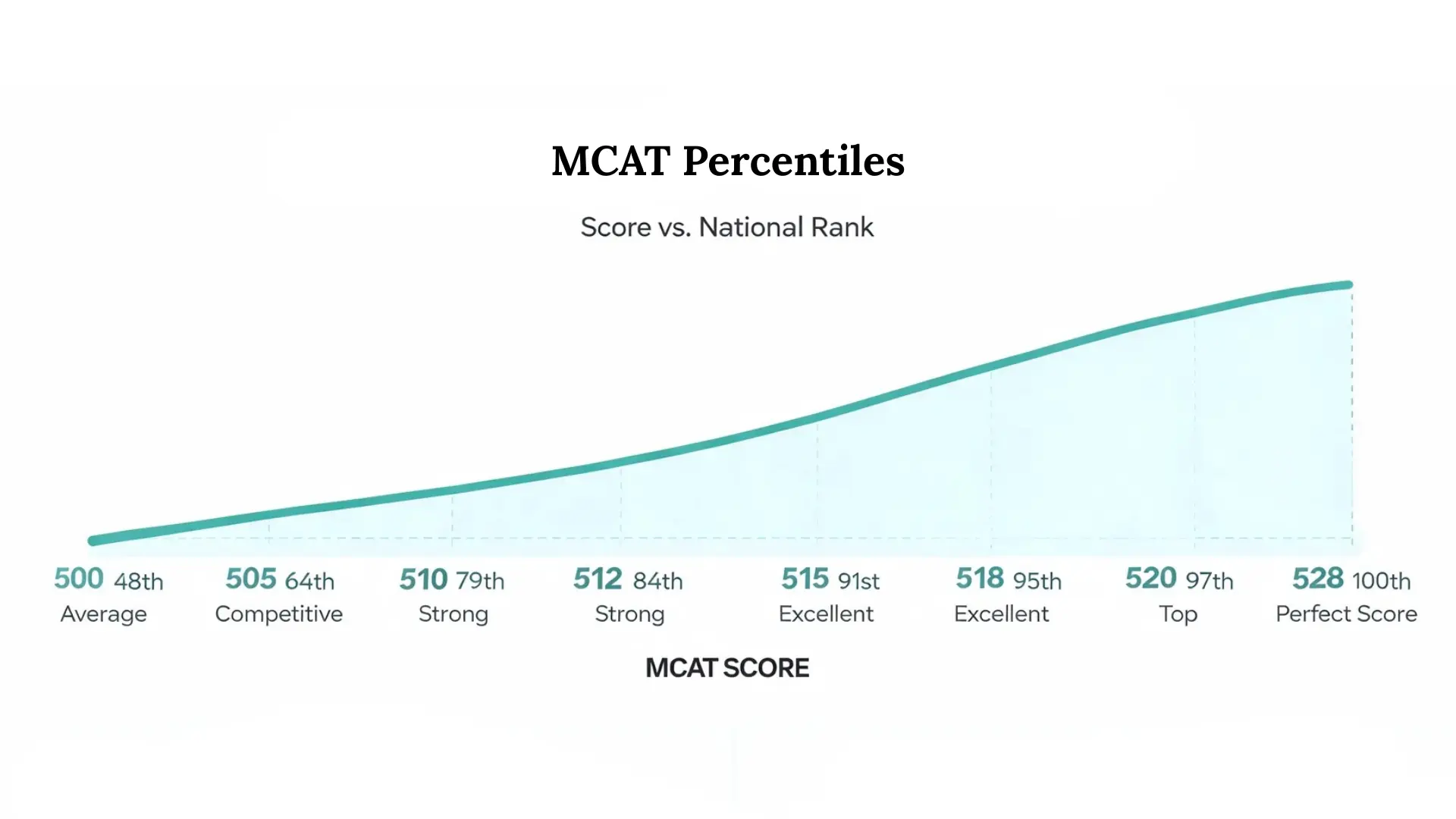
Your MCAT score is more than just a number. Knowing your percentile rank shows you where you actually stand. Here is what you need to know:
What MCAT Percentile Ranks Mean
Your MCAT percentile shows how your score compares to that of every other test taker. A score in the 79th percentile means you did better than 79% of people who took the MCAT.
The AAMC updates these ranks every May 1 using three years of testing data. Raw numbers alone can mislead you; a 510 is not just 10 points above 500.
It is a national ranking. Medical schools look at your total score and section balance together. Percentiles give you the full, honest view.
Current MCAT Percentile Examples
These percentile ranks run from May 1, 2026, through April 30, 2027, based on 2023–2025 test data. Use this table to see exactly where your score stands nationally.
| MCAT Total Score | Percentile Rank | Avg Section Score | Competitiveness |
|---|---|---|---|
| 500 | 48th | 125 | Below Average |
| 505 | 64th | 126 | Average |
| 508 | 74th | 127 | Competitive |
| 510 | 79th | 128 | Competitive |
| 512 | 84th | 128 | Strong |
| 515 | 91st | 129 | Very Strong |
| 518 | 95th | 130 | Excellent |
| 520 | 97th | 130 | Excellent |
| 528 | 100th | 132 | Perfect Score |
These numbers are based on real test results across 2023, 2024, and 2025. Here is why your percentile tells a bigger story than your score alone:
- A 510 is not just 10 points above 500; it is a jump from the 48th to the 79th percentile.
- Medical schools compare you to every other applicant, not just a scoring scale.
- Section balance matters too; four strong sections beat one high score and three weak ones.
Source: AAMC Official MCAT Percentile Ranks. To find the most current data, go to aamc.org and search “MCAT percentile ranks” in the search bar. Percentile ranks are updated every May 1 and reflect results from the three most recent testing years.
What MCAT Score Should You Aim For?
There is no single target score that works for every student. Your goal depends on your school list, GPA, and overall application. Here is how to figure out the right number for you:
- Build a school list first and look up each school’s median MCAT and accepted student score range.
- Compare your score to each school’s 10th, 25th, 50th, 75th, and 90th percentile data when available.
- A higher GPA can offset a slightly lower MCAT, but it does not always make up the gap.
- A lower GPA puts more pressure on your MCAT, so a stronger score becomes even more important.
- Strong clinical experience, research, and leadership help your application, but do not erase academic concerns.
- Aim for a balanced section profile; one very low section can raise red flags even with a strong total score.
Use these points as a personal checklist, not a guaranteed formula. Talk to a pre-med advisor to set a realistic and school-specific target.
How Medical Schools Use MCAT Scores

Your MCAT score is one piece of a much bigger puzzle. Schools look at the full image, not just one number. Here is how your score fits into the process:
MCAT Scores as One Part of Holistic Review
MCAT scores help admissions committees check if you are ready for the academic demands of medical school.
But they are not the only thing schools look at. Your GPA, coursework, clinical experience, research, and personal qualities all matter too.
So does your mission fit, and how you perform in interviews. No single factor makes or breaks your application. Schools want to see the full image of who you are.
Why School-Specific MCAT Ranges Matter
A good MCAT score is not a fixed number; it depends on where you apply. A score that is competitive at one school may be below the median at another.
Using one universal cutoff is a mistake many applicants make. Always check each school’s published class profile or MSAR data. Your score needs to match your actual school list, not a general benchmark you found online.
When a Higher MCAT Score Matters Most
Sometimes a strong MCAT score carries extra weight in your application. Certain situations make admissions committees look at your score even more closely. Here is when a higher MCAT score matters most:
- A lower GPA puts more pressure on your MCAT to show academic readiness.
- A very competitive school list means you need a score that matches those schools’ medians.
- Reapplicants often need a stronger score to show meaningful improvement since their last application.
- Weak science coursework makes a strong science section score even more important to admissions teams.
- Applying out of state to public medical schools often means facing a higher bar for every part of your application.
These are not reasons to panic; they are reasons to plan smart. Use this list to honestly assess where your application stands right now.
Should You Retake the MCAT?
Deciding whether to retake the MCAT is one of the biggest calls you will make. It is not always the right move for everyone. Here is how to think it through:
Reasons to Consider Retaking
Retaking makes sense in some situations, but not all of them. Look at your score honestly before making any decision. Here are the main reasons to consider retaking:
- Your score is below the typical range for most schools on your list.
- One section is significantly weaker than the others and is dragging down your total score.
- Your practice scores were consistently higher, which suggests you can do better on test day.
A retake is worth it only if you can realistically improve. Make sure you have the time and a stronger study plan before you commit.
Reasons Not to Retake Automatically
Retaking is not always the smartest move. Sometimes your energy is better spent strengthening other parts of your application. Here are solid reasons to skip the retake:
- Your score is already competitive for the schools on your list.
- Your practice test trend does not suggest a likely increase in score with more prep time.
- A lower retake score could hurt your application strategy more than your current score does.
Not every applicant needs a higher score to be competitive. Be honest about whether a retake will actually help your chances.
Frequently Asked Questions
Is 500 a Good MCAT Score?
A 500 sits at the 48th percentile and is near the midpoint of the scale. It may fall below average for most MD matriculants.
Is 510 a Good MCAT Score?
A 510 lands at the 79th percentile, making it a strong score for many applicants. Your GPA and school list still matter a lot.
Do Wrong Answers Hurt Your MCAT Score?
No. The AAMC confirms there is no penalty for wrong answers or guessing. Always answer every question before your section time runs out.
Do MCAT Percentiles Change?
Yes. The AAMC updates percentile ranks every May 1 using data from the three most recent testing years to keep rankings accurate and current.
Final Words
You now have the tools to read your MCAT score the right way. The MCAT score range is just the starting point; what you do with that knowledge truly matters.
Your next move should be personal and specific to your own goals. Take your results seriously and match them to the schools you actually want to attend.
Build a plan that fits your real situation, timeline, and target programs. A strong application takes more than a good score; it takes strategy.
You are more than a number on a page. Go get the score you deserve. Have thoughts or questions? Drop them in the comments below.