

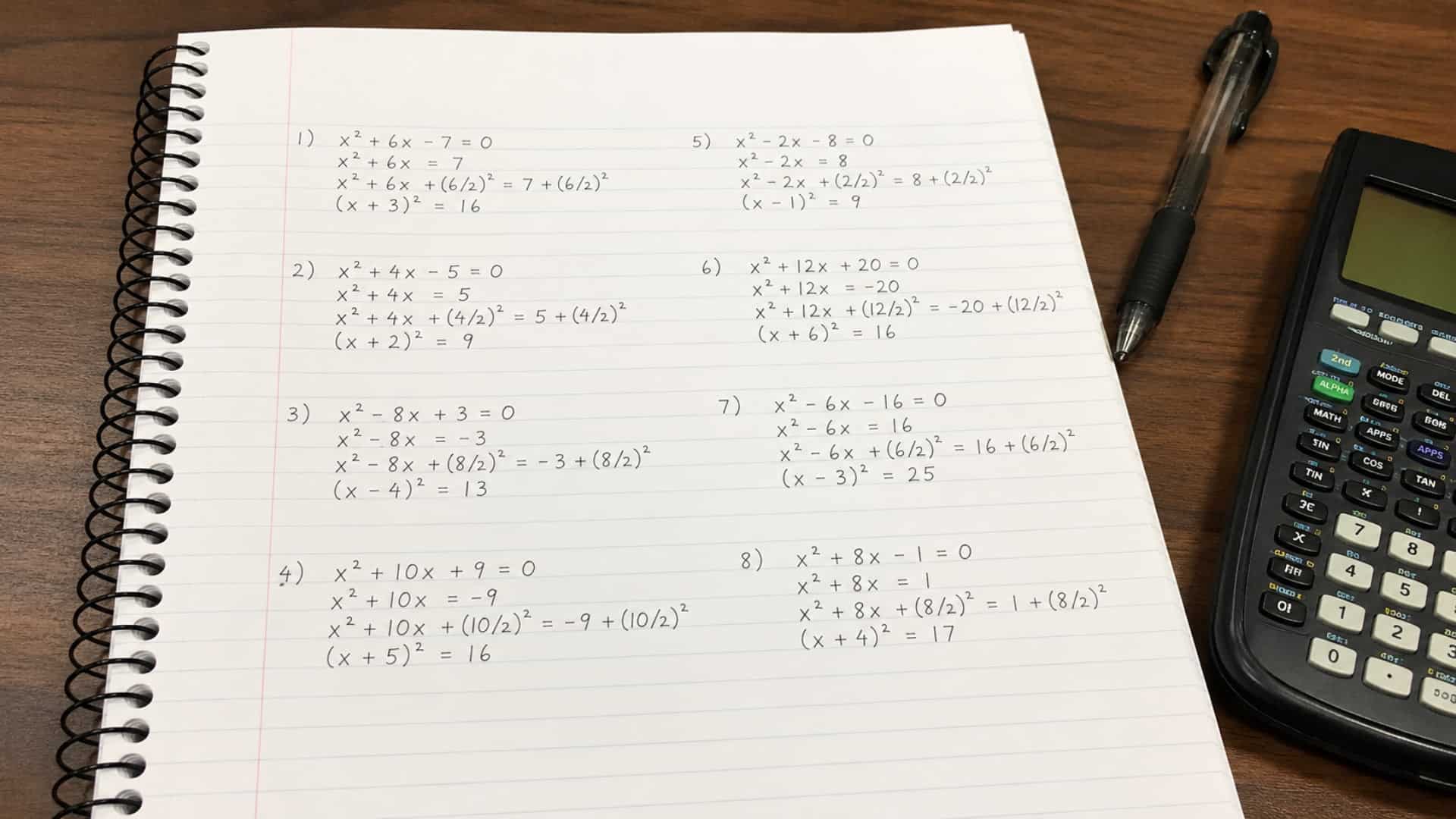

Memorizing the quadratic formula gets you an answer. Completing the square gives you understanding.
If you are in Algebra, Algebra II, or pre-calculus, mastering completing the square practice problems is what separates students who follow steps from students who actually think algebraically.
This covers the full step-by-step method, tiered completing the square practice from beginner to advanced.
We have also covered free interactive tools and printable PDFs, and literally all that you need to build real fluency with this technique.
Completing the Square: The Method Behind the Math
Most students encounter quadratic expressions written as ax² + bx + c, but this form hides the parabola’s most useful information.
Completing the square rewrites that expression into vertex form, a(x – h)² + k, making the vertex immediately visible.
The name comes from geometry: x² + bx can be visualized as an incomplete square, and adding the missing corner piece literally completes it.
This method works best when the leading coefficient is one and b is even. Use it to find a parabola’s vertex, solve equations that resist factoring, and derive the quadratic formula from scratch.
The Step-by-Step Method: How to Complete the Square?

Understanding the method matters more than memorizing the answer. Completing the square follows a reliable sequence of steps that works for every quadratic expression, whether the leading coefficient is 1 or larger.
Work through each step carefully before moving to practice problems.
When the Leading Coefficient is 1
Start with a straightforward example: x² + 6x + 5 = 0.
- Step 1: Move the constant to the right side. Rewrite the equation so only the x terms stay on the left: x² + 6x = -5.
- Step 2: Find half the coefficient of x. Take the middle term’s coefficient, which is 6, and divide it by two. That gives you 3.
- Step 3: Square that number. Multiply 3 by itself to get 9. This is the value that will complete the square.
- Step 4: Add that value to both sides. Adding 9 to both sides keeps the equation balanced: x² + 6x + 9 = -5 + 9, which simplifies to x² + 6x + 9 = 4.
- Step 5: Factor the left side as a perfect square trinomial. Using the identity x² + 2xy + y² = (x + y)², the left side becomes (x + 3)². Your equation is now (x + 3)² = 4. In vertex form: y = (x + 3)² – 4, placing the vertex at (-3, -4).
When the Leading Coefficient is Not 1
When a ≠ 1, always factor out the leading coefficient from the variable terms before doing anything else. Skipping this step is the most common source of errors in completing the square problems.
Take 2x² + 12x + 10 = 0.
- Factor out the leading coefficient from x terms only: 2(x² + 6x) + 10 = 0.
- Find half of 6, square it: (3)² = 9. Add and subtract inside the bracket: 2(x² + 6x + 9 – 9) + 10 = 0.
- Simplify: 2(x + 3)² – 18 + 10 = 0, which gives 2(x + 3)² – 8 = 0. Vertex form: y = 2(x + 3)² – 8, with vertex at (-3, -8).
Quick-Reference Formula
For any quadratic ax² + bx + c, the vertex form is: a(x + m)² + n
Where:
- m = b/2a (half the x-coefficient, adjusted for a)
- n = c – (b²/4a) (the remaining constant)
Completing the Square Practice Problems (Beginner-to-Advanced)
The problems below are organized by difficulty so you can build confidence before tackling harder cases.
If you are just starting out or refining your skills, these completing the square practice problems cover every variation, from basic integer coefficients all the way to advanced multi-step equations.
Level 1: Basic Practice Problems
These problems are the best starting point. Each one has an even x-coefficient, which means no fractions appear during the process.
Practice Problems:
- x² + 8x + 12 = 0
- x² – 6x – 16 = 0
- x² + 10x + 9 = 0
- x² – 4x – 5 = 0
- x² + 2x – 8 = 0
Worked Example x² + 8x + 12 = 0: Move the constant: x² + 8x = -12. Half of 8 is 4; square it to get 16. Add to both sides: x² + 8x + 16 = 4. Factor: (x + 4)² = 4. Solve: x + 4 = ±2, giving x = -2 or x = -6.
Answer Key: x = -2, -6 | x = 8, -2 | x = -1, -9 | x = 5, -1 | x = 2, -4
Level 2: Intermediate Practice Problems
This level introduces odd coefficients, which means fractions appear mid-process. This is where most students slow down; work through each step carefully rather than skipping ahead.
Practice Problems:
- x² + 7x – 3 = 0
- x² – 5x + 2 = 0
- x² + 3x – 10 = 0
- x² – 9x + 14 = 0
- x² + 11x + 18 = 0
Note: Half of an odd number produces a fraction. For x² + 7x – 3 = 0, half of 7 is 7/2, and its square is 49/4. Keep fractions in your work rather than converting to decimals; it keeps the algebra clean and accurate.
Answer Key: x = (-7 ± √61)/2 | x = (5 ± √17)/2 | x = 2, -5 | x = 7, 2 | x = -2, -9
Level 3: Advanced Practice Problems
Always factor out the leading coefficient from the variable terms before completing the square. Skipping this step produces incorrect vertex forms and wrong solutions.
Practice Problems:
- 2x² + 8x – 10 = 0
- 3x² + 12x + 9 = 0
- 2x² – 12x + 4 = 0
- 4x² + 16x – 20 = 0
- 3x² + 6x – 24 = 0
Answer Key: x = 1, -5 | x = -1, -3 | x = 3 ± √7 | x = 1, -5 | x = 2, -4
Vertex Form Practice Problems
Completing the square not only provides a reliable method for solving quadratic equations but also builds a deeper understanding of the properties of parabolas, specifically where the vertex lies and which direction the curve opens.
Rewrite each function in vertex form and identify the vertex:
- f(x) = x² – 8x + 7 → Vertex form: (x – 4)² – 9; Vertex: (4, -9)
- f(x) = 2x² + 4x – 6 → Vertex form: 2(x + 1)² – 8; Vertex: (-1, -8)
- f(x) = -x² – 4x – 1 → Vertex form: -(x + 2)² + 3; Vertex: (-2, 3)
Word Problems Using Completing the Square
These two problems mirror exactly what appears on standardized tests, completing the square applied to real situations where setting up the equation matters just as much as solving it.
- Problem One Area Model: A rectangular garden has a length that is 6 meters more than its width. The total area is 40 square meters. Write a quadratic equation and use completing the square to find the width.
- Problem Two Projectile Motion: A ball is launched upward, and its height in feet is modeled by h = -t² + 8t + 3, where t is time in seconds. Use completing the square to find the maximum height and the time at which it occurs.
These problem types appear regularly on standardized tests, including the SAT and ACT, making them worth practicing until the setup feels automatic.
Free Interactive Practice Tools for Completing the Square
These tools give immediate feedback, making them ideal for self-paced review. Bookmark the ones that match your current level and return to them between practice sessions.
Resource | Type | Best For | Difficulty Level |
|---|---|---|---|
Interactive quiz | Beginners | Beginner | |
Interactive quiz | Mid-level algebra | Intermediate | |
Adaptive quiz | Skill mastery tracking | All Levels | |
Guided worksheet | Exam-style questions | Intermediate | |
Auto-generated problems | Classroom or homework | All Levels |
Practice Completing the Square: Free PDF Resource
Structured problems, worked examples, and a full answer key, all in one printable sheet.
Working through problems on paper builds a different kind of fluency than screen-based practice, and having a dedicated sheet removes every distraction between questions.
Problems progress from straightforward expressions to multi-step equations, making this resource useful across skill levels.
Download it, print a copy, and work through every problem before checking answers.
Download the Completing the Square Practice PDF Free
Other Completing the Square Worksheets You Can Download
Printable worksheets let students work offline and build handwriting fluency, which research links to deeper math retention.
Resource | Problems | Answer Key | Skill Level |
|---|---|---|---|
Multiple levels | Yes | All Levels | |
Beginner to advanced | Yes | Beginner to Advanced | |
Pure algebra drill | Yes | Intermediate | |
Thirty-six skill and exam questions | Yes | Intermediate to Advanced |
Use these alongside the interactive tools above for a well-rounded practice routine that covers both screen-based and paper-based learning.
Completing the Square Practice by Skill Level and Topic
Not every resource fits every goal. Matching the right tool to the right stage of practice keeps sessions focused and skills moving forward.
- Beginner Algebra: Khan Academy’s completing the square lesson and IXL Algebra build foundational understanding before independent problem-solving begins.
- Graphing and Vertex Form: Desmos visualizes the parabola after vertex form conversion; Khan Academy’s vertex form review connects the algebra directly to the graph.
- Complex Numbers: Khan Academy’s Algebra 2 complex numbers section bridges completing the square with imaginary number solutions for advanced learners.
- Standardized Test Practice: Corbettmaths mirrors real question style; Kuta Software builds speed and accuracy under timed conditions.
Match the current goal to the right resource, and every practice session builds algebra skills that hold up under exam pressure.
Frequently Asked Questions (FAQs)
What are the Steps for Completing the Square?
Move the constant, halve the x-coefficient, square it, add to both sides, then factor the perfect square trinomial.
Why Do You Add (b/2)² to Both Sides?
Adding to both sides keeps the equation balanced while deliberately creating a perfect square trinomial on the left.
Can You Complete the Square When the Leading Coefficient is Not 1?
Yes, factor out the leading coefficient first, complete the square, then rewrite everything in vertex form at the end.
Is Completing the Square the Same as Using the Quadratic Formula?
No, the quadratic formula gives roots only; completing the square also reveals the vertex form, which is more useful for graphing.
Final Thoughts
Completing the square is not just an algebra trick; it is a foundational skill that carries forward into pre-calculus, calculus, and standardized test prep.
This walked you through beginner, intermediate, and advancedcompleting-the-square practice problems, covering everything from basic integer coefficients to multi-step equations with leading coefficients greater than one.
Start with the Level One problems, then move to Khan Academy or IXL for immediate feedback on your accuracy.
Bookmark this page for ongoing access to the free PDFs, interactive tools, and full problem sets.
The more consistently you practice, the more automatic this method becomes.