



The SAT math section makes thousands of students nervous every year.
Will algebra pop up? What about geometry? How much trigonometry should you know?
Well, these questions keep many test-takers awake at night.
The thing is that the SAT math content isn’t random, the test follows a clear pattern. Once you know what math is on the SAT, you can focus your study time on topics that actually matter.
This blog breaks down the specific math concepts you’ll face on test day. You’ll learn which areas carry the most weight and how to prepare for each one.
Decoding the SAT Exam – A Quick Overview
The SAT is a standardized test that colleges use to evaluate students. It measures your readiness for college-level work.
The exam has two main sections: Evidence-Based Reading and Writing, plus Math.
You get 154 minutes total to complete everything. The math portion takes up 70 minutes of that time.
Your final score ranges from 400 to 1600 points. Math accounts for half of this total. That’s 200 to 800 points riding on your math performance alone.
The test appears in two formats: digital and paper. Most students now take the digital version. It adapts to your skill level as you go. Knowing this structure helps you plan better.
You’ll know exactly how much time each section demands, and you’ll see why math preparation matters so much for your overall score.
Understanding What Math is on The SAT
The SAT math section tests four major content areas. Each one covers specific concepts you’ve learned in school.
Here’s how the SAT Math topics break down:
| Content Area | Percentage of Test | What It Covers |
|---|---|---|
| Algebra | 35% | Linear equations, systems of equations, inequalities |
| Advanced Math | 35% | Quadratic functions, exponential growth, polynomials |
| Problem-Solving and Data Analysis | 15% | Ratios, percentages, statistics, probability |
| Geometry and Trigonometry | 15% | Shapes, angles, circles, basic trig functions |
Notice how algebra and advanced math dominate the test. Together, they make up 70% of all questions. That means you should spend most of your prep time on these two areas.
The remaining 30% is split between data analysis and geometry. Don’t ignore them, but they require less focus.
The Four Core Math Domains – What You’ll Actually See
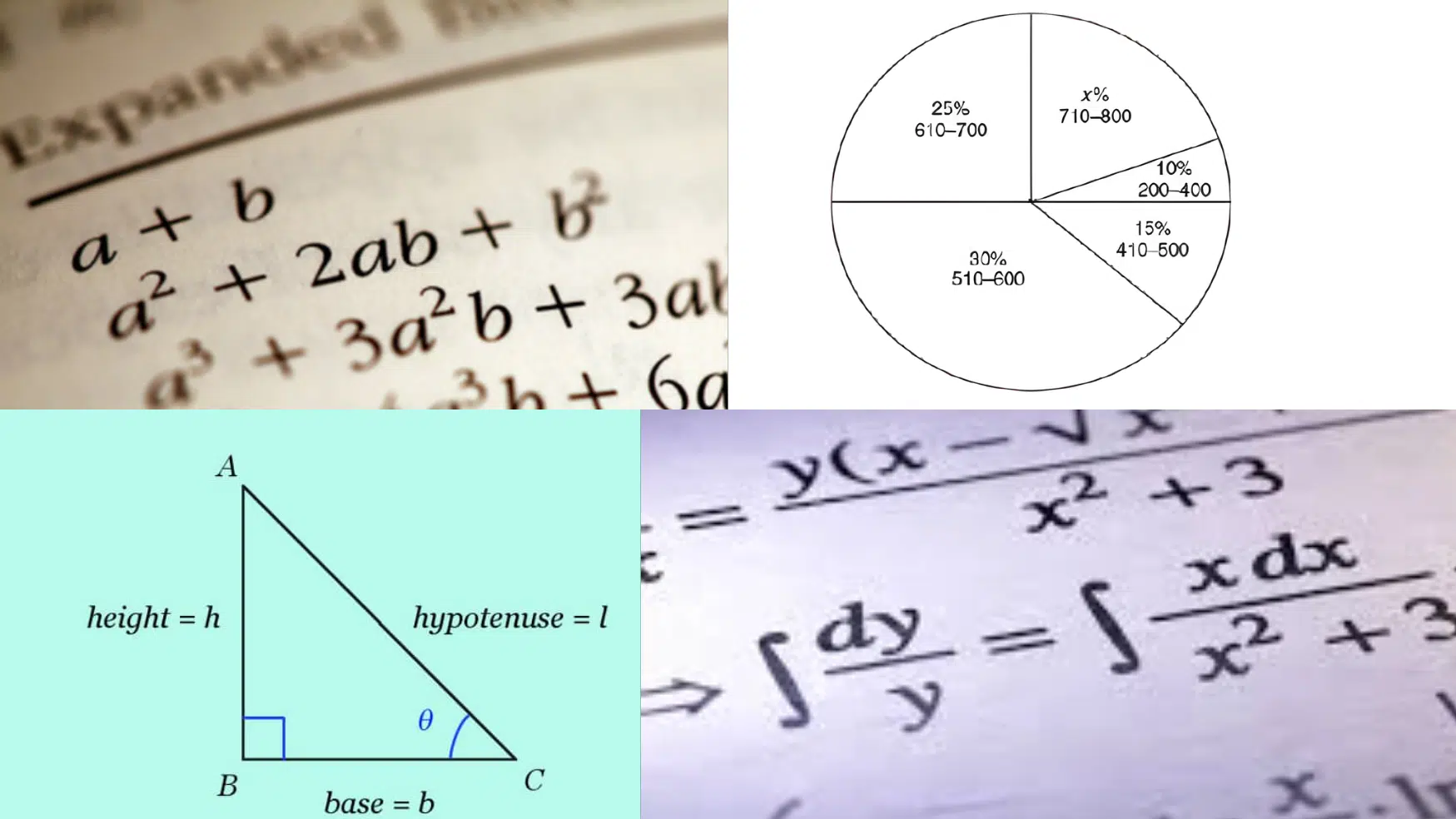
The SAT doesn’t throw random math problems at you. It sticks to four specific domains. Let’s break down what you’ll actually face in each one.
Algebra: The Foundation of SAT Math
This domain forms the backbone of the test. You’ll see it everywhere.
- Linear equations and how to solve them
- Systems of equations with two variables
- Inequalities and their graphs
- Word problems that translate into algebraic expressions
Most questions here test whether you can set up equations correctly. Then you solve them step by step.
Advanced Math: Beyond Basic Algebra
This section builds on what you already know. It takes algebra to the next level.
- Quadratic equations and their solutions
- Exponential growth and decay problems
- Polynomial operations and factoring
- Function notation and transformations
These problems often involve multiple steps. You might need to factor first, then solve. Or graph a function, then interpret it.
Problem-Solving and Data Analysis: Real-World Math
Here’s where math meets everyday life. These questions use practical scenarios.
- Ratios and proportions in context
- Percentages and percent change
- Reading charts, graphs, and tables
- Basic statistics like mean and median
- Probability of simple events
You’ll analyze data sets and conclude. The math itself isn’t hard, but the challenge is understanding what the question asks.
Geometry and Trigonometry: Shapes and Angles
This is the smallest domain, but you can’t skip it entirely.
- Area and perimeter of common shapes
- Volume of three-dimensional objects
- Circle properties and equations
- Right triangle trigonometry (sine, cosine, tangent)
- The Pythagorean theorem
Most geometry questions are straightforward. You apply a formula and calculate. Trigonometry only covers the basics.
Sample SAT Math Practice Questions
Knowing what math is on the SAT is one thing, and testing yourself is another. These practice questions cover all four content domains, so try solving them before checking the answers.
Question 1: If 3x + 7 = 22, what is the value of x?
Answer 1: x = 5
Question 2: A rectangle has a length of 12 inches and a width of 8 inches. What is its area?
Answer 2: 96 square inches
Question 3: Solve for y: 2y – 5 = 15
Answer 3: y = 10
Question 4: What is 35% of 200?
Answer 4: 70
Question 5: If a right triangle has legs of 6 and 8, what is the length of the hypotenuse?
Answer 5: 10
Question 6: Solve the system: x + y = 10 and x – y = 4
Answer 6: x = 7, y = 3
Question 7: What is the slope of a line passing through points (2, 3) and (6, 11)?
Answer 7: 2
Question 8: A circle has a radius of 5. What is its area? (Use π ≈ 3.14)
Answer 8: 78.5 square units
Question 9: If f(x) = 2x² + 3, what is f(4)?
Answer 9: 35
Question 10: The mean of five numbers is 20. Four of the numbers are 18, 22, 19, and 21. What is the fifth number?
Answer 10: 20
Question 11: In a right triangle, if the angle is 30° and the hypotenuse is 10, what is the length of the side opposite the angle?
Answer 11: 5
For more practice questions, click here.
Essential Formulas You Need to Know
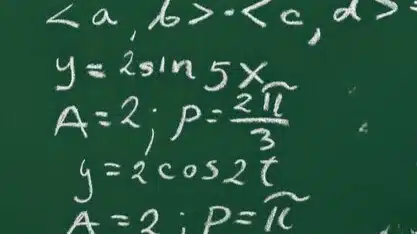
The SAT provides some formulas at the start of each math section. But you shouldn’t rely on that reference sheet alone. Memorizing key formulas saves precious time during the test.
- Area of a rectangle: length × width
- Area of a triangle: ½ × base × height
- Circumference of a circle: 2πr or πd
- Area of a circle: πr²
- Volume of a rectangular solid: length × width × height
- Pythagorean theorem: a² + b² = c²
- Slope formula: (y₂ – y₁) / (x₂ – x₁)
- Slope-intercept form: y = mx + b
- Quadratic formula: x = [-b ± √(b² – 4ac)] / 2a
- Distance formula: d = √[(x₂ – x₁)² + (y₂ – y₁)²]
- Sine: opposite / hypotenuse
- Cosine: adjacent / hypotenuse
- Tangent: opposite/adjacent
Wrapping It Up
Now you know exactly what math is on the SAT. The four domains aren’t mysteries anymore. Algebra and advanced math take center stage. Data analysis and geometry fill in the gaps.
Focus your study sessions on the areas that matter most and memorize those formulas until they become second nature.
The SAT math section is manageable once you understand its structure. You’ve got the breakdown and the formulas too. Now it’s time to put in the work.
Start preparing today. Your target score is within reach.