



Most military candidates spend the bulk of their prep time on the AFQT sections and treat the ASVAB Mechanical Comprehension subtest as an afterthought.
That is a costly mistake if a technical, mechanical, or aviation role is the goal.
This subtest does not touch your AFQT score, but it is the one standing between you and the high-value hands-on careers across every branch.
Understanding what it covers, how it is structured, and which concepts carry the most weight on test day is what turns a shaky mechanical score into a competitive one.
What is the ASVAB Mechanical Comprehension Subtest?
The ASVAB Mechanical Comprehension subtest is a dedicated section of the Armed Services Vocational Aptitude Battery.
It measures how well you understand the physical and mechanical principles behind everyday machines and systems, such as gears, pulleys, levers, and basic forces.
Format | Questions | Time Limit |
|---|---|---|
CAT-ASVAB (computerized) | 15 | 22 minutes |
P&P-ASVAB (paper) | 25 | 19 minutes |
It does not count toward your AFQT score, the number used for general enlistment eligibility.
What it does affect is your eligibility for specific military jobs, particularly those in the technical, mechanical, or engineering fields. It also factors into your Science/Technical Skills Career Exploration Score.
Topics Covered on the ASVAB Mechanical Comprehension Test
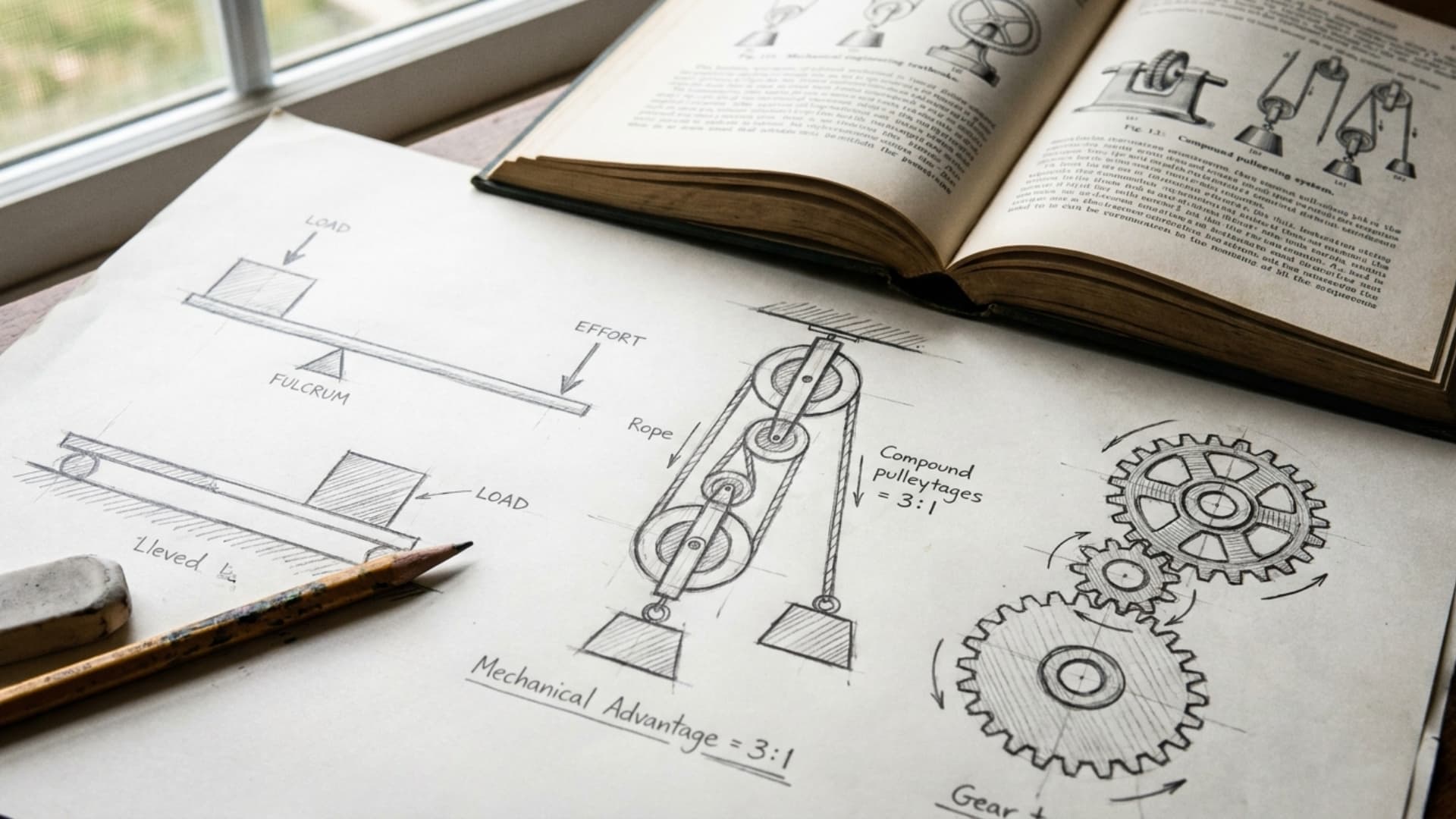
The subtest pulls from three core areas: mechanical systems, motion and forces, and fluid dynamics.
1. Mechanical Devices and Simple Machines
This is the biggest chunk of the subtest. You will need to understand how gears, levers, pulleys, and hydraulic jacks work, including how to calculate mechanical advantage.
Gear ratios come up frequently, so understanding the relationship between gear size, torque, and rotational speed is worth dedicated study time.
Questions in this area often show a diagram of a system and ask what happens when one component changes.
2. Mechanical Motion and Forces
Expect questions on velocity, acceleration, force, friction, and gravity.
You do not need advanced physics knowledge, but you do need a solid grasp of how these forces interact in real mechanical situations.
Being comfortable with formulas like F = ma and knowing how to apply them quickly without a calculator will help you work through these questions efficiently within the time limit.
3. Fluid Mechanics
This section covers buoyancy, pressure, and hydraulic systems.
Hydraulic jacks and Pascal’s Law show up regularly, and understanding how pressure applied to a fluid is transmitted evenly throughout a closed system is a concept the test revisits in different ways.
While fluid mechanics makes up a smaller portion of the subtest, it is specific enough that skipping it entirely can cost you easy points.
4. Basic Physics Principles
Rounding out the subtest are questions on gravity, equilibrium, friction, centrifugal force, and elasticity.
Some questions ask you to identify how a physical principle applies to a given mechanical situation, while others require solving a short equation.
Knowing the standard units for each formula, such as newtons for force or meters per second for velocity, is just as important as knowing the formula itself.
How is the ASVAB Mechanical Comprehension Test Scored?
Like all ASVAB subtests, the Mechanical Comprehension section is scored on a percentile scale from 0 to 100. A score of 50 means you performed about average compared to other test takers in your grade.
Score Range | Performance Level | What It Means |
|---|---|---|
1 to 30 | Below Average | May limit eligibility for most technical and mechanical military roles |
31 to 49 | Slightly Below Average | Qualifies for some roles but may fall short for competitive technical jobs |
50 | Average | Meets the baseline for many entry-level mechanical and technical positions |
51 to 70 | Above Average | Opens doors to a wider range of technical roles across most branches |
71 to 99 | Well Above Average | Qualifies for the most competitive mechanical and engineering military jobs |
There is no single passing score for this subtest. What counts as strong depends entirely on the branch you are enlisting in and the job you are targeting.
ASVAB Mechanical Comprehension Sample Questions
Below are five practice questions covering the core topic areas, with answers and explanations at the end.
Q1. A lever has a load of 200 pounds placed 2 feet from the fulcrum. How much force is needed to lift the load if the effort arm is 4 feet long?
A. 50 pounds
B. 100 pounds
C. 200 pounds
D. 400 pounds
Q2. A pulley system has four rope segments supporting a load. If the load weighs 400 pounds, how much force is needed to lift it?
A. 400 pounds
B. 200 pounds
C. 100 pounds
D. 50 pounds
Q3. A gear with 10 teeth meshes with a gear with 40 teeth. If the smaller gear rotates at 120 RPM, how fast does the larger gear rotate?
A. 480 RPM
B. 60 RPM
C. 30 RPM
D. 15 RPM
Q4. Water is pumped through a pipe that narrows from a wide section to a narrow section. What happens to the water pressure in the narrow section?
A. It increases
B. It stays the same
C. It decreases
D. It doubles
Q5. A 10-pound object is resting on a flat surface. The coefficient of friction between the object and the surface is 0.4. What is the friction force acting on the object?
A. 2.5 pounds
B. 4 pounds
C. 10 pounds
D. 25 pounds
Below are the answers to the five practice questions above.
Question | Answer | Explanation |
|---|---|---|
1 | B, 100 pounds | Load × load arm = effort × effort arm. So 200 x 2 = effort x 4, which means effort = 100 pounds. |
2 | C, 100 pounds | Mechanical advantage equals the number of rope segments. With four segments: 400 / 4 = 100 pounds. |
3 | C, 30 RPM | Gear ratio = 40 / 10 = 4. The larger gear rotates at 1/4 the speed: 120/4 = 30 RPM. |
4 | C, It decreases | As fluid speed increases in a narrower pipe, pressure drops. This is Bernoulli’s principle. |
5 | B, 4 pounds | Friction force = coefficient x normal force. So 0.4 x 10 = 4 pounds. |
Review any questions you got wrong before moving on, and take note of which topic area tripped you up most.
ASVAB Mechanical Comprehension Study Resources
You do not need to spend a lot of money to prepare well for this subtest. There are solid free options available, and a few paid resources worth considering if you want more structure or depth.
Here is a breakdown of both.
Free Resources
The resources below cost nothing and cover the core MC topics well enough to build a strong foundation. Bookmark a couple and rotate between them to keep your practice varied.
- Official ASVAB Website: The official site offers sample questions for every subtest, including Mechanical Comprehension. It is the best starting point since the questions reflect the actual test format and difficulty level.
- ASVAB CEP: Run by the same organization that administers the test, this site includes subtest breakdowns, study tips, and career exploration tools. Useful for understanding exactly what the MC subtest measures.
- ASVAB Tutor: Offers multiple free Mechanical Comprehension practice tests with 16 questions each, closely modeled after the real subtest format. A good option for repeated timed practice at no cost.
- ASVAB Practice Tests: Another free site with MC-specific practice questions covering mechanics, simple machines, and fluid power. Questions come with detailed answer explanations.
- Khan Academy: Does not have ASVAB-specific content, but its free physics and mechanics modules cover most of the foundational concepts tested on the MC subtest, including forces, motion, and simple machines.
Paid Resources
If you want more structure, deeper content coverage, or full-length practice exams with detailed feedback, these paid options are worth the investment.
- Kaplan ASVAB Prep offers a comprehensive ASVAB study guide and online course that includes Mechanical Comprehension practice questions with full explanations.
- Mometrix ASVAB Study Guide: Includes a dedicated MC section with practice questions, concept reviews, and test-taking strategies. Also available as an online course with video lessons if you prefer learning visually.
- ASVAB Test Practice: Offers a paid Mechanical Comprehension module with in-depth coverage of all three core topic areas, practice questions, and timed test simulations.
- Princeton Review ASVAB Prep: A well-known test prep brand with a solid ASVAB guide that covers all subtests. Useful if you want a single resource that covers everything from AFQT prep to technical subtests like MC.
ASVAB Mechanical Comprehension Study Plan
Spreading your prep across four weeks gives you enough time to build foundational knowledge, work through all core topic areas, and get comfortable with timed practice before test day.
Week | Focus Area | What to Do |
|---|---|---|
Week 1 | Basic Physics and Fundamentals | Review Newton’s laws, gravity, force, friction, and equilibrium. Build flashcards for key formulas and units. |
Week 2 | Mechanical Devices and Systems | Study levers, pulleys, gears, hydraulic jacks, and mechanical advantage. Practice gear ratio calculations. |
Week 3 | Fluid Mechanics and Applied Physics | Cover buoyancy, pressure, Pascal’s Law, Bernoulli’s principle, centrifugal force, and elasticity. |
Week 4 | Timed Practice and Final Review | Take full-length timed practice tests daily. Review every wrong answer and revisit weak areas before test day. |
Study Tips for ASVAB Mechanical Comprehension
Mechanical Comprehension rewards consistent practice with diagrams, formulas, and applied reasoning more than any other subtest. The core topics are finite and learnable.
- Start with the Fundamentals: Get comfortable with Newton’s laws, gravity, force, mass, and acceleration before touching practice tests. These concepts show up across every topic area on the subtest.
- Practice Reading Diagrams: A large portion of questions present mechanical situations visually. Work through diagram-based practice regularly so reading gear systems and pulley setups becomes second nature.
- Use Flashcards for Key Formulas: Write out mechanical advantage, gear ratios, and force equations in your own words. Pair each formula with a sample problem so you remember how to apply it.
- Take Timed Practice Tests: You get roughly 1.3 minutes per question with no calculator. Regular timed practice builds the speed and confidence you need to work through questions without second-guessing.
- Focus on Weak Areas: After each session, identify which topic cost you the most points and spend extra time there before your next practice round.
Military Jobs That Require Strong ASVAB Mechanical Comprehension Scores
Your MC score directly shapes which technical and mechanical roles you qualify for across every branch.
Here is a look at some of the jobs where it matters most.
Branch | Job Title | What They Do |
|---|---|---|
Army | Motor Transport Operator | Operates and maintains wheeled vehicles |
Navy | Aviation Machinist’s Mate | Maintains and repairs aircraft engines and related systems |
Engineman | Operates and maintains internal combustion engines on ships | |
Air Force | Electrical Systems Technician | Installs and maintains electrical systems on aircraft and facilities |
Marines | Motor Vehicle Operator | Drives and maintains tactical and combat vehicles |
Engineer Equipment Mechanic | Repairs and maintains heavy construction and combat engineer equipment |
Line score cutoffs vary by branch and job code, so check the official requirements for your target role directly with a recruiter.
Frequently Asked Questions (FAQs)
Is Mechanical Comprehension on the ASVAB Hard?
It depends on your background. If you have hands-on experience with machines or have studied basic physics, many questions will feel manageable.
Does Mechanical Comprehension Count Toward the AFQT Score?
No. The MC subtest does not factor into your AFQT score, which is the number used for general enlistment eligibility. It does, however, directly influence your qualification for specific technical and mechanical military jobs.
How Many Questions are on the ASVAB Mechanical Comprehension Test?
The computerized CAT-ASVAB has 15 questions with a 22-minute time limit. The paper version has 25 questions with a 19-minute limit. Both formats require you to work quickly and without a calculator.
Can I Retake the ASVAB If I Score Low on the Mechanical Comprehension Section?
Yes. You can retake the ASVAB, though there are waiting periods between attempts. If your MC score is holding you back from a specific job, targeted prep before your retake can lead to a meaningful score improvement.
Final Thoughts
The ASVAB Mechanical Comprehension subtest is one of the more learnable sections on the exam.
With three well-defined topic areas, a manageable number of questions, and plenty of practice resources available, there is no reason to go into test day underprepared.
Start with the fundamentals, work through timed practice tests regularly, and pay close attention to diagrams.
Small, consistent study sessions will move the needle more than last-minute cramming ever will.
If you found this post helpful, bookmark this page so you can come back to the practice questions, study plan, and resource list whenever you need them.