

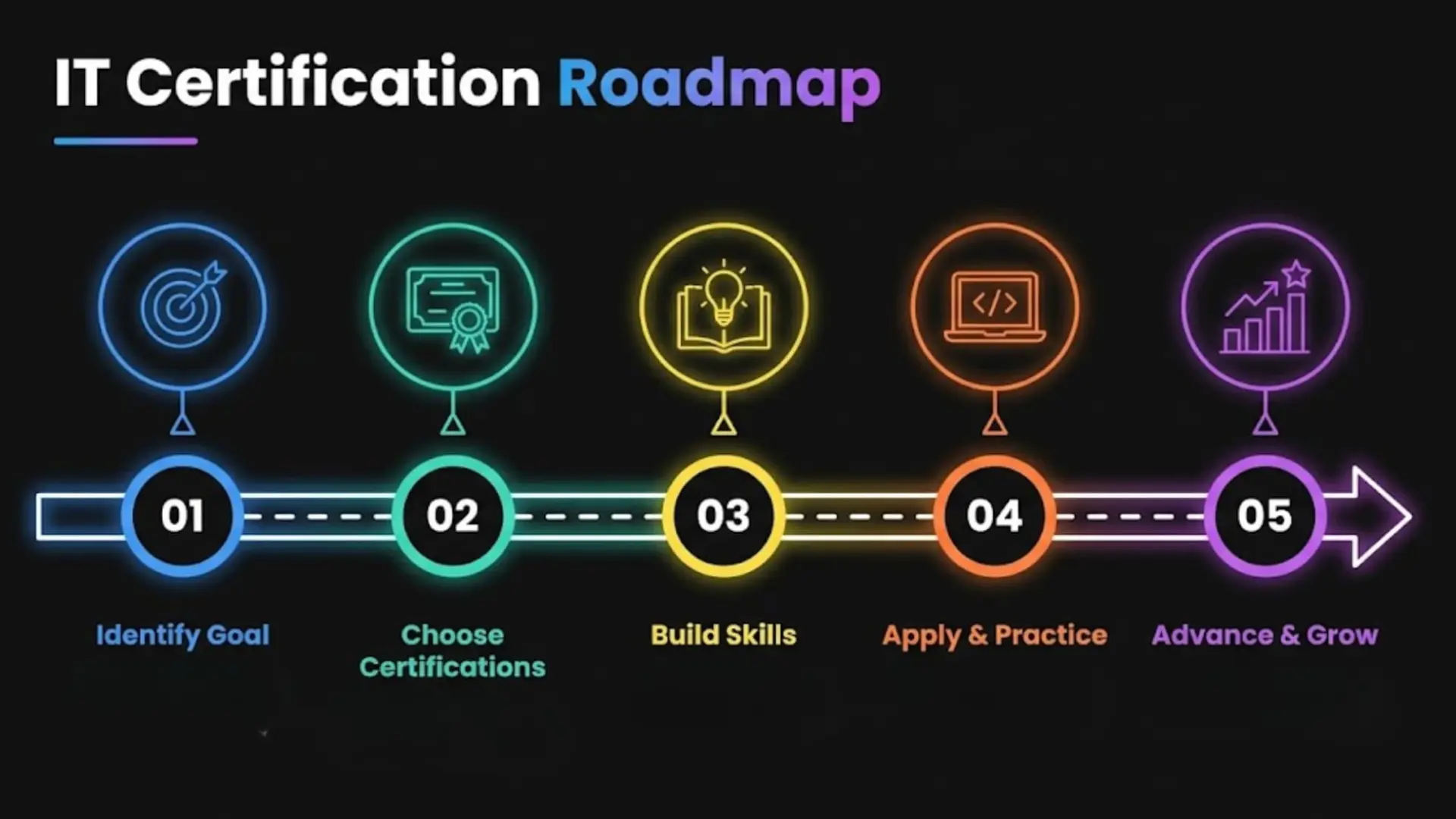

Every IT job posting seems to want a different certification, and none of them explain which one comes first.
You open one page for Security, another for Network, and somehow end up more confused than when you started.
That confusion is exactly what an IT certification roadmap is meant to clear up by lining up your options in an order that actually makes sense for where you are right now.
Your next move should not depend on guesswork, and it won’t once you see how these paths connect.
What an IT Certification Roadmap Actually Shows
An IT certification roadmap is a sequenced path that moves from entry-level exams to specialist credentials, built around job roles instead of a random pile of cert names.
It answers a simple question: what comes next, and why.
Most roadmap graphics follow a flowchart or tier layout, moving from beginner to intermediate to advanced.
A solid one includes four things. Firstly, an entry point for someone starting from zero. Second, a mid-level branch where the path splits based on interest.
A specialization stage tied to an actual job title. And lastly, a rough timeline showing how long each stage realistically takes.
Without those four pieces, a roadmap is just a list with extra formatting.
IT Certification Roadmap by Your Career Path

IT careers split into a handful of core tracks, and each one follows its own certification order once the basics are covered.
The roadmaps below break down six of the most common paths step by step, from entry point to advanced credential:
1. IT Operations Roadmap for Entry-Level IT Operator
Monitoring systems, responding to incidents, and keeping day-to-day operations running smoothly define this role, making it a practical starting point for IT support and infrastructure work.
People entering this track begin with basic computer and OS knowledge, then build toward service management and cloud-platform fundamentals.
Experience: Entry-level after 3-6 months, junior operator after 6-12 months.
Path Forward:
- CompTIA A+: Entry-level IT support certification.
- ITIL Foundation: IT service management certification.
- Microsoft Certified: Azure Fundamentals: Cloud fundamentals certification.
- Linux Essentials: Foundational Linux certification.
- Microsoft Certified: Systems Administrator: Mid-level operations certification.
2. Networking Roadmap for Network Engineer
Routers, switches, and network uptime fall squarely on this role, and the certification path reflects that hands-on focus from the very first exam.
Most people entering this track already have some comfort with hardware, which makes networking a natural next specialization.
Experience: Entry-level after 6-12 months, mid-level after 1-2 years, advanced after 3+ years.
Path Forward:
- Network+: Entry-level networking certification.
- CCNA: Mid-level routing and switching certification.
- CCNP: Advanced or expert-level networking certification.
- CCIE: Expert-level certification for enterprise network design and troubleshooting.
3. Cybersecurity Roadmap for Security Analyst
Threat monitoring and incident response define this role, and the path leading into it runs longer than most other tracks since employers expect deeper hands-on judgment before trusting someone with active threats.
Patience matters more here than in almost any other specialization.
Experience: Foundational after 1-2 years, analyst-level after 3-4 years, advanced after 4+ years, expert after a decade or more.
Path Forward:
- Security+: Foundational security certification.
- CySA+: Analyst-level certification.
- PenTest+: Specialized offensive security certification.
- SecurityX: Expert-level security certification.
- CISSP: Advanced certification for cybersecurity leadership and program management.
4. Data and AI Roadmap for Data Analyst
Spreadsheets and dashboards are just the starting point here, since this path eventually pushes into engineering-adjacent data work that blends analysis with automation.
Anyone coming from a business or reporting background tends to move through this track faster than expected.
Experience: Entry-level after 1 year, mid-level after 2-3 years, advanced after 4+ years.
Path Forward:
- Data+: Entry-level data certification.
- Microsoft Certified: Azure Data Engineer Associate: Data engineering certification.
- Microsoft Certified: Azure AI Engineer Associate: AI specialization certification.
- AWS Certified Machine Learning Engineer-Associate: Associate-level certification for AI and machine learning specialization.
5. DevOps Roadmap for DevOps Engineer
Automation and deployment pipelines sit at the center of this role, blending systems knowledge with modern development practices in a way few other tracks require.
This path also tends to move faster once the foundational certification is done, since much of the remaining skill comes from tool-specific practice.
Experience: Foundational after 1 year, mid-level after 2-3 years, advanced after 4+ years.
Path Forward:
- Linux+: Foundational systems certification.
- Cloud+: Cloud infrastructure certification.
- Certified Kubernetes Administrator: Containerization and orchestration certification.
- AWS Certified DevOps Engineer: Advanced or expert-level DevOps and site reliability certification.
6. Systems Administration Roadmap for SysAdmin
Keeping servers and endpoints running smoothly is the daily reality of this role, long before enterprise-scale systems or automation enter the picture.
It is also one of the more direct paths on this list, with fewer branching decisions along the way.
Experience: Entry-level after 6 months, mid-level after 1.5–2 years, advanced after 3+ years.
Path Forward:
- VMware Certified Professional (VCP): Expert-level certification for virtualization and enterprise systems.
- Server+: Server administration certification.
- Red Hat Certified System Administrator (RHCSA): Advanced systems certification.
- Microsoft Certified: Windows Server Hybrid Administrator Associate: Enterprise infrastructure certification.
7. Cloud Computing Roadmap for Cloud Engineer
Platform choice matters early in this track, since the certifications shift from vendor-neutral basics into a single ecosystem faster than most people expect.
Once that choice is made, the rest of the path becomes more about depth than breadth.
Experience: Foundational after 1–2 years, associate-level after 2–3 years, professional after 4+ years.
Path Forward:
- AWS Certified Solutions Architect Associate: Associate-level cloud certification.
- AWS Certified Solutions Architect: Professional: Platform-specific professional-level certification.
- Cloud+: Foundational vendor-neutral certification.
- AWS Certified Advanced Networking: Specialty: Expert or specialty-level cloud certification.
If you are newer to cloud platforms, working through an AWS foundational exam first can make the jump to an Associate-level exam feel far less steep.
Download CompTIA IT Certification Roadmap Designed for Your Goals
Most beginners follow one sequence regardless of their eventual specialty: A+, then Network+, then Security+, before branching into CySA+, PenTest+, or another advanced track.
This order shows up across nearly every career path covered above, which makes it worth having as a standalone reference.
The downloadable PDF below breaks this sequence into a full visual roadmap.
It includes a certification pyramid, a career-path decision tree, a cost and study-time comparison table, and a printable one-page cheat sheet for quick reference during exam planning.
Download the CompTIA IT Certification Roadmap PDF
How to Choose the Right IT Certification Roadmap?
Choosing a roadmap that fits your situation matters more than picking the most popular one. Use these checks before locking in a direction:
- Start With The Job Role, Not The Exam: Decide what job you want first, then work backward to the certifications that lead there.
- Check Entry Requirements For Each Certification: Some assume prior exams or experience; others don’t.
- Match The Roadmap To Current Experience Level: A beginner path looks nothing like one built for a career changer with IT years behind them.
- Compare Vendor-Neutral vs Vendor-Specific Paths: CompTIA builds foundational skills, while AWS or Cisco certs go deep on one platform.
- Weigh Cost Against Expected Salary Increase: Some certifications pay for themselves fast, others take longer to justify.
- Factor In Renewal And Continuing Education: Certifications expire, and upkeep costs time and money.
- Look At Real Job Postings For The Target Role: They confirm which certifications employers actually ask for.
Remember, your roadmap should reflect your goals, not someone else’s shortcut. It should be built just for you to make progress in your career goals.
What Computer Engineers and People Say About IT Certification
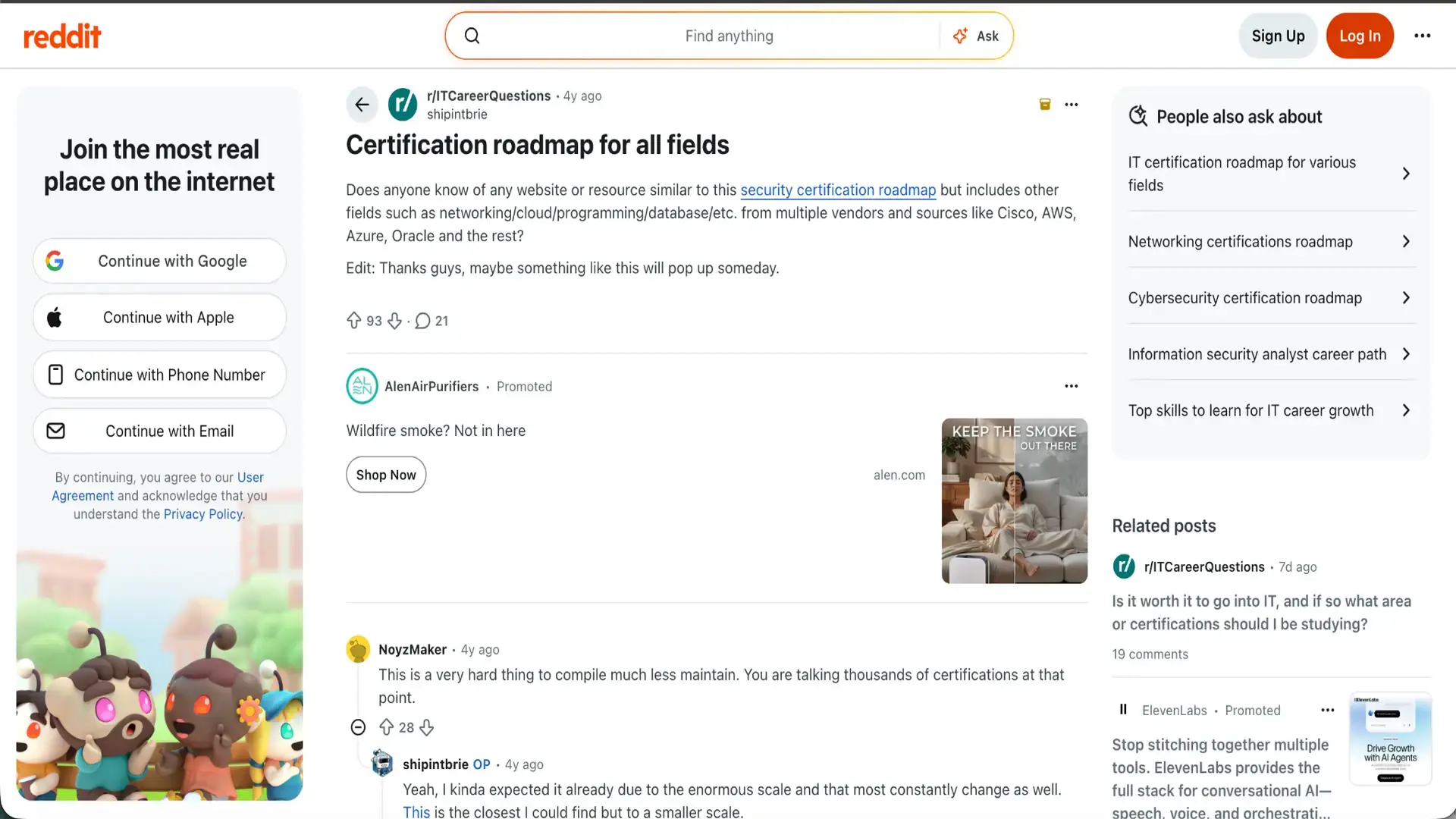
Reddit threads on certification planning tend to circle back to the same points.
Many users say a single unified roadmap across every vendor does not really exist, since the certification landscape is too large and changes too often to track cleanly.
Several commenters note that CompTIA’s own roadmap is a solid starting reference, though it covers a limited slice of the full vendor landscape.
Someone with zero IT experience is usually pointed toward A+, while someone switching fields with existing knowledge often gets pointed straight to networking-focused certifications instead.
One recurring theme: job relevance matters more than certification count.
Commenters warn against chasing every available credential and suggest focusing on certifications tied to real, current job postings instead.
Overall, the community view lines up with a simple idea: match the path to your starting point, not the other way around.
CompTIA vs Other Popular Vendors
Certification costs shift once you look past CompTIA alone, since vendor-specific paths often carry different fees and renewal rules for the same job role:
Vendor | Focus Area | Avg. Exam Cost | Renewal Cycle | Vendor Lock-In | Best For |
CompTIA | Vendor-neutral IT fundamentals | $390-$550 | 3 years, CEUs | Low, works everywhere | Beginners and career changers |
Cisco | Networking hardware and infrastructure | $300-$400 | 3 years | High, Cisco-specific gear | Network engineers |
AWS | Cloud infrastructure and services | $100-$300 | 3 years | High, AWS platform only | Cloud engineers on AWS |
Microsoft | Cloud, servers, and productivity tools | $99-$165 | 1-2 years | High, Microsoft ecosystem | Azure and Windows admins |
Google Cloud | Cloud architecture and data | $99-$200 | 2 years | High, GCP platform only | Cloud and data engineers |
Linux Foundation | Open-source systems administration | $250-$445 | 2-3 years | Low, open-source based | Linux and DevOps roles |
PMI | Project and program management | $445-$675 | 3 years, PDUs | Low, role-based skill | Project coordinators and managers |
Vendor-neutral paths like CompTIA travel well across employers, while vendor-specific ones pay off fastest when the job already points to a specific platform.
Tips to Study Effectively for IT Certifications
Passing the exam is one goal, but retaining the material is what actually helps once the job starts. These five habits keep both on track.
- Structure Your Study Schedule: Break the exam objectives into weekly blocks instead of studying whatever feels easiest that day.
- Use Practice Exams Regularly: Timed practice tests reveal weak spots long before exam day and build comfort with question phrasing.
- Practice In A Hands-On Lab: Reading about a concept is different from configuring it yourself in a real or virtual environment.
- Join A Community Study Group: Explaining a concept to someone else exposes gaps that solo review often misses.
- Space Out Review Before Exam Day: Short daily review sessions in the final week beat one long cram the night before.
Stack these five together, and exam day stops feeling like a guessing game.
Final Thoughts
Remember, no certification path stays the same for long, and that’s fine.
New exams replace old ones, vendors rebrand their credentials, and job requirements shift right along with them.
What stays useful is the habit of checking your next step against where you actually stand, instead of chasing whatever certification is trending that month.
An it certification roadmap only works if you keep coming back to it as your experience grows.
Where are you starting from, and which track are you leaning toward? Drop it in the comments, and let’s figure out the next step together.
Frequently Asked Questions
Do Employers Actually Verify IT Certifications?
Most employers verify certifications through CompTIA’s official verification tool or directly with the issuing vendor before finalizing a formal job offer.
Can You Land An IT Job With Certifications And No Degree?
Yes, many entry-level IT roles hire based on certifications alone, since hands-on skills often matter more than a formal college degree.
How Many IT Certifications Should You Realistically Hold?
Most professionals hold three to five relevant certifications at once, since collecting more than that rarely adds value without matching job experience behind them.
Do You Have to Follow the CompTIA Roadmap in Order?
No, CompTIA certifications do not have to be completed in a fixed order. Choose certifications based on your experience, career goals, and required technical skills.