


Epic certification carries significant weight in healthcare IT; certified professionals consistently command higher salaries and greater job opportunities across hospitals and health systems nationwide.
Yet the path to certification is widely misunderstood. Many assume getting Epic certified works like a standard IT exam: sign up, study, pass.
The reality is far different. Epic’s credentialing process involves employer sponsorship, hands-on system access, and structured training that no amount of self-study can replace.
For anyone building a career in healthcare IT, understanding the full list of Epic certifications and exactly how to become Epic-certified is the essential first step.
What is Epic Certification?
Epic Systems is the dominant electronic health record (EHR) platform, used by over 350 hospitals and health systems to manage patient data, clinical workflows, and billing operations.
Epic certification validates that a professional can configure, implement, and support specific Epic modules within a live healthcare environment.
Unlike standard IT certifications purchased and tested independently, Epic certification requires employer sponsorship and mandatory on-site training at Epic’s headquarters in Verona, Wisconsin.
Healthcare employers prioritize certified professionals because they reduce implementation risk and bring verified, module-specific expertise that generic IT credentials simply cannot demonstrate.
How to Get Epic Certified?
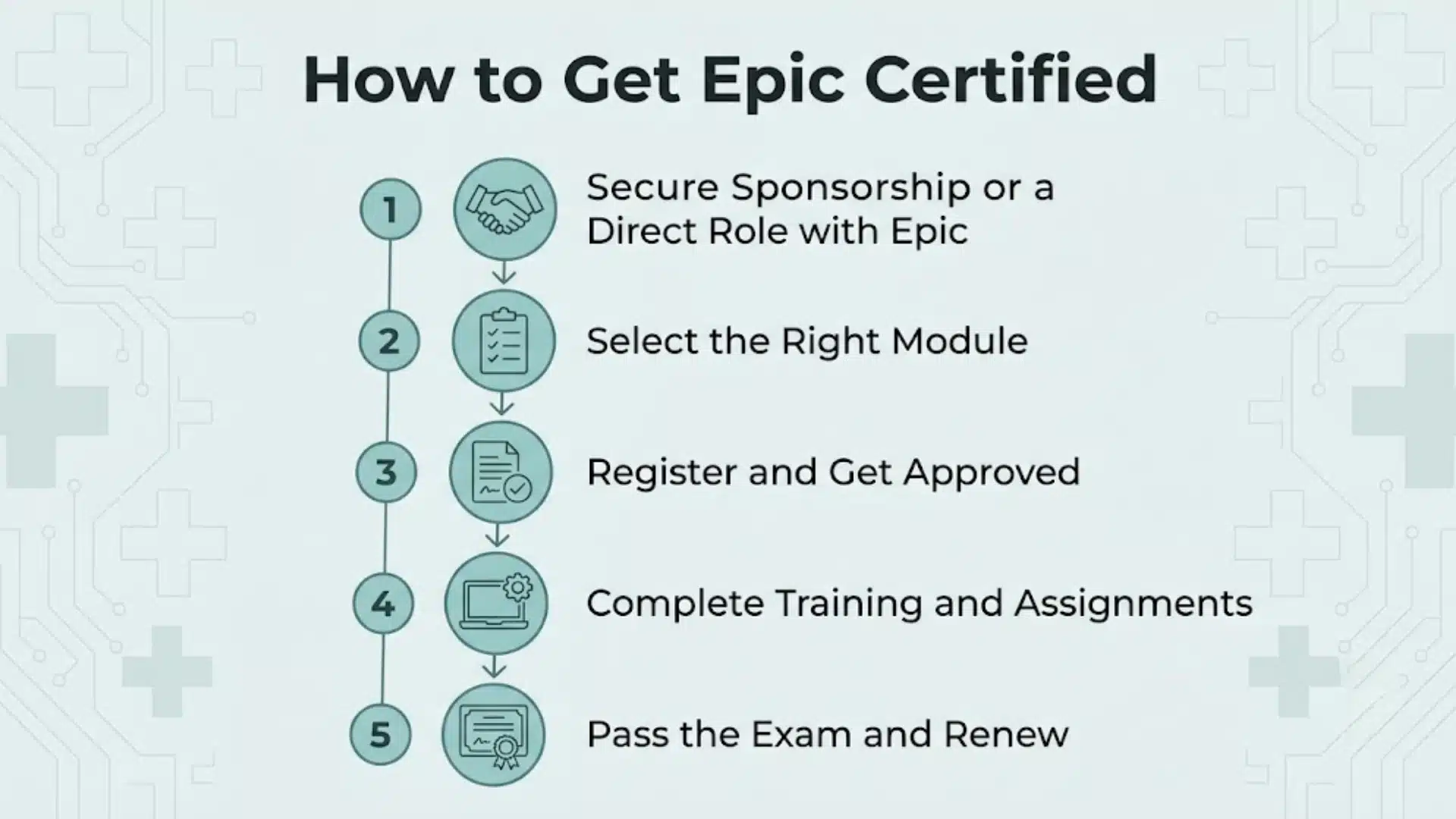
Getting Epic certified follows a structured, employer-driven process that differs significantly from self-directed IT credentialing programs.
Each step requires organizational involvement, making preparation and alignment with your employer essential before training begins.
Step 1: Secure Organizational Sponsorship
Epic certification is not available directly to individuals.
In practice, there are two paths: get sponsored by a hospital, health system, or consulting firm that holds an active Epic contract, or get hired by Epic itself and train from the inside.
Epic posts open roles on its own careers site, and some of those positions lead to certification as part of the job.
Without a sponsoring organization, Epic will not authorize your access to training materials, exams, or credentialing.
Step 2: Select the Right Module
Epic offers dozens of modules such as Ambulatory, Inpatient, Willow, Beacon, Cadence, and Clarity, each tied to specific clinical or technical functions.
Talk with your manager or project lead to determine which module matches your job responsibilities and the organization’s implementation needs.
Choosing based on personal interest alone can create friction, since your employer typically decides which certifications get funded based on staffing gaps and project priorities.
Step 3: Register and Get Approved
Once a module is chosen, your employer submits your registration through Epic’s UserWeb portal.
This step involves internal approvals from IT leadership, budget sign-off for training costs, and scheduling coordination with Epic’s training calendar.
Certification slots are limited and often tied to project timelines, so registration usually happens months in advance.
Employees rarely have direct control over this process beyond confirming availability and completing any prerequisite coursework assigned beforehand.
Step 4: Complete Training and Assignments
Training typically takes place at Epic’s campus in Verona, Wisconsin, though remote options exist for select modules.
Sessions run 1 to 3 weeks and combine lectures with hands-on system building.
After classroom instruction ends, trainees complete assignments requiring them to configure workflows, build test environments, or solve scenario-based problems.
These assignments prove practical competency and are graded before you become eligible to sit for the certification exam.
Step 5: Pass the Exam and Renew
The final exam tests both theoretical knowledge and applied skills specific to your module. Passing grants official certification status recognized within the Epic ecosystem.
Because Epic releases new software versions annually, certified staff must complete recertification training to stay current with updated features and workflows.
Skipping recertification can result in lapsed status, requiring you to repeat portions of the original certification process.
List of Epic Certifications
Epic certification spans multiple modules, each tied to a distinct part of the EHR platform. Here’s a look at the most common ones and what they cover.
- Epic Ambulatory: Covers outpatient clinical workflows, including patient scheduling, documentation, order entry, and electronic prescribing for clinics.
- Epic Inpatient Clinical Documentation: Focuses on hospital charting, care plans, orders, and documentation workflows for physicians and nursing teams.
- Epic ASAP: Covers emergency department workflows, including triage, patient tracking, clinical documentation, orders, and discharge processes.
- Epic Beaker: Focuses on laboratory workflows, specimen management, test processing, result reporting, and laboratory system configuration.
- Epic Cadence: Covers appointment scheduling, provider calendars, patient registration, referral coordination, and resource management across healthcare facilities.
- Epic Resolute: Focuses on hospital and professional billing, claims management, charge capture, payment processing, and revenue cycle workflows.
- Epic Willow: Covers pharmacy operations, including medication ordering, verification, dispensing, inventory management, and clinical pharmacy workflows.
- Epic Radiant: Focuses on radiology scheduling, imaging orders, procedure tracking, result documentation, and diagnostic imaging workflows.
- Epic Cogito: Covers healthcare analytics, reporting tools, dashboards, data visualization, and operational performance measurement within Epic.
Whatever module you pick, choosing one that matches your role and career direction is what turns a certification into a real advantage.
How Long Does It Take to Get Epic Certified?
The timeline varies by module and organizational readiness, but most candidates complete the full process within eight to twelve weeks from sponsorship to certification.
Phase | Typical Duration |
|---|---|
Training Phase | 3 to 5 days, conducted at the Verona campus or through approved remote sessions |
Project Completion Phase | 2 to 4 weeks, depending on project complexity and available system access |
Exam Preparation Phase | 1 to 2 weeks reviewing module content and practicing configuration tasks |
Typical Timeline for Most Candidates | 8 to 12 weeks from employer sponsorship confirmation to certified status |
Because certification carries real career value, it also attracts scams that promise shortcuts.
The same red flags that show up when checking if a certificate is legitimate apply here: if anyone offers Epic certification outside employer sponsorship or direct hire, treat it as a scam.
Epic Certification Requirements
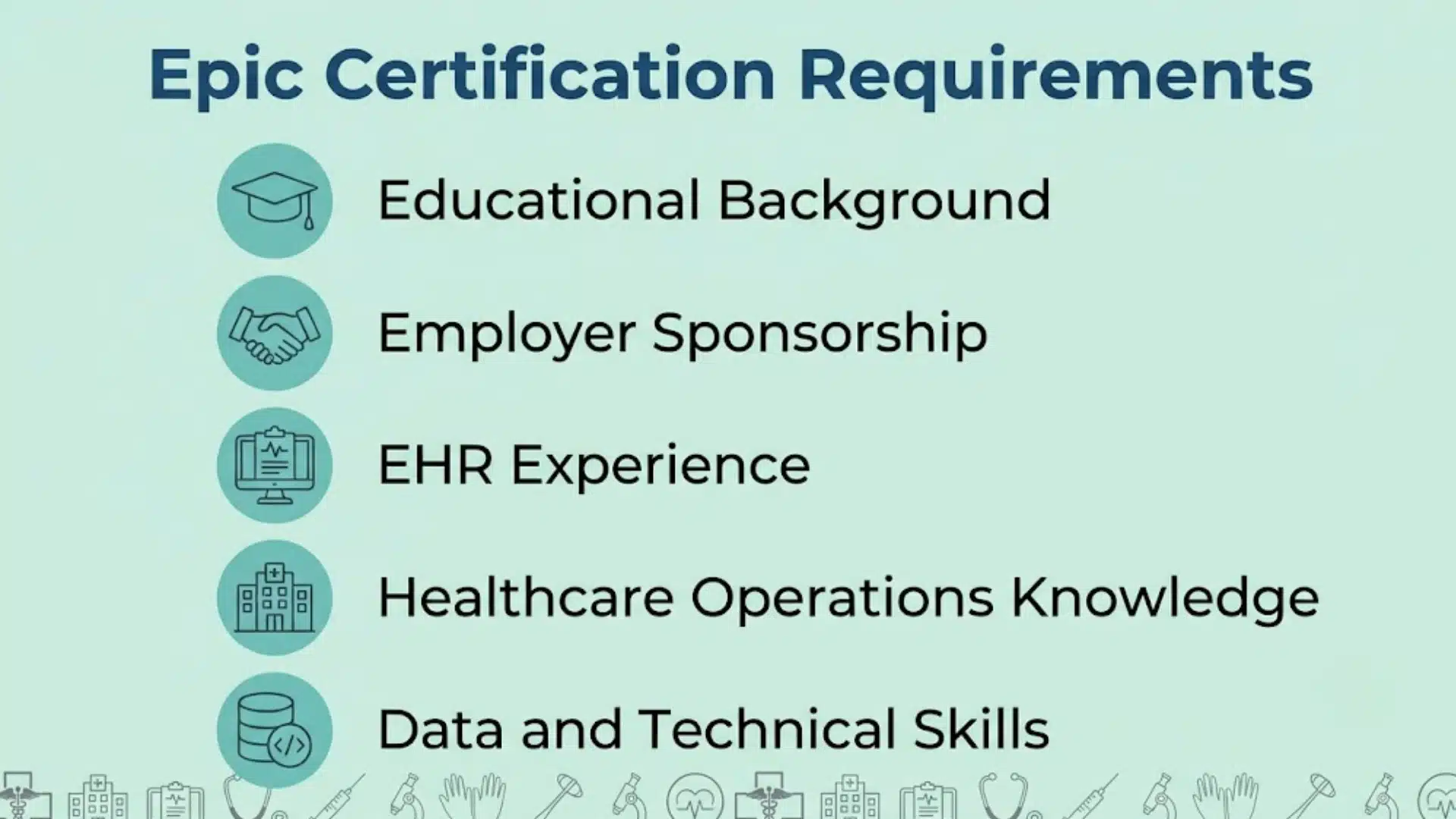
Meeting Epic certification requirements involves a combination of educational background, employer sponsorship, and relevant technical skills that collectively strengthen your candidacy.
- Educational Background: Most candidates hold degrees in healthcare administration, information technology, nursing, or a related clinical or technical field.
- Employer Sponsorship: Sponsorship from an Epic customer organization or authorized partner is mandatory, as Epic offers no independent certification enrollment pathway.
- EHR Experience: Prior hands-on experience with an electronic health record system demonstrates technical adaptability and reduces onboarding time for sponsoring organizations.
- Healthcare Operations Knowledge: Familiarity with clinical workflows, billing processes, or departmental operations directly strengthens module selection and training performance.
- Data and Technical Skills: Proficiency in SQL, database fundamentals, or system configuration provides candidates with a measurable advantage in training and certification exams.
Can You Get Epic Certified Without Working for a Hospital?
Yes, but Epic certification usually requires sponsorship from an Epic customer organization, such as a hospital or healthcare employer.
Working for an Epic-authorized consulting partner or implementation firm provides an equally valid path, as these organizations maintain established sponsorship agreements with Epic Systems.
Independent contractors and self-employed professionals, however, face significant barriers.
Epic does not offer open enrollment or self-sponsored certification pathways.
Organizational affiliation remains a hard requirement regardless of prior EHR experience, making employer relationship the single most critical factor in accessing Epic’s credentialing process.
What Does Epic Training Include?
Epic training combines structured instruction with practical application, ensuring candidates develop both conceptual understanding and real-world configuration skills before sitting the certification exam.
Training Component | What It Covers |
|---|---|
Classroom Learning | Module-specific configuration, clinical workflows, and system architecture, delivered through instructor-led sessions at Epic’s Verona campus |
Online Learning Modules | Self-paced digital coursework covering terminology, navigation, and foundational concepts before and after in-person training |
Hands-On Exercises | Guided build tasks completed directly within Epic’s training environment, replicating real healthcare organization scenarios |
Workflow-Based Assignments | Post-training projects requiring candidates to configure functional workflows and demonstrate applied module competency |
Certification Exams | Module-specific assessments test theoretical knowledge and practical configuration skills before live environment deployment |
Common Challenges During the Certification Process
The Epic certification process can be challenging due to limited access, intensive training requirements, complex workflows, and the need to balance certification with daily job responsibilities.
- Finding Sponsorship: There is no independent pathway, making employer affiliation the biggest barrier to accessing certification.
- Choosing the Wrong Module: Misaligned module selection wastes training investment and delays career progression tied to your actual role.
- Balancing Training With Work Responsibilities: Multi-day training alongside active job duties requires advance planning and direct coordination with your employer.
- Preparing for Certification Exams: The test applied configuration knowledge, catching candidates off guard who underestimated the hands-on preparation requirements.
Epic Certification Career Paths After Completion
After completing Epic certification, professionals can explore various roles in healthcare IT, implementation, consulting, and system management. Common career paths include:
- Epic Analyst: Configures, supports, and maintains specific Epic modules while helping healthcare organizations optimize their electronic health record workflows.
- Epic Consultant: Works with healthcare clients during Epic implementations, upgrades, and optimization projects to improve system performance and usability.
- Clinical Applications Specialist: Connects clinical teams with Epic solutions by improving workflows, resolving system issues, and supporting healthcare staff needs.
- Revenue Cycle Analyst: Manages Epic financial modules related to billing, claims, payments, and revenue cycle processes within healthcare organizations.
- Epic Trainer: Creates training materials and teaches healthcare employees how to use Epic systems effectively in their daily work.
- Project Manager: Coordinates Epic implementation projects by managing timelines, teams, resources, and communication across different departments.
Epic Certification Salary and Career Value
Certified Epic professionals generally out-earn uncertified EHR staff, though the exact numbers swing widely depending on role, region, and years of experience.
For an Epic Trainer, Indeed’s compensation data for Epic-focused roles put average annual pay at $87,912 in the United States.
Senior analysts and consultants often clear $110,000 or more.
Credentialed Trainer pay tends to run lower and is reported inconsistently across sources.
Location, hospital system size, and whether the position is staff or contract all affect where you land in that range.
Epic Certification vs Epic Proficiency vs Epic Accreditation
Epic’s credentialing structure includes three distinct levels, each reflecting varying depths of system knowledge, training investment, and professional standing within the Epic ecosystem.
Credential | What It Means | Who It’s For |
|---|---|---|
Epic Proficiency | Basic working knowledge of a specific Epic module, typically gained through internal training | End users and clinical staff who use Epic daily |
Epic Accreditation | Intermediate credential validating functional competency within a specific application area | Staff moving toward specialized support roles |
Epic Certification | Highest credential level, requiring formal sponsorship, training, building projects, and passing an exam | Analysts, consultants, and implementation specialists |
Among Epic’s three credential levels, certification carries the highest career value.
Epic Proficiency suits daily end users, while Accreditation demonstrates moderate functional competency for professionals moving toward support roles.
Neither, however, matches the hiring influence of full Epic Certification.
Final Thoughts
Earning Epic certification takes patience, employer backing, and real hands-on practice, but the payoff is a credential hospitals and health systems actively seek out.
Since the process depends entirely on sponsorship, your first move should always be building that employer connection before anything else.
With so many options across the list of Epic certifications, from Ambulatory to Willow to Cadence, picking the module that fits your role matters just as much as passing the exam itself.
Which Epic certification are you pursuing or considering? Share your role, preferred module, or certification experience in the comments below.
Frequently Asked Questions
Can You Pay for Epic Certification Yourself?
No, Epic does not offer self-pay enrollment; certification costs must be covered through an authorized sponsoring organization.
Which Epic Certification is Most Popular?
EpicCare Ambulatory and Resolute Professional Billing remain among the most widely pursued certifications nationwide across healthcare organizations.
Can You Take Epic Training Online?
Partially, some modules offer approved remote training options, though certain components still require in-person attendance at the Verona campus.
How Often Do You Need to Renew Certification?
Epic releases annual platform updates requiring certified professionals to complete version-specific recertification training to maintain active credential status.