

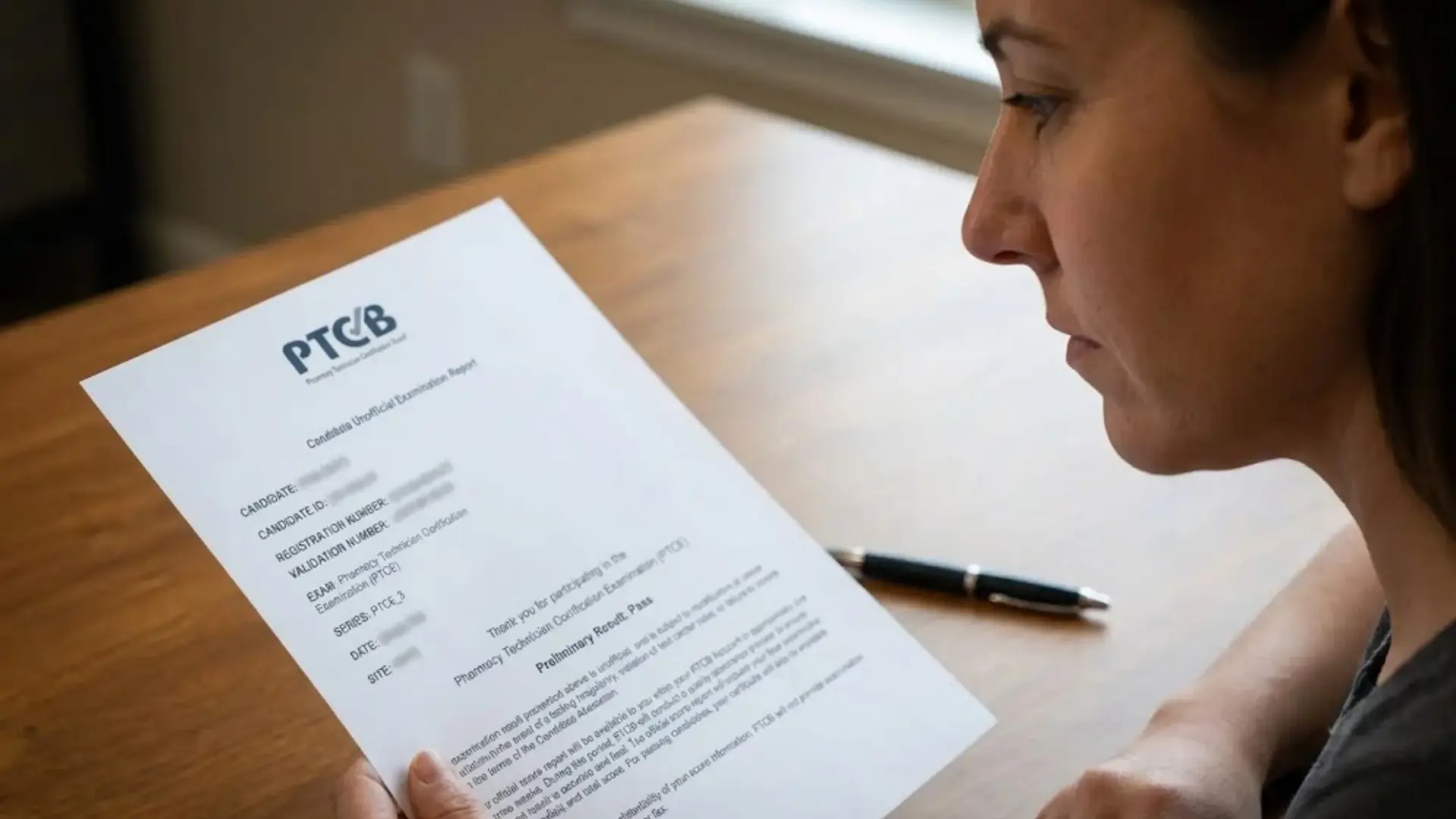

Memorizing drug names and rereading notes feels productive, but neither shows whether that knowledge holds up under timed, exam-style conditions.
A PTCB practice test measures readiness in a way that studying alone does not. It shows which topics are already solid and which ones need more review before the exam.
This blog includes a list of free PTCB practice tests and a suggested study schedule broken into weekly blocks.
It also covers specific strategies for pharmacy calculations, drug classification, and federal regulation questions.
Each resource below includes its question count, topics covered, and a link for access.
What is the PTCB Exam?
The PTCE (Pharmacy Technician Certification Exam) is the nationally recognized exam you must pass to earn the Certified Pharmacy Technician (CPhT) credential.
This is separate from the state licensing rules governing pharmacy technicians in many states.
Here is everything you need to know about the exam at a glance:
| Detail | Information |
| Administered By | Pharmacy Technician Certification Board (PTCB) |
| Total Questions | 90 (80 scored + 10 unscored) |
| Exam Duration | 1 hour, 50 minutes |
| Score Scale | 1,000 – 1,600 |
| Passing Score | 1,400 |
| Exam Fee | $129 |
| Test Delivery | In-person only at Pearson VUE (as of 2026) |
| Authorization Window | 90 days to schedule after approval |
| Certification Validity | 2 years (20 CE hours required for renewal) |
| Current Blueprint Version | v1.4 (effective January 6, 2026) |
Before you can sit for it, you must complete either a PTCB-recognized education or training program or have a minimum of 500 hours of pharmacy technician work experience across any pharmacy setting.
Exam dates, fees, and blueprint versions can shift between testing cycles, so it’s worth double-checking these details on PTCB’s site before you lock in a study plan.
PTCB Exam Syllabus Breakdown: What Each Domain Actually Tests

Every domain on the PTCB exam maps directly to something you will do on the pharmacy floor. Here is what each one covers and how much each section weighs on your score:
1. Medications
This is the largest domain for a reason. Every shift, you handle drug names, flag interactions, and pull the right product.
A wrong call here does not stay on paper; it follows a patient home. Knowing your medications cold is non-negotiable.
- Topics Covered: Generic and brand drug names, drug classifications and therapeutic uses, drug interactions and contraindications, look-alike/sound-alike medications.
- Score Weightage: 35%
2. Patient Safety and Quality Assurance
Errors in pharmacy reach real patients. This domain tests whether you can catch a mistake before it leaves the counter.
Barcode mismatches, temperature excursions, recall handling, and near-miss reporting are not edge cases; they are weekly realities in any pharmacy setting.
- Topics Covered: High-alert and LASA medications, error prevention strategies, barcode scanning and NDC verification, and cold-chain and storage compliance.
- Score Weightage: 23.75%
3. Order Entry and Processing
This domain is where math lives. Days supply, dosage calculations, SIG code interpretation, and insurance adjudication are tasks you will run through dozens of times per shift.
Your accuracy here directly determines what a patient picks up and how much they pay for it.
- Topics Covered: Pharmacy calculations and unit conversions, days supply and quantity dispensed, SIG code interpretation, insurance billing and prior authorization.
- Score Weightage: 22.5%
4. Federal Requirements
Pharmacy does not run on instinct, it runs on federal law.
From your first week on the job, you will be expected to handle controlled substances correctly, understand DSCSA traceability, and recognize what requires a pharmacist’s intervention.
- Topics Covered: DEA controlled substance schedules and forms, HIPAA and protected health information, Drug Supply Chain Security Act, FDA recall classifications.
- Score Weightage: 18.75%
Common PTCB Exam Question Types You Need to Prepare For
Knowing what each question type asks of you before you sit down for a test sharpens both your speed and your accuracy on the real exam. Here is what your question paper will actually look like:
| Question Type | What It Involves | Skill Tested |
| Standard Multiple Choice | Four options, one correct answer | Knowledge recall |
| Scenario-Based Questions | Patient or dispensing situation with an applied question | Clinical reasoning |
| Multiple-Response | Select all correct answers from a list | Comprehensive knowledge |
| Hot Spot | Click the correct area on a diagram or label | Visual identification |
| Drag-and-Drop Ordering | Arrange steps or items in correct sequence | Procedural accuracy |
| Calculation Questions | Days’ supply, dosage, concentration, conversions | Pharmacy math |
| LASA/High-Alert Drug Questions | Identify risk, error prevention, or correct drug | Patient safety application |
Once these formats feel familiar, your time on the actual exam shifts from figuring out what is being asked to simply answering it, which is exactly where your score improves.
Best PTCB Practice Test and Resources for Study

The resources below are split by type: free platforms, paid tools worth the investment, and YouTube channels so you can build a prep stack that fits your budget and your learning style:
1. Free PTCB Practice Test Platforms
No paywalls, no trial periods. The below resources are completely free to use:
- PTCB.org Official Free PDFs: You need an account for it, and you can download the PTCE Content Outline and the CPhT Knowledge Reference.
- Union Test Prep: Full lessons, domain flashcards, and multiple practice tests at zero cost; its explanations run brief, so use it for volume practice, not deep breakdowns.
- PTCBPracticeTest.com: Eight full-length free tests plus standalone quizzes on pharmacy math and controlled substances.
Rotate between these three, so your PTCB exam questions stay pattern-free, and your prep stays honest
2. Paid Resources That Are Actually Worth It
Free gets you far, but these paid options fill the gaps free content cannot. Treat paid resources as precision tools, not a replacement for volume practice on free platforms.
- Mometrix: The free test is solid, but the paid course adds video lessons, flashcards, and a calculations module with step-by-step walkthroughs.
- PTCBTestPrep.com: Fifty lessons across ten modules written by pharmacists, seven full-length simulated exams, downloadable PDF notes.
- GoTestPrep: Thirty-question domain-specific sets with answer explanations plus a free downloadable study guide.
3. YouTube Channels for PTCB Exam Prep
Audio-visual learners get a lot here, watch a domain, then immediately test yourself on one of the platforms above:
- PTCB Prep Guide: A channel built specifically for CPhT candidates, covering domain walkthroughs, top 200 drugs, and content in plain language.
- PTCB PTCE Pharmacy Technician CPhT Test Prep Playlist: A compiled playlist of pharmacy tech exam prep videos covering calculations, federal law, and drug knowledge.
- Pharmacy Technician Certification Board (Official PTCB Channel): Short official videos on exam logistics, scheduling, and policy updates straight from PTCB.
- Tony PharmD: Calculation walkthroughs and federal law breakdowns aimed at technician-level content.
Video review works best as a warm-up, not a main event to watch, then test.
Download Our Pharmacy Tech Study Guide Free PDF
This free practice exam PDF gives candidates a full 90-question, 2026 blueprint-aligned test with 80 scored items distributed across all four domains and ten unscored pretest-style questions woven in, exactly like the real PTCE.
Every answer comes with a detailed explanation, a domain tag, and a score tracker so candidates know precisely where their gaps are.
The timing plan and post-test review table help users turn missed questions into a targeted study action.
Use it alongside the free online resources listed above: take the timed PDF test first, then drill weak domains on Union Test Prep or Pharmacy Tech Scholar.
Download the Free PTCB Practice Test PDF
Your 8-Week PTCB Study Schedule
Eight weeks is enough time to go from uncertain to exam-ready, but only if your prep is structured around the right topics in the right order.
The schedule below maps each week to a focused goal, a daily time commitment, and the specific topics your study sessions should cover:
| Week | Focus Area | Daily Time | Topics to Cover |
|---|---|---|---|
| Week 1 | Diagnostic baseline | 45 min | Full practice test; note weak domains |
| Week 2 | Content outline review | 1 hr | 2026 blueprint; domain weights; exam format |
| Week 3 | Medications Part 1 | 1.5 hrs | Top 200 drugs: brand vs. generic names |
| Week 4 | Medications Part 2 | 1.5 hrs | Drug classes; side effects; interactions |
| Week 5 | Medications Part 3 | 1.5 hrs | LASA drugs; DEA schedules; storage rules |
| Week 6 | Federal Requirements | 1.5 hrs | DSCSA; controlled substance law; recalls |
| Week 7 | Patient Safety and QA | 1 hr | Error prevention: high-alert medications |
| Week 8 | Order Entry + Math | 1 hr | Days’ supply; dosage calculations; sig codes |
| Final 3 Days | Full exam simulation | 2 hrs | Timed 90-question tests; error log review |
By the time you hit Week 8, your goal is not to learn new material; it is to confirm what you already know holds up under timed conditions.
Practical Tips to Maximize Your Test Score
A practice test is only as useful as how you use it. These habits turn every session into a targeted score-builder:
- Simulate Real Conditions: Time yourself strictly, no pausing, no checking your phone mid-test.
- Track Every Missed Question: Log the domain, topic, and the reason you got it wrong.
- Flag Unsure Answers: A lucky correct guess still hides a real knowledge gap worth fixing.
- Rotate Resources: Switching between test banks helps you avoid memorizing patterns rather than concepts.
- Focus on Calculations Weekly: Pharmacy math breaks down without consistent practice; do not leave it for last.
- Check Your Timing per Domain: Spending too long on Medications can cost you time on Order Entry calculations.
Remember, small adjustments to how you practice make a bigger difference than simply adding more questions to your queue.
Conclusion
Every pharmacy technician who passed the PTCB exam started exactly where you are right now, working through questions and building confidence, one domain at a time.
A well-used PTCB practice test does not just prepare you for the format; it trains you to think the way the exam expects.
You already have the resources, the schedule, and the blueprint breakdown.
The only thing left is to start. Do not forget to download the free PDF before your next study session; it keeps everything you need in one place.
Frequently Asked Questions
Does the PTCB Exam Score Report Show Where You Went Wrong?
Yes. Your score report breaks down performance across all four knowledge domains, giving you a clear view of which specific areas need the most attention before a retake.
Can You Use a Calculator During the PTCB Exam?
An on-screen calculator is provided at the Pearson VUE testing center. Personal calculators are not permitted, so practicing pharmacy math using only an on-screen tool beforehand is strongly recommended.
What Happens to Your PTCB Application If You Do Not Test Within Ninety Days?
Your authorization to test expires, and your application fee is forfeited. You must submit a new application and pay the full fee again to receive a fresh testing authorization window.