

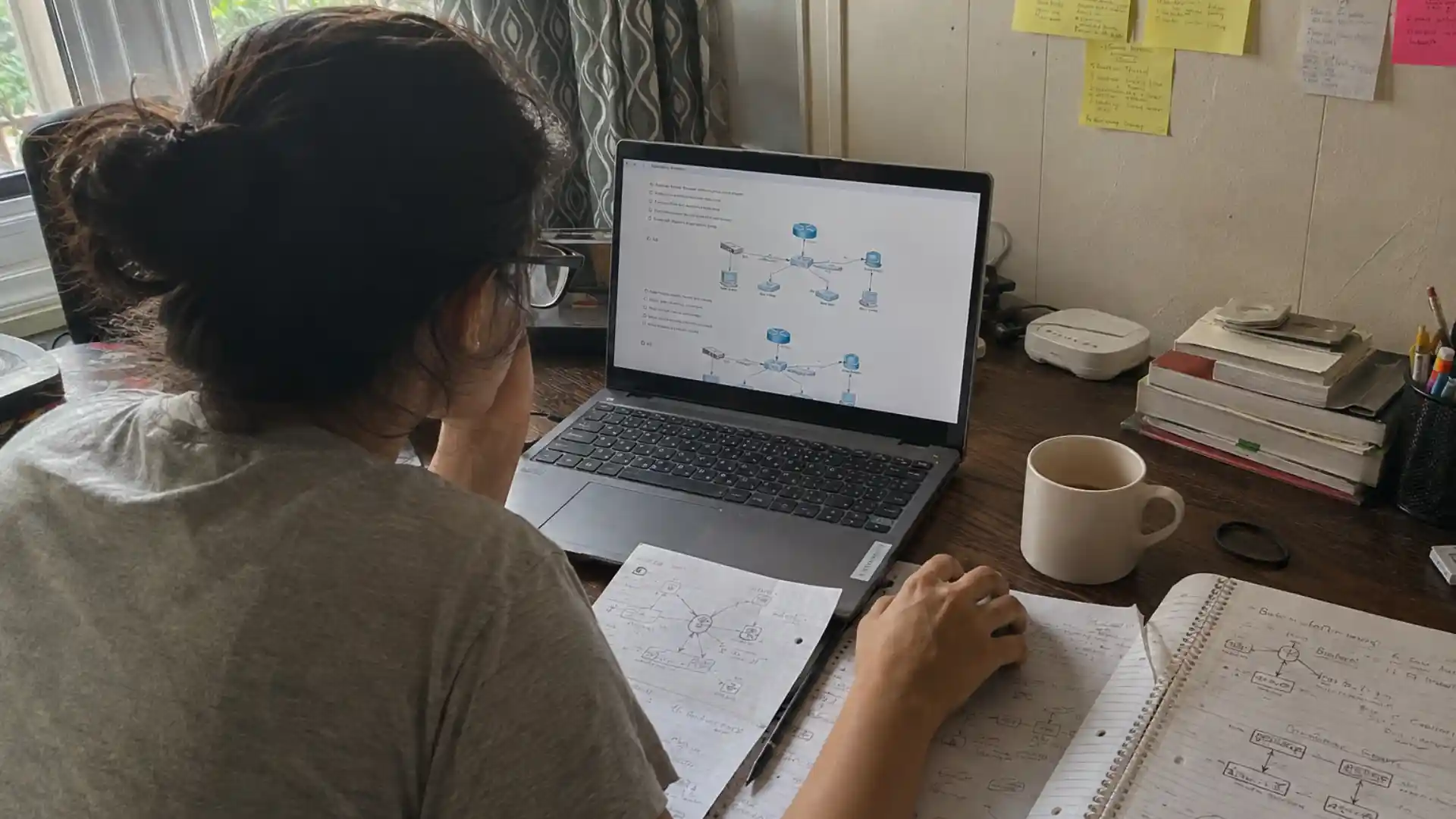

The CCNA exam covers networking basics across several topics.
A solid CCNA practice test helps you know what to expect. It shows how questions get worded and structured.
You start recognizing patterns across different topic areas. Weak domains show up early, so you know where to focus. Scenario-based questions get easier with repetition.
Real understanding works better than memorizing answers. Skipping shortcuts and dumps keeps your prep on track. Steady practice builds confidence before exam day.
Small, regular study sessions work better than rushed cramming.
Brief Overview of CCNA Practice Test
A CCNA practice test works like a dress rehearsal for the 200-301 exam, minus the pressure of it actually counting.
Cisco built this certification around six domains, covering fundamentals, security, and automation among others, so practice questions should hit that same range.
Regular practice trains your brain to recall facts faster, exposes shaky topics, and makes scenario-based questions feel familiar instead of jarring.
Skip the dumps though, since they age fast and leave you memorizing answers instead of learning the material.
| Category | Detail |
|---|---|
| Duration | 120 minutes |
| Number of Questions | 100 to 120 (Cisco can adjust slightly per session) |
| Passing Score | Not officially published; candidates generally report needing around 825 out of 1000 points |
Once you know the exam’s shape, you can pace practice sessions around real time limits instead of guessing.
CCNA Exam Topics Covered in Practice Tests
Each domain carries its own weight on exam day, so here is what to expect from the official Cisco Certified Network Associate blueprint:
- Network Fundamentals covers IP addressing, topologies, cabling, and the OSI model, making up about 20 percent of the exam.
- Network Access tests VLANs, trunking, EtherChannel, spanning tree, and wireless basics through switch troubleshooting scenarios.
- IP Connectivity covers routing tables, OSPF, administrative distance, and HSRP, often the toughest domain since it links multiple concepts at once.
- IP Services focuses on NAT, DHCP, DNS, and quality of service through real-world troubleshooting questions.
- Security Fundamentals covers ACLs, port security, and VPNs, an area Cisco keeps expanding.
- Automation and Programmability rounds things out with JSON, REST APIs, and controller-based networking.
Free CCNA Practice Test Questions

Try these sample questions to check where you stand before taking a full-length mock exam.
1. Which OSI layer is responsible for logical addressing and routing?
A) Data Link
B) Network
C) Transport
D) Session
Correct Answer: B. The Network layer handles logical addressing and determines the best path for data to travel across networks.
2. What is the default subnet mask for a Class C network?
A) 255.0.0.0
B) 255.255.0.0
C) 255.255.255.0
D) 255.255.255.255
Correct Answer: C. Class C networks use a default mask of 255.255.255.0, providing 254 usable host addresses per subnet.
3. Which protocol prevents Layer 2 loops in a switched network?
A) OSPF
B) STP
C) BGP
D) ARP
Correct Answer: B. Spanning Tree Protocol blocks redundant paths to stop loops while keeping a backup path available if the primary link fails.
4. What does NAT primarily accomplish?
A) Encrypts traffic between routers
B) Translates private IP addresses to public ones
C) Assigns hostnames to devices
D) Manages VLAN tagging
Correct Answer: B. NAT allows multiple devices on a private network to share a single public IP address for internet access.
5. In OSPF, what value determines the best path to a destination?
A) Hop count
B) Cost
C) Administrative distance
D) Bandwidth delay
Correct Answer: B. OSPF calculates cost based on interface bandwidth, and the path with the lowest total cost is chosen.
6. Which command displays the routing table on a Cisco router?
A) show ip interface
B) show running-config
C) show ip route
D) show vlan brief
Correct Answer: C. This command lists all known routes, their sources, and the next-hop addresses used for forwarding traffic.
7. What is the purpose of DHCP?
A) Resolve domain names to IP addresses
B) Automatically assign IP configuration to hosts
C) Encrypt data in transit
D) Manage switch port security
Correct Answer: B. DHCP automatically hands out IP addresses, subnet masks, gateways, and DNS settings to connected devices.
8. Which wireless standard operates only in the 5 GHz band?
A) 802.11b
B) 802.11g
C) 802.11a
D) 802.11n
Correct Answer: C. 802.11a was one of the earliest standards to operate exclusively in the 5 GHz frequency range.
9. What does an access control list primarily do?
A) Assigns VLAN membership
B) Filters traffic based on defined rules
C) Balances load across multiple links
D) Converts IPv4 to IPv6
Correct Answer: B. ACLs permit or deny traffic based on criteria like source address, destination address, or port number.
10. Which port security violation mode drops offending traffic but keeps the port active?
A) Shutdown
B) Restrict
C) Protect
D) Disable
Correct Answer: B. Restrict mode drops unauthorized traffic and logs the violation while keeping the port operational for allowed devices.
Here are some more free practice questions: Download PDF for free CCNA practice questions
Where to Find CCNA Practice Questions?
Several trusted platforms provide realistic questions to sharpen your exam preparation.
Here is how they break down by cost and source:
Official Resources
Both of these come straight from Cisco, so the content always lines up with actual exam objectives:
- Cisco Skills for All: Cisco’s own free platform, built around the current 200-301 blueprint.
- Cisco Networking Academy: Quizzes built into structured, instructor-paced course modules.
Free Resources
These three cost nothing and work well for early diagnostic practice before you commit to a paid plan:
- LearnCisco.net: 55 fresh questions per attempt, 90-minute timed sessions, no signup needed.
- 9tut.com: Free composite quiz pulled straight from CCNA topic areas, plus written tutorials for each domain.
- TechTarget: A quick 20-question quiz covering all six domains, good for a fast readiness check.
Paid Resources
Each of these takes a different approach, so pick based on how you like to study:
- Boson ExSim-Max: Realistic simulation questions with detailed explanations.
- AlphaPrep: Adaptive testing that adjusts to your current skill level.
- MeasureUp: Certification mode and practice mode, 265 total questions.
- Udemy: Affordable, well-reviewed courses bundled with quiz banks.
- Pearson Test Prep: Practice software bundled with Cisco Press study guides.
How Many Practice Tests Should You Take Before the CCNA Exam?
There is no single number that works for everyone, since your starting knowledge shapes how many rounds you need.
Most candidates benefit from three to five full-length practice tests, spaced out over several weeks rather than crammed into a few days.
Early tests establish your baseline and expose weak domains. Middle tests track whether targeted review is actually closing those gaps.
Final tests, taken in the week before your exam, confirm you can consistently hit your target score under real time pressure.
Retaking the same test repeatedly teaches you the answers, not the concepts, so rotate between different question banks whenever you can.
How to Use CCNA Practice Tests Effectively?
Taking practice exams only pays off when paired with careful review and steady improvement.
- Take a Diagnostic Test First: Establish a baseline before structured study begins.
- Review Every Incorrect Answer: Understand why the correct answer is right, not just what it is.
- Focus on Weak Domains: Spend extra time on the areas where your scores are lowest.
- Simulate Exam Conditions: Time yourself and avoid distractions during full mock exams.
- Track Your Scores: Watch for trends across weeks, not just single test results.
- Retake Tests After Revision: Confirm that weak areas have actually improved.
- Avoid Memorizing Answers: Focus on understanding the underlying concept instead.
Recommended 30-Day CCNA Practice Test Study Plan
A structured study schedule helps you steadily build confidence before exam day.
| Week | Focus Areas | Daily Activity |
| Week 1 | Network Fundamentals | Daily quizzes on topics like IP addressing, the OSI model, cabling, and topologies |
| Week 2 | Switching, Routing, IP addressing | Practice questions on VLANs, STP, OSPF, static routing, and subnetting |
| Week 3 | Security, Automation, Services, Mixed-topic practice | Quizzes on ACLs, NAT, DHCP, DNS, APIs, plus combined topic drills |
| Week 4 | Full mock exams, Error review, Final revision | Timed full-length exams, reviewing every wrong answer, revisiting weak domains |
What Score Should You Aim for Before Taking the CCNA Exam?
Your practice test scores can help determine your readiness for the certification exam.
Most instructors suggest achieving a score of 85 to 90 percent or higher on full mock exams before scheduling the real test.
However, a single high score isn’t sufficient; consistency across multiple attempts is more important, as one lucky test doesn’t guarantee success.
Before booking, ensure you can repeatedly pass timed mock exams, accurately review and explain incorrect answers, and complete simulation questions within the time limit.
Frequently Asked Questions (FAQs)
How Similar are CCNA Practice Tests to the Actual Exam?
Quality practice tests aim to match the exam’s tone and difficulty, though question wording and simulation complexity vary between the practice test and the actual Cisco exam.
Are Cisco Exam Dumps Recommended?
No. Using dumps violates Cisco’s certification agreement and can result in the cancellation of your certification if discovered.
How Difficult is the CCNA 200-301 Exam?
It’s considered moderately challenging, especially for candidates without hands-on networking experience, since it combines theory with applied configuration skills.
The Bottom Line
Every CCNA practice test helps sharpen both speed and accuracy. Reviewing wrong answers matters more than repeating right ones.
Weak domains need extra attention, not quick skimming!
Timed sessions help build the stamina exam conditions require. Rotating question banks keeps concepts fresh instead of memorized.
Small improvements each week add up over time. Keep tracking your scores and reviewing your work regularly.
Your prep today shapes your results on exam day.
Share your own prep tips and study questions in the comments below to help other future CCNA candidates prepare well.