
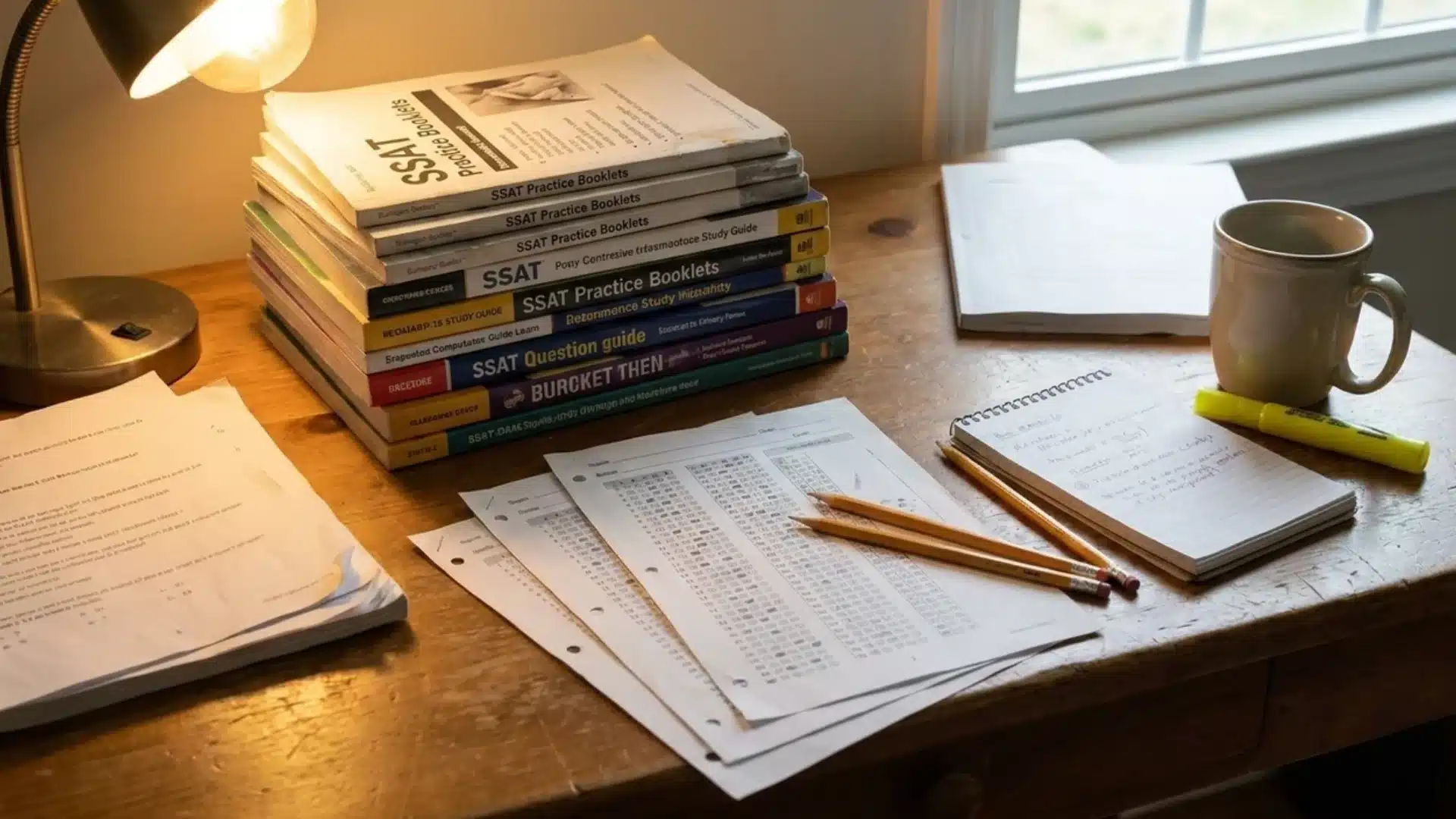

The SSAT covers math, reading, and vocabulary in one sitting. A solid SSAT practice test shows you what to expect. It walks you through each section ahead of time.
Timing, question styles, and pacing start to feel familiar. Weak spots show up early, so you know what to fix. Steady practice and honest review help scores improve over time.
Checking mistakes after each round helps you avoid repeating them.
Each practice round works as simple rehearsal, not a final test. That habit can make prep feel easier to manage.
SSAT Test Format at a Glance
Grade level decides almost everything about the SSAT experience. Elementary, Middle, and Upper Level all fall under one test.
Content difficulty shifts between Middle and Upper. The actual structure stays identical for both.
Elementary students get one 15-minute break. Middle and Upper Level students get two 10-minute breaks instead.
Calculators stay off the table at every level. No exceptions apply here.
Here is how the numbers stack up across each level:
| Detail | Elementary | Middle | Upper |
|---|---|---|---|
| Grades | 3rd–4th | 5th–8th | 9th–11th |
| Total time | 2 hrs 5 min | 3 hrs 5–10 min | 3 hrs 5–10 min |
| Scored questions | 89 | 167 | 167 |
| Score range | 300–600 | 440–710 | 500–800 |
Once you know where your child’s level falls on this chart, pacing practice sessions around the real clock becomes a lot easier.
SSAT Practice Test Sections Explained
Each SSAT level covers four core areas. The structure shifts slightly by grade.
Here is a look at what each section covers:
- Quantitative: Covers arithmetic, algebra, and geometry. Middle and upper-level students get two sections. Calculators are not allowed.
- Verbal Reasoning: Tests vocabulary through synonyms and analogies. Some students find this section harder than others.
- Reading Comprehension: Includes stories, poems, and essays with questions on main ideas and tone. Passages get a bit harder in higher grades.
- Writing Sample: Gives students 25 minutes to write on a personal or general topic. This section is not scored.
- Overall Format: Every section is timed, so pacing matters along with knowing the material.
Knowing what each section covers can help with practice. It also helps students see which areas need more work.
Official SSAT Practice Tests and Study Materials
Before looking at third-party resources, it helps to know what the SSAT itself offers, straight from the people who write the real test.
Here is what the official lineup includes:
| Resource | Format | Content | Free/Paid | Best For |
|---|---|---|---|---|
| Official Practice Tests | Online + guidebooks | 4 full-length tests (~600 questions); 1,000+ extra online questions | Paid subscription | Closest simulation to the exam |
| Study Guide Books | Physical books | Practice questions and tips by section and grade | Paid, shipped | Structured review before full tests |
| Free Mini-Practice Test | Online | 30-question diagnostic with instant report | Free | Spotting early strengths and gaps |
Best Third-Party SSAT Prep Platforms

Since official practice materials are limited, most students end up supplementing with third-party platforms; here is where to look and what each type offers.
1. Free SSAT Practice Platforms
This section highlights free SSAT practice platforms that help students build basic skills, understand question types, and start preparation without cost:
- Test Innovators (Free Tools): Provides sample SSAT questions and short tests to help you understand the format and timing. Best for beginners. Limited full tests and analytics in the free version.
- Varsity Tutors SSAT Practice: Offers free quizzes, diagnostic tests, and practice sets. Good for early skill check. Lacks deep analysis and full-length simulations.
- 4Tests SSAT Practice: Free full-length SSAT-style tests with basic scoring. Useful for self-evaluation. No detailed explanations or tracking features.
2. Paid SSAT Practice Platforms
Paid SSAT prep platforms that offer structured courses, full-length tests, and detailed performance tracking for stronger exam preparation:
- Test Innovators (Paid Plans): Offers full-length SSAT tests, detailed score reports, and adaptive practice tools. Best for students needing structured prep and performance tracking.
- Kaplan SSAT Prep: Provides live classes, on-demand lessons, and practice tests with expert instruction. Best for students seeking guided learning and test-taking strategies.
- The Princeton Review SSAT Prep: Includes tutoring, live courses, and practice materials focused on SSAT sections. Best for students who need strong support to improve their scores.
- PrepMaven SSAT Tutoring & Prep: Offers one-on-one tutoring with Ivy League tutors and personalized study plans. Best for students targeting competitive private school admissions.
3. Question Banks for Section-by-Section Practice
For focused, section-by-section practice, question banks are the better fit than sitting through an entire test each time:
- Ivy Global offers free practice organized by level and section, letting students filter by topic and difficulty. Their free resources include SSAT practice tests, math videos, and question sets covering both Middle and Upper Level content.
- PrepMaven provides a free downloadable practice question bank covering every section, built to mirror the real SSAT’s structure and five-answer format rather than generic test prep questions.
- Test Innovators partners directly with the SSAT’s own test maker, offering officially licensed sample questions alongside instant feedback and score tracking.
Most question banks also provide instant explanations for answers, which makes it easier to fix mistakes right when they happen rather than reviewing everything at the end.
How to Use SSAT Practice Tests Effectively?
SSAT practice tests help you get used to the question types. Regular timed practice also helps you improve over time.
Here is how to build a practice routine:
| Strategy | What to Do | How Often |
|---|---|---|
| Weekly Practice Plan | Mix reading, math, and verbal practice each day. | Daily |
| Timed Full Tests | Take one full test under timed conditions. | Weekly |
| Review Wrong Answers | Write down why each wrong answer happened. | After every test |
| Error Log | Track weak spots like vocabulary or algebra. | Ongoing |
| Quiet, Timed Setting | Practice with steady timing and few distractions. | Every session |
This routine works well when you keep it up for several weeks. Small, steady practice adds up more than a few long study sessions.
How to Build an Effective SSAT Preparation Plan?
A strong prep plan works best when it’s structured around time, not just topics. Here’s what an effective one typically includes:
- Set a Realistic Timeline: Most students benefit from starting three to six months before test day
- Diagnose Weak Areas Early: Take one baseline test first to figure out which sections need attention
- Balance All Sections Weekly: Split study time across quantitative, verbal, and reading instead of favoring one
- Build in Review Time: Reserve part of each week purely for reviewing past mistakes
- Increase Intensity near Test Day: Shift toward full-length, timed practice tests in the final few weeks
A good plan flexes as weak spots shift, so revisiting it every couple of weeks keeps it useful instead of static.
How Many SSAT Practice Tests Should You Take?
There’s no single number, but most tutors and prep programs point toward a similar range. A baseline test at the start reveals where a student actually stands before studying begins.
From there, three to five full-length tests across the prep window tend to be enough for most students to see solid improvement.
Spacing them out matters just as much as the count. Taking one every one to two weeks leaves room to review mistakes before the next attempt.
A final full-length test about a week before the real SSAT helps confirm pacing and stamina.
Quality matters more than quantity here. Rushing through too many tests back-to-back usually backfires, leaving no real time to learn from mistakes.
Common Mistakes Students Make During Their Prep
Many students lose marks not because the test is too hard, but because of habits that are easy to fix. Spotting these mistakes early can save a lot of wasted practice time. Here are some common mistakes to watch out for:
- Overusing Untimed Practice Only: More work feels easier but does not build exam speed in the true sense.
- Ignoring Vocabulary Building: Weak vocabulary often leads to lower verbal section scores.
- Not Reviewing Incorrect Answers: Mistakes repeat when answers are not analyzed.
- Skipping Full-Length Tests: Without full tests, students struggle with timing and stamina.
Fixing even one or two of these habits can lead to steady score improvement. Small changes in your routine often make a bigger difference than extra hours of practice.
Frequently Asked Questions (FAQs)
How Many SSAT Practice Tests Should Students Take?
Students should take multiple full-length practice tests to build timing, accuracy, and stamina for the test.
Are Official SSAT Practice Tests Harder than Real Exams?
Official practice tests closely match the real exam in difficulty and question style.
Can SSAT Prep Be Done Without Coaching?
Yes, students can prepare independently using structured practice tests, study plans, and review strategies.
Wrapping It Up
Steady effort over time helps you prepare for the SSAT. Every SSAT practice test builds both skills and confidence. Review each mistake instead of moving past it quickly.
Small fixes now can prevent bigger issues later. Keep sessions short, honest, and steady over time.
Progress often builds slowly before it becomes noticeable.
Keep showing up and reviewing your work each week. Your score reflects the effort you put in.
Share your own SSAT prep tips and questions with other parents and students in the comments section below.