


PA school admissions vary a lot from one program to the next. Some schools set lower GPA cutoffs and skip standardized tests.
Others accept fewer patient care hours or offer more open interview slots. These differences shape your real odds of getting in.
Picking schools that match your background can boost your chances fast. That is exactly where knowing the easiest PA schools to get into pays off.
A clear list gives you solid options instead of blind hope. Each school here has its own set of requirements. Smart choices now save you time and effort later.
What Makes a PA School “Easier” to Get Into?
The term “easier” simply means that a program is less competitive than others.
Some schools can be more accessible due to their higher acceptance rates, lower GPA expectations, fewer admission requirements, or larger class sizes.
Some programs accept applicants with cumulative GPAs as low as 2.75.
While a growing number of PA programs have either dropped the GRE entirely or replaced it with alternatives such as the PA-CAT or CASPer .
Understanding these differences can help you develop effective strategies and improve your chances of gaining admission.
Why Applying to Multiple PA Schools is Important?
Applying to multiple PA schools, regardless of PA program length , boosts your chances of getting admission. Here is why casting a wider net pays off:
- With over 34,600 applicants competing for roughly 12,636 seats in the recent years CASPA cycle, the odds demand a broader strategy.
- Even accessible programs do not guarantee acceptance.
- While one may prioritize patient care hours, another may prioritize GPA or mission fit. Applying broadly means your strengths are more likely to align with at least one program’s priorities.
Therefore, your strategy should include building a list of schools to apply to rather than relying on just one or two, which could put your application cycle at risk.
Easiest PA Schools to Get Into

The programs below are considered more accessible based on lower GPA thresholds, GRE requirements, or patient care experience.
1. University of Utah Physician Assistant Program
Located in Salt Lake City, the University of Utah gives preference to candidates with three or more qualifying factors.
These include rural or underserved community background, science GPA, and the quality and quantity of direct patient care experience.
Admission offers are extended based on the highest interview scores, and a basic anatomy and physiology test is administered during the interview session.
- Minimum GPA: 3.0 cumulative and science GPA as calculated by CASPA
- GRE Requirement: Not required
- Patient Care Experience: Minimum of 2,000 hours of direct patient care experience required. Paid experience has more weight than volunteer hours.
2. Missouri State University PA Program
The program gives added consideration to rural upbringing, first-generation college students, Missouri residency, military service, and prior leadership experience.
It is the most accessible program in the country, with a 52% acceptance rate and a minimum GPA of 3.0.
The 27-month curriculum leads to a Master of Physician Assistant Studies degree and includes both didactic and clinical training components.
- Minimum GPA: 3.0 cumulative as calculated by CASPA
- GRE Requirement: PA-CAT is recommended; GRE or MCAT are also accepted but not required
- Patient Care Experience: Minimum 500 paid, direct patient care hours required at the time of CASPA submission.
3. Lipscomb University PA Program
The program uses rolling admissions and strongly encourages applicants to apply as early as possible.
Lipscomb also participates in the Yellow Ribbon Program, making graduate education more financially accessible for eligible veterans and their dependents.
With an acceptance rate of 67% to 74%, it is one of the most accessible accredited PA programs in the country.
- Minimum GPA: 3.0 cumulative GPA and 3.2 overall science GPA
- GRE Requirement: Not required
- Patient Care Experience: Patient contact hours are required, but there is no set minimum.
4. University of North Dakota PA Program
UND is one of the few programs offering a hybrid delivery model that combines online coursework with on-campus sessions.
North Dakota residents receive the highest preference, followed by those in other states, including Minnesota, Montana, and South Dakota.
The program has a strong focus on preparing PAs for rural and primary care settings.
- Minimum GPA: 3.0 undergraduate GPA on a 4.0 scale.
- GRE Requirement: Not required
- Patient Care Experience: Minimum of 1,000 paid hours of healthcare experience completed within the United States, related to direct, supervised patient care.
5. A.T. Still University PA Program (Central Coast)
The program uses rolling admissions and emphasizes service to underserved communities in Central Coast California.
Its built-in clinical hours make it particularly appealing for career changers who have not yet accumulated large PCE totals.
The program uses an overall review and places significant weight on mission alignment and community service orientation.
- Minimum GPA: 3.0 cumulative and science GPA
- GRE Requirement: Not required
- Patient Care Experience: Healthcare experience is preferred; the program integrates 400 hours of direct patient care into the curriculum.
6. University of New England PA Program
The program emphasizes interprofessional education, working alongside students in medicine, dental, nursing, and pharmacy programs.
CASPer is recommended but not required, and the 500-hour PCE minimum makes it accessible for recent graduates still building clinical experience.
The program looks beyond GPA alone, making it a strong option for well-rounded applicants with meaningful healthcare backgrounds.
- Minimum GPA: 3.0 cumulative GPA as calculated by CASPA
- GRE Requirement: Not required
- Patient Care Experience: Minimum of 500 hours of direct patient care experience before application submission.
7. South University PA Program
The program accepts a range of healthcare backgrounds for its PCE requirement.
Multiple campuses also mean more available seats and a higher chance of acceptance when applying to multiple locations.
Rolling admissions at select campuses reward early applicants with faster decisions.
- Minimum GPA: 3.0 cumulative GPA
- GRE Requirement: Not required
- Patient Care Experience: Minimum 500 to 1,000 hours of direct patient care experience, depending on campus
8. Marquette University PA Program
Marquette’s 200-hour PCE minimum is among the lowest of any accredited PA program, making it highly accessible for recent graduates.
The program is grounded in the Jesuit tradition and considers motivation, maturity, and suitability for clinical practice alongside academic metrics.
Approximately half of its annual class of 55 students comes from Marquette undergraduates, so external applicants compete for roughly half the available seats.
- Minimum GPA: Minimum cumulative GPA of 3.0 as calculated by CASPA
- GRE Requirement: GRE scores are optional. Applicants choosing to submit GRE scores should send them to the Marquette PA program code 5872.
- Patient Care Experience: Minimum of 200 hours of patient contact and healthcare experience.
9. Eastern Virginia Medical School (EVMS) PA Program
EVMS benefits from its location within a major medical center complex, giving students access to a wide range of clinical training environments.
The program evaluates applicants through four lenses: cognitive and academic ability, personal and non-cognitive qualities, healthcare experience, and community service.
No standardized test is required, giving applicants with strong clinical backgrounds a fair path to admission.
- Minimum GPA: 3.0 cumulative GPA on a 4.0 scale is required to be eligible to apply
- GRE Requirement: GRE, MCAT, and PA-CAT are not required
- Patient Care Experience: Between 1,500 and 2,700 total healthcare hours are typical among competitive admitted applicants.
EVMS is now integrated with Old Dominion University as Macon & Joan Brock Virginia Health Sciences
10. Samuel Merritt University PA Program
The admissions team reviews the entire application, including healthcare experience, letters of recommendation, and background.
The program features a human cadaver lab where students perform their own dissections and a large simulation center used throughout the curriculum.
Samuel Merritt also has a strong track record of graduating PAs who go on to serve underserved communities throughout California.
- Minimum GPA: Minimum cumulative GPA of 2.8 and minimum overall science GPA of 2.8 as calculated on the CASPA application
- GRE Requirement: Not required
- Patient Care Experience: Minimum of 1,000 hours of patient care experience required
11. Rosalind Franklin University PA Program
The program received approximately 4,292 applications for its 2025 class with only 67 available seats, making it highly competitive.
The program gives special consideration to upward academic trends, making it a strong option for applicants who have improved over time.
Rolling admissions with monthly interviews from July through January reward early applicants with more available spots.
- Minimum GPA: Minimum overall and science GPA of 2.75 on a 4.0 scale
- GRE Requirement: Not required
- Patient Care Experience: Direct patient care experience is preferred
12. Barry University PA Program
The curriculum integrates social justice principles throughout coursework, with clinical rotations across South Florida’s diverse patient population.
Applicants whose profiles reflect a commitment to underserved communities and health equity tend to stand out during the review process.
Note that the shift from GRE to PA-CAT is a significant change for the current cycle, and applicants should complete the PA-CAT well in advance of the application deadline.
- Minimum GPA: 3.0 cumulative and science GPA
- GRE Requirement: GRE is no longer required. Barry University now requires the PA-CAT examination, with CASPer strongly recommended.
- Patient Care Experience: 1,000 hours recommended; no hard minimum published
13. Midwestern University PA Program – Glendale
The program uses rolling admissions, evaluating applications and extending interview invitations from July through February.
First-year PA students complete a university-wide interprofessional course alongside students from other health professions programs on campus.
The program’s 3.0 GPA floor and large class size make it one of the most accessible programs in the Southwest.
- Minimum GPA: Minimum cumulative and science GPA of 3.0 on a 4.0 scale
- GRE Requirement: Not currently required; GRE will be required beginning the 2027-2028 application cycle
- Patient Care Experience: Average paid healthcare hours for matriculating students ranged between 500 and 2,000 hours.
14. Lincoln Memorial University PA Program – Harrogate
Lincoln Memorial University was founded with a mission of service to Appalachia and surrounding underserved communities.
Applicants from Appalachian states, including Tennessee, Kentucky, Virginia, and West Virginia, receive preference in admissions.
The program uses rolling admissions and gives guaranteed interviews to LMU undergraduate students enrolled in its GPA pathway program who meet minimum criteria.
- Minimum GPA: Minimum cumulative and science GPA of 2.8 required for application.
- GRE Requirement: Required; scores must be within five years of the application date
- Patient Care Experience: Healthcare experience is required; no published hard minimum hour count, though competitive applicants present strong clinical backgrounds
15. Canisius University PA Program
Canisius University’s PA program is rooted in the Jesuit tradition with a strong focus on social justice and health equity.
The program requires no standardized testing and evaluates candidates as a whole person, not just numbers.
Applicants who demonstrate a clear understanding of the Jesuit mission and a commitment to serving diverse communities tend to stand out in this program’s review process.
- Minimum GPA: Preferred 3.0 cumulative GPA
- GRE Requirement: Not required
- Patient Care Experience: Minimum of 500 hours of direct patient contact required, with a heavy emphasis placed on the quality of the experience.
Note: Program details, GPA cutoffs, and requirements can change each cycle. Verify current information on each school’s official website before you apply.
How to Apply to PA Schools ?

PA school applications are managed through CASPA, the Central Application Service for Physician Assistants.
You complete one application and send it to as many programs as you choose.
The cycle opens each April, and most programs use rolling admissions, so applying early gives you a clear advantage.
- Step 1: Create an account at caspaonline.org and fill in your academic history, healthcare experience, and personal statement.
- Step 2: Request that official transcripts be sent directly to CASPA from all institutions attended.
- Step 3: Submit three letters of recommendation through the CASPA portal.
- Step 4: Select your target programs, pay the application fee, and submit your application.
- Step 5: Wait for CASPA to verify your transcripts, a process that takes two to four weeks. Apply early to avoid delays.
Applying early and keeping every CASPA requirement organized can make a real difference in how your application is reviewed.
Once an interview invite lands in your inbox, reviewing common PA interview questions can help you walk in ready instead of rehearsed.
Common Mistakes When Applying to a PA School
Even strong applicants can lose ground by overlooking small but important details in the PA school application process.
Knowing these common pitfalls ahead of time can help you submit a stronger, more polished application.
| Mistake | Consequence | Fix |
|---|---|---|
| Applying Late | Rolling admissions fill seats fast | Apply as early as possible |
| Weak Personal Statement | Feels generic to reviewers | Write specific, honest experiences |
| Low Healthcare Hours | Shows limited patient care exposure | Gain hands-on clinical hours early |
| Incomplete Transcripts | Delays CASPA verification | Request transcripts well ahead |
| Missing Prerequisites | Can cause automatic rejection | Check each program’s requirements |
| Generic Recommendations | Adds little admissions value | Choose recommenders who know you well |
Avoiding these mistakes gives your application a cleaner, more competitive edge from the start. A little extra care in preparation often makes the difference between rejection and acceptance.
What the PA Applicant Community is Saying?
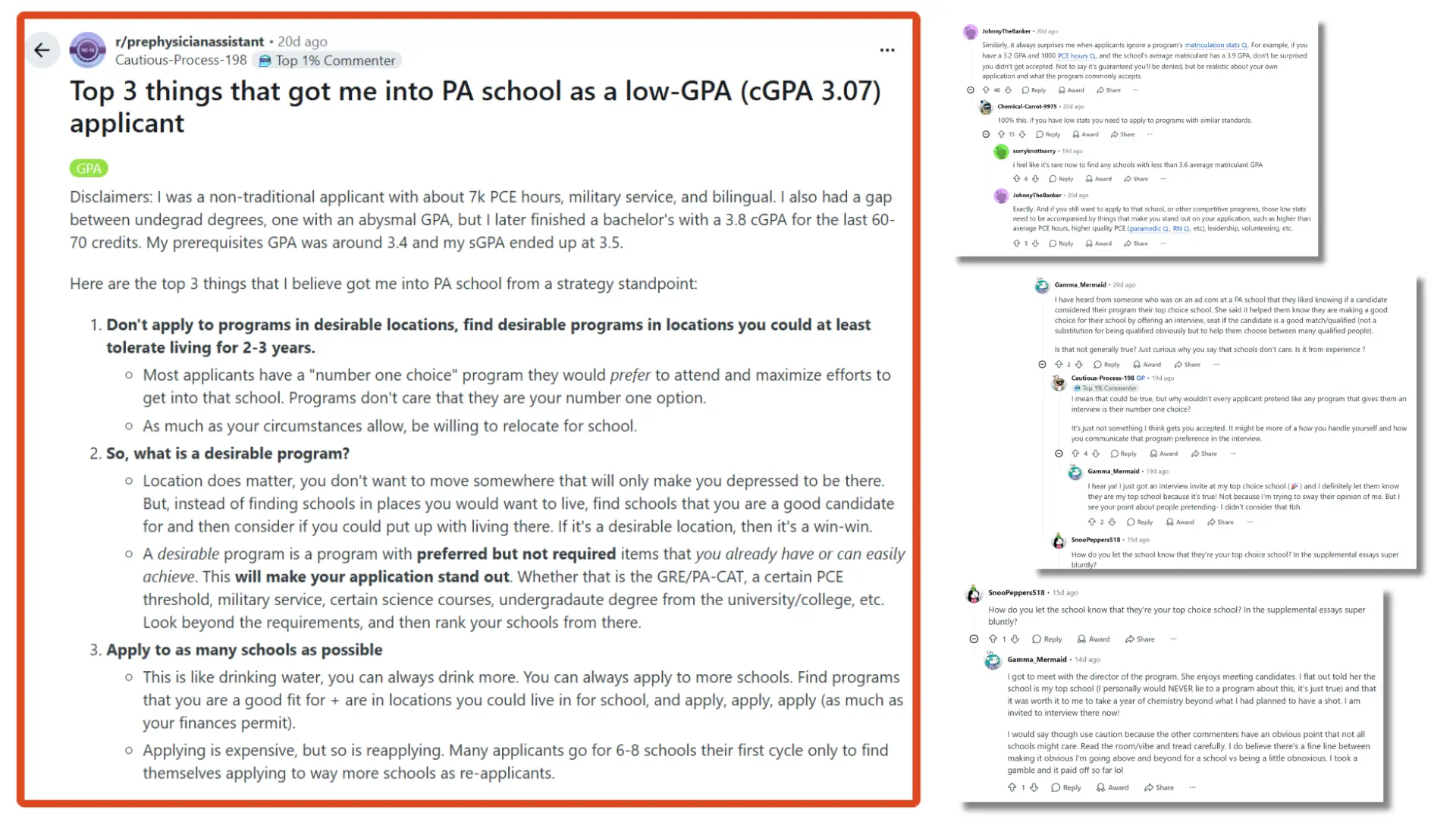
The r/prephysicianassistant centers on a low-GPA applicant’s case for strategy over stats. Pick programs by fit and location tolerance rather than prestige.
Target schools where your numbers already beat their preferred criteria. Apply broadly since more applications mean better odds.
The community largely agreed but sharpened the point. Matching a program’s actual matriculant averages matters more than ambition.
Less competitive regions quietly improve acceptance chances. A rising GPA trend can outweigh any single tactic.
- JohnnyTheBanker warned against ignoring a program’s matriculation stats before applying.
- Purple_Avocado36 suggested lower-density regions for better odds
The Bottom Line
Picking the right PA school takes more than luck and hope. Focus on programs that already match your GPA and hours. Apply to several schools instead of pinning hopes on just one.
Rolling admissions reward early applicants, so submit your papers soon. Strong recommendations and an honest personal statement carry real weight too.
The easiest PA schools to get into still expect real effort and drive. Quality never drops just because admission rules feel more relaxed.
Pick a few schools from this list and start your application soon. Don’t forget to share your picks in the comments.
Frequently Asked Questions
Are “Easy” PA Schools Still Good Quality Programs?
Yes. “Easy” refers to admissions criteria, not education quality. All accredited programs meet the same ARC-PA standards, and every graduate sits the same national licensing exam, the PANCE.
What Makes PA School Applications Get Rejected Most Often?
The most common reasons include low GPA or weak science grades, insufficient patient care hours, a generic personal statement, missing prerequisites, and applying too late or to too few programs.
Do Easier PA Schools Still Require Strong Interviews?
Yes. Interviews are critical in every program. Communication skills, patient care mindset, and responses to behavioral and scenario-based questions carry significant weight.