
The TEAS science section trips up a lot of students, and it is easy to see why. It is not just about memorizing facts. You need to apply concepts, read data, and work fast under pressure.
That is a lot to handle without the right preparation. Practicing with an ATI TEAS science practice test is one of the smartest moves you can make early on.
It shows you exactly where you stand before you ever walk into the exam room. The sections ahead break down everything you need to know about the format, the question types, and the best study resources. Let’s get into it.
TEAS Science Section Format
Most students sit down for the science section, thinking it will feel like a straightforward quiz. It does not.
The science section gives you 60 minutes to work through 50 questions, and it is designed to test not just what you know but also how well you can apply scientific concepts under pressure.
Of the 50 questions, 44 are scored, and 6 are unscored. Scored questions are the ones that actually count toward your final result. The unscored ones are questions ATI is quietly testing out for future versions of the exam.
The 44 scored questions are split across four topic areas:
| Topic Area | Scored Questions |
|---|---|
| Human Anatomy & Physiology | 18 |
| Biology | 8 |
| Chemistry | 8 |
| Scientific Reasoning | 10 |
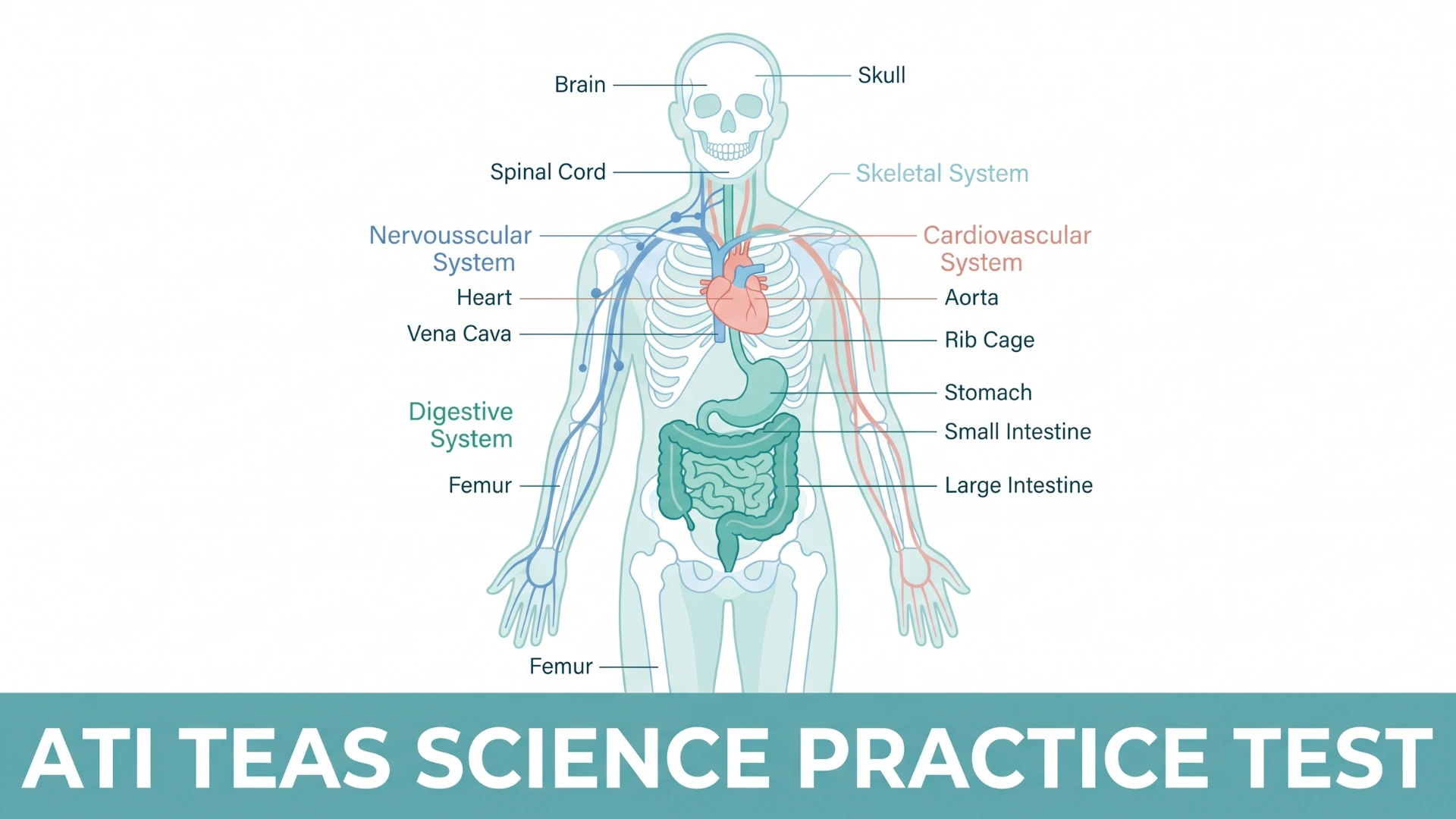
Anatomy and physiology carry the most weight by far. If your study time is limited, that is where to start.
Types of Questions You’ll See on the TEAS Science Section
Knowing the format before test day removes a layer of surprise. The science section uses four question types, each testing you a little differently.
1. Standard Multiple Choice
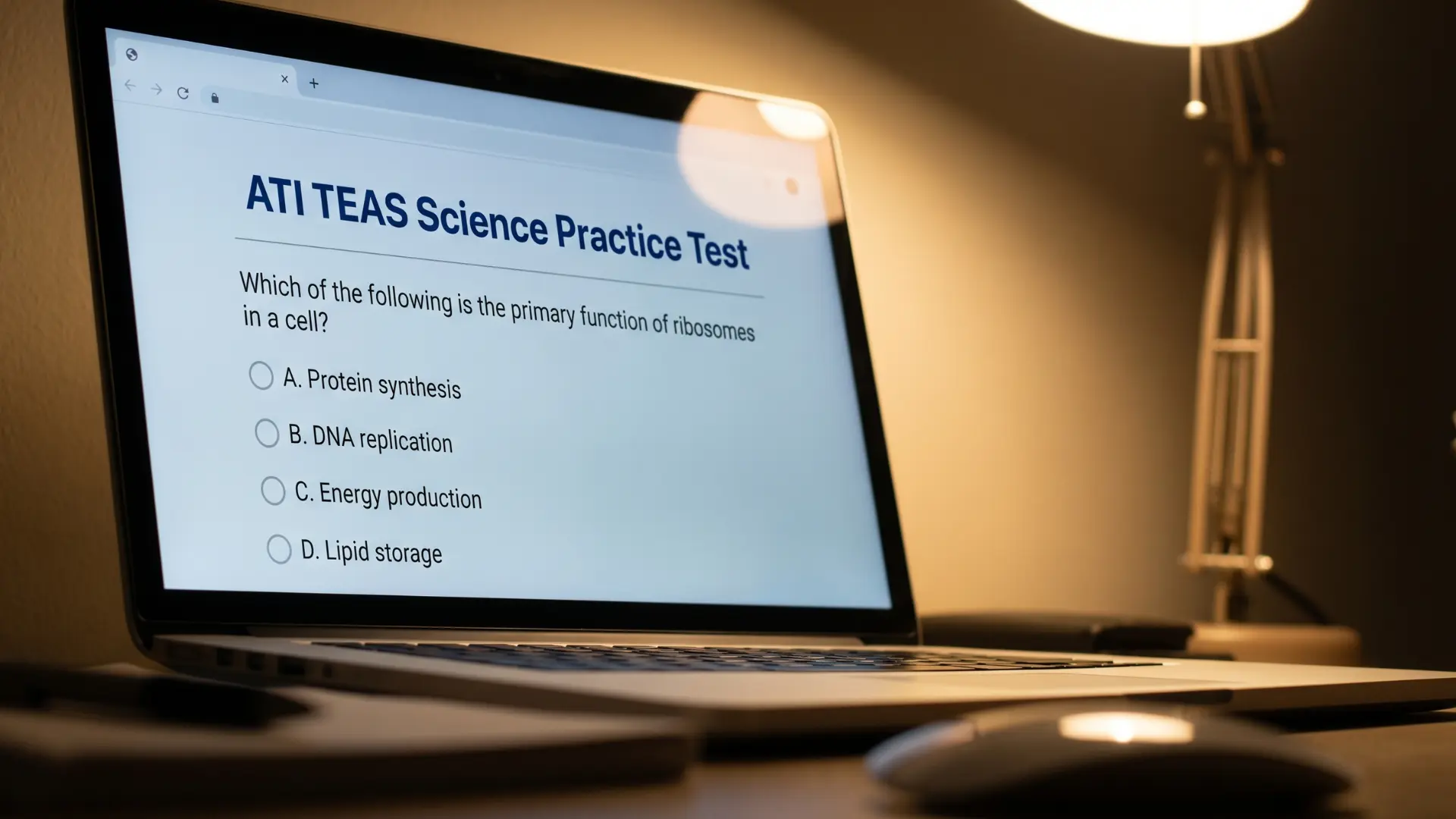
1 question, 4 options, 1 correct answer. The wrong options are written to look convincing and are not random. They are designed to catch students who half-read the question or stop at the first answer that sounds familiar. Read all four options before committing to one.
2. Direct Recall
Straightforward, fact-based questions like “which organ produces insulin,” or “what is the powerhouse of the cell.” You either know it or you do not.
There is no way to reason your way through these, which is why consistent content review matters more than test-taking strategy for this type.
3. Application-Based
A scenario is described, and you are asked to apply a concept to answer it. Instead of asking what red blood cells do, the question might describe a patient with low hemoglobin and ask which bodily process would be most affected.
Same concept, harder delivery. These show up more than most students expect. Studying the why behind things, not just the what, is what separates students who score well here from those who do not.
4. Passage-Based
A short paragraph of scientific information appears before the question. Everything you need to answer it is inside that paragraph.
The answer is always supported by something in the passage itself. Students consistently lose points here by bringing in outside knowledge or overthinking.
Read it carefully, identify what it actually says, and let that guide your answer.
5. Data and Graph Interpretation Questions
Out of all the question types on the TEAS science section, data and graph interpretation is where the most avoidable points get lost.
You will be shown a chart, table, or graph, followed by a question asking what conclusion can be drawn from it.
It might be a bar graph showing enzyme activity at different temperatures, a table comparing results from two experimental groups, or a line graph tracking hormone levels over time.
Free TEAS Science Practice Tests & Study Resources
Taking practice tests is the single most effective thing you can do before sitting for the science section. But not all resources are equal. Here are the ones actually worth your time.
1. ATI Official Free Practice Test
Start here. ATI offers a free 60-question practice exam covering all four sections, including science, with 15 questions per section.
It includes alternate item types like select all that apply and fill in the blank, and gives you a score report with study recommendations at the end. It is the only practice test written by the actual creators of the TEAS.
2. Khan Academy Science Courses
Free, no account needed to browse. Khan Academy covers high school and AP-level biology, chemistry, and physiology, all of which directly overlap with TEAS science content.
Use it to brush up on concepts, not as a standalone practice test resource.
3. Mometrix TEAS Science Practice Test
Free practice questions with detailed answer explanations.
Mometrix has compiled data from nearly 30,000 test-takers and identified the five science questions students most commonly get wrong, making their explanations particularly useful for targeting weak spots.
4. Union Test Prep
A free resource with 150 practice questions that match the style and format of the actual TEAS, arranged across all four content areas, including science.
Free practice questions broken down by section. A good option for quick topic-specific drills when you want to focus on one area at a time.
5. Pocket Prep
App-based, available on iOS and Android. Best for studying in short bursts on your phone. The free version offers a limited number of questions, while the paid version unlocks the full question bank.
One tip worth remembering: do not just take tests and move on. Every wrong answer is a signal.
Go back, read the explanation, understand why you missed it, and note the topic. That habit alone will do more for your score than taking ten practice tests back to back.
6. Quizlet
Free, no account required to browse. Quizlet hosts hundreds of user-created TEAS science flashcard sets and practice quizzes covering anatomy, biology, chemistry, and scientific reasoning.
Best used alongside full-length practice tests to reinforce concepts and terminology you keep missing.
Not a substitute for timed practice, but a solid tool for targeted review between full test sessions.
7. NurseHub
Free TEAS science practice questions with detailed answer explanations broken down by subject area.
Makes it easy to target specific topics rather than retaking full-length tests every time.
A strong option when you already know which science areas need the most work and want focused drilling without sitting through an entire exam again.
8. Nursing.com
Free video-based science review covering core topics tested on the ATI TEAS. Lessons are short, focused, and built specifically for nursing school applicants.
Useful if you retain information better through watching than reading.
Not a practice test resource, but a strong complement when a concept is not clicking and you need a different way to absorb it.
9. Test-Guide
Free full-length and section-specific TEAS practice tests, no sign-up required. Science questions cover all tested subject areas and come with answer explanations.
A reliable option when you want extra practice volume without paying for a premium resource.
Works well in the final week before your exam when you need repetition more than new study material.
TEAS Test Study Guide:
ATI recommends at least 6 weeks of preparation before taking the TEAS. Take a diagnostic test first. Your score tells you exactly how much time you need and where to focus.
6-Week TEAS Science Study Schedule
Six weeks gives you enough time to cover every subject without burning out. Here is a simple week-by-week breakdown to follow:
| Week | Focus | Daily Time | Key Activities | Goal |
|---|---|---|---|---|
| Week 1 | Diagnostic practice test, identify weak areas | 1 hour | Take a full practice test, note every weak area | Know exactly where to focus |
| Week 2 | Anatomy and Physiology | 1 to 2 hours | Review body systems, flashcards, and short quizzes | Build a strong science foundation |
| Week 3 | Biology and Chemistry | 1 to 2 hours | Study cells, genetics, and basic chemistry concepts | Cover remaining science content |
| Week 4 | Scientific Reasoning and Data Interpretation | 1 hour | Practice graph reading, data questions, and reasoning drills | Strengthen test-taking skills |
| Week 5 | Full practice test, review every wrong answer | 2 hours | Timed full test, detailed answer review | Identify any remaining gaps |
| Week 6 | Targeted review of weak spots, light revision | 1 hour | Revisit weak areas, light reading, rest before the test | Walk in confident and prepared |
If you only have 2 weeks, compress content review into the first week with one topic per day. Spend week two on weak areas only.
Study Tips That Actually Move Your Score
Preparation strategy matters as much as study time. These habits will help you get more out of every session.
- Start With a Diagnostic Test: Take a practice test first, so you know exactly where to focus.
- Review Every Wrong Answer: Read each explanation, note the topic, and understand why you missed it.
- Study in Timed Blocks: Keep sessions to 45-60 minutes. Longer sessions reduce retention.
- Go Back to the Concept: Review the concept before drilling more practice questions.
- Wind Down the Final Week: Stop learning new material. Review weak areas and take one full timed test to finish strong.
Small, consistent habits beat long, irregular sessions every single time. Stick to the plan, and the score will follow.
Understanding Your TEAS Science Score
Your TEAS score is a weighted average across all four sections: Reading, Math, Science, and English. No single score works as a universal pass mark. Every program sets its own bar.
Most nursing programs require between 60% and 75% overall. Competitive programs often want 75% or higher. Allied health programs vary widely, so it’s worth checking directly with the school.
The science section carries extra weight in many cases. Some programs will turn down your application if your science score falls below 60%, even if your overall score looks fine.
Always check the exact requirements for each program you apply to before test day.
What to Expect on Test Day
Walking into the exam knowing what the interface looks like removes one more thing to stress about. Here is exactly what you will encounter:
- The test is computer-based at most testing centers
- Beyond standard multiple-choice, you will see multiple-select, fill-in-the-blank, ordered response, and hotspot questions
- No calculator is available during the science section. The built-in calculator only unlocks for math
- You cannot go back to a previous section once you move forward
- The science section gives you 60 minutes for 50 questions, just over a minute per question
- Metric conversions, simple ratios, and basic arithmetic are worth reviewing before you sit down
- Bring a valid photo ID. No personal items are allowed at the testing station
Knowing the format in advance means you walk in with one less thing to worry about and more mental energy for the questions that actually count.
Frequently Asked Questions
How Hard is the TEAS Science Section Compared to The Other Sections?
The science section is widely considered the most difficult part of the TEAS. It covers four completely different disciplines under a 60-minute time limit, which is what catches most students off guard.
How Many Questions Can I Get Wrong and Still Pass?
A passing science score in most programs means getting around 70% of questions correct. Out of 44 scored questions, that’s roughly 13 misses before most programs consider you below their threshold.
Is the Science Section the Same Every Time?
No. ATI creates multiple versions of the exam, so the specific questions change with every attempt. The topics stay consistent with the official blueprint, but you will not see the same questions twice.
Can I Retake the TEAS if I Am Not Happy with My Science Score?
Yes. If testing through ATI directly, the retake policy requires a 14-day wait between attempts. Most schools cap attempts at three per year, with many requiring a 30-day wait between retakes. Always confirm your specific program’s policy before scheduling.
Final Thoughts
Scoring well on the TEAS science section comes down to one thing: focused preparation. Knowing the format helps.
Practicing regularly helps even more. An ATI TEAS science practice test gives you a clear vision of where you are and what still needs work. Use that information well. Study the topics that trip you up.
Review every wrong answer carefully. Do not just take tests and move on. Each session should bring you a little closer to the score your program requires.
You have everything you need to walk in prepared and confident. Now it is time to put it into action. Scored higher than you expected? Drop your score in the comments below.