

Medical school has a way of making even the most disciplined students feel like they’re drowning.
The reading never ends. The exams keep coming. And the advice you relied on in undergrad stops working almost immediately.
Learning how to study for medical school means rebuilding your approach from the ground up.
This post covers the study methods, scheduling strategies, and subject-specific techniques that actually hold up under the pressure of preclinical coursework and beyond.
Less noise. More of what works.
What Makes Medical School Studying So Much Harder
In undergrad, strong study habits were enough to get by. In medical school, those same habits will get you buried.
The volume is relentless. Students move through dense material across multiple subjects every single week, with no room to fall behind.
The material also has to stick in the long term, not just through the next exam. Clinical recall years later depends on how well you learned it the first time.
On top of that, USMLE and shelf exams test reasoning through clinical vignettes rather than fact regurgitation. Recognizing a drug name is not enough. You need to know why it works, when it fails, and what happens next.
The students who perform well are not the ones who study the most. They are the ones who study differently.
The Best Study Methods for Medical School
1. Active Recall
Works best for: All subjects, all stages.
Time commitment: 20-30 min per session.
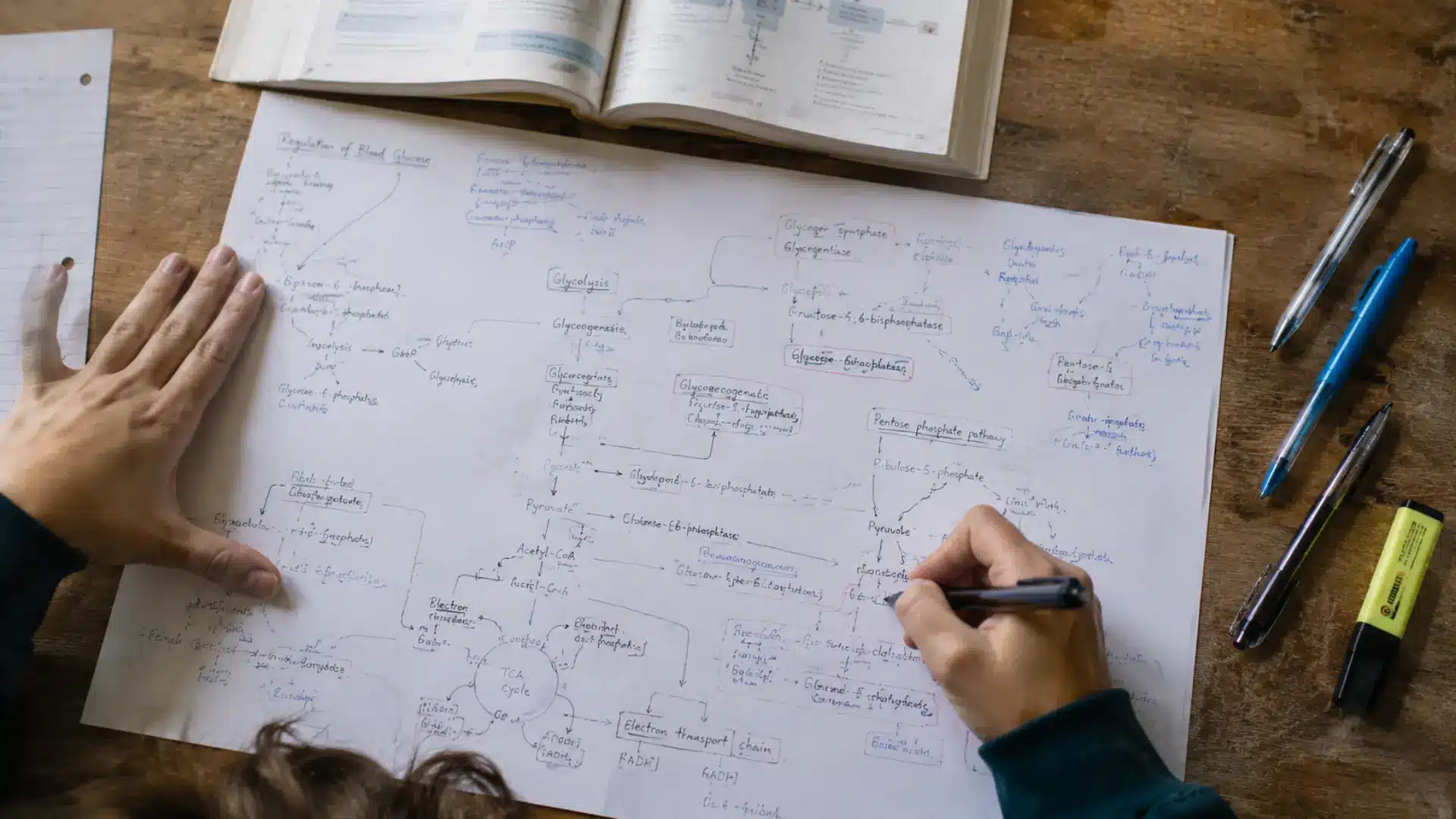
Active recall means pulling information out of your brain instead of pushing it back in. Re-reading feels productive but does very little for long-term retention.
Testing yourself forces your brain to retrieve, and that retrieval process is what builds lasting memory.
Put it into practice by closing your notes and writing down everything you remember. Use flashcards, work through question banks, or just quiz yourself out loud. The discomfort of not knowing is the point.
2. Spaced Repetition
Works best for: High-volume memorization.
Time commitment: 30-60 min daily.
Your brain forgets predictably. Without review, most new information fades within days. Spaced repetition works by scheduling reviews right before forgetting occurs, reinforcing memory each time.
Anki is the standard tool for this. Pre-made decks like AnKing cover the high-yield content mapped to First Aid and USMLE, which saves significant setup time.
Making your own cards works well for material that your class emphasizes that AnKing does not cover. Most students do best combining both: use AnKing as the foundation and build on top of it.
3. The Pomodoro Technique
Works best for: Focus and burnout prevention.
Time commitment: 50 min work, 10 min rest.
A standard Pomodoro consists of 25 minutes of focused work followed by a 5-minute break.
A 50/10 format works better for medical school, where concepts often require longer, uninterrupted blocks to fully process.
The break is not optional. It is where consolidation happens. Step away from the material completely and come back sharper.
4. Teaching Back (Feynman Method)
Works best for: Complex mechanisms and pathways.
Time commitment: 15-20 min per concept.
If you cannot explain it simply, you do not know it yet.
The Feynman method exposes exactly where your understanding breaks down, which makes it especially useful for pathophysiology, drug mechanisms, and any process with multiple moving parts.
You do not need an audience. Explain the concept out loud to yourself, write it out like you are teaching a confused classmate, or sketch the pathway from memory. Wherever you get stuck is where you need to go back.
5. High-Yield Passive Review
Works best for: Building initial frameworks.
Time commitment: 20-40 min per topic.
Passive review has a place in medical school studying, but only as a complement to active methods.
Sketchy works well for pharmacology and microbiology because the visual storytelling makes associations stick. Pathoma keeps pathology concepts tight and clinical.
The practical way to layer both in one session: watch a Sketchy video or a Pathoma chapter first to build the framework, then immediately switch to active recall.
6. Interleaving
Works best for: Mixed subject days, exam prep
Time commitment: Built into existing study blocks
Interleaving means alternating between different subjects or topics within a single study session rather than spending the entire block on one topic.
It feels less efficient than blocked studying, but the mental effort of switching contexts is exactly what strengthens long-term retention and flexible recall.
In practice, spend 40 minutes on cardiology, switch to a pharmacology question set, then return to a different cardiology concept.
7. The Blurting Method
Works best for: end-of-session review, weak subject identification.
Time commitment: 10-15 min per topic
Take a blank sheet of paper and write down everything you know about a topic from memory. No notes, no prompts, nothing open.
Whatever comes out is what you actually know. Whatever does not come out is what needs more work.
It is one of the fastest ways to identify gaps without running through an entire question bank. Use it at the end of a study session as a quick audit, or at the start of a review day to see what survived from the previous week.
How to Study for Different Sections
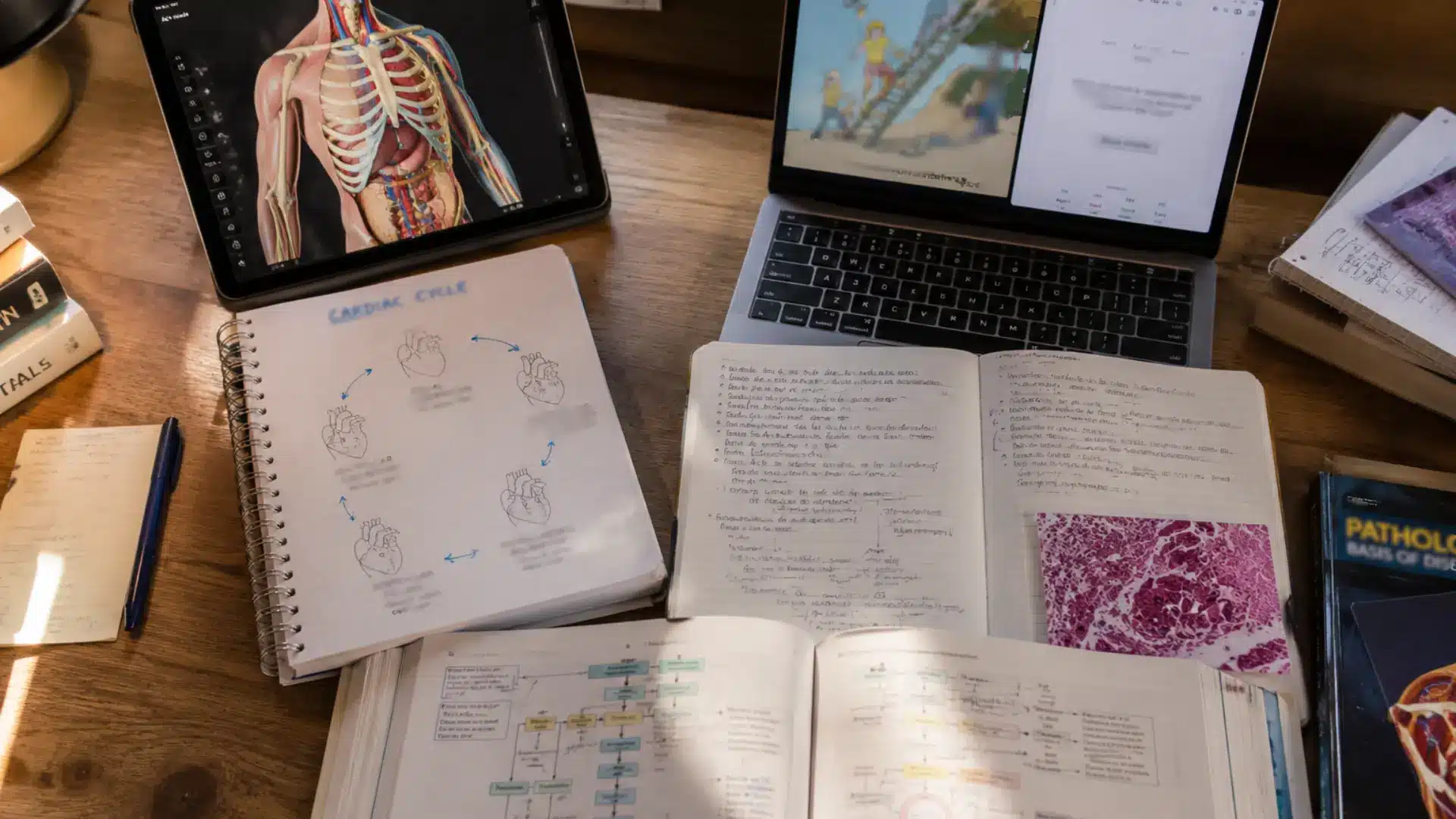
Every subject in medical school has its own logic. Here is how to approach each one:
1. Anatomy
Anatomy rewards students who think in three dimensions, and flat diagrams alone will never give you the spatial understanding this subject demands. Building a strong foundation before you ever touch a cadaver starts with the right tools and the right habits:
- Use 3D tools like Visible Body or Complete Anatomy alongside your atlas to build spatial understanding of every structure
- Cross-reference lab structures with your atlas regularly to connect what you see on screen with what you see in person
- Use Anki mnemonics consistently to lock in nerve and muscle groups that are easy to confuse under pressure
Cadaver time is limited, so never just observe in the lab. Actively identify, trace, and quiz yourself on every structure your group exposes to make the most of every session.
2. Physiology
Physiology is the one subject where memorization will actively work against you. The concepts connect, and understanding those connections is what carries you through vignette-based questions later:
- Draw out entire systems from scratch: the cardiac cycle, the renin-angiotensin-aldosterone system, acid-base compensation
- Use concept maps instead of flashcards to see how each component feeds into the next
- If you can reproduce the pathway without looking, you understand it. If you cannot, you have only memorized it
Tip: Keep a dedicated notebook just for hand-drawn pathways. Redrawing from scratch every few days is more effective than reviewing a diagram you already made.
3. Pharmacology
Start with drug classes, not individual agents. Understanding the class mechanism gives you a framework that applies across every drug within it:
- Learn the mechanism of the class before memorizing individual drug names
- Once the class is solid, layer in individual agents using Anki and Sketchy together
- Watch the Sketchy video first, add the corresponding Anki cards immediately after, and review them the same day
- Do not move to a new drug class until the current one is solid in Anki
Pharmacology becomes manageable the moment you stop treating every drug as a separate thing to memorize and start seeing it as part of a system you already understand.
4. Pathology
Robbins provides the depth. Pathoma provides the clinical clarity. Use them together rather than choosing one:
- Read the relevant Robbins section first to build foundational understanding
- Watch the corresponding Pathoma chapter to see how that knowledge gets applied and tested
- Start practicing with image-based questions earlier than feels necessary
If the first time you see histology slides or gross specimens is during dedicated Step 1 prep, you are already behind.
5. Biochemistry
Not all biochemistry is worth equal attention. For USMLE Step 1, focus lands heaviest on enzyme deficiencies, metabolic disorders, and key cycle intermediates:
- For pathways like glycolysis, the urea cycle, and the citric acid cycle, draw and redraw from memory until the flow is automatic
- For enzyme deficiencies and associated diseases, Anki cards are more efficient than charts
- Always connect the biochemistry back to a clinical presentation or disease
Tip: Do not force one format onto all of biochemistry. Charts work for pathways. Flashcards work for deficiencies. Use both.
Where to Find the Right Question Bank
Not every question bank is built for the same purpose. Here is where to find the most widely used ones.
- UWorld: Gold standard for Step 1 and Step 2 CK prep. Most closely matches real exam difficulty.
- Amboss: Best during coursework and dedicated prep. Combines a question bank with an integrated medical library.
- Kaplan: Straightforward question style. Best for building early M1 foundations.
- NBME Practice Exams: Not a traditional bank, but the closest simulation of the actual Step 1 exam format.
- Sketchy: Visual learning for pharmacology and microbiology. Free trial available upon sign-up.
- Pathoma: Concise, high-yield pathology resource. Pairs well with Robbins for Step 1 prep.
Most students do not need all of these. Pick one primary question bank, supplement with Anki, and add resources only when a specific gap needs filling.
Preclinical vs. Clinical Years: How Your Approach Should Shift
The content changes every year in medical school. What got you through M1 will not be enough for M2, and what worked in preclinical years looks completely different once rotations begin.
Here is how the approach shifts at each stage:
| Feature | M1 | M2 | Clinical Years |
|---|---|---|---|
| Primary Focus | Building foundational systems | Integration and Clinical Reasoning | Shelf exams and patient application |
| Study Approach | Methods-heavy, finding what works | Question-heavy, spaced repetition at full volume | Case-based, subject-by-subject |
| Anki Usage | Building the habit, starting AnKing | Full deck active, daily reviews non-negotiable | Maintenance mode, high-yield only |
| Question Banks | Light usage, tutor mode only | Daily habit, mix of tutor and timed | Shelf-specific banks, timed mode |
| Passive Review | A higher proportion of concepts are new | Minimal, only to fill framework gaps | Almost none |
| Biggest Mistake | Over-relying on passive re-reading | Treating M2 like an extended M1 | Ignoring Anki during busy rotations |
The shift from one year to the next is not just about adding more. It is about adjusting the ratio. Less passive, more active.
Build Your Study Schedule Around These Tips
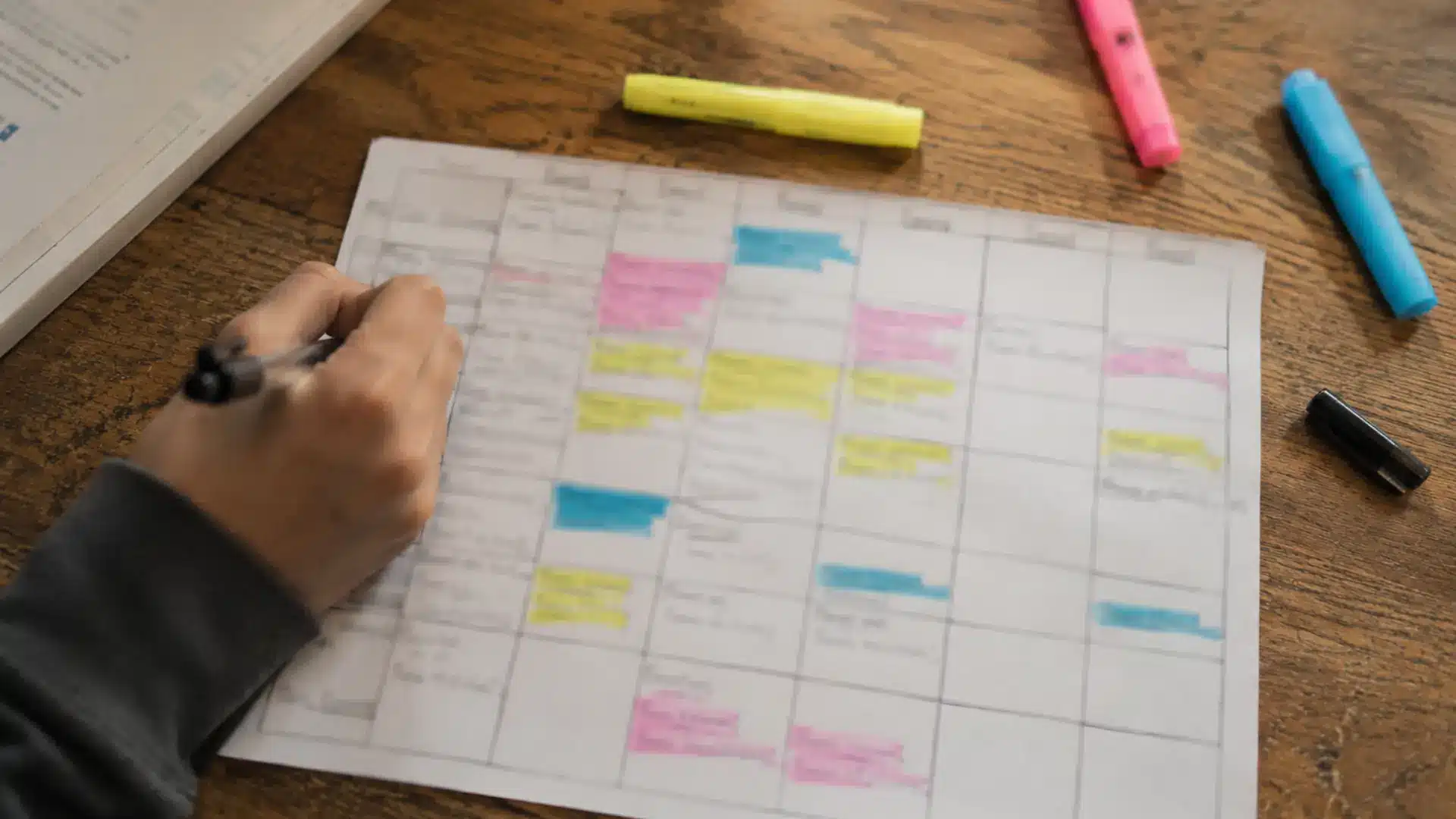
The right methods mean nothing without a structure to hold them. Here is an actual weekly plan built around everything covered above.
Daily Structure
A productive day in medical school is not about studying from sunrise to midnight. It is about protecting the right blocks in the right order.
| Time Block | Activity | Goal | Output |
|---|---|---|---|
| Morning (2–3 hrs) | New material: lecture, Pathoma, or Sketchy, depending on the subject | Build first exposure to new concepts | Completed notes or annotated slides |
| Mid-morning (1–2 hrs) | Active recall on morning content; close notes, self-test, Anki cards | Reinforce what was just learned before it fades | Flagged weak areas from self-testing |
| Afternoon (2–3 hrs) | Question bank block in tutor mode, full answer review after | Apply knowledge and identify gaps through practice questions | Reviewed explanations and updated notes |
| Evening (30–45 min) | Anki reviews: due cards only, no new content | Maintain retention of previously learned material | Due card streak cleared |
| Night (20–30 min) | Flag weak areas, update study plan for the next day | Set a clear focus for the next morning session | Updated plan ready for the next day |
The daily structure stays consistent. What changes is the subject, the question bank topic, and how close you are to the next exam.
Weekly Structure
Zoom out to the week, and the pattern becomes clear: weekdays build, Saturday catches up, and Sunday consolidates.
| Day | Focus | Primary Activity | Goal |
|---|---|---|---|
| Monday to Friday | New content in the morning, active recall, and Qbank in the afternoon | Learn new material, self-test, and complete a timed question bank block | Build fresh knowledge daily and reinforce it before it fades |
| Saturday | Catch-up day; revisit anything flagged during the week | Review flagged topics, redo missed questions, and fill knowledge gaps | Close the gaps that opened during the week before the Sunday review |
| Sunday | Review only, no new content; clear Anki backlog and revisit weak points | Anki backlog, weak topic review, and light consolidation of the full week | Lock in the week’s learning and enter Monday with a clean slate |
One full week of this, repeated consistently, compounds faster than any cramming session ever will.
What to Adjust Based on Where You Are in The Semester:
The plan shifts as the semester progresses. Here is how to adapt it without losing momentum.
- Early in the block: Tutor mode on question banks, higher proportion of passive review to build frameworks
- Mid-block: Switch to mixed mode, increase active recall, reduce passive review
- Two weeks before exams: Timed question blocks daily, Anki maintenance only, no new resources
The schedule is not the goal. Retention is. Block the time, protect it consistently, and let the methods do the work.
Medical School Study Myths That Need to Stop
Bad advice spreads fast in medical school. Here are the ones worth ignoring.
Myth 1: “You Need to Read Every Word of Every Textbook.”
Fact: No medical student has the time, and the ones who try fall behind. High-yield resources exist for a reason. Robbins, First Aid, and Pathoma cover what actually gets tested.
Myth 2: “More Hours Always Mean Better Results.”
Fact: Hours are not the metric. Retention is. Six focused hours of active recall will outperform ten hours of passive re-reading in both the short and long term.
Myth 3: “Anki is only for Memorization-Heavy Subjects.”
Fact: Anki works across every subject in medical school, including physiology and pathology. Any concept that needs to stay accessible long-term is a candidate for a card.
Myth 4: “You should master one subject before moving to the next.”
Fact: Medical school does not allow for that kind of sequencing. Subjects overlap, exams stack, and waiting for mastery before moving on creates dangerous gaps.
Myth 5:“Smart Students Do Not Need a System.”
Fact: The students who perform best in medical school are almost always the ones with the most consistent systems, not the ones with the most raw intelligence.
Common Study Mistakes Medical Students Make
Most students do not fail because they did not study hard enough. They fail because they studied the wrong way for too long.
- Re-reading without recall: Running your eyes over notes creates familiarity, not retention. If you cannot close the material and reproduce what you just read, you have not learned it.
- Starting Anki too late: The deck compounds. Starting late in M2 means inheriting a backlog that never fully clears, which defeats the entire logic of spaced repetition. Start in M1.
- Skipping weak subjects until dedicated to them: Avoiding biochemistry or biostatistics until Step 1 is dedicated to them means learning those subjects under pressure, with no margin for error.
- Neglecting sleep in favor of more hours: Memory consolidation happens during sleep. A well-rested six-hour session will outperform a sleep-deprived ten-hour one almost every time.
- Over-relying on lecture slides: Lecture slides are an outline, not a curriculum. They tell you what the professor finds important, not what Step 1 or shelf exams will test.
Most of these mistakes share the same root: prioritizing comfort over effectiveness. Re-reading is comfortable. Avoiding weak subjects is comfortable.
Frequently Asked Questions
How Many Hours a Day Do Medical Students Study?
Most M1 and M2 students study between 6 and 10 hours daily. Hours alone are not a reliable measure; a focused 6-hour session with active recall will consistently outperform a distracted 10-hour one.
Is Anki Necessary for Medical School?
Not strictly necessary, but it is the most efficient tool available for the volume medical school demands. Students who avoid it usually spend significantly more time reviewing the same material with worse retention.
What is the Best Study Method for Step 1?
Active recall through question banks, combined with spaced repetition in Anki, is the most consistently effective approach. Doing 40 questions daily with a thorough review of answers will outperform doing 200 questions passively every time.
Can You Study Too Much in Medical School?
Yes. Studying beyond the point of productive retention is counterproductive. Fatigue impairs memory consolidation, and if retention feels flat despite more hours, the session is no longer working.
How Do Medical Students Stay Organized?
Most rely on a weekly schedule, a running Anki deck, and a system for flagging weak areas. The tool matters less than the habit of regularly reviewing and adjusting the schedule.
Final Thoughts
Learning how to study for medical school comes down to one principle: method over hours. The students who perform well are not studying more.
They are studying actively, spacing their reviews, and protecting a system that compounds over time.
In this post, we covered the study methods that actually work, how to build a schedule around them, subject-specific strategies for anatomy through biochemistry, how to use question banks effectively, and the most common mistakes to avoid.
Bookmark this page and come back to it whenever the approach needs a reset.