

You can write the best DBQ of your life and still walk out with a disappointing score.
The MCQ section makes up nearly half your AP World History grade, and most students barely prepare for it.
Weeks go into the essays. An hour, maybe two, goes into multiple choice. That gap is exactly where scores drop. Consistent AP World MCQ practice is what closes that gap before exam day.
High-frequency terms, time periods, tips, and free resources. Everything you need starts here.
Understanding the AP World History MCQ Section
The MCQ section gives you 55 questions and exactly 55 minutes to answer them. That works out to roughly one minute per question, so pacing matters more than most students expect.
Questions do not come individually. They are grouped in sets of 3 to 4 questions, each tied to a single stimulus. That stimulus could be a written excerpt, a map, a chart, or a historical image.
The good news on scoring: there is no penalty for wrong answers. Every unanswered question is a missed opportunity, which is why understanding the total exam duration from the start helps you guess smart and always guess.
High Frequency Themes to Know for AP World History MCQs
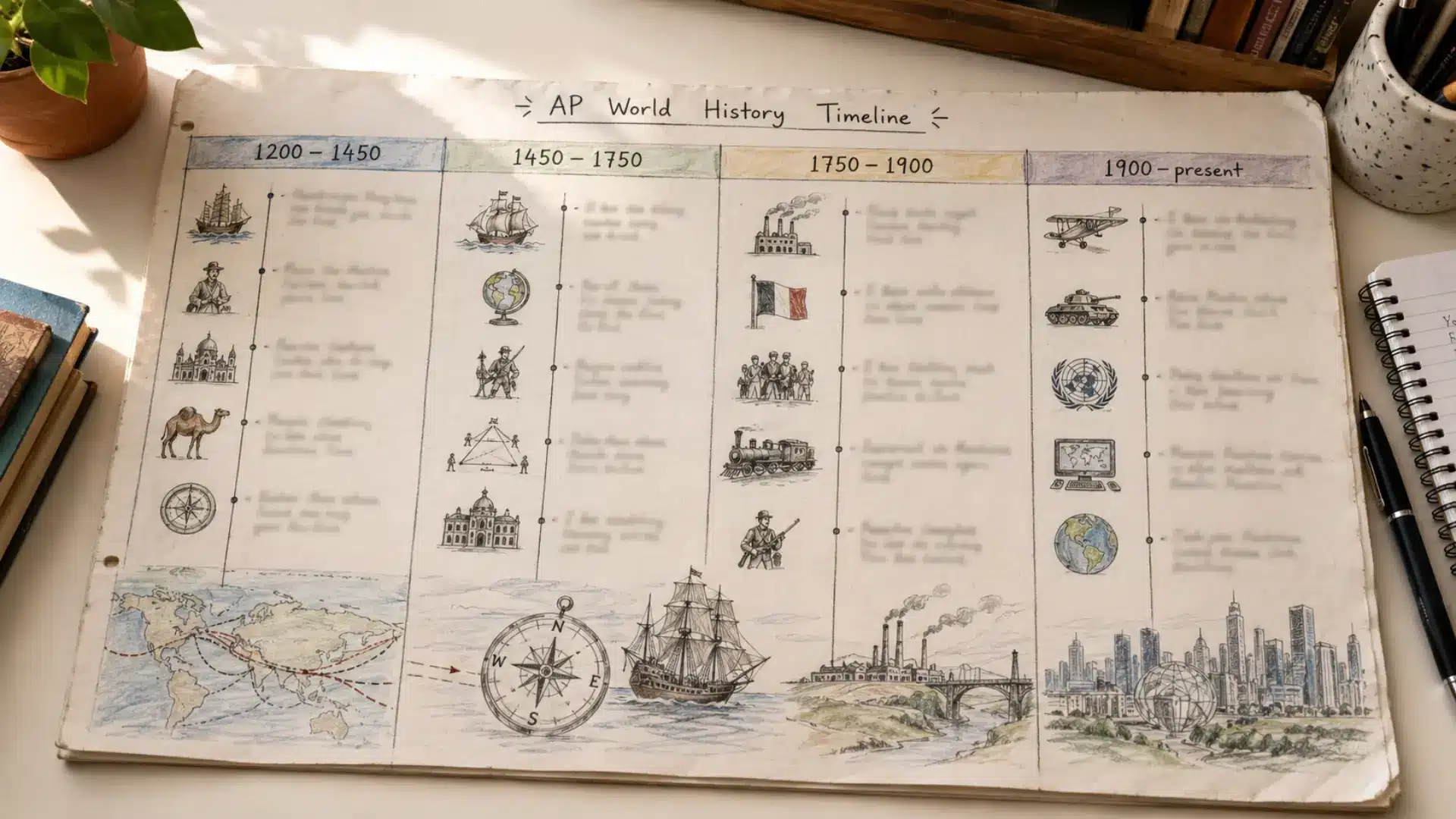
College Board does not test random facts. It tests themes that repeat across time periods and civilizations. If you can recognize these five themes in any stimulus, you will be ahead of most students in the room.
1) Trade and Exchange Networks
This is the single most tested theme across all four periods. From the Silk Road connecting China to the Mediterranean, to the Indian Ocean trade network linking East Africa, South Asia, and Southeast Asia, to the Atlantic trade system that emerged after 1450, exchange networks show up everywhere on this exam.
Know who controlled these routes, what moved along them beyond just goods, and how they shifted power between civilizations over time.
2) State Building and Empire Comparison
The College Board loves asking you to compare how different empires built and maintained power. The Mongol Empire, the Ottoman Empire, the Ming Dynasty, the Mughal Empire, and European colonial empires are all fair game.
Focus on how each state legitimized authority, managed diverse populations, and eventually declined. Comparison questions across these empires are extremely common.
3) Social Hierarchies and Gender Roles Across Cultures
How societies organize themselves internally is a recurring theme. Caste systems, slavery, patriarchy, and the role of religion in reinforcing social structures all appear regularly in MCQ stimuli.
Pay close attention to how gender roles and social hierarchies changed or stayed the same across different time periods. Continuity and change over time questions love this theme.
4) Technological and Environmental Change
From the introduction of new crops during the Columbian Exchange to the Industrial Revolution changing labor and cities, technology and environment shaped every period of world history on this exam.
Think about how new technologies spread along trade routes, how environmental factors like disease and climate affected civilizations, and how industrialization changed the relationship between humans and the natural world.
5) Revolutions and Political Changes
The Age of Revolutions, from roughly 1750 to 1900, is one of the most heavily tested stretches of the entire course. The French Revolution, the Haitian Revolution, Latin American independence movements, and the rise of nationalism all connect to this theme.
Understand what caused these revolutions, who benefited, who did not, and how they reshaped political structures globally.
What Time Periods Are Covered on the AP World History Exam?
The AP World History exam spans over 800 years of global history. Knowing how much each period is weighted helps you study smarter, not harder.
| Period | Key Topics | Exam Weight |
|---|---|---|
| Period 1: Foundations and Trade Networks | Rise of major empires, Silk Road, Indian Ocean trade networks, spread of religions across Afro-Eurasia | 8 to 10% |
| Period 2: Exploration and Early Empires | European exploration, Columbian Exchange, transatlantic slave trade, rise of land and sea-based empires | 15-20% |
| Period 3: Industrialization and Imperialism | Industrial Revolution, rise of nationalism, European colonization of Africa and Asia, Age of Revolutions | 12 to 15% |
| Period 4: Global Conflict and Decolonization | World War One, World War Two, Cold War, independence movements across Asia and Africa, and modern globalization | 20% |
AP World History MCQ Practice Questions
Stimulus 1:
“The merchants who travel the roads of Central Asia carry with them not only goods but also ideas, religions, and technologies. The exchange along these routes has changed civilizations from China to the Mediterranean.”
– Adapted from a 13th-century account of Silk Road trade
Question 1: Based on the passage, what was the primary significance of Central Asian trade routes?
A) They allowed Chinese emperors to expand political control westward
B) They facilitated the exchange of goods, ideas, and cultural practices across civilizations
C) They were used exclusively by Arab merchants to dominate global trade
D) They connected Europe and Africa through overland routes
Question 2: Which of the following best represents a continuity in trade networks between 1200 and 1450?
A) The decline of the Indian Ocean trade due to Mongol invasions
B) The consistent role of Muslim merchants in connecting Afro-Eurasian trade routes
C) The replacement of the Silk Road by Atlantic sea routes
D) The dominance of European trading companies in Asian markets
Stimulus 2:
“The arrival of European ships along the West African coast fundamentally altered existing trade relationships. Local rulers who had once controlled interior trade routes now found themselves negotiating directly with foreign merchants offering new goods in exchange for enslaved people.”
– Adapted from a modern historian’s analysis of Atlantic trade, 2002
Question 3: The passage best supports which of the following arguments about European contact with West Africa?
A) European merchants replaced all existing African trade networks
B) African rulers had no agency in trade negotiations with Europeans
C) European arrival disrupted and changed existing African trade structures
D) The transatlantic slave trade was entirely controlled by European merchants
Question 4: Which of the following developments most directly led to the expansion of the Atlantic slave trade between 1450 and 1750?
A) The decline of the Ottoman Empire and its trade routes
B) European demand for labor on plantations in the Americas following colonization
C) The collapse of indigenous trade networks in West Africa
D) Portuguese quest of the Indian Ocean coastline
Stimulus 3:
“The factory system drew thousands of rural workers into urban centers, changing not only how goods were produced but how families lived, how time was measured, and how social hierarchies were organized.”
– Adapted from a 19th-century social commentary on industrialization in Britain.
Question 5: The passage suggests that industrialization in Britain primarily resulted in:
A) The immediate improvement of living standards for rural workers
B) Broad social and cultural conversions beyond just economic production
C) The decline of urban centers as workers preferred rural factory work
D) Government-led efforts to protect workers from factory conditions
Question 6: Which of the following best represents a consequence of European imperialism in Asia and Africa from 1750 to 1900?
A) The strengthening of local political institutions through European administrative support
B) The extraction of raw materials and the displacement of local economies to benefit European industries
C) The voluntary adoption of European cultural practices by Asian and African populations
D) The decline of European industrial output due to colonial management costs
Stimulus 4:
“The period following the Second World War witnessed an unprecedented wave of independence movements across Asia and Africa. Colonial populations who had fought alongside European powers now demanded the same freedoms they had helped defend.”
– Adapted from a post-colonial history textbook, 1998
Question 7: According to the passage, what was a key factor driving decolonization after World War II?
A) European powers willingly granted independence as part of postwar reconstruction plans
B) The United Nations forced European nations to immediately abandon all colonies
C) Colonial populations used their wartime contributions to demand political independence
D) The Cold War had no influence on decolonization movements in Asia and Africa
Question 8: The Cold War rivalry between the United States and the Soviet Union most directly affected decolonization by:
A) Preventing newly independent nations from joining international organizations
B) Causing both superpowers to support or oppose independence movements based on their own strategic interests
C) Encouraging European colonial powers to maintain control over their territories
D) Creating a unified global response to end colonialism by 1950
Stimulus 5:
“Between 1870 and 1914, European powers divided nearly the entire African continent among themselves, redrawing borders with little regard for existing ethnic, cultural, or political boundaries.”
– Adapted from a world history academic journal, 2005
Question 9: The passage most directly illustrates which of the following historical developments?
A) The decline of European interest in African natural resources
B) The role of African leaders in shaping colonial borders
C) The impact of European imperialism on African political and cultural structures
D) The peaceful negotiation between European and African governments over territorial boundaries
Question 10: Which of the following best represents a long-term consequence of the colonial border drawing described in the passage?
A) The strengthening of pan-African cultural identity across the continent
B) Political instability and ethnic conflict in post-independence African nations
C) The rapid economic development of formerly colonized African territories
D) The immediate restoration of pre-colonial political boundaries after independence
Answer Key
| Question | Answer |
|---|---|
| 1 | B |
| 2 | B |
| 3 | C |
| 4 | B |
| 5 | B |
| 6 | B |
| 7 | C |
| 8 | B |
| 9 | C |
| 10 | B |
Where to Find More AP World History Past Exams for Free
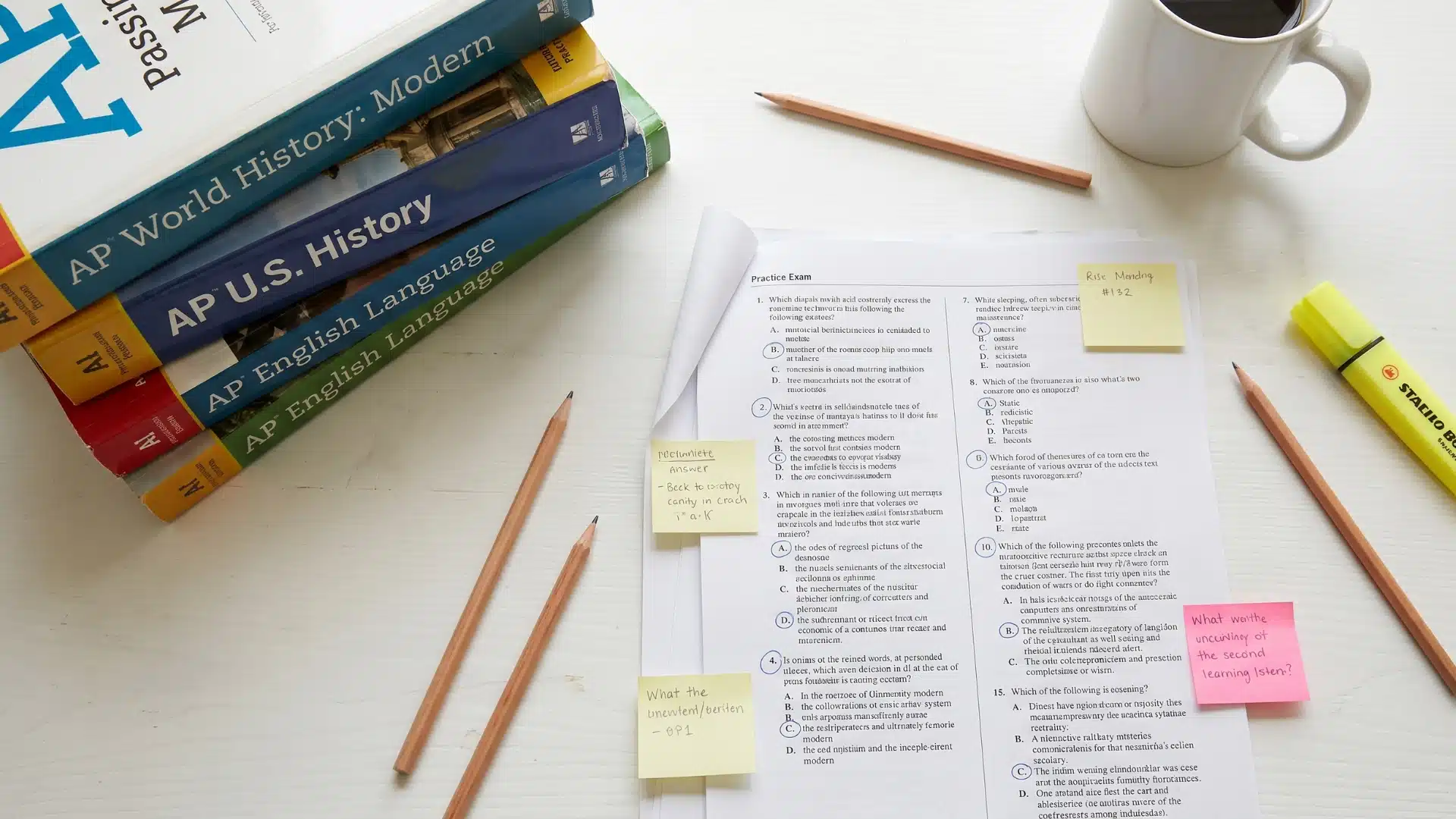
Practicing with real exam material is one of the most important things you can do before test day. Here are the best places to find AP World History past exams and practice questions for free.
1. College Board Official Released Exams
This is your most important resource. The College Board publishes free-response questions from past exams going back to 2018, along with scoring guidelines and sample student responses.
You can download free response questions from past AP World History exams, along with scoring guidelines, sample responses from exam takers, and scoring distributions directly from AP Central.
2. AP Classroom Question Bank (School Login Required)
If your school offers AP World History, your teacher should have access to AP Classroom through the College Board. This platform has a large bank of official MCQ practice questions organized by unit and topic. Ask your teacher to assign practice sets or grant you access.
3. Khan Academy
Khan Academy’s World History Project AP exercises feature a mix of stimulus-based and non-stimulus-based questions, aligned with the Course and Exam Description for AP World History: Modern.
They encourage students to use essential historical thinking skills such as causation, contextualization, comparison, and change over time.
4. Albexrt.io (Free and Paid)
Albert provides practice questions for both multiple-choice and free-response item types, along with full-length practice tests that closely mimic the actual exam.
Albert.io offers a limited number of free AP World History practice questions with a free account, including multiple-choice and free-response questions.
5. Varsity Tutors
Varsity Tutors has several free AP World History practice tests. Once you finish a test, you get immediate feedback with explanations for each question.
It is a solid option for quick, targeted practice sessions between longer study blocks, especially if you want to zero in on specific topics rather than sit through a full-length exam every time.
6. High School Test Prep
The High School Test Prep website offers free practice tests covering all nine units of AP World History, along with a full-length practice exam with 55 multiple-choice questions, SAQs, LEQs, and a DBQ.
It is one of the few free resources that gives you a complete exam experience from start to finish, making it ideal for timed full-length practice runs as your exam date gets closer.
Tips to Tackle AP World History MCQs
Knowing the content is only half the battle. How you approach each question matters just as much. These five strategies will help you work through the MCQ section faster, smarter, and with more confidence.
- Read the Stimulus Before the Question: Read the source fully first, then move to the question. Skimming leads to misreading.
- Eliminate Obviously Wrong Answers First: Cross out answers with wrong time periods or extreme claims. Narrowing to two options improves your odds.
- Watch for EXCEPT and NOT Questions: These require opposite thinking. Circle these words every time, or you will lose easy points.
- Connect the Stimulus to Broader Historical Context: Link the source to a larger pattern. Ask yourself how it fits into the bigger historical story.
- Manage Your Time at Roughly One Minute Per Question: If a question takes more than 90 seconds, mark it and move on.
How to Review Your AP World History Practice Test Results
Taking practice tests is only useful if you review them properly. Most students check their score and move on. That is a missed opportunity. Here is how to turn every practice test into real improvement.
- Step 1: Categorize Your Mistakes by Time Period and Theme: Do not just count wrong answers. Sort them by time period and theme. This tells you exactly where to focus next, rather than studying everything equally.
- Step 2: Identify Recurring Wrong-Answer Patterns: Every student has a pattern. Some fall for answers that sound historically accurate but do not match the stimulus.
- Step 3: Use the AP Course and Exam Description as a Checklist: The College Board publishes the full CED for free. After each practice test, cross-reference your weak areas with it and systematically work through the gaps.
- Step 4: Use Spaced Repetition for Content Gaps: Review weak topics after 1 day, then 3 days, then 1 week. This method is far more effective than cramming and builds the kind of recall that holds up under exam pressure.
Frequently Asked Questions (FAQs)
How many MCQ questions are on the AP World History Exam?
There are 55 multiple-choice questions, and you have 55 minutes to complete them, which works out to roughly 1 minute per question.
How Much of the AP World History Score is The MCQ Section?
The MCQ section makes up 40% of your total AP World History score, making it the single largest contributor to your final grade.
Is There a Penalty for Wrong Answers on the AP World History MCQ?
No. The AP World History exam does not penalize wrong answers. Every unanswered question is a missed opportunity, so always make your best guess if you are unsure.
What Topics Are Covered in the AP World History MCQ Section?
The MCQ section covers content across all six AP World History units, spanning from circa 1200 CE to the present. Expect questions on trade networks, empires, cultural exchanges, revolutions, industrialization, and globalization.
What is the Best Strategy for tackling AP World History MCQs?
Start by reading the stimulus carefully before looking at the answer choices. Eliminate obviously wrong answers first, then choose the best remaining option.
Final Thoughts
AP World History MCQ practice is where scores are won or lost quietly.
From real past exam questions to key topics, free resources, proven strategies, and a smart way to review your results, everything you need is here.
The students who score highest are not the smartest in the room. They are simply the most prepared.
Want to prep for other exams too? Visit our website for more study-relevant content and practice resources.