

You spent weeks memorizing dates, causes, and consequences. You walked in confidently. Then you saw the questions and realized the College Board was not testing what you knew. It was testing how you think.
That gap is exactly what APUSH practice questions close. Stimulus analysis, causation, comparison, and argumentation are all learnable skills.
Below you will find APUSH practice MCQs, SAQs, DBQs, and LEQ questions, expert strategies for each, and a free PDF to download.
Stop reviewing. Start scoring.
Know the Exam Before You Practice
Understanding the format is step one. Every point is weighted differently, and knowing where the exam puts its emphasis helps you prioritize your practice time.
| Section | Questions | Time | Weight |
| Multiple Choice(MCQ) | 55 | 55 Minutes | 40% |
| Short Answer(SAQ) | 3 | 40 Minutes | 20% |
| Document-Based(DBQ) | 1 | 60 Minutes | 25% |
| Long Essay(LAQ) | 1 | 40 Minutes | 15% |
The DBQ and LEQ together carry 40% of your score, yet most students spend the least time on essays. Shifting even one hour a week toward timed writing practice can meaningfully change your final number.
APUSH Practice MCQs
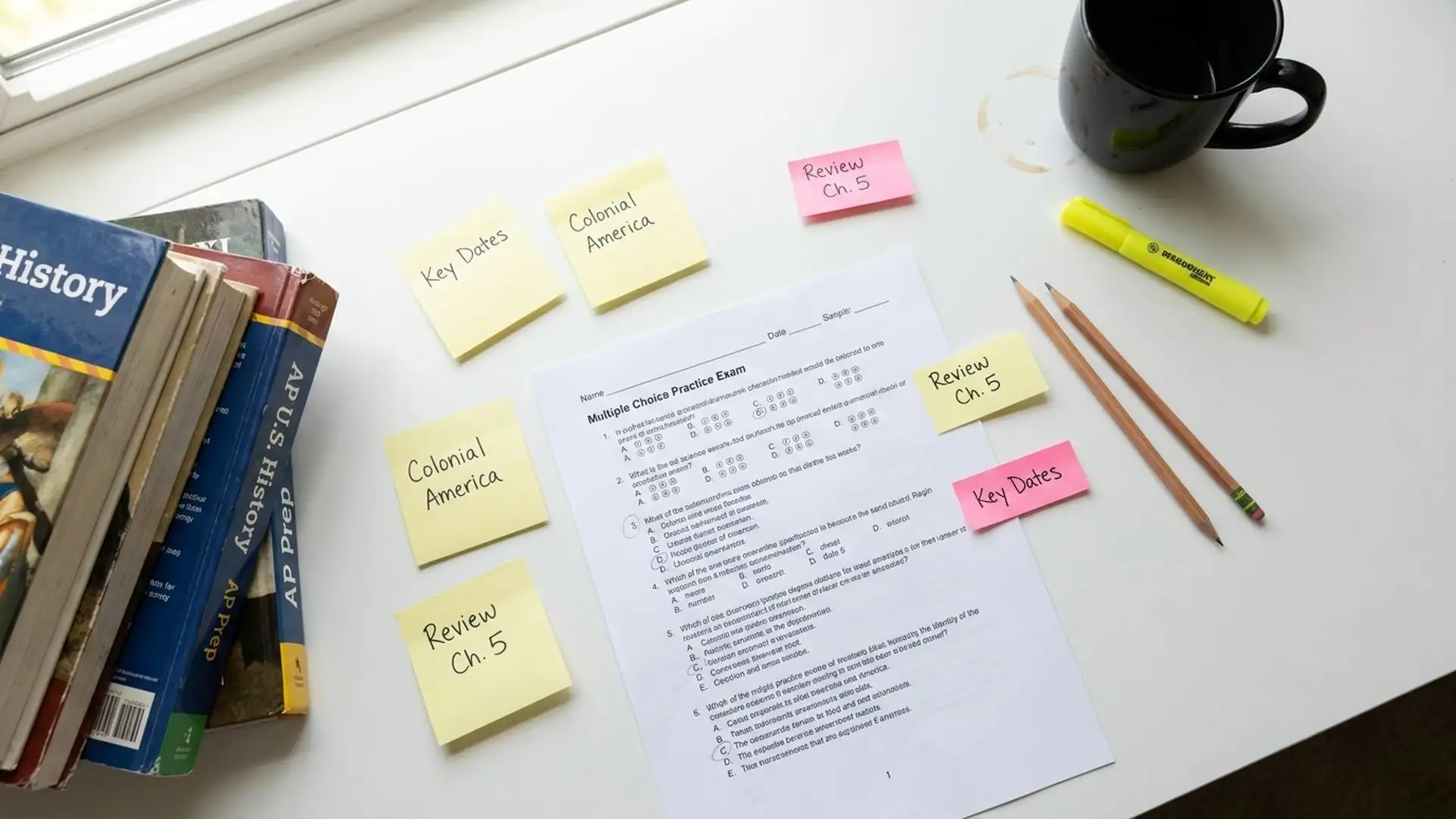
Every APUSH practice MCQ is stimulus-based. Each question includes a primary source, such as a quote, map, chart, or historian’s argument, that you must analyze, not just memorize.
Approach these five questions like the real exam: read the source first, identify the skill being tested, then use elimination to find the best answer.
Question 1
“Governments are instituted among Men, deriving their just powers from the consent of the governed. That whenever any Form of Government becomes destructive of these ends, it is the Right of the People to alter or to abolish it.”
– Thomas Jefferson, Declaration of Independence, 1776
The excerpt was written primarily in response to which of the following?
A. British attempts to assert greater parliamentary control over the colonies
B. Colonial governments’ failures to implement mercantilist trade policies
C. British inability to protect colonists from Native American attacks
D. Colonial attempts to extend political rights to enslaved people
Question 2
“The great rule of conduct for us, in regard to foreign nations, is in extending our commercial relations to have with them as little political connection as possible.”
– George Washington, Farewell Address, 1796
Washington’s concerns were primarily a response to which controversy?
A. Debate over annexing Canada from Great Britain
B. Partisan dispute over supporting Revolutionary France
C. Conflict over treatment of Native tribes west of the Appalachians
D. British failure to vacate western forts after 1783
Correct Answer – B
Question 3
“The condition of the African race throughout all the States where the ancient relation between the two has been retained enjoys a degree of health and comfort which may well compare with that of the laboring population of any country in Christendom.”
– John C. Calhoun, 1844
Which of the following most directly undermines Calhoun’s argument?
A. Many enslaved people adopted elements of Christianity
B. A majority of white Southerners did not own enslaved people
C. Enslaved people actively resisted bondage through flight and rebellion
D. Abolitionist societies struggled to organize in Southern states
Correct Answer – C
Question 4
We meet in the midst of a nation brought to the verge of moral, political, and material ruin. Corruption dominates the ballot-box, the legislatures, the Congress… the land concentrating in the hands of the capitalists.”
– Populist Party Platform, 1892
The Populist Party platform most directly reflected the grievances of which group?
A. Urban industrial workers are facing unsafe factory conditions
B. Farmers burdened by railroad monopolies and falling crop prices
C. Recent immigrants seeking political representation in cities
D. Southern industrialists competing with Northern manufacturers
Correct Answer – B
Question 5
“There is, at present, no danger of another insurrection… [but] there is an utter absence of national feeling… the Negro exists, in popular opinion, for the special object of raising cotton, rice, and sugar for the whites.”
– Carl Schurz, Report on the Condition of the South, 1865
Republican Reconstruction efforts ultimately failed primarily because of which development?
A. Republican opposition to Black voting rights
B. Southern states’ peaceful re-entry into the Union
C. Northern withdrawal of federal enforcement amid white supremacist violence
D. The Supreme Court struck down the 14th Amendment
Correct Answer – C
SAQ Practice – Short Answer Questions
SAQs award 1 point per part; no partial credit; no thesis required. The ACE method (Answer, Cite, Explain) earns full marks every time when applied consistently. Each response should be three to five focused sentences.
SAQ 1
Required · Periods 3–8
Use the excerpts below.
Excerpt A: “American social development has been continually beginning over again on the frontier. The true point of view in the history of this nation is not the Atlantic coast, it is the Great West.” – Frederick Jackson Turner, 1893
Excerpt B: “The history of the West is a study of a place undergoing conquest and never fully escaping its consequences.” – Patricia Nelson Limerick, 1987
(a) Briefly describe ONE major difference between Turner’s and Limerick’s historical interpretations.
(b) Briefly explain ONE historical development from 1865–1898 that supports Turner’s argument.
(c) Briefly explain ONE historical development from 1865–1898 that supports Limerick’s argument.
Tip: Name a specific law, event, or person in each part. “Westward Expansion” alone earns nothing. Try the Homestead Act for (b) and the Dawes Act for (c).
SAQ 2
(a) Briefly describe ONE historical similarity between Progressive Era reforms (1900s) and New Deal reforms (1930s).
(b) Briefly describe ONE historical difference between the two reform eras.
(c) Briefly explain ONE effect of either era on the relationship between the federal government and American citizens.
Tip: For the difference, push past “the New Deal did more.” Explain what structural change made it different — Social Security created permanent entitlement programs; Progressive Era regulation did not.
DBQ and LEQ: Essay Practice
After completing the document-based question, move to the long essay question to build a broader historical argument using outside evidence and clear historical reasoning.
DBQ – Progressive Era
Evaluate the extent to which the Progressive Era (1890–1920) represented a significant change of the relationship between the federal government and American society.
Use at least 6 of the 7 documents.
Include: thesis · contextualization · document evidence · outside evidence · sourcing (HAPP on 3+ docs) · complexity. Sourcing tip: For each document you source, answer one of these: Who is the audience? What is the purpose? What historical situation shaped it? One sentence per document earns the point.
LEQ – Choose One on Exam Day
The long essay question gives you more choice and flexibility, so focus on building a clear argument that directly answers the prompt.
LEQ 1 · Causation · Periods 3–4
Evaluate the extent to which political and ideological factors, rather than economic factors, caused the American Revolution. Don’t just list causes — argue which type mattered more and explain why.
LEQ 2 · Continuity & Change · Periods 5–6
Evaluate the extent to which the status and rights of African Americans changed in the period from 1865 to 1900. Strong responses acknowledge the real initial change (the 13th–15th Amendments) while arguing that the reversal through Plessy and Jim Crow produced more continuity than conversion.
Download Your Free APUSH Practice Packet
You don’t need to hunt across ten different websites to get started. We’ve put everything in one place: a free, comprehensive 33-page PDF built specifically for AP U.S. History students preparing for exam day.
Inside you’ll find 55 stimulus-based APUSH practice MCQs across all nine periods, four SAQs with ACE-method guidance, a full DBQ with seven primary source documents, four timed LEQ prompts, and a complete answer key with skill-by-skill explanations.
Every question mirrors the real exam format: the same structure, the same historical thinking skills, the same sourcing demands.
It’s the closest thing to a real practice exam you can get for free.
Download the APUSH Practice PDF
Official APUSH Practice Resources

Practicing with real exam materials is non-negotiable. Below are the most reliable sources for APUSH practice questions from official College Board releases to expert prep platforms used by top scorers across the USA.
College Board & Official Sources
- 2024 APUSH Free-Response Questions – Official FRQ set with DBQ, LEQ, and SAQ prompts straight from the 2024 exam.
- AP Central Past Exam Questions Archive – Every released FRQ from 2015 onward, with scoring guidelines and sample responses.
- AP Classroom – Official College Board platform with personalized MCQ practice, progress checks, and full-length practice exams by period.
Trusted Third-Party Resources
- Gilder Lehrman Institute – Stimulus-based practice sets built by historians, closely aligned to the current College Board exam format.
- Khan Academy AP US History – Free video lessons organized by period, paired with practice questions and immediate feedback.
- Albert.io APUSH Practice – Thousands of APUSH practice MCQs with detailed explanations, organized by period and historical thinking skill.
- Kaplan AP US History – Full-length practice tests, timed section drills, and score prediction tools backed by decades of AP prep expertise.
- Heimler’s History YouTube – Concise, high-quality APUSH review videos covering every period and essay skill, trusted by hundreds of thousands of students.
Use these resources regularly to strengthen both your APUSH knowledge and exam skills before test day.
How to Practice APUSH Questions Effectively
Random practice helps. Structured practice separates a 3 from a 5. Three habits make the biggest difference:
- Review every wrong MCQ, not just the right answer. Wrong choices on APUSH are usually true statements that answer a slightly different question. That distinction is exactly what the exam tests.
- Time for every essay, no exceptions. A DBQ without a clock feels manageable. With one, it isn’t. Most students discover the time problem only after losing those points for real.
- Score yourself with the official College Board rubric. Ten minutes of reading a scoring guideline after writing beats any review book. You’ll see exactly which points you left on the table and why.
Consistent, timed practice with careful review is what turns strong preparation into a high APUSH score.
Frequently Asked Questions
How Many APUSH Practice Questions Should I Do Before the Exam?
Target 200–250 MCQs, 8–10 SAQs, and 3–4 DBQs over four to six weeks. Reviewing every wrong answer matters as much as answering questions.
Where Can I Find Official APUSH Practice Questions?
AP Central (apcentral.collegeboard.org) offers free released exams. The Gilder Lehrman Institute provides high-quality stimulus-based sets closely aligned to the current exam format.
Which APUSH Periods Appear Most on the Exam?
Periods 3–8 account for roughly 80% of the exam weight. Periods 3–5 and Period 7 are most heavily tested. Periods 1 and 9 combined represent under 8%.
What Is a Good Score on APUSH Practice Tests?
Aim for 65%+ on MCQs for a 3, and 80%+ for a 4 or 5. Strong essay performance can meaningfully boost a borderline overall score.
Is APUSH Harder Than AP World History?
APUSH covers a narrower scope with greater depth. The core skills, sourcing, argumentation, and analysis, are identical. Practicing one exam genuinely strengthens performance on the other.
The Bottom Line
Most students lose APUSH points not because they don’t know history, but because they’ve never practiced thinking the way the College Board demands. That gap closes faster than you’d expect.
You now have real APUSH practice questions, official sources, timed essay prompts, and a free 33-page PDF covering every section. The only step left is using them.
Students who hit 4s and 5s aren’t smarter; they just practiced more deliberately. Treat every wrong answer as a lesson, not a loss.
If you found this helpful, drop a comment below and share where you are in your APUSH prep. We read every single one.